

Showing posts with label race. Show all posts
Showing posts with label race. Show all posts
Monday, April 1, 2024

Friday, July 15, 2022
Airship 27 Production Presents Bass Reeves – Frontier Marshal Vol 5
Airship 27 Production is proud to present the fifth volume in its best-selling series featuring U.S. Deputy Marshal, Bass Reeves whose career spanned thirty years under Judge Isaac Parker.
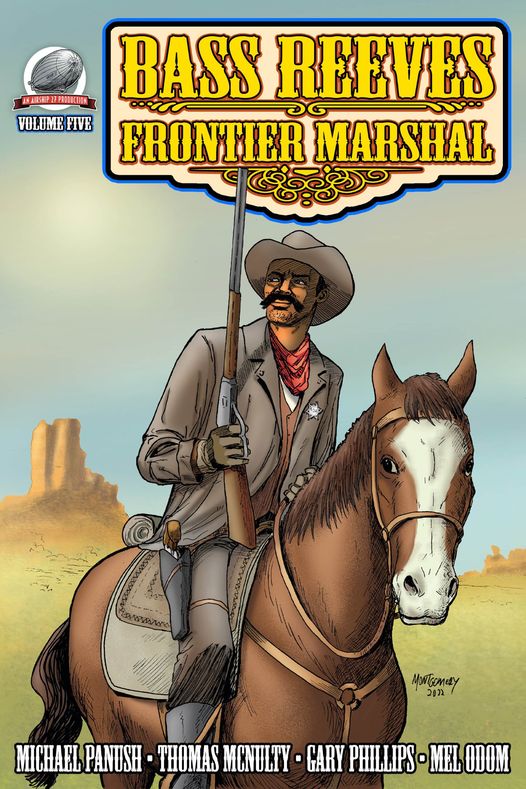
“What with two known Hollywood projects in the works, it seems Bass Reeves’ story is finally getting the recognition is deserves,” says Airship 27 Production Managing Editor Ron Fortier. “Both Paramount Plus and HBO have simultaneous western series now in development featuring Reeves,” Fortier reports. “Aside from the bogus fabrication of Reeves ever being an inspiration for the Lone Ranger radio show, the man’s factual career is more fantastic than any scriptwriter could have ever devised. We’re thrilled that our pulp scribes have jumped at the chance of writing new stories of this larger-than-life American hero.”
Artist Warren Montgomery provides the cover and Rob Davis interior illustrations. Writers Michael Panush, Thomas McNulty, Gary Phillips, and Mel Odom offer up tales of the frontier as seen through the eyes of the greatest lawman of them all. This is old fashion, western action as only these gritty pulp scribes can deliver. So saddle up and get ready to ride in adventure.
AIRSHIP 27 PRODUCTION – PULP FICTION FOR A NEW GENERATION!
Available now from Amazon in paperback and soon on Kindle.
Tuesday, September 21, 2021
Geek Culture: Leading the Way AND Pulling Us Back?!

Sadly, I think geek culture may be the last hold out for the old "we want our women to look nice in this office" and "he's one of the good ones" and "get back in the closet" white boys' club, since we've had it that way so long in our comics.
Ironically, geek culture is also helping to lead the way out of that boys' club with its current forward momentum on inclusion and showcasing heroes across racial lines and gender spectrums.
Of course, with every step we take forward there's somebody with a sign saying to stop putting our agenda in their comics. First, getting better as people isn't an agenda, it's a society's goal, last time I checked. Second, those are their comics; they belong to all of us who read and watch the things they inspire, and they've been in the hands of those who would resist growth for far too long.
The latest social media hoohaw about the costume change for Faye Valentine really just drove it all home for me. All the creators of the live-action show did was slightly alter her costume to make it work for a real-live woman who is supposed to be a true ass-kicker. But then some of the anime fans lost their shit because either (a) the costume wasn't just like the animated version (I can see your point, but c'mon, don't these costumes need to work in real life if you do a real-life show with real-life actors?) or (b) the costume didn't portray Faye as the dream fantasy wank material that whiny, horny, entitled fans wanted her to remain (to which I say, please grow up and understand that women, even drawn and animated women, were not put her solely for your eye candy). Though, to be fair, even in the new costume for the live-action show, Daniella Pineda is super sexy.
Anyone remember the uproar when Wonder Woman got pants and "fans" went nuts because they believed it was their God-given right to see Wonder Woman's butt in bathing suit armor because the world owed it to them... or some equally asinine reason?
How 'bout when the gawky version of the new Wonder Girl created by John Byrne suddenly became "hot" and blossomed into a model -- because, as we all know, superheroines can't be flat-chested. It's a fantasy! They're supposed to be built like fit porn stars. (Right? And so are the men by the same fantasy argument, but ironically, not for the female readers. Instead, because that's how every American, red-blooded male is trained to see himself since birth, well, all the normal ones anyway.)
I can almost hear -- We are the white, straight men, and we are tired of all you, well, other people who are not white, straight men telling us there are problems with the way we ran the world (and by extension, the entertainment industry). Stop insinuating we were ever doing something wrong. Stop changing things. We want our women to look sexy and appreciate our leering or at least realize that when we stare at their ass or their boobs or their legs, it's really a compliment and they should be thankful we think they are attractive (like they're supposed to be). We want our heroes to be white and musclebound and to have women flock to them in appreciation for being saved. (It matters not that we have now or ever looked like those strapping young shark killers or Nazi smashers on the covers of Men's Adventure magazines.)
We see ourselves as King Conan with the women who adore us at the feet of our throne. Funny how Conan looks so much like our goal rather than a dark-skinned man. I mean, sure, give him a tan from all that walking from ancient land to ancient land, but not too much. He's not Middle-Eastern or African or from the indigenous peoples of South America. We created an ancient land of whiteness just for him. And if we ever need a person from one of those lands, we'll just "Iron Fist" it or "White Goddess" it and put a Caucasian who was orphaned there and grew to become the tribal hero or village leader or chosen one.
We are Luke Skywalker atop the triangle with Leia gripping our leg for safety. Can't we have our one last bastion of male power fantasy where white guys still run the world and women love us, and we can be benevolent leaders to our sidekicks and B-players (where all the "good" multicultural characters are supposed to be?
It's like I'm hearing the same message through all the bumper stickers, op-eds, whiny complaints, conversations on social media, or griping over the comic book store counter.
That message?
"Why are all the major heroes now black or Latinx or gay or women and not being relegated to the sidelines as sidekicks and B-listers like they used to be? Where are all my white guys going? We resent all our white guys suddenly having to take the sideline roles to make way for other folks. And why do the females character have to hate 'real men' so much?"
I haven't done the research on this other than by simply watching TV and movies and reading comics, but I'm pretty sure the truth still is that if you counted heads, the comics and entertainment industry remains predominantly represented by white straight guys in main roles.
In spite of the complaints about women finally getting to lead films without having to be romantic partners, in spite of black actors finally getting to play parts that haven't been traditionally black or characters who "aren't black in the source material," in spite of LGBTQIA+ roles no longer having to be the token gay for comedic distraction or over-the-top flameliness, in spite of all that, the bulk of the entertainment world hasn't really changed. Count the characters and do the math.
But it's Captain American! But it's Superman! But it's... !
They're not supposed to be at the top of the triangle.
There's the rub. Don't take our icons. Our white straight icons. Go create your own. These are my toys.
No, they're not your toys. They never have been. And so what if we finally have a black Superman or a trans Flash or a black Captain America or a female Captain Marvel or a Muslim Ms. Marvel or a bisexual Robin. Do the math. The straight, white guys are still way ahead and still by and large write all the checks.
But that never stops folks from arguing that they're having an agenda "shoved down" their throats. But to be fair, that sounds like a story I've heard before...Back in the days of emancipation, white landowners didn't want the anti-slavery agenda shoved down their throats.
Back in the days of Irish immigration, citizens didn't want the "Irish are citizens too" agenda shoved down their throats (and they were white too!)
Back in the days of suffrage, men didn't want the women's voting agenda shoved down their throats.
Back in the days of desegregation, whites didn't want the black agenda shoved down their throats.
Back in the days of equal rights for women, men didn't want the feminist agenda shoved down their throats.
And now, folks are quick to jump on the train that they are having the LGBTQIA+ agenda shoved down their throats.
They were wrong then, and they are wrong now.
And they never stop to think about the years of having white, straight, patriarchal culture shoved down the throats of others. As if one is "normal" and the other is "other than normal" and needn't be presented as such. But there's another word for that -- default. For far too many, the default culture is the one of the white straight patriarchy and it's perfectly fine to have your little "representation" as long as it doesn't intrude on the "normal" or the default culture.
You see, the thing is that by "agenda being shoved down our throats," what they mean is "we don't want to have to acknowledge your right to representation" and "we don't want to see you showing up on our shows and in our comics" and "we don't want to actually have to see you as people IF it forces us to confront nasty realities we'd rather avoid."
But here's the real, five-dollar deal for you.
If you have a virtual highlighter you might just want to put this in yellow.
Ready?
Just having greater representation in the publishing and entertainment world isn't trying to shove an agenda. It isn't. It's trying to make us a better people, better citizens, more welcoming and loving individuals. It's trying to make our published entertainment look more like the world outside our doors and give all people someone with whom they can identify in the entertainment they see. It's trying to help all people of any race, nationality, gender, spectrum, feel like they belong in America (and by extension, existence). It's trying to help all people feel they matter and are important.
And if you still want to call that an agenda rather than progress up the scale of what it means to be a better human, then I really feel sorry for you.
Saturday, June 12, 2021
[link] Fandom, Entitlement and the Alt-Right
by Jim MacQuarrie
Well… no evil except casual racism and misogyny, but still….
As a kid, my favorite superheroes were the Flash and Green Lantern. The Flash, because his real power wasn’t super-speed; his speed was a tool he used, but his real power was that he was smart – he outsmarted his opponents. He knew more about scientific principles than they did and he applied his knowledge in clever and creative ways to solve problems that he couldn’t outrun. As a puny little kid who read too much and knew too much random stuff, that resonated with me.
My other favorite, Green Lantern, worked on two levels (three if you count the fantastic art by Gil Kane). First, he had a ring that was functionally magic; if he could think of it, the ring could do it. Second, and more importantly, the ring ran on willpower. He had to bring resolve to the fight, to dig in and hold on and never give up, because if he didn’t, the ring would fail. He kept that willpower up through something completely unique to comics: his daily oath. When he charged up his ring by pressing it to its power battery, he would recite the pledge I quoted at the top. Some writers suggested that he said it as a way of timing the process; the length of time it took to recite the oath was how long it took to charge the ring for another 24 hours. But he could just as easily have sung “I’m a Little Teapot” if it was just about timing. It’s so much more than that.
As I said, the Green Lantern Oath is unique in comics. Superman had a mission statement (“fighting a never-ending battle for Truth, Justice and the American Way”); Spider-Man had an aphorism (“with great power must also come great responsibility”); Batman had a promise (“I swear by the spirits of my parents to avenge their deaths by spending the rest of my life warring on all criminals”); and Captain America had several thick volumes of inspiring speeches on the nature of freedom and the responsibility to defend it. But only Green Lantern had an ongoing, present-tense pledge that he recited daily.
When my son was a Boy Scout, I found that the Scout Oath and Law were the best thing anyone ever gave a parent. Suddenly I had a checklist of ideals and standards that he promised to uphold, principles he publicly raised his hand and swore to every Monday night, and I held him to them. “A Scout is clean,” I’d say while pointing at a mess he’d made. “A Scout is helpful,” “a Scout is courteous,” and so on, and I believe the reminders about who he was and what he’d promised to become helped to make him the good, kind and decent man he is today.
Read the full article: https://atomicjunkshop.com/fandom-entitlement-and-the-alt-right/
Thursday, April 22, 2021
My Diversity Soapbox (Or Don't You Throw That "Woke" Shade at Me)

One of the things that bugs me as a writer who aims for diversity in my work is that in the eyes of a lot of folks, any attempt to be diverse and inclusive somehow gets automatically declared as woke or virtue signaling.
Now to be fair, some are. But not all of it. And not most of it. In fact, among the stuff worth reading or watching, very little of it.
It's just that there's a predisposition of some people to see anything diverse and intentionally so as woke or virtue signaling so they can then immediately dismiss it as lesser work.
 But... They're Trying To Push an Agenda

To be fair, there are times when people ARE pushing a belief and "agenda-ize" their work, but geez-Louise do I feel like the lady doth protest too much. It's not every one. Hell, it's not even most of them. But they get lumped together by "anti-wokes" all the time. To quote rocker Steve Taylor, "Good, bad, there they go down the same drain."
There are lots of great socially conscious stories with great writing that have at their hearts BOTH strong storytelling and an intentionally socially conscious (or diversity-driven) story. Look no further than the drug issues of classic Spider-Man for some of the best examples of this. Or the race issues of Green Lantern and Green Arrow. Or the new Far Sector comic. Or... well, you get the picture.
The antithesis of that is the trouble that comes when certain groups push back so hard against any progressivism in comics as though "the good ol' days" own those characters and stories outright and modern ideals only serve to turn them into damaged goods. As if "good comics" and progressive ideals don't mix.
Nowhere does it say that any comics, let alone super hero books, are supposed to only include white, middle-class, straight couples with 2.5 white, straight kids. Nor shouldn't favorite characters change it up from time to time and be replaced with various races or genders. Change has been the single constant in the comics I've read since my childhood, well, at least for the characters who weren't the trademarked faces of the companies. Seems like those are more untouchable (and not in the Elliot Ness sense of the word).
 As most of my favorite heroes are C-listers and below, trust me, they are changed all the time. The designs. The people in the costumes. Their races. Their genders. Their powers and backstories. Why not broaden that to include A- and B-listers as fair game.
And even then, with DC's multiverse, why not have a black Superman or a trans Batman or a have Nubia take Wonder Woman's spot on the Justice League? Why not? "Because that's not my Superman or Wonder Woman, and you can't take those away from us fans, damn it! You can't push your agenda on me."
The Way They Used To Be
To be fair, DC and Marvel have tried this from time to time, and often with awful backlash from "fans" who immediately scream about how much they dislike the change. Some manage to stick (like, at least for now, Ms. Marvel and lesbian Harley and Ivy) and some run the scope of a long story arc (Jane Foster female Thor and Falcon-Cap, which was as natural a progression as Dick to Batman, in my opinion). Others are quickly shot down by fans as pandering and disappear from the racks with little to no fanfare.
It's that "friendly fire" of "I like my comics the way they used to be."
Oh, so you mean the Golden Age? I agree. We should completely reject Hal Jordan and Barry Allen and all the changes that arrived with the Silver Age.
"No, no. Those changes are okay. Those are the changes that were made for us and we like those heroes."
 Well, if those Silver Age changes were put into place to reflect a more modern sensibility than the 1940s and 1950s, shouldn't we update again to reflect the change in culture and society from the 1960s to the 2020s? Why not a new "Silver" Age change to recreate a new DC Universe in a modern light? What about the changes that need to be made for other generations, more inclusive generations?
"Oh, no. Those characters are established now. We can't mess with them. We updated their backstories and their technology and their timelines instead to keep them fresh. If you want to recreate something beyond that you'll have to just create new characters instead."
I'm starting to believe Janus or Harvey Dent might be behind this little double standard.
Dropping Some Comic Shop Truth
But maybe it really is about characters and not an aversion to real, modern-cultural change for comics... Sadly, my experience as a comic book shop manager tells me otherwise.
These are actual questions asked/statements said to me when I managed a comic book shop by actual, real, living people:
"Why do they have to put their gays in my comics? They're just comic books."
Because LGBTQ+ people are part of the real world and they like to see themselves in the pages of entertainment and on TV and movies just like the rest of us.
"They should stop trying to push an agenda on me, man."
As if having diverse characters, particularly in leading roles, is about pushing an agenda and not just inclusion of all those folks who exist in reality.
So, what's there to do? Sadly, it's an uphill climb, and I'll tell you why.
 It's because of little hypocritical tendencies like these:
"I don't mind comic characters that are POC or are LGBTQ+ as long as they don't change my favorite characters. They should just create new characters instead."
On the surface, that's a safe statement, right? Maybe, if it stood alone in a vacuum.
If you ever make that first statement and don't support books with new characters, then I won't say that makes you a hypocrite, but it does create a concern to be questioned. It's kind of like saying: "I just want my old favorite characters and if SOMEBODY ELSE wants to support inclusion in comics, well, that's okay, but not at the expense of my favorite key characters who I won't allow to be taken from the spotlight to make room for new characters of diversity, whether by changing them or by sidelining them."
But unfortunately, it doesn't stop there. The questions continue to indict the asker.
"Why did they have to make (insert a favorite character) black, gay, etc.?"
"Why are they publishing that book? That's not the (insert favorite team), not the real one. I don't know hardly any of those new characters."
"If people really wanted diversity, they would have bought (insert inclusive character whose solo book died from lack of support), wouldn't they?
That's when the true colors come bleeding out, it seems.
So, from a long-term fan standpoint, from that perspective, it seems it would be wrong to change or replace characters (either directly as in the new LSH book or N52 Wally West or by new legacy character as with Ms. Marvel).
 But apparently, it's also wrong to sideline the favorites to allow for an influx of new characters on a team book that has a better chance of surviving than creating a new character as a solo book lead.
That seems a bit like wanting to play both sides to relegate diversity to the sidelines, where new books go to die, and then you also get to the last question mentioned above: "See, fans don't really want diversity. That's why those new books don't sell well."
I only bring all this up because you'd be surprised how often I heard all of those statements when I was managing a comic book store. It's the ultimate "have your cake and eat it too" against diversity in comics.
They Wouldn't Make Luke Cage White, Would They?
There's a huge difference between being portrayed as white and whiteness being critical to a character's story.

That's my beef with the whole "Well, they wouldn't make Luke Cage white" strawman argument. Luke's story is based on his blackness. Changing it would be more than a repaint of the character. Same goes for Black Panther, Black Lightning.
And that argument doesn't even hold up because we white folks have our ways (thank you, Langston Hughes) of doing that already. Remember black face? Remember white folks playing black folks in movies and being "painted" because they couldn't have white and black actors actually share a scene with each other?
When a character's race is important to the story or to the character's values or self, then I say don't mess with it or do so only with the greatest respect when adapting the base story. But when it's only important to fans who have read the book and only care about "that particular visual representation" then I'm okay with the changes.
Ask yourself this: "Is this character important to the history of comics or the history of a particular culture? Is this character or team important to the history of publishing comics or the history of a particular culture? Sometimes they're both. Is Captain America more important to comics history or to white history? Is Luke Cage more important to comics history or black history, or is he important to both because of his culture and race? (For the record, if you say Captain America is more important to white history, then you might be drinking the wrong Kool-Aid. He's important to American history, but America isn't just blonde and white.)
See, there's a huge difference between characters' importance to a race or culture and their importance to the history of publishing alone. If you can't see that difference honestly, you're probably just reacting with straw man arguments because you don't want to sound like a racist. (But guess what... you failed.)
The same argument goes for gender and sexual identity, in my book. "If you would make Alan Scott or Iceman gay, what about if you made Midnighter and Apollo straight?" If you can honestly ask that question you really, really don't understand the idea of representation in art and entertainment. When a group is already underrepresented in media, taking any of the examples away is a step back, not forward. If you want to ask that question and do it with any degree of seriousness, ask it when there is equal representation to serve as a starting point. Until then, we've got a long way to go.
 Who Woke My Inclusion?

What I'm REALLY tired of is the way "woke" and "virtue signaling" are thrown around almost every time someone ventures to be inclusive in their work. I remember when including people was just "inclusion" or "diversity" and they were noble endeavors to pursue, not "wokeness" or "virtue signaling" and suddenly by changing the words they became bad things to do.
Being inclusive is part of who I am as a writer and a human being, and it's not something I do to try to look like I'm morally superior to anyone. It comes naturally to me as a human being. (Okay, I know that sounds "woke" but bear with me. lol)
It's something I worked hard at changing about myself to become a better human being from the time I learned about my non-inclusive tendencies in high school and college.
I don't do it to signal anything about anyone (unless I signal that "hey, I like to a fun story with all kinds of people in it"). I have to do that in a way that's true to the story and the characters and the setting. But if I can do that, then why should folks balk at inclusion as the next intentional piece of that story make-up?

Perhaps instead of looking at it as if comics publishers, etc., are suddenly trying to be "woke" and "pushy" by publishing "all these" ethnic and LGBTQ+ books and characters, maybe the truth is that the environment has opened up to the point that formerly disenfranchised creators are finally able to publish the books they've been dreaming of for years -- or progressive creators finally getting to tell the stories that support their beliefs and LGBTQ+ allies rather than suppress those beliefs.
Okay, my soapbox is beginning to groan under the weight of my frustration here, so I'll step down. Be excellent to each other and party on, dudes!
Saturday, March 6, 2021
[Link] 6 BLACK INDIE SFF WRITERS YOU SHOULD BE READING

Assuming here that SFF is your jam, of course. But here are six Black indie SFF writers out there (indie meaning small press and self pub) who deserve way more attention than they’ve been getting. Give their books a look!
Read the full article: https://bookriot.com/black-indie-sff-writers/
Saturday, February 13, 2021
[Link] Who Gave You the Right to Tell That Story?
Ten authors on the most divisive question in fiction, and the times they wrote outside their own identities.

By Lila Shapiro
A few years ago, a writer named Ashima Saigal from Grand Rapids, Michigan, witnessed an incident on a bus in which a group of black kids were mistreated by the police. She was disturbed, and soon after, she wrote about it. Later, reading over what she’d written, she realized the story wasn’t working. She’d tried to write from one of the kid’s perspectives, but Saigal, who is Indian-American, wasn’t sure that she had the skill or knowledge to write from the point of view of a black child. She decided to sign up for an online creative writing course called “Writing the Other.”
The course was founded by the speculative-fiction writers Nisi Shawl, who is black, and Cynthia Ward, who is white, nearly twenty years ago. They’d met a decade or so earlier, at a fantasy and science-fiction workshop, and were inspired to design their own writing class after a conversation with another classmate, a white friend who’d declared that she’d never write a character who didn’t share her background or identity because she’d be sure to get it wrong. “My immediate thought was, ‘well that’s taking the easy way out!’” recalled Shawl. While imagining the lives of people who are different from you is virtually a prerequisite of most successful fiction writing, the consequences of doing it poorly have grown more serious since the pre-Twitter, pre-woke ’90s, as the conversation about who gets to tell whose stories has moved from the fringes of publishing into the mainstream. J.K. Rowling, Lionel Shriver, and Kathryn Stockett have all caught heat for botching the job. In the young-adult fiction world, a number of books have been pulled in advance of their releases for clichéd and problematic portrayals of minorities. The conversation is often depicted in the media as a binary: On one side are those who argue that only writers from marginalized backgrounds should tell stories about people who share their cultural histories — a course correction for an industry that is overwhelmingly white — while on the other are those who say this wish amounts to censorship.
Read the full article: https://www.vulture.com/2019/10/who-gave-you-the-right-to-tell-that-story.html
Sunday, May 27, 2018
[Link] After decades of dwarfs and elves, writers of color redefine fantasy
by Donna Bryson
For decades, the field of fantasy books was dominated by white men penning tales about dwarfs, elves, and other Norse-based mythology. Today, that’s changing as diverse writers are bringing fresh voices to the field, incorporating the myths and legends of cultures around the world. “People have been trying to do this for decades,” says author Tomi Adeyemi. “It’s just that enough people have broken down the doors over the decades that we’re where we are now.” Certainly, speculative fiction writers since at least Octavia Butler, the first science fiction writer to win a MacArthur Grant, have looked beyond Europe for inspiration. But no longer can they be dismissed as niche. From the $1 billion-plus box-office take of “Black Panther,” directed by Ryan Coogler, to the success of Ms. Adeyami's breakout debut, “Children of Blood and Bone,” audiences and readers are flocking to well-drawn worlds inspired by African and Asian countries. As one science fiction professor says, “We are not the field that thinks that what white men say is the only way to say things."
 N.K. Jemisin, the first black writer to win the Hugo Award for best novel, packs a powerful idea into a few lines of dialogue in “The Fifth Season,” in which an otherworldly woman’s search for her daughter resonates with the emotions of African-Americans after the Civil War desperate to reunite families ravaged by slavery.
“There’s a hole, a gap,” Ms. Jemisin writes. “In history.”
History suffers when perspectives are left out, Jemisin points out. The same may be said of literature. After decades of dwarves, elves, and other Norse-based mythology, the world of fantasy is changing, incorporating the myths and legends of cultures around the world.
While the field was largely dominated by white men in decades past, today diverse writers are bringing new voices to the conversation, imagining futures based on more inclusive readings of the past, and creating multiethnic worlds that can help people understand their own. Certainly, speculative fiction writers since at least Octavia Butler – the first science-fiction writer to win a MacArthur grant – have looked beyond Europe for inspiration. But no longer can they be dismissed as niche. From the $1 billion-plus box office of “Black Panther,” directed by Ryan Coogler, to this spring’s breakout debut novel, “Children of Blood and Bone,” by Nigerian-American author Tomi Adeyemi, audiences and readers are flocking to well-drawn worlds inspired by African and Asian countries.
“People have been trying to do this for decades,” says Ms. Adeyemi, acknowledging those who laid the foundation. “It’s just that enough people have broken down the doors over the decades that we’re where we are now.”
Read the full article: https://www.csmonitor.com/Books/2018/0521/After-decades-of-dwarfs-and-elves-writers-of-color-redefine-fantasy
For decades, the field of fantasy books was dominated by white men penning tales about dwarfs, elves, and other Norse-based mythology. Today, that’s changing as diverse writers are bringing fresh voices to the field, incorporating the myths and legends of cultures around the world. “People have been trying to do this for decades,” says author Tomi Adeyemi. “It’s just that enough people have broken down the doors over the decades that we’re where we are now.” Certainly, speculative fiction writers since at least Octavia Butler, the first science fiction writer to win a MacArthur Grant, have looked beyond Europe for inspiration. But no longer can they be dismissed as niche. From the $1 billion-plus box-office take of “Black Panther,” directed by Ryan Coogler, to the success of Ms. Adeyami's breakout debut, “Children of Blood and Bone,” audiences and readers are flocking to well-drawn worlds inspired by African and Asian countries. As one science fiction professor says, “We are not the field that thinks that what white men say is the only way to say things."
 N.K. Jemisin, the first black writer to win the Hugo Award for best novel, packs a powerful idea into a few lines of dialogue in “The Fifth Season,” in which an otherworldly woman’s search for her daughter resonates with the emotions of African-Americans after the Civil War desperate to reunite families ravaged by slavery.
“There’s a hole, a gap,” Ms. Jemisin writes. “In history.”
History suffers when perspectives are left out, Jemisin points out. The same may be said of literature. After decades of dwarves, elves, and other Norse-based mythology, the world of fantasy is changing, incorporating the myths and legends of cultures around the world.
While the field was largely dominated by white men in decades past, today diverse writers are bringing new voices to the conversation, imagining futures based on more inclusive readings of the past, and creating multiethnic worlds that can help people understand their own. Certainly, speculative fiction writers since at least Octavia Butler – the first science-fiction writer to win a MacArthur grant – have looked beyond Europe for inspiration. But no longer can they be dismissed as niche. From the $1 billion-plus box office of “Black Panther,” directed by Ryan Coogler, to this spring’s breakout debut novel, “Children of Blood and Bone,” by Nigerian-American author Tomi Adeyemi, audiences and readers are flocking to well-drawn worlds inspired by African and Asian countries.
“People have been trying to do this for decades,” says Ms. Adeyemi, acknowledging those who laid the foundation. “It’s just that enough people have broken down the doors over the decades that we’re where we are now.”
Read the full article: https://www.csmonitor.com/Books/2018/0521/After-decades-of-dwarfs-and-elves-writers-of-color-redefine-fantasy
Friday, May 25, 2018
[Link] Bombshells and Bae: Sexism in Afrofuturism
by Balogun Ojetade
I love reading and writing Afrofuturistic and Afroretroistic stories – particularly science fiction, fantasy and horror featuring larger than life heroes and sheroes and eye-popping action. I really do. But I am growing increasingly disgusted by the sexism within a lot of it. I can no longer read books in which people of color and women are constantly oppressed and seen as lesser beings in a world based on fantasy and science fiction – even if WE are the authors of it.
 Lately – as the father of seven daughters who are all avid readers of Afrofuturism and Afroretroism – I have become particularly disgusted with the continuing sexism in the writing and in the visual art.
Writers, you can create a world with any rules you choose. In your world, you don’t have to continue to perpetuate the sexist tropes so prevalent in Fantasy and Science Fiction since its inception.
Are you that lacking in creativity that you cannot write something better? Are you that apathetic to the plight of our Sisters? Or have you convinced yourself you have to maintain some sexist status quo to sell?
Bruh. Do better.
Certain tropes have been formed and propagated. Given the overwhelming number of novels set in a sort of idealized, white, medieval Europe; given the grossly oversimplified and homogenized concept of medieval gender roles, stereotypes and sexist archetypes have arisen in Fantasy and Science Fiction and Black male writers are giving us the same old trite bullshit. Some examples of these played out, tired tropes are...
Read the full article:http://greydogtales.com/blog/women-speculative-fiction-men-write/
I love reading and writing Afrofuturistic and Afroretroistic stories – particularly science fiction, fantasy and horror featuring larger than life heroes and sheroes and eye-popping action. I really do. But I am growing increasingly disgusted by the sexism within a lot of it. I can no longer read books in which people of color and women are constantly oppressed and seen as lesser beings in a world based on fantasy and science fiction – even if WE are the authors of it.

Writers, you can create a world with any rules you choose. In your world, you don’t have to continue to perpetuate the sexist tropes so prevalent in Fantasy and Science Fiction since its inception.
Are you that lacking in creativity that you cannot write something better? Are you that apathetic to the plight of our Sisters? Or have you convinced yourself you have to maintain some sexist status quo to sell?
Bruh. Do better.
Certain tropes have been formed and propagated. Given the overwhelming number of novels set in a sort of idealized, white, medieval Europe; given the grossly oversimplified and homogenized concept of medieval gender roles, stereotypes and sexist archetypes have arisen in Fantasy and Science Fiction and Black male writers are giving us the same old trite bullshit. Some examples of these played out, tired tropes are...
Read the full article:http://greydogtales.com/blog/women-speculative-fiction-men-write/
Tuesday, April 24, 2018
Political Correctness and New Pulp Fiction

=====================================================

But let’s back up first and walk before we try to run, as the cliché goes. When we talk about political correctness, we’re not really talking about politics at all. We’re talking about cultural exclusivity/inclusivity and cultural sensitivity, and most commonly we’re talking about culture clashes (and that’s where politics gets involved). In particular, we usually are talking about the “good ol’ days” bumping heads with the new-fangled days of integration and acceptance of things like interracial relationships, homosexuality, transgender issues, counterculture (pierces, tattoos, and the like), etc.
There are several points of view when it comes to these clashes.
One says don’t sweat it because the good ol’ days were good, and even things like racism and sexism and homophobia can be overlooked because it was a different time and that makes it all right.
Another says history is filled with bad things like racism and sexism and homophobia, and those memories must be purged and hidden so future generations don’t know they ever existed.
Still another says sure, those things were there, and we can learn from them, but let’s cut our elders some slack. They just didn’t know any better.

Still others say that when we revisit that racist and sexist past, we must use our creativity to recreate that past with culturally sensitive stories in our art, even to the point of rewriting the past so that characters in the 30s are as culturally sensitive with blacks and women voters as we oft believe ourselves to be today.
Others beyond even those have views that combine some of these already mentioned, often in personally confusing ways that don't always line up logically in their worldviews. Hence the struggle, as they say, is real.
Where does all this leave us as writers of new pulp and genre fiction? Do we have a responsibility to the truth of the past, the values of the past, the values of the new culture, the dictates of the market, or somehow to all of these things and more?
A few days ago, a fellow writer of new pulp put forth the following on one of the pulp groups I'm a member of:
At [a con] two weeks ago, I participated in a panel on “Cops and Crime in New Pulp Fiction.” An audience member raised a question concerning political correctness and its impact on NPF. I commented at the time that writing period fiction entails bringing along the baggage of the era, including attitudes and epithets. I also suggested that a part of the nostalgia that fuels the re-emerging pulp fiction market is the joy of reading fiction free from the iron bands of PC.
I recommend reading the new novel by Christopher Moore (Love Bites, Fluke, Island of the Sequined Love Nun, etc.) titled Noir (New York: Harper Collins, 2018), a tongue-in-cheek take on the old the pulp detective genre.
Moore's Author's Note at the beginning of the book reads thus: This story is set in 1947 America. The language and attitudes of the narrators and characters regarding race, culture, and gender are contemporary to that time and may be disturbing to some. Characters and events are fictional.
Well said, Moore.
Frankly, gang, we as pulp writers are not the United Nations, and we need not be all inclusive, nor do we need to be sensitive toward giving offense to any given mainstream reader or special interest group. We write for a niche market, not some public library reading circle or the Weekly Reader Book Club. Write what is genuine.
End of Sermon.
I agree... to a point.
What are our priorities as modern writers of old-style stories? What are our responsibilities as contemporary authors writing about older times and character of previous generations?

For example, a cop thriller needs to get its setting—and particularly the police work of its time—right. But, if you're writing an urban fantasy set in the 1920s, then it's far less important to be as accurate—unless you really want to stress the dichotomy between the two worlds. If not, the accuracy of the Valentine’s Day Massacre or police procedure isn’t as important to a world where a wizard and vampire operate as founders of the FBI.
The same could be said for cultural issues. If you’re dealing with an alternate take on historical reality, your 1920s Chicago or New York can be a super-happy world where everyone loved everyone else and no man ever slapped a woman for hysterics. It’s about the story context.
For this topic though, let’s assume a more real world example and story. A cops and robbers thriller (or even a private detective mystery) or a wartime pilot adventure needs to be fairly accurate to the time period. Racism was rampant. Sexism too, and being gay could get you killed if people found out—among other things.
As a writer, you don't have the luxury to pretend these things didn't happen. However, you also don't have the luxury of reshaping them in to harmless tidbits of history. You have to face them for what they were and are.
A caveat… Some among us are writing what equates to a “benevolent” form of propaganda, such as in the religious publishing world. For example, your audience demands that you don’t use “bad” language or (let’s just say) uncomfortable situations. That’s not my calling, and for most of my readers here, that’s not the case either. But if it is yours, you have rules for your market and you must follow them. But even that doesn’t necessarily prevent you from hitting some of these more heavy ideas in a more tactful way.
Along those same lines, some among are writing a less religious but equally "benevolent" propagandized fiction in which the writer caters specifically to his or her cultural worldviews. These can include revisionist histories that "nice" up the world for "safer" reading or doing what can come across as a sort of “reverse racism” that often comes with a “let’s see how they like it” tone induced to elicit social change. Just like religious fiction, these have their place and thir markets, but let’s not confuse them for truth in setting.
Don't read so much negativity into the word "propaganda" at this point. I mean it purely in the sense that the writing is intentionally out to influence or indoctrinate.

Outside of those caveats, we contemporary writers have a responsibility to modern readers to be sure that things we understand are bad now, like racism, homophobia, and sexism, while accepted at the time, are in fact bad things.
So, how do you write them?
For me, it gets down to character. The characters who occupy my stories are always on a sliding scale—starting somewhere between pure good and pure bad, and constantly sliding back and forth toward one or the other.
Those bad things from history are great ways to build my non-heroic characters. Your villains can be filled up with these things. That’s fair game. If your villain is a racist bastard who beats women and sees them as less important than a man, that's one thing, but if your hero has the same ideas and the same nature, then you may have a problem when it comes to modern readers.
Your heroes can also be struggling with some of these issues, but usually will be more enlightened in the others. Or at the very least, your hero, if he believes these ideas, must be struggling to better himself against them or to begin to learn the wrongness of them.
Let’s say your hero is on a case that involves a man killed because his rich uncle found out he was gay and it would bring shame on the family name. Let’s say your hero can totally understand that reasoning but is learning throughout the case that maybe that kind of violence is never the answer in such a situation. It may not be a full enlightenment, but it is a step toward the light, so to speak. And that works for a modern reader, particularly if the character’s further adventures continue his progression toward being a better human being.
Be careful though, because the further your hero is from full enlightenment in terms of today’s standards, the harder the sell will be for a contemporary audience. That said, readers have always been and continue to be suckers for a good change-of-heart or redemptive story.
It’s important to mention that these issues also involve questions about marketing. As a writer you may have the ability to write whatever the hell you want, but as a marketer who wants to sell books, you have a responsibility to write what will appeal to your market. And most modern readers don't want an abusive hero.
Now, these are all issues that are near and dear to my fiction writing career. After all, my first published story was about the legacy of an African-American boy who was rescued from a hanging by a still somewhat racist Southern sheriff. These kind of inclusive characters who still struggle are very important to me because they ring true. I don’t know anyone who is pure Lawful Good or pure Chaotic Evil (to use the gaming terms). And I love to write the gradations between those two points.

Also, Rick is a philanderer (a bad thing), but his reasons are based in those same pressures. He's in love with Evelyn, a black woman who sings at Belle’s club, but they both understand their relationship won't work in that world, in that time. Therefore, he struggles because he can't commit to the one woman he really wants to, no matter what, and it sends him out to other women to try to get around that loss.
The truths of his world make a good man do bad things, and I think that's the difference, that's the important story Rick is telling in his adventures.
And I think that’s a good way to wrap this up. The standards and truths of the time must influence your stories if you choose to set them there. You ignore them at your peril as a writer, and you risk missing out on the really important stories that might be waiting to come out.
Wednesday, February 14, 2018
Nugget #121 -- White-Washed Pulps

Historically, the world of the pulps is a very white-washed world,
much like the movies and radio drama of the time. It’s not that
people of color didn’t exist to inhabit stories of The Shadow,
Secret Agent X, or Philip Marlowe. It’s that they didn’t have
the social power to prove they mattered to the narrative.
Wednesday, November 22, 2017
Nugget #111 -- Writers Are Anythings Writing Anybodies
The good news is that you don’t have to be White, Black,
Latino, Asian, Male, Female, Gay, Straight, Trans, etc.
to write a greater diversity of characters. You can be an
anything and still write an anybody. Why? Because
you’re a writer. It’s the nature of what you do. Period.
 |
| By Gordana Adamovic-Mladenovic from Windsor, Canada (This morning we caught a rainbow...) [CC BY 2.0 (http://creativecommons.org/licenses/by/2.0)], via Wikimedia Commons |
Thursday, April 27, 2017
Why Diversity? It's Just Fiction. What's the Big Deal?

Quick! What’s the biggest buzzword in modern fiction? Everyone together on the count of three… 1,2, 3…DIVERSITY!
“Way to go, Sean,” you’re probably thinking. “Way to piss off most of the people who might ever be likely to read your blog.” (And to be honest, you might be right.)
But if you’ll bear with me a moment, I want to guide us all to think about diversity as something deeper than a mere buzzword, something that gets beyond social politics and political correctness, and something that relates more to creating great fiction rather than trying to change the world.
WHY NOT CHANGE THE WORLD?
 |
| What if Che Guevara had written The Grapes of Wrath? |
By that, I mean that writers are committed above all else to the story. But when writers surrender stories to the express purpose of changing the world through social and cultural order, they become propagandists and they pollute the very nature of telling stories.
Most every great piece of fiction that has helped to create change in the world has been an aftereffect of the story the writer wanted to tell. It began with story, not with revolution.
Bear in mind, I’m referring only to fiction for this article. Non-fiction lives by different rules in this regard.
My take on this is simple: If you want to change the world as a writer, write great stories that change people. If you want to change the world through activism, go build someone a house, march in a parade, or work a crisis hotline. If you want to do both, do both, but don’t confuse storytelling with activism.
“But what about the history of stories, you know fables and fairy tales that taught morals? And what about books like the Narnia stories or The Fountainhead that were basically just thinly veiled religious or political primers?” you ask.
And you’re right. Fables and fairy tales were told primarily to encourage safe and “better” behaviour in children. But I’d argue that C.S. Lewis and Ayn Rand were wanting to tell stories to entertain and intrigue readers first and foremost and didn’t really give a damn about whether they picked up the religious or political symbolism or not as they read it (that could be something they learned later if the entertaining story stuck with them well enough and caused them to ponder).
But let’s go back in history a little earlier than that. Let’s look at myths and legends. They tried to explain the world, to put people in a place that made some kind of sense. They tried to uncover some truth about the human condition.
That’s my calling as a writer and my understanding of the craft. And I’m willing to bet I’m not the only one. I want to put stories in a context to understand the world and its people, even if I do it under the goal of entertaining readers. If I somehow contribute to changing the world or its people in the process, that’s just icing on the cake. The cake is the body of work, the stories themselves. Did they entertain? Were they worth sharing in the first place?
All that said, don’t mistake writing less diversely for the sake of story with the idea of setting out intentionally to offend by ignoring diversity. Just as the heads side doesn’t add up for me, neither does the tails side. If you choose not to be as diverse, it should be from a commitment to craft, not from being an obstinate jackass to further your own viewpoint, which is (you could call it) a sort of reverse propaganda by way of intentional absence.
GOOD AND BAD DIVERSITY: NO GO, POWER RANGERS
Perhaps I should have given this section the subheading “What Not To Do” instead.
Sadly, the first place beginning writers (even more sadly, some experienced writers) turn when trying to make their work more diverse and accessible is to the paint-by-numbers approach. It’s a method seen most obviously in the cartoon Captain Planet and in Power Rangers.
 |
| Pink is for girls. Yellow is for Asians?! And black is for... Wait... really?! |
Obviously, that description is a bit over the top, but the mindset is pretty spot-on. I can’t tell you how many writers I’ve talked with at conventions who see this as the most efficient approach to create multicultural casts in their works. Even those who'd never admit it to anyone can't still be found out by the way it shows up in their work. It's the kind of lowest-common-denominator "diversity" that turns people off from writing better diverse casts in the first place.
The problems this approach creates are fairly obvious, but in the interest of complete transparency, I’ll outline them here.
- It kills otherwise good stories with characters that don’t belong. If you need to tell a story about a solo adventurer or a pair of thieves, forcing a larger starring cast for the sake of diversity only weakens your story. Better to save that for your background cast and your "world-building" cast of extras.
- It kills characterization. That’s how you get characters who seems as flat as the pages on which they’re written, at best -- or are offensive as stereotypes and caricatures at worst.
- It’s demeaning to your readers. You’re telling them as a writer that they did this to you, that it’s their fault you have to write like this. You’re also telling them they’re too dumb to enjoy your work if it didn’t include all the right plug-n-play pieces.
- It builds a story from the wrong foundation. If you’re a long-time reader of the blog, you’ll know that I believe strongly that story is that magical baby that happens when a plot and great characterization meet and start a family. (And if you’re a new reader, well, now you know too.) By forcing characters to fit an arbitrary model of inclusion, you end up shoehorning them into your plot. And any writer worth his or her inkjet cartridges will tell you that’s only a prescription for trouble further along the creative process.
So, if that’s “bad diversity,” then what is “good diversity”?
- Good diversity is a natural outgrowth from story and character. It is part and parcel (as the saying goes) of the storying process.
- Good diversity begins when you start to create a story. It is there with you at the inception, and it stays with you throughout the telling of your tale.
- Good diversity relates to your setting. Does a multicultural group make sense in terms of when your story happens in history and/or where in the world it happens? If not, what is the plausible (in terms of the rules of your story, as this can change based on genre) reason to have an unconventional character or cast of characters inhabit your story?
- Good diversity enters a story because it’s part of what the story needs. Put simply, it “works” because it a necessary turn of events or addition without which the story couldn’t take place successfully.
- Good diversity comes from the hard work of plotting. It’s something that a lot of thought and effort is put into. It is never an add-on. It is never a list of check marks you can review after the fact or fix in “easy edits.”
- Good diversity makes sense in the context of your fiction. Good diversity will never rip your readers out of a story. It helps to create the immersion experience for a reader, rather than to create a greater suspension of disbelief to be accepted no matter how out of place.
 |
| Because this is apparently what it means to grow up white. |
Believe it or not, I still hear this often, and yes, mostly from old white guys in my age range. But for any writer with the drive to remain relevant and continue to tell stories about the world as it is, was, and will be, I find it to be a huge cop-out.
In my experience this excuse comes from either writers too lazy to learn different habits to improve their storytelling or from writers who, to quote the speaker from one of the conversations with a old guy in my age range, “don’t give a damn about that multicultural shit.”
Either way, for any practicing and publishing author, it’s an empty excuse in this day and age.
The good news is that you don’t have to be White, Black, Latino, Asian, Male, Female, Gay, Straight, Trans, etc. to write a greater diversity of characters. You can be an anything and still write an anybody. Why? Because you’re a writer. It’s the nature of what you do. Period.
The axiom of “write what you know” still applies. Do you have friends? Are they all one gender? One race? Bleed them onto your pages. Use them as reference material. Use them for research material. Ask questions. Pay attention. Understand them.
While the Internet isn’t a perfect research tool, it does contain thousands upon thousands of resources for understanding history and cultures other than your own. Need to learn about slang or jargon? (Just be careful with that. Can I get a “Sweet Christmas”? Anybody?) Need to know what race relations are like in the country of Rwanda of even the state of Rhode Island? What about videos of places and people you’ve never been? It’s all there.
BELIEVABLE DIVERSITY FOR PERIOD PIECES
This is the crucial point of this article for me as a pulp writer. Historically, the world of the pulps is a very whitewashed world, much like the movies and radio drama of the time. It’s not that people of color didn’t exist to inhabit stories of The Shadow, Secret Agent X, or Philip Marlowe. It’s that they didn’t have the social power to prove they mattered to the narrative.
And that’s something that I can do differently with my stories today, but not because I want to be a social justice warrior (not that there’s anything wrong with that, thank you, George and Jerry) but because I think the stories can be a lot more compelling when they include the whole of the truth of history instead of only the white parts.

But it had to be believable. Having a black-white buddy cop drama just wouldn’t have worked -- not without a damn good reason for readers to buy it other than just “because I wrote it that way.” But Rick being a white man who found refuge in a black world did work, because it was part of his character, and not just part but the core of his DNA as a more authentic person, albeit a person of fiction. And it was something that I as a writer could relate to. After all, I grew up with a caregiver named Sarah, a black woman who helped to shape me as a child and still ultimately as a man long after she had passed on.
It’s too easy to assume that the world was whiter back then just because that’s what the bulk of our media of the time shows us. But the world then had just as much color on its palette. It had just as much variation of rhythm to its music. We can enjoy the stories the media of the time tells us, but we can’t let ourselves believe those stories are the “real” truth of the world at that time.
Are you writing a 1790s historical romance? Are you writing a WWII battle epic? Are you writing a Roman tragedy? The world was diverse, even then. If you don’t know to what degree, then do your job as a researching writer and find out. Then tell the truth of your story in all its fullness. Build your world on a more honest model.
Like with so many issues we writers face, it comes down to research. If you don’t know the truth of the time period you plan to write, then look it up. Find out the hues of that world. Then paint with all those shades.
SO, BACK TO OUR MAIN QUESTION
Why diversity? Does it matter?
Yes. Clearly it matters, or else I wouldn’t have just devoted 2000+ words to it. Nor would so many other writers give their opinions and advice on the matter. (See the links at the bottom of this article.)
Not only is it an important issue for the world of fiction to consider, it’s also important that we get it right.
And that means thinking about diversity like writers, not politicians... like authors, not activists... like storytellers, not philosophers. There’s a place for all that, sure, and if it’s something we’re passionate about, believe me, it’ll come through in your work. You don’t have to force it and turn your stories into causes.
 |
| Yep. I said that, and I meant it. |
Reality is diverse. That’s a narrative truth we must understand in order to create the best stories we can. And no matter how out-there or weird or horrific or super-hero-ish or sci-fi or fantastic or vampire-y our stories can become, they still owe allegiance to the things that are intrinsically true.
It’s just fiction. Sure. But even “just fiction” is always more than mere fiction.
We write to put stories in a contextual narrative to understand the world and its people, but we do it under the goal of entertaining readers. We create the illusion of reality into order to help readers escape to a safe place that feels enough like home in all the true things that ultimately matter.
But we only do that by becoming better tellers of our own special lies called stories, and we only do that by somehow basing them on a foundation of truth about the world and its people.
===========================================
http://www.divabooknerd.com/2016/06/diversity-in-fiction-not-everyone-is.html
https://mythicscribes.com/miscellaneous/racial-diversity-in-speculative-fiction/
https://headinherbooks.wordpress.com/2016/08/30/the-importance-of-diversity-in-fiction/
https://katetilton.com/diversity-fiction/
Thursday, February 9, 2017
The Changing Face(s) of Pulp: Does New Pulp Make Heroes for Every Reader?

 It’s often said about TV shows and movies: “The heroes never looked like me. I just never felt represented.” Books without pictures didn’t have the problem to the same extent, but it’s no surprise that the classic pulp tales that inspired New Pulp were by and large a very white, very male place to be. But with new heroes like those in Asian Pulp and Black Pulp, Dillon, and others, pulps' colors are changing, and readers are finding more and more heroes they can identify with.
How important is it that pulp stories become more reflective of society -- even when the stories are set in times past?
Perry Constantine: I think it's very important. Representation matters. Think of that little black boy who went up to President Obama with awe in his eyes and asked in such a quiet voice, "I want to know if my hair is just like yours" and then the President bent over and asked him to touch it. Can you imagine how important that must have felt for that child? Can you imagine how it must have felt for his parents who never had a figure like that? The same is true for fiction as well. It can help shape our morals and our ethics. I was recently contacted by a woman who read the description of my new novel, FALLEN IDOL. It's set in Japan and the protagonist is a female private eye named Kyoko. The woman told me, "I had to buy it right away because my step-daughter's name is Kyoko and I couldn't wait to show it to her."
Derrick Ferguson: As New Pulp writers we're trying to emulate the fantastic fun and rip-roaring action of Classic Pulp. But without the mistakes of Classic Pulp. Those stories that we love so much were written for another time, one that we like to think was less enlightened (although I look around at the United States today and I ain't all that sure of that) less tolerant and less understanding.
Gordon Dymowski: It's very important - we're much more sophisticated and knowledgeable about certain social aspects. Nothing is written in a vacuum, and writers have a responsibility for reflecting current social norms and behaviors. Even if we're writing about something that happened in the past, we have use our current perspective to inform how we present the past. "Cowboys and Indians" might be a great concept for a ten-year-old to have, but it reeks as slightly awkward when you're older.
 It's not an easy job marrying a style of writing that most readers today are unfamiliar with and yet try to stay true to the cultural changes that have taken place in the intervening years but that's part of the challenge of making New Pulp work and bringing it to the masses to read and enjoy. But as writers we wouldn't be honest if we didn't acknowledge the society we live in now and do our best to represent that society today.
 As for writing New Pulp stories that are set in the past...I myself believe that writers have to be faithful to the time period they're writing in. It doesn't work to try and write 1930s characters but have them voicing modern day attitudes and opinions. In my character of Fortune McCall who lives and works in the 1930s he's a black man of extraordinary wealth and influence but even so, he's still a black man and there are still lines he can't cross. That's not to say he doesn't have the brains to work around those lines but that's the fun of writing a black adventurer in the 1930s. It's not only possible but essential for New Pulp writers who write stories set in the 1930s/40s/50s/Whenever to shine a new light on multiculturalism and portray characters of different races, religious affiliations and sexual preferences in as honest as possible in a way that they couldn't have been portrayed back in the heyday of Classic Pulp. But still keeping an eye on the fact that you can't take a man or woman from 2017 and drop them back in 1937 and think you're striking a blow for Political Correctness and leveling the playing field by making up for all the racist/sexist/intolerant fiction written in the past. Because Political Correctness didn't exist back then.
Characters still have to be written as being true to the time period they live in. That's not to say you can't have characters push the envelope. Of course they should. Otherwise why bother writing about them? But put some thought into it and do your homework.
Let’s compare classic and new. How receptive are readers to these multicultural protagonists? Or does the new still lag behind the classic heroes in general popularity?
Gordon Dymowski: I think that there's still a general lack of awareness about New Pulp among those outside our usual circles. I once had to berate someone in a conversation because he felt that Hollywood was "spending too much time making movies about stuff that nobody knows"....like Doc Savage and John Carter. I think there's a general willingness to accept characters of color who have a slightly pulpy flavor (say, Dennis Dun in Big Trouble in Little China or Taimak in The Last Dragon), but I think there's a general lack of awareness about classic pulp for newer audiences...
 And I think that, even in New Pulp circles, there's still a reluctance to accept multicultural characters -- witness how many pulp fans complained about Dwayne Johnson being cast as Doc Savage, and that Chris Hemsworth should have been cast....without realizing that Chris Hemsworth doesn't open movies unless they're made by Marvel. I don't think a lot of pulp fans really notice cultural differences unless they're done to "major" characters.
 All in all, I think readers are receptive to multicultural characters when they're well-written. When there's an effort to go beyond obvious stereotypes and create well-rounded characters who are informed by their immediate culture. (Think Walter Moseley's Easy Rawlins).
Derrick Ferguson: Well, what readers are we talking about? My perception and experience is that fans of Classic Pulp have no use or need for New Pulp in any way, shape or form. But that's okay. New Pulp deserves and needs new readers that are eager for new heroes that represent them no matter what their race, age or gender may be told in a breathless prose that doesn't give them a chance to catch their breath. And those readers are out there. I hear from them (occasionally) on Facebook, Twitter and by email. I myself think that New Pulp has produced characters that can stand beside Classic Pulp heroes with no shame at all. And readers who don't know anything about Classic Pulp characters have embraced the idea/concept of these multicultural protagonists if the popularity of "Black Pulp" and "Asian Pulp" is an accurate measure of their enjoyment
Perry Constantine: I think there's still lag. As unfortunate as it is, the market is still over-saturated with white dudes as the heroes and that's in large part because that's what readers are buying. Hollywood is slowly starting to realize that they can make movies that don't just focus on white dudes, but it's something they're still slow to come to grips with.
Why have new characters of various races been successful in pulp without all the noise that comics are getting when they interject new multicultural heroes into the mix?
 Derrick Ferguson: Because comics are surviving now by being a sideshow act. It's not enough to just tell good stories with good art (I'm talking about Marvel and DC here). There's a respectable number of independent comic creators who are producing excellent comic books with multicultural heroes and heroines. It's only Marvel and DC who still treat it as if they're breaking the Internet when they announce they've got a new black hero, a new Latina heroine, a new gay and/or lesbian hero. When I created Dillon and Fortune McCall and Sebastain Red I knew full well it was going to take years for them to catch on. And Dillon's been around for 15 years now and I'll still get emails from new readers who inform me that they never bothered with the character before because they thought; "it was some blaxploitation thing." And I think that's the mindset of writers: we're marathoners who realize that we have to put in the time and work to get readers to turn their heads in our direction. And I think that after a floundering around period we're finally starting to learn how to make The Internet work for us. There's a whole lot of other writers who have mastered that and did it years ago. Especially the Romance and Street Lit writers.
 Perry Constantine: Depends on how you define success. One of the reasons I've stopped my pulpier series is because the market is still extremely small. So I'm not so sure I would say that they've actually been successful. But as for why there's not as much noise, I think it's because there isn't as big of a readership as comics. There's no big pulp news sites along the lines of CBR or Newsarama where these things grab headlines. If you're a pulp reader and you hate the idea of minority pulp characters, there's so much other material out there so you can easily ignore it without getting headlines popping up in your news sites.
Gordon Dymowski: I call major league shenanigans on this question...how are you defining successful?
Because most of the fanfare around comics injecting new multicultural heroes (especially Marvel) has been due more to changes in their readership than in any kind of "noise". And reader feedback has relied on the complaint that "diversity is being forced upon them". My advice - look out the window. Actually drive ten to fifteen minutes outside of your neighborhood - we're living in a multicultural society.
 I think comics are better at it because there's a greater receptiveness towards multicultural efforts. When I read a fellow pulp fan declare "Yellow Peril, baby!" in a similarly-themed conversation, that is a huge red flag for some fans' unwillingness to let go of nostalgia. (And yes, it actually did happen). I think it also means bringing in more diverse writers - Pro Se's Black Pulp and Asian Pulp are great first steps, but if we want more diverse pulp books, we need to encourage more diverse pulp writers. Because having those perspectives means a wider storytelling palette, which then means more opportunities for great stories.
 But comics are not "less successful" than pulp - they're just making more of an effort towards inclusion.
We’ve seen racial changes with New Pulp, but what about in terms of other societal changes such as gender and sexual identity? How ready do you feel New Pulp is to reflect those evolving cultural identities?
Gordon Dymowski: I think gender/sexual identity issues are coming along a lot more slowly, but only because those issues are more nuanced. We've made huge strides - Barry Reese's work with a character in his Lazarus Grey series is light-years beyond Mickey Spillane's infamous revelation in Vengeance is Mine. Trying to encapsulate that experience - or any experience of the "other", to use more academic terms - is very difficult within a pulp milieu. It means being more empathetic and sensitive, and given some of the more culturally conservative aspects of New Pulp... I think it's going to take awhile.
It will take authors working hard, doing the work of actually meeting and understanding those other perspectives, and not using them as just another category. (Or "the Captain Planet approach", to put it simply). Pulp has always reflected its times, and right now, we're at a time when previously marginalized groups are standing up and claiming their voice.
 We need to welcome those voices as authors in the New Pulp movement...because then we'll be on our way to becoming more inclusive and representative of our audience.
 Perry Constantine: There's representation of different genders and sexual identities as well. I think there are more than a few female pulp characters these days who are getting their own stories. As far as sexuality, that's been a little less touched on. I know Adam Lance Garcia and Barry Reese have both written gay characters, but I can't think of many more examples. But I don't think "is New Pulp ready for that?" is really the question we should be asking. Was comics ready for a black superhero? Was it ready for a gay one? A Muslim one? A lot of people at the time would have said no. Instead of asking "is New Pulp ready for this," writers should be asking themselves, "why not do this?"
Derrick Ferguson: New Pulp is more than ready. The talent is there and I'm optimistic enough to believe that the audience is there as well. It's only a matter of New Pulp being able to crack that wall that's holding it back from being known by the mainstream.
Subscribe to:
Posts (Atom)