Showing posts with label Sci-Fi. Show all posts

Friday, March 6, 2026

[Link] 10 books for fans of slow burn, character-driven science fiction


These 10 sci-fi books are perfect for readers who enjoy getting lost in character-driven stories that unfold at their own pace.


by Ash Anjum

Science fiction is often known for big ideas and high-stakes plots that move quickly from one moment to the next. It's a genre that usually thrives on faced-paced storytelling that keeps readers hooked through constant forward motion.

But some science fiction stories take a different approach. These books put characters at the center, allowing their thoughts, relationships and personal journeys to lead the story. The alien worlds and advanced technology still matter, but the real plot has to do with the characters' heads and hearts.

These slower-paced stories give you time to really know the characters and feel for them. Today, we’ve put together a list of 10 such character-driven books that fans of thoughtful, slow-burn sci-fi will appreciate.

Read the full article: https://winteriscoming.net/10-books-for-fans-slow-burn-character-driven-science-fiction

Friday, January 2, 2026

HORRIFIC SCRIBES PRESENTS: INVASIONS OF WORLD, HOME, BODY, AND MIND

BOOK LAUNCH! The first e-book anthology from the HORRIFIC SCRIBES archive is now available through Amazon, Kobo, Smashwords and many other fine retailers! Coming soon to even more!

Invaders threaten us from above, below, within, and beyond. Not scared enough yet? This anthology will help! From the Horrific Scribes web archive of original short fiction (and some poetry) come 24 selections that involve horrific invasions. Only 23 are short stories--one is a group of poems--and that's not the only way the book cover deceives you. None of the stories involves UFOs attacking Earth. 

Horrific Scribes seeks "the provocative, scary, and strange," and these works offer a wide array of perspectives on invasion, many of them unfamiliar. They stretch and cross the boundaries of horror, sci-fi, and other speculative fiction with dark edges. 

Settle in and let your imagination be overrun by the invasions conjured by Phoebe Barr, Jim Best, Amanda M. Blake, Jon Clendaniel, David Corse, Richard Dansky, John Davis, Laura DeHaan, T. Fox Dunham, H.J. Dutton, Joseph Hirsch, Tom Johnstone, Kasimma, Emmanuel Komen, Leonardo J. Lamanna, Steven Mathes, Thomas C. Mavroudis, Trisha Ridinger McKee, Eric Nash, M. Brandon Robbins, Cassandra O'Sullivan Sachar, Sydney Sackett, K. Thompson, and Fendy S. Tulodo.

https://www.amazon.com/Horrific-Scribes-Presents-Invasions-Anthologies-ebook/dp/B0G2FM82LC

https://horrificscribblings.com/shop-page/

Friday, December 19, 2025

Book Review: The Stars Within (Stefan Petruca)


From the Back-Cover Blurb:  

Wyrm’s mother always told him he was special, that he was the World Soul who’d bring peace to the galaxy. But she’s babbling now, committed to an asylum, leaving the sickly 10-year-old on a perilous journey to find his father.

That father is none other than Anacharsis Stifler, the man who discovered the Plasma in old Earth’s ruins, a weapon that’s allowed the atheist Archosians to liberate planet after planet from their superstitious beliefs, whether they want to be liberated or not.

When Anacharsis returned to Earth to find a cure for his wife, he vanished, setting off not only Wyrm’s desperate trek, but an invasion of the fragile world by Archosian High Commander Sebe Mordent, who can’t allow anyone else to find whatever secrets remain.

Meanwhile, the Pantheon, an uneasy collection of diverse faiths, approach their old foes, the Kundun Slave-kings, in the hope of forming an alliance to stop the atheist expansion. En route, Wyrm is forced to throw in with a manipulative gender-shifting alien, a war criminal, a genocidal female scientist, and the childlike woman Calico.

But is Calico harmless, or a visitor from Earth’s past sent to judge whether humanity is worth preserving? The Stars Within is a sprawling sci-fi epic, populated with complex, at times flawed, at times heroic, but always real characters.

Political intrigue, theological musings, and a tightly-woven action-driven story play out in six intertwining narratives set in a fully realized universe on the verge of mass war.

Here's my review:

Thursday, December 28, 2023

Doug Van Belle: Something Worth Sharing

Douglas A. Van Belle is an award-winning author and screenwriter, and winner of New Zealand's prestigious Sir Julius Vogel Award. His recent work includes science fiction novels The Barking Death Squirrels, The Care and Feeding of Your Lunatic Mage, and the YA title, The Kahutahuta. He spends his days as a Senior Lecturer at Victoria University of Wellington, where his research includes the politics of crises and role science fiction in society, which are related in surprising ways. Also an artisan bladesmith, he is a passionate advocate for the therapeutic value of playing with fire and pounding the living daylights out of white-hot steel.

Tell us a bit about your latest work. 

A World Adrift was published by Wordfire Press in October, and I guess you could call it my breakout novel.  Wordfire probably still counts as an indie but it has an established global distribution chain and a marketing program to match the big publishers. Perhaps more importantly, it’s run by a best-selling science fiction author, Kevin J. Anderson, who created it specifically for science fiction authors and fans. He knows the genre and its fans better than any other publisher out there so I suspected that I might have something special when he asked to see it even though Wordfire was closed to submissions. Then, just a few hours after getting his hands on a typo-laden monstrosity of a first draft, he emailed me a contract and I knew I’d finally managed to take that next step. 

A World Adrift is set in the skies of Venus, roughly 800 years after humans first settled the habitable layer about 55 kilometers above the surface. It’s a steam-punkish world of Zepplin cities, kitesurfing airships, empires, war, and economic collapse. But unlike most things you might call steampunk, everything in the story is real or realistic.  That habitable layer in the Venusian atmosphere exists, and all the steampunk elements are logical and realistic projections of the science, engineering, and socio-economic realities of living there.

The novel is about the people caught up in a coup, and again, every element is as accurate and realistic as it can be. I’m an academic who has spent decades studying the human side of the politics of crises and disasters, and that informs every aspect of the plot. Still, the politics and that plot are the framework, not the story.  The stories are about the people; reluctant heroes thrown into the breach; decent people swept onto the wrong side; poor choices; plans that fall apart; improvisations that go wrong; and clever solutions that win reprieves but fall short of resolutions.

Drama is personal. Stories are personal.

What are the themes and subjects you tend to revisit in your work?

My first instinct is to say that I don’t revisit themes. I have an extended development process for novels and screenplays that involves a lot of exploration and a lot of writing of scenes that I think of as concept sketches, few of which ever make it into the novel or screenplay. Through that process, I discover the themes and the ideas I want to write about, and they reflect how the story evolves and how the characters take shape.

However, one of my more philosophically inclined friends recently introduced me to a small group of fans by describing my fiction as reflections of the tragic comedy that is humanity, and I’m starting to think he may have something there. Humor is and always has been a big part of my fiction, but when that friend referenced tragic comedy, he was talking about the countless ironies inherent to the clash between humanity and the human condition.  I bring a lot of my background in politics, psychology, sociology, and the sciences into that, but that’s all stage and setting for characters trapped between what they think should be and what is, which is the tragedy comedy that is humanity.

What happened in your life that prompted you to become a writer?

Nothing. And that’s not a cop-out. Like someone who always had a flare for drawing, or could just always sing, I’ve always just been a writer. Fiction has always been the just-for-fun part of that, and somewhere along the way it evolved into something worth sharing. There’s been a hell of a lot of work I’ve had to put into learning the craft of writing fiction, and that came after realizing that I had stories worth sharing, but there was no big bang event.

What inspires you to write?

When it comes to fiction, nothing. And that’s an actual answer. I desperately want to spend every minute of every day playing with stories and ideas and the only thing it takes to get me writing is an hour or two when there’s nothing on the schedule that I can’t put off.

Honestly, I have to wonder why the people who struggle to find the motivation or the inspiration to write fiction bother. If you aren’t writing fiction simply for the pure artistic joy of creating something, why are you doing it?  Spoiler alert, if you’re doing it for the money, fame, or the respect it brings your way, I have some bad news for you.

What would be your dream project?

A World Adrift is pretty close. Hard science fiction where I didn’t have to make a single compromise on the science to create a wow kind of world, and a story that just about wrote itself, that is my dream project. However, I’d have to say that if I could find that in a big TV project, that would be better. I’m a far better screenwriter than I am a novelist and to get the opportunity to write something like A World Adrift for the screen would be the dream. I’ve done a lot of uncredited ghostwriting and script fixing for a NZ studio, but that’s just work. Getting the chance to create something for the screen is the dream.

If you have any former project to do over to make it better, which one would it be, and what would you do? 

That’s a good one, one I’ve never heard before, and the answer is obvious. My novella, Breathe.

There are tons of little things I would like to change in my novel, Barking Death Squirrels, particularly some of the details around the central female character, but that’s just a re-edit with a competent editor. I received a lot of useful editorial input on the stories that made up the chapters in Barking Death Squirrels, so the editor for the novel couldn’t do much damage, but that also meant that I couldn’t see how unprofessional they were until after they edited Breathe. It wasn’t just the embarrassing mess they made of the copy-editing; they made countless editorial changes that they didn’t mark up.  I probably still should have seen that her changes transformed the hapless, hopeless, and tragic romantic idiot into a creepy AF horror story cliché of a villain; or the way that cutting some of the clever little things that the overly chipper woman did turned her into a bubble-headed idiot; or worst of all, the way cutting a few critical sentences introducing the woman trying to keep the spark in her marriage turned her into a misogynistic cliché; but with all the drafts an author holds in their head when they’re reviewing copy edits, it’s pretty damn tough to spot things that are no longer in there when they aren’t signaled. 

Fortunately, I just might get a redo on Breathe.  A NZ filmmaker picked up an option on the story and I fixed the issues when I wrote the adaptation. It’s not clear if I’ll get to expand the novella into a novel, but so far, that’s part of plan, and if I do, I’ll fix the issues there as well as add the new story elements from the adaptation.

What writers have influenced your style and technique?

Unironically, I’m going to say “all of them.” Obviously, I haven’t read all of the authors out there, but when it comes to Fantasy and Science Fiction, I’m about as close to that mark as anyone might be able to manage.  I’m also pretty omnivorous when it comes to reading and I get something out of all of it. Even the trashy stuff that’s so bad I can’t finish it has an influence. I can’t tell you how many novels I’ve abandoned and then subsequently I wondered if this, that, or the other thing might have made it work.

Having said that, Larry Niven was huge. I read Ringworld back when I was far too young to read Ringworld and the whole idea of building a world changed everything for me.

Where would you rank writing on the "Is it an art or it is a science continuum?" Why?

Art, no question, but like any form of art, there is a tremendous amount of craft, that you might call the science, involved.  You can’t really paint in an artistic way until you understand layering, color theory, perspective, stroke, and texture. Writing fiction is the same. It’s an art built on a science of technique that we call craft.

What is the most difficult part of your artistic process?

The three weeks or so after finishing a big project. The stretch run on a novel, screenplay, textbook, or research monograph is so intense and so all-consuming that finishing it can feel like stepping out an airlock. Even after dozens of books, finishing that final draft leaves me lost and hopeless. I wake up the next morning certain that I will never again have a good idea and spiral down from there.  A lot of the writers I know save some little projects for those dark weeks after the novel, but that doesn’t work for me. I just have to ride it out. I kind of sleepwalk through at least a few weeks where I can’t do anything and can’t get anything done. It’s pretty damn bleak.

How do your writer friends help you become a better writer? Or do they not?

In every way you can imagine, and this question is just begging for some name-dropping, so let me oblige. Robert J. Sawyer treated me like his equal from the moment I published my first story, and I can’t possibly say how huge that was. David Brin taught me more than I can say about being the professional writer that Rob inspired me to be. David Gerold taught me how to appreciate the community that is science fiction. Chatting black-hole physics and chaos theory with Stephen R. Donaldson back when I was in graduate school showed me how a writer extracts story elements out of knowledge. The entire team at Andromeda Spaceways Inflight Magazine was always there to encourage me to play around with ideas, push things to the edge of absurdity, and take creative risks. Melinda Snodgrass was generous in helping me build a professional network at science fiction conventions. Greg Bear whispered in my ear that I needed to enjoy everything that went with being a professional, and then he went and showed me how.  Larry Niven’s writings inspired me, and now that I can call him an acquaintance, his humility is just as inspirational as his writing. I can’t tell you how many times I’ve seen him waiting in a queue at a convention when he could just walk up to the front and get waived through like a VIP. Steven Barnes taught me to find my own way, find my own voice, and find my own process. Kevin J. Anderson taught me more about the business side of the profession than most writers ever learn. And a special nod has to go to my fellow Kiwi, Lee Murray. Relentlessly supportive, she doesn’t hesitate to throw biting critiques at my work. She taught me the difference between style and self-indulgently bloated prose and for that, I will always be grateful.

What does literary success look like to you?

Pretty much, this. The instant you can say that writing fiction is a bit more than a hobby, you are a literary success, you are the one in a thousand, and I think I finally hit that mark with A World Adrift. I’d love to build a big audience. I’d love to have my agent land me a multi-book contract with one of the big publishing houses. I’d love to get a screen production of one of my works off the ground. I’d love to build my fiction into a second career, but I can honestly say that I appreciate this moment for exactly what it is.

Any other upcoming projects you would like to plug?

Zombies From Mars. It’s a reworking of one of my short stories into a scripted, radio-drama podcast and the first episodes should drop in early 2024. I keep saying I write fiction just for the fun of it and this version of Zombies is the most fun I have had in ages.  It’s a biting critique of bureaucracy and capitalism, masquerading as over-the-top absurdist comedy. On top of that, not only did I get to be involved in just about every part of the production, I got to work with my daughter, who’s one of the co-stars. I knew she was talented, but I had no idea she was that talented, and discovering that was priceless.

I’ll shout out on social media when that goes live, but I’ve also just put my next novel, Killing Beauty in the hands of my agent. That’s a dark thriller set in a future where medical technology has advanced to the point where everyone can live forever. I’ve also just been offered the chance to adapt a prominent author’s biggest novel into a TV series, which isn’t quite getting something of my own produced, but it could be big if all the other pieces can be put in place. So, let’s hope.

For more information, visit:

https://www.facebook.com/dvbpleasantlyinsane


Saturday, April 16, 2022

[Link] Nine sci-fi subgenres to help you understand the future

by Jay Owens

“Cyberpunk” has been the go-to imagery of the future for a startlingly long time—Bruce Bethke’s short story of that name is 35 years old, and Ridley Scott’s Blade Runner was released in 1982. We need some newer words for what’s coming next.

So I punted a question out on Twitter, asking the fans, authors, and futurists I know to share what they saw going on in speculative writing around the world and (often) outside the Anglosphere. These visions are, ultimately, reflections of where people believe the world is headed now, and cyberpunk is not the only vision the world has to offer—indeed, it was never the only one.

Read the full article: https://qz.com/quartzy/1447599/nine-sci-fi-subgenres-to-help-you-understand-the-future/

Saturday, March 6, 2021

[Link] 6 BLACK INDIE SFF WRITERS YOU SHOULD BE READING

by Alex Acks 

Assuming here that SFF is your jam, of course. But here are six Black indie SFF writers out there (indie meaning small press and self pub) who deserve way more attention than they’ve been getting. Give their books a look!

Read the full article: https://bookriot.com/black-indie-sff-writers/

Saturday, January 30, 2021

[Link] Cyberpunk is getting its biggest push since the late ‘90s, but why don’t audiences seem to care?

By David Houghton

Dark, technologically driven futures seem ever more relevant. But are we already too far down that path to notice?

The future is getting dark again. Or at least it’s trying to. Largely missing in action since the late-‘90s, the Cyberpunk genre has been trying really goddamn hard to re-establish itself in the mainstream over the last year or so. Once the dominant – or at least most influential and invigorating – literary sci-fi genre of the ‘80s, and a major shaper of cinema in that decade and its follow-up, the world of grim-dark, neon drenched, near-future hellholes and invasive, revolutionary tech-use has rather diminished since then. Under the weight of flopped movies, aesthetic fatigue, and The Matrix getting way too big and then becoming rubbish, Cyberpunk fell hard and rather fast. But now, it’s trying to rise again.

Read the full article. https://www.gamesradar.com/cyberpunk-is-getting-its-biggest-push-since-the-late-90s-but-why-dont-audiences-seem-to-care/

Friday, January 5, 2018

Preach it, Rev. Green! (aka, It Ain't Easy)

Note: A little something I felt the need to remind myself.

I started writing with a more lit focus, but with a love for genre fiction, and my earlier writing reflects that struggle between lit and genre in a way that made me, well, me... I want to embrace all kinds of work and style and create something new in pulps, horror, fantasy, sci-fi, superheroes, whatever.

As Kermit sang:

When green is all there is to be
It could make you wonder why
But why wonder why wonder
I am green, and it'll do fine
It's beautiful, and I think it's what I want to be 

So, I'm gonna be green because, well that's what I am.

Saturday, August 26, 2017

Mechanoid Press Announces a New Book and a Bundle!


Battles for the Night Bundle


Battles for the Night is a 10-book box set about planetary conquest by some of today's best storytellers!

Comrades in Arms By Kevin J. Anderson
Europa Nightmare By Wayne Faust & Charles Eugene Anderson
The Final Survey of Andrei Kreutzmann By Stefon Mears
Mars: The Machine War By Joseph Robert Lewis
Only Sheepdog on the Moon By Stefon Mears
Archer of Venus By James Palmer
Stealing from Pirates By Stefon Mears
Blaster Squad #1 By Russ Crossley
Athena Setting By Sean Monaghan
Five by Five 3: Target Zone By Kevin J. Anderson

========================

From the Files of Her Majesty's Clandestine Service


This book brings together for the first time the steampunk adventures of Sarah Frost, agent of the Queen! Clockwork robots, a despotic superhuman intelligence, and a spring-loaded attacker await you.

The Clockwork Conundrum:

Sarah Frost is beautiful, wealthy, intelligent, and bored out of her mind!

Subjected to a life of parties and dances and mindless chatter when she'd rather be running her missing father's factory, Sarah is intrigued when a strange fog descends over London that leaves chaos and missing people in its wake. With her long-suffering valet/bodyguard Wednesday in tow, Sarah vows to get to the bottom of it, but what she discovers is something far more earth-shattering. It will take all her genius and resourcefulness to untangle a plot by inventor Charles Babbage and Ada Byron, Countess of Lovelace to destroy the British Empire, and uncover the bizarre purpose of the secretive Voyeur Society. Victorian spies, mad scientists, and other-dimensional entities cross swords in this wildly pulpy steampunk romp that will leave you asking for more.

The Drood Enigma:

Charles Dickens is Missing!

Sarah Frost has just settled into her role as an agent for the Queen when she gets her strangest assignment yet. A man has been found wandering the London streets, naked and delirious. He is none other than Wilkie Collins, writer, friend and confidant of the reclusive author Charles Dickens, whom Collins claims has been kidnapped by a shadowy foe no one has ever seen. A man known only as Edwin Drood.

Sarah takes the case without hesitation, dragging her valet and bodyguard Mr. Wednesday deep into the poverty-stricken East End to find clues to the famous author’s whereabouts. What she finds is a powerful force that can ensorcel anyone into doing its bidding, a cadre of chimney sweeps busily building something in a moldering warehouse, and a superhuman intelligence with designs on the British Empire. It takes a woman’s touch, as Sarah Frost must once more do her best for Queen and country in this latest tale from the files of Her Majesty’s Clandestine Service!

Don't miss the exciting follow-up to The Clockwork Conundrum!

The Spring-heeled Jack Affair:

In this never before published adventure, Sarah must come to the aid of a group of women suffragists who are being attacked by a spring-footed fiend. But it will take all of Sarah's fortitude to overcome the malevolent foe when she becomes Spring-heeled Jack's next target!

Check it out here.

Friday, August 11, 2017

[Link] 100 Must-Read SFF Short Story Collections

by Margaret Kingsbury

While classic authors like Mary Shelley, Jules Verne, and H.G. Wells wrote some of the earliest SFF fiction, the popularity of SFF as a genre started with short stories. Both the Pulp and Golden Age eras of science fiction and fantasy (from about 1920-1960) were steeped in short stories, with publications like Amazing Stories and Astounding Science Fiction publishing the first works by SFF giants like Edgar Rice Burroughs, Isaac Asimov, and Ray Bradbury, among many others. SFF short stories were hugely popular with the public, and its thanks in part to these short story writers and magazines that we have epic SFF franchises like Star Wars and Star Trek.

Nowadays, short stories take the back burner to novels and epic series for most SFF fans. However, many fantastic SFF writers write short stories, for many reasons. Some get their own start in shorter works and later turn to novels — like Ken Liu, Yoon Ha Lee, and Theodora Goss. Others prefer writing short stories — like Kelly Link and Carmen Maria Machado. Still other SFF authors readily switch back and forth between long and short works — Catherynne M. Valente, China Miéville, and Neil Gaiman, among others.

I read SFF short stories for many reasons. I love their brevity. They encapsulate the emotional impact of a single moment much like a poem does, but unlike poetry, they still give richness and depth to character and setting. And hey, I like that feeling of being completely immersed in a new world for 20 minutes, and then being finished. I love my epic series like any other SFF fan, but sometimes I crave bite-size pieces. It’s like chocolate. And short stories are great places to discover new authors. It requires less commitment than reading a novel, and I love discovering authors through their short stories before they’ve written their first novel.

Also, shorts are often far weirder than novels. And I do so love weirdness.

I’ve compiled 100 must-read SFF short story collections so you can set out devouring these bite-sized chocolaty treats of weird worlds and astounding stories too. I tried to pick newish authors and collections, so you won’t find any of the Pulp and Golden Age writers on this list (well, I snuck in an Ursula Le Guin, but it’s a new release!). There are 60 collections of individual author’s short stories, and 40 anthologies of multiple authors. For the anthologies, I only used an editor once. Many editors compile a ton of anthologies, like John Joseph Adams, Terri Windling, and Ellen Datlow. But I wanted to give as diverse a list as possible, so I only listed one by these editors.

I hope you enjoy these as much as I!

Read the full article: http://bookriot.com/2017/07/25/100-must-read-sff-short-story-collections/amp/

Tuesday, August 1, 2017

[Link] 100 MUST-READ SCI-FI FANTASY NOVELS BY FEMALE AUTHORS

By Nikki Vanry

Ready for your TBR list to explode? I’ve gathered the 100 best sci-fi fantasy novels by female authors and there is sooooo much reading goodness to dig into. From YA to adult lit, from magical realism to epic fantasy to post-apocalyptic sci-fi feminism, from short stories to series, there’s a book on this list for every single reader.

Do note that I’ve only listed the first book in any given series, so expect that this list could easily give you ten times as much reading power (especially with those stick-to-your-gut epic fantasy series). I’ve also only included one book per writer to showcase the widest range of voices from sci-fi fantasy novels by female authors. So if you want to sink into a really prolific writer like Ursula K. Le Guin or Octavia Butler, you’ve got loads more to work with as well.

Read the full article: http://bookriot.com/2016/07/09/100-must-read-sci-fi-fantasy-novels-female-authors-2/

Saturday, March 5, 2016

[Link] Science Fiction Publishers 2016 (No Agent Required!)

by Bryn Donovan

Hi friends! Last week I published a list of agents who represent scifi, but as I said, you can publish a book without an agent. Here are a bunch of publishers who accept unagented submissions, along with comments from editors on what they’re looking for. All the tweets here date from late summer and fall 2015.

Clicking on the name of the publisher will take you straight to the submission guidelines. I often hear agents and editors say that simply adhering to all the guidelines will make your submission stand out.

I’ve mostly focused on publishers of novels, but I’ve included some publishers of short fiction, too. I’ve noted when a publisher is exclusively digital.

Read the full article: http://bryndonovan.com/2015/11/29/science-fiction-publishers-2016-no-agent-required/

Tuesday, December 29, 2015

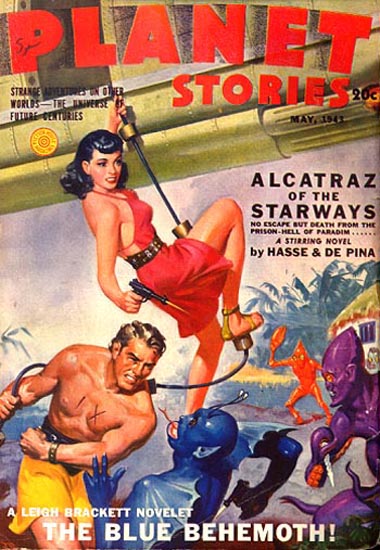
The Cover Story (Part 2) -- The Woman's Rise to Pulp Power

by Sean Taylor

Last week we covered (no pun intended) all the ways pulp magazine covers portrayed women as victims and powerless and little more than a damsel in distress with no more function in the story that to be rescued by the strapping young (or crazy old) hero.

This week we're going in a different direction. For all the ways pulp covers depowered and dehumanized woman, they also portrayed them in positions of power -- even over heroic men!

The (Not So Helpless) Damsel in Distress


As they say in the movie WHAT ABOUT BOB, baby steps. And baby steps from last week's covers would most definitely have to be when the stereotypical damsel in distress fights back (with or without the help of the hero). They may still be (mostly) at the mercy of the villain, but not going gently and ladylike into that role.


The Vixen


Enter the true woman of power -- The Bad Girl! This empowered woman could defeat the hero because her lust for evil gave her strength to ignore society's rules and get her own way. She maintained her power at the point of a blade or the business end of a pistol. But, only for so long. In the end, the hero did have to one-up her (and often try to redeem her back to the soft, little lady who follows the rules).


The Girl Friday


Sometimes even the good girl gets to experience some power, even if she is relegated to the sidekick role. Regardless, her importance grew from damsel in distress to the Girl Friday without whom the hero would be lost. This was still a good first step out of the dark ages and into truly heroic women of some level of ability.


The Goddess


Now we're getting somewhere. This woman has the kind of power that makes the hero take notice. (But it's okay, she's just a fantasy.) The goddess holds absolute sway over the hearts and wills of almost all who see her -- or she takes their worship by force. But... as a fantasy of a woman with ultimate power, she can usually only hold it in her place of power (as in She Who Must Be Obeyed) or risk losing it all to find love with the hero. Except for those rare opportunities in which she gets to be the heroine and the hero at the same time.


The Solo Adventurer


The ultimate growth for the female heroes. This adventurer could hold her own with the boys. She tamed the west. She explored the galaxies. She solved the case before the cops. She bent the jungle cats to her will.

She may have often been paired with a male hero, but it was clear she didn't need him. She saved as much as, or even more than she needed to be saved. She fired as many bullets or lazers as the good guy at her side (or not at her side). In some cases, she also had her own male foil as a sidekick, a "guy Friday" if you will.

The times were a'changin' and it was her time to shine.


What the Future Holds...


Next week we'll look at what pulp covers got right to help little boys grow up to be confident, stalwart men.

So, until next time, keep it pulpy.