

Showing posts with label women in genre. Show all posts
Showing posts with label women in genre. Show all posts
Thursday, July 2, 2026

Saturday, July 16, 2022
[Link] Margaret Atwood, The Art of Fiction No. 121
Interviewed by Mary Morris
The manuscript of “Frogless,” a poem that appears in this issue, by Margaret Atwood. Ms. Atwood wrote the poem on an SAS Hotel’s bedside notepad while she was in Gothenburg, Sweden last September for the Nordic Book Fair. “I’ve written quite a lot under those circumstances. Perhaps it’s being in a hotel room or a plane with no ringing phone and no supervision. Also, there’s something about jet lag that breaks down the barriers.”

Her second book of poetry, The Circle Game, earned her the Governor General’s Award—Canada’s highest literary honor—and from that time forward she has been a dominant figure in Canadian letters. In 1972 Atwood sparked a hot debate when she published a controversial critical study of Canadian literature, Survival: A Thematic Guide to Canadian Literature. In it she claimed that Canadian literature reflects the submissive as well as survivalist tendencies of the country, born from its being a subordinate ally to the United States, a former colony, and a country with vast stretches of untamed land. Following the publication of this volume, Atwood retreated from Toronto, where she had been working as an editor at the publishing house Anansi, to a farm in Alliston, Ontario, where she began to write full time.
Atwood has published nineteen collections of poetry—including The Circle Game (1964), The Journals of Susanna Moodie (1970), Power Politics (1971), You Are Happy (1974), True Stories (1981) and Interlunar (1984)—but she is best known for her novels, which include Surfacing (1972), Lady Oracle (1976), and Cat’s Eye (1988). Her most widely read novel is The Handmaid’s Tale (1986), a chilling account of a puritanical theocracy that won Atwood a second Governor General’s Award and was recently made into a motion picture. She is also the author of two children’s books, Up in the Tree (1978) and Anna’s Pet (1980) and two collections of short stories, Dancing Girls (1977) and Bluebeard’s Egg (1983). She has edited Oxford anthologies of Canadian verse and Canadian short stories and, with Shannon Ravenel, the 1989 volume of The Best American Short Stories.
The question of the status of women has frequently been an issue in Atwood’s work, and feminists have seized upon her writing as a product of the movement. Atwood has also made other political and philosophical issues themes in her work, such as Canada’s struggle to create an identity and, in recent years, her concern for human rights.
This interview was conducted in a house near Princeton University, where Atwood had gone to give some readings and lectures. In person, Atwood is much as one might expect from reading her work—incisive. For many hours over a period of two days, while teenage boys bounced basketballs and played music outside, people walked in and out, and football games played on the television in the next room, Atwood sat, attentive, answering each question without hesitation. She never strayed from her point, never seemed to tire, and remained, like a narrator from any one of her books, unflappable.
INTERVIEWER: Has the theme of survival always been intrinsic to your work?
MARGARET ATWOOD: I grew up in the north woods of Canada. You had to know certain things about survival. Wilderness survival courses weren’t very formalized when I was growing up, but I was taught certain things about what to do if I got lost in the woods. Things were immediate in that way and therefore quite simple. It was part of my life from the beginning.
Read the full article: https://www.theparisreview.org/interviews/2262/the-art-of-fiction-no-121-margaret-atwood
Thursday, November 16, 2017
[Link] The Women of Men's Adventure

The paperback original men’s adventure and western series of the seventies and eighties provided a fertile proving ground for dozens of authors—some of whom wrote hundreds of books in the near uncountable number of series which proliferated during the time period. The huge majority of the writers of these action-oriented, violence dripping, sex-soaked series filled with lone wolf vigilantes, elite military teams, shoot first cops, lusty international spies, billionaire adventurers, and the many other variations had one thing in common—they were males. While they weren’t necessarily as hairy-chested, muscular, or quick-triggered as their fictional creations, they were certainly toiling in the traditionally male written, testosterone filled, genre.
While the low rent end of Hemmingway Street was customarily male, there were a surprising number of women writers who embraced the macho guidelines of the genre—matching their male counterparts bullet for bullet, violence for violence, and sexual kink for sexual fetish. They infiltrated the genre seamlessly, proven by the fact no men’s adventure series reader ever stopped reading the latest installment, outraged because, “Hey! This was written by a broad!”
Fortunately, a number of women writers who braved the world of men’s action-adventure paperback series were willing to share their experiences…
Read the full article: http://www.paulbishopbooks.com/2017/09/the-women-of-mens-adventure_20.html
Friday, August 18, 2017
[Link] Women Who Conquered the Comics World

The day after she returns from the 2014 San Diego Comic-Con International, comics icon Trina Robbins sits down with me outside at a café just around the corner from her home in San Francisco’s Castro District. As we talk and eat, trains from the Muni Metro railway come thundering by. Robbins’ partner, Steve Leialoha, a comic artist for Marvel and an inker for the DC/Vertigo series “Fables,” arrives fresh from Comic Con with his bags and joins us at the table for half an hour or so.
“When I got to San Francisco in 1970, I discovered that maybe it was the mecca of underground comix for the guys, but not for the girls.”
As both a comics creator and historian, Robbins is particularly interested in the unknown history of female cartoonists and the ways they were celebrated and thwarted throughout the last century. Late last year, Robbins published a Fantagraphics book called Pretty in Ink: North American Women Cartoonists, 1896-2013, and now, the Cartoon Art Museum in San Francisco is presenting an exhibition of Robbins’ personal collection based on the book.
The subject is particularly relevant right now, given that new comic-book-based movies are hitting the big screen every few months, yet not a single one has revolved around a female hero. Marvel has taken bold steps by making a Pakistani American teen the new Ms. Marvel, in a comic-book series written by a woman, and turning Thor into a woman in its upcoming revamp of the series. At the same time, the major publisher raised feminist ire with a sexualized variant cover of its new Spider-Woman series. If a woman had drawn Spider-Woman instead of a man, it’s unlikely she would have sacrificed the hero’s comfort and mobility in favor of an erotic pose.
Robbins knows something about the glass ceiling for women cartoonists because she first hit it herself in the early 1970s, when she tried to join the male-dominated “underground comix” movement based in San Francisco. After the men cartoonists shut her out, Robbins joined forces with other women cartoonists to create their own women’s-lib comic books. She went on to become a well-respected mainstream comic artist and writer, as well as a feminist comics critic who’s written myriad nonfiction books on the subject of great women cartoonists and the powerful female characters they created. Naturally, Robbins has spent some time hunting down the original cartoons from the women who paved the way for her career, and as luck would have it, she found the very first comic strip ever drawn by a woman, “The Old Subscriber Calls” by Rose O’Neill, practically in her backyard.
Read the full article: http://www.collectorsweekly.com/articles/women-who-conquered-the-comics-world/
Tuesday, August 1, 2017
[Link] 100 MUST-READ SCI-FI FANTASY NOVELS BY FEMALE AUTHORS
 By Nikki Vanry
Ready for your TBR list to explode? I’ve gathered the 100 best sci-fi fantasy novels by female authors and there is sooooo much reading goodness to dig into. From YA to adult lit, from magical realism to epic fantasy to post-apocalyptic sci-fi feminism, from short stories to series, there’s a book on this list for every single reader.
Do note that I’ve only listed the first book in any given series, so expect that this list could easily give you ten times as much reading power (especially with those stick-to-your-gut epic fantasy series). I’ve also only included one book per writer to showcase the widest range of voices from sci-fi fantasy novels by female authors. So if you want to sink into a really prolific writer like Ursula K. Le Guin or Octavia Butler, you’ve got loads more to work with as well.
Read the full article: http://bookriot.com/2016/07/09/100-must-read-sci-fi-fantasy-novels-female-authors-2/
Tuesday, December 29, 2015
The Cover Story (Part 2) -- The Woman's Rise to Pulp Power
by Sean Taylor
Last week we covered (no pun intended) all the ways pulp magazine covers portrayed women as victims and powerless and little more than a damsel in distress with no more function in the story that to be rescued by the strapping young (or crazy old) hero.
This week we're going in a different direction. For all the ways pulp covers depowered and dehumanized woman, they also portrayed them in positions of power -- even over heroic men!
As they say in the movie WHAT ABOUT BOB, baby steps. And baby steps from last week's covers would most definitely have to be when the stereotypical damsel in distress fights back (with or without the help of the hero). They may still be (mostly) at the mercy of the villain, but not going gently and ladylike into that role.


Enter the true woman of power -- The Bad Girl! This empowered woman could defeat the hero because her lust for evil gave her strength to ignore society's rules and get her own way. She maintained her power at the point of a blade or the business end of a pistol. But, only for so long. In the end, the hero did have to one-up her (and often try to redeem her back to the soft, little lady who follows the rules).


Sometimes even the good girl gets to experience some power, even if she is relegated to the sidekick role. Regardless, her importance grew from damsel in distress to the Girl Friday without whom the hero would be lost. This was still a good first step out of the dark ages and into truly heroic women of some level of ability.


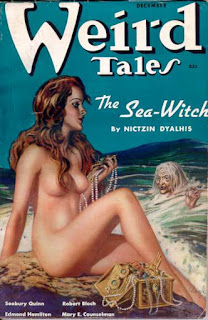
Now we're getting somewhere. This woman has the kind of power that makes the hero take notice. (But it's okay, she's just a fantasy.) The goddess holds absolute sway over the hearts and wills of almost all who see her -- or she takes their worship by force. But... as a fantasy of a woman with ultimate power, she can usually only hold it in her place of power (as in She Who Must Be Obeyed) or risk losing it all to find love with the hero. Except for those rare opportunities in which she gets to be the heroine and the hero at the same time.


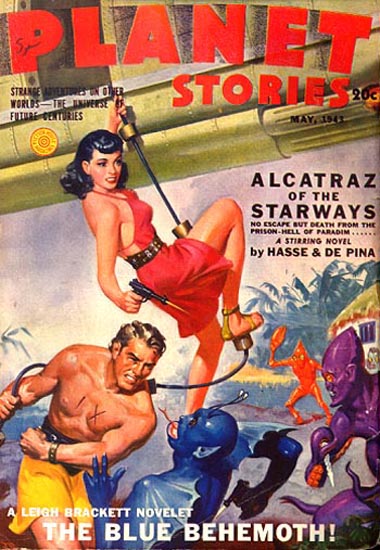
The ultimate growth for the female heroes. This adventurer could hold her own with the boys. She tamed the west. She explored the galaxies. She solved the case before the cops. She bent the jungle cats to her will.
She may have often been paired with a male hero, but it was clear she didn't need him. She saved as much as, or even more than she needed to be saved. She fired as many bullets or lazers as the good guy at her side (or not at her side). In some cases, she also had her own male foil as a sidekick, a "guy Friday" if you will.
The times were a'changin' and it was her time to shine.


Next week we'll look at what pulp covers got right to help little boys grow up to be confident, stalwart men.
So, until next time, keep it pulpy.
Last week we covered (no pun intended) all the ways pulp magazine covers portrayed women as victims and powerless and little more than a damsel in distress with no more function in the story that to be rescued by the strapping young (or crazy old) hero.
This week we're going in a different direction. For all the ways pulp covers depowered and dehumanized woman, they also portrayed them in positions of power -- even over heroic men!
The (Not So Helpless) Damsel in Distress
As they say in the movie WHAT ABOUT BOB, baby steps. And baby steps from last week's covers would most definitely have to be when the stereotypical damsel in distress fights back (with or without the help of the hero). They may still be (mostly) at the mercy of the villain, but not going gently and ladylike into that role.


The Vixen
Enter the true woman of power -- The Bad Girl! This empowered woman could defeat the hero because her lust for evil gave her strength to ignore society's rules and get her own way. She maintained her power at the point of a blade or the business end of a pistol. But, only for so long. In the end, the hero did have to one-up her (and often try to redeem her back to the soft, little lady who follows the rules).


The Girl Friday
Sometimes even the good girl gets to experience some power, even if she is relegated to the sidekick role. Regardless, her importance grew from damsel in distress to the Girl Friday without whom the hero would be lost. This was still a good first step out of the dark ages and into truly heroic women of some level of ability.



The Goddess
Now we're getting somewhere. This woman has the kind of power that makes the hero take notice. (But it's okay, she's just a fantasy.) The goddess holds absolute sway over the hearts and wills of almost all who see her -- or she takes their worship by force. But... as a fantasy of a woman with ultimate power, she can usually only hold it in her place of power (as in She Who Must Be Obeyed) or risk losing it all to find love with the hero. Except for those rare opportunities in which she gets to be the heroine and the hero at the same time.


The Solo Adventurer
The ultimate growth for the female heroes. This adventurer could hold her own with the boys. She tamed the west. She explored the galaxies. She solved the case before the cops. She bent the jungle cats to her will.
She may have often been paired with a male hero, but it was clear she didn't need him. She saved as much as, or even more than she needed to be saved. She fired as many bullets or lazers as the good guy at her side (or not at her side). In some cases, she also had her own male foil as a sidekick, a "guy Friday" if you will.
The times were a'changin' and it was her time to shine.


What the Future Holds...
Next week we'll look at what pulp covers got right to help little boys grow up to be confident, stalwart men.
So, until next time, keep it pulpy.
Subscribe to:
Posts (Atom)