Tuesday, May 22, 2012

THE GREEN HORNET: STILL AT LARGE - Contents Announced!

THE GREEN HORNET: STILL AT LARGE - Contents Announced!

Cover: Douglas Klauba
New Pulp writer/editor Win Scott Eckert has announced the writers and story titles for the upcoming Moonstone Books release of Green Hornet: Still At Large.

I'm pleased to announce the final contents for The Green Hornet: Still at Large, due out from Moonstone Books in July 2012.

Edited by Joe Gentile, Win Scott Eckert, and Matthew Baugh, this third anthology featuring the 1960s Green Hornet, based on the television program starring Van Williams and Bruce Lee, follows The Green Hornet Chronicles and The Green Hornet Casefiles, and will ship in two editions.

The softcover trade paperback features a cover by Douglas Klauba, while the limited edition hardcover boasts a cover by Ruben Procopio. It is anticipated that as with the prior books, the third volume will also see an eBook edition, although the specific date has not been announced.

Contents:
Cover: Ruben Procopio
"Hero" by S.J. Rozan
"The Black Torpedo" by Will Murray
"The World Will End in Fire" by Richard Dean Starr
"The Man Inside" by Matthew Baugh
"Death from Beyond" by Ron Fortier
"Play the Game" by Thom Brannan
"The Gauntlet" by Bobby Nash
"Chaos and the Year of the Dog" by Bobbie Metevier
"Axford's Sting” by Dan Wickline
"Revenge of the Yellowjacket" by Howard Hopkins
"The Man in the Picture" by Patricia Weakley
"Masks" by C.J. Henderson
"Bad Man's Blunder" by John Allen Small
"Losers, Weepers" by Rich Harvey
"Stormfront" by Greg Gick
"The Night I Met The Hornet" by Mel Odom
"Progress" by Win Scott Eckert

The limited edition hardcover will also feature:

“The Green Hornet Timeline,” a chronology of the Moonstone stories from the three anthologies, fit into the timeline of the original television episodes, by Win Scott Eckert

A bonus story featuring the 1930s-40s Green Hornet from the radio show and serials, “The Green Hornet Meets The Avenger” by Michael Uslan

Pre-ordering information:
Amazon.com (trade paperback)
Amazon.com (limited hardcover)
B&N.com (trade paperback)
B&N.com (limited hardcover)

The Writer Will Take Your Questions Now (#173) -- Fantasy and Wonder

What is your working definition of fantasy as a literary genre?

I know a lot of folks define their fantasy by the proliferation of elves and orcs and fairies (oh my), or by the travel to mysterious worlds that are defined more by magic than by science. I, however, prefer to define it by how much said fantasy story plays into and upon a sense of wonder in the reader. There's a sort of fantastic "what if" at play in true fantasy for me.

What if my boring life could get exciting when I entered a magical wardrobe?

What if an invalid is the savior of a mystical land?

What if I could fly a dragon on a daily basis?

What if the girl of my dreams was a star that fell to earth?

What if my brother was Ananzi the Spider?

What if...

And so it goes.

Sure, that gets into the other slices of fantasy, such as urban, high, etc., but in each case, the appeal isn't in the setting so much as in the way it draws on my sense of wonder and what if, and to me, that's what makes fantasy fantastic.

Monday, May 21, 2012

My schedule for Alabama Phoenix Festival this weekend!


You ARE coming to Birmingham for the Alabama Phoenix Festival, right? Well, when you're there, drop by and visit me at my table or at any of the following panels:

Me, with the lovely and talented Charis Taylor, who
will also be a guest at APF (and doing panels).
Friday:
12:30 PM - Breaking and Entering (breaking into comics)

Saturday:
11:30 AM - Marketing 101 - How to promote yourself and your work
1:00 PM - Page by Page - Join Larry Hama as he talks about his life as a writer, artist, and editor in the comic book business (Moderated by Sean Taylor)
2:30 PM - World Creation
4:00 PM - The Bloody Pulps   
5:30 PM - Steampunk Stories

Sunday:
10:00 AM - Religion in Fiction
11:30 AM - Get it and go! - You get your first job as a writer or artist on a published book...now what?

The Writer Will Take Your Questions Now (#172) -- Hard of Soft Sci-Fi?

Do you prefer hard sci-fi (science-based) or soft sci-fi (space fantasy)?

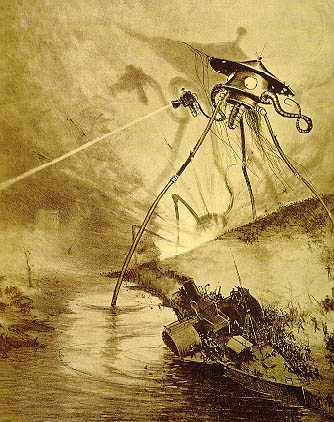
War of the Worlds is more than just
a rollicking good romp. It says
something about us.
Actually I like them both, but only when either of them uses science as a jumping-off point to speculate about concepts like human nature and other less technological concerns.

I thinks that's why I like Ray Bradbury's work so much. He didn't get bogged down in the science of how a time machine worked. Instead he used the "fact" of the time machine in the story to present a tale about human greed and how it has a farther reaching impact than merely the person who is being greedy.

It's why I enjoy the work of Asimov when he address religious blindness that seeks to serve itself and it's traditions rather than the people it passes over everyday. 

It's why I love the work of Gary Kilworth, who shows via the same kind of time-travel trappings how we need look any further than ourselves to see whose sin is screwing up the world.

It's why I love the science fiction of Kurt Vonnegut Jr. when he satirized the culture of automation and how it destroys little by little the value of the human individual like a certain self-playing musical instrument.

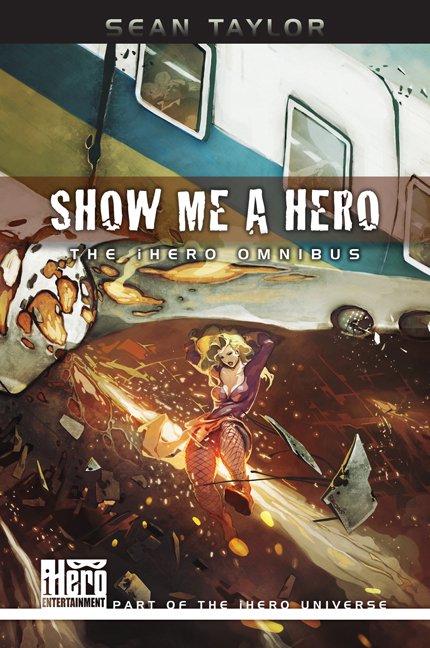
It's why I love the involvement of Le Guin's researchers who try to learn about other cultures without impacting them negatively or becoming too ingrained in their politics. (Kudos and a free copy of my SHOW ME A HERO e-book to anyone who can name the first four works referenced and any of the Le Guin novels contained in that reference.)

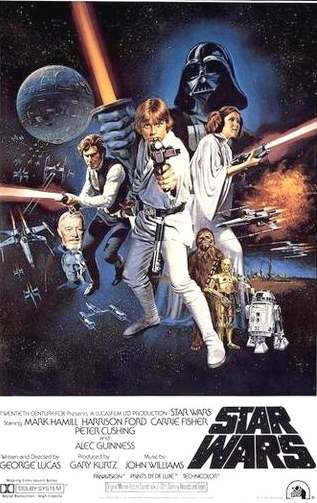
I'm not a huge fan of fantasy stories in a space setting, such as the Pern series or the like. Other than the original Star Wars (A New Hope), that kind of story usually leaves me flat. But neither am I a fan of stories that are merely scientific extrapolations with a sugar-coated dressing of fictionalized story. I want sci-fi that speculates not just technology, but what it means to (and for) and says about the humans who use that technology. That's what get my sci-fi geek going.

Sunday, May 20, 2012

[Link] On World Building with D.A. Adams

Today I have a great author with us to talk about World Building.  D.A. Adams, created an amazing world for his book series, The Brotherhood of Dwarves so I figured he would be a great author to chat about World building. 

On World Building with D.A. Adams

Please, allow me to preface everything I’m about to say with this disclaimer:  I don’t consider myself an expert or an authority on world building, so take all of my advice with a grain of salt.  That said, I do believe there are some paramount fundamentals for creating a new space that all writers should adhere to.  Most importantly, all writers, regardless of genre or style must partake in some form of world building because all fiction involves inventing an alternate reality in which their story takes place.  Even if the story is set in the “real world,” any attempt at capturing the essence of our reality will fall short because our world is simply too large, too complex, and too dynamic ever to be rendered flawlessly in any medium.  The best any writer can hope to achieve is creating a reality in their story that the audience will accept and believe.

To do this, the foundation of the world must be grounded in verisimilitude, or a likeness to reality.  Regardless of how far-fetched or different from our universe the fictional world may seem, for it to be trusted in and believed by the audience, there must be something that connects it to our reality.  An audience will believe in a magical school in an alternate dimension where kids play a form of lacrosse on flying broomsticks if there is something that they can relate to, such as the underdog overcoming the bully.  The audience will believe in an all powerful energy that certain people can tap into for incredible powers if there is something attached to it like the tempering of selfish desires.  So when you are creating the laws of your world, you must find something that grounds it in reality so the audience will believe you when you bend a law or two of our actual reality.

Also, it’s imperative that societies remain modeled after something that exists in nature, not necessarily human societies, but something that follows a believable order of organization.  Perhaps, you model your society on the hierarchy of ants or maybe the reproductive cycle of a gourd.  Either is fine as long as you create this hierarchy and remain true to it.  This organization and structure should be thought through and researched before the actual writing takes place.  Otherwise, you run the risk of contradicting yourself during the telling of your story.  There are exceptions to this, of course, as part of writing is discovery, but for me, it’s important to know all of my cultures, races, and societies before I begin telling the story.  Another important factor here is the “black sheep” or “renegade” phenomenon.  In human societies, there is always a counter-culture that defies authority, regardless of how effective that authority may be.  You must keep this in mind whenever creating a human-like society or you risk creating a flat, two-dimensional, unrealistic culture that your audience may not fully believe.  At this point of world building, research is crucial.  Please, let me repeat, research is critical.

Continue reading: http://alisbookshelfreviews.blogspot.com/2012/05/guest-post-world-building-with-da-adams.html

The Writer Will Take Your Questions Now (#171) -- Coming Up Short

What do you do when you get stuck considerably short of a word count for story? Are there spots you find easier to expand upon then others? (from a conversation with a friend) 

Numbers are out to get you. It's true.
I usually write full plots to meet the space requirements, so I haven't had to face this in a while, but when I was getting used to that, I usually reserved those extra words for either adding extra beats in the action sequence, a sort of "mini story triangle in the fight scene to beef it up" and give it its own "story."

Or, I would add the characterization bits that I initially didn't think I'd have room for, such as more Whedonesque "peripheral" dialog that helped bring the characters to life. For example, in Dominatrix, I was able to add a scene at a cafe where the leads are discussing whether Duran Duran is the best pop band ever or just a bunch of posers because there's no middle ground. It's completely peripheral to the plot, but incredibly telling about the characters, and I was thrilled to have room to include it.

Saturday, May 19, 2012

Upcoming Book Signing in Rome, GA.


Meet Bobby Nash, Sean Taylor, and Michael Gordon at Legends of Rome on June 9th 12 - 2 p.m. www.legendsinteractive.com

COMING TO Legends of Rome!
June 9th 12-2 pm!

Bobby Nash, author of Green Hornet Casefiles, Domino Lady, Yin Yang & more.

Sean Taylor, author of IDW's Robots vs. Zombies: This Means War, Classics Mutilated, Gene Simmon's House of Horror & more.

Mike Gordon, author of Tiki Zombie, publisher of Crypto Zo comic and the new Invisible Scarlet O'Neil!

Bring your art portfolios for critiques! Authors stop in to discuss getting your work published!

The Writer Will Take Your Questions Now (#170) -- At the Movies, Take 2

You mentioned Fishnet Angel and how that used to be your first choice for having a film or TV done. Which actors do you think would be right for the roles if that if it were to happen?

Ten years ago when I first started doing a lot with Fishnet Angel, I would have told you that Erika Elaniak would have been perfect for the role. If today were 2001, I'd still stand by that, but as times change and actors out-age the characters (who remain sort of timeless), I'll have to pick from a new crop of actors.


Fishnet Angel/Marcia - January Jones


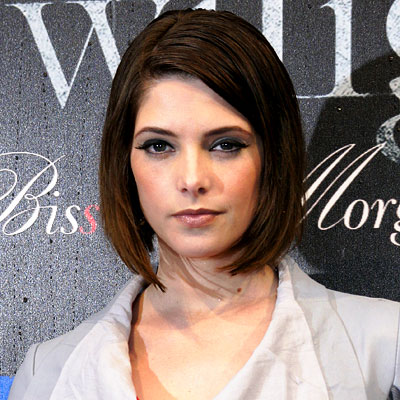
Andi - Ashley Greene


Mark (pre-Fishnet Angel) - James Franco

Friday, May 18, 2012

[Link] Fantasy Meets Reality

by Lance Stahlberg

Bouncing off a round table that my buddy Sean Taylor did about a week ago, The Story Behind Urban Fantasy. It got me to thinking about the stories I watched/read growing up, and the stuff that would eventually inspire me to actually try telling these stories myself.

One of the first books I remember cracking open as a child was The Lion the Witch and the Wardrobe.  I was mesmerized by a world populated by magic creatures and witches and talking animals presented as if it were REAL.  No hoaky, kiddie, cartoony gimmicks.  No singing.  This was a real world where a bunch of kids actually went and battled evil.

I also grew up watching cartoons, natch.  In particular I remember kind of hating Scooby Doo (while sitting glued to this opium for kids every day), thinking how lame it was that every case had to be some stupid old guy playing tricks with fake ghosts and stage magic and whatnot.  Why couldn't they fight real monsters dammit?  Guess the creative geniuses at Hanna Barbera thought that would have been too silly. -_-

But that's how it was for the first roughly two decades of my life.  Creators of the time couldn't seem to bring themselves to mix elements of fantasy or the supernatural into the real world without portraying it as a comedic spoof.  There were a few good attempts, mostly in the horror genre, but they were VERY few and far between.

Except for comic books, the one medium where writers had no constraints.

Continue reading http://roguewolf.blogspot.com/2012/05/fantasy-finally-meets-reality.html

RIP Ernie Chan


Read the full story: http://goodcomics.comicbookresources.com/2012/05/17/r-i-p-ernie-chan/

The Writer Will Take Your Questions Now (#169) -- Movie Aspirations

Of all the stories you've written, which would you most like to see adapted to either film or television?

Oooh. Good question.

A few years ago, I would have quickly answered with "Fishnet Angel, of course." While I would still love to see the Tyranian warrior goddess up on the big screen, I don't think that would be my best bet for a first film project.

So which one would I prefer now to see on the big or small screen?

"Die Giftig Lillie" from The Ruby Files, Volume 1. I can't think of many things more fun than seeing Rick Ruby, Evelyn, and Edie played onscreen with all those shootouts, all that sexual tension, and the pulp-noir action.

And who should play the roles? That's a tougher decision. First thoughts, though?


Edie - Scarlett Johansson


Evelyn - Gabrielle Union

Rick - Eric Stoltz

What do you think?

Thursday, May 17, 2012

Science Fiction, Space Fantasy, and the World of Speculative Storytelling

Once upon a time there was a young woman named Mary Shelley. She wrote a little story you may have heard of called Frankenstein, and the genre known as science fiction was born (whether it was self-aware or not yet). Then came the space fantasies and the Burroughs and the Bradburys and the Asimovs, and eventually, science came calling and tried to take back the ground it had lost to the fantasists.

Thus we have a huge range of varying work that passes for science fiction nowadays.

So to get to the heart of the matter and talk space turkey about the mixed up genre, we went straight to the writers to make the magic happen (metaphorically, of course, since magic isn't technically science, no matter how indistinguishable it is from it -- thank you, Arthur C. Clarke).

What is your working definition of sci-fi as a literary genre?

William D. Prystauk: Science Fiction must have a story with real science at it's core. For instance, ANDROMEDA STRAIN and TIMECRIMES, while movies like STAR WARS are science fantasy. Just because the latter tale takes place in space does not mean it's science fiction since that element is not the foundation for the story.

R.J. Sullivan: A story that examines either how a scientific advancement or theoretical postulation can affect the people caught up in it.

H. David Blalock: Science fiction is story-telling based on an exaggeration of science fact that never requires the reader to question the feasibility of the science used. Once that line is crossed, you've stepped into science fantasy. Hard science fiction is difficult to write mainly because it requires real research and often a working knowledge of the science used. Science fantasy (or "soft sci-fi") is much easier and more common. It can break laws of physics and disregard the restrictions of hard science.

Herika R Raymer: Science-fiction is that which takes technology into a desired effect or even takes humanity to a extra-terrestrial, or otherwordly, location. Science-fiction can be exploring the limits of nanotechnology, digital technology, or even medical technology. I especially like the science-fiction that deals with possible extra-terrestrial creatures. Exploring other worlds, meeting other creatures, and generally exploring what might happen if humans finally became space explorers. What would they find? How would they react?

Lee Houston Jr.: For me, true science fiction has to have at least one element that is not possible in our current world, whether it be a spaceship, aliens, taking place upon another planet, or more preferably, all of the above and then some.

Elizabeth Donald: Science fiction foretells a plausible future or alternate present with technology that does not currently exist, but could within our understand of the world. Any science sufficiently advanced from ours may appear like magic, but science fiction best tells us about ourselves by showing us a conceivable outcome of our present day. It is distinguished from fantasy by its explainable phenomena, and from horror in that while it may be thrilling, its primary focus is not to evoke fear.

What is it about sci-fi that drew you to writing it?

William D. Prystauk: The fun of being able to explore something new. And I really did since I had to read up on science based items to have a better grounded and more realistic story.

R.J. Sullivan: Star Trek.

H. David Blalock: The challenge of actually staying inside the confines of science fiction without breaking the rules. Doing that and keeping the readers' interest is an art form.

Herika R Raymer:
The fascination that what was once science-fiction is now science-fact. For instance, in the old science fiction books and movies there were communication devices and transportation devices, as well as medical procedures, that were simply too far-fetched to believe. Yet look at today: personal computers, cell phones, tracking devices, laser surgeries, and more. There is still a dark side to it, and pointing that out can be just as dangerous in real life as it is on the page. It is interesting to see what might be science fiction today become science fact tomorrow.

Lee Houston Jr.: Like fantasy, science fiction gives the writer a place to let their imagination truly run wild and free. Granted, it might be a very long time before anything written now ever has a remote chance of coming true, if ever. But it is the mere thought of the possibilities, of striving to accomplish the "impossible", that keeps me coming back as both a writer and a reader.

Elizabeth Donald: The best science fiction tells us about ourselves. It is allegory and metaphor, it is a cautionary tale or a utopia to which we may strive. I have never been so fond of science fiction that depends on machinery and an absolute attention to technology and physics as I have the stories of people of the future, what they think and what they can show us.

Where's your prefered working space on the continuum between hard sci-fi and soft sci-fi?

William D. Prystauk:
  I don't like soft stuff. I'm an adult and I want stories that feel real in all regards. This does not mean that I expect grand explosions and piss-and-vinegar characters, I just want a sense of real familiarity with the characters and stories within the realm of physics that don't go "over the top."

R.J. Sullivan: Soft sci-fi, because of its focus on character and their response to the science rather than a study of the science itself.

H. David Blalock: I prefer to work closer to the soft sci-fi simply because, on the whole, I am a lazy writer. I can stretch science to my liking in science fantasy without regard to whether my audience will allow it or not. The audience of hard science fiction (which is increasingly small and may not last out this generation) is much stricter on the author, expecting more and demanding more.

Herika R Raymer: I imagining you mean hard-scifi as being militaristic in the details, and unfortunately I cannot write that. Unlike some writers I know, I do not have the science background to do hard science fiction though I am not sure I would want to. I like leaving some details to the imagination – which is why I can write soft science-fiction. A fellow writer once told me that, no matter how hard you try, there will always be someone who will pick apart your devices and tell you how it is not only not feasible but would not work. So they said the safest route is to use elementary science for kids, that way you get the base, you get it right, and leave the rest to imagination. It has worked for me.

Lee Houston Jr.:
Hard gives you all the details and explanations. Soft just presents the concepts and expects the reader to accept everything at face value. In either, the science (fiction) has to at least be plausible. But I try to stay in the middle of the two extremes. I present the ideas and devices, give the readers some details, and let them fill in the rest how they see fit. For example, I've stated that Hugh Monn, Private Detective's Hover 3001, which is more akin to Luke Skywalker's land speeder than George Jetson's flying vehicle in my mind's eye, gets 500 to a fuel cell. But I never said 500 what, let alone what he is using for fuel, or how many fuel cells the vehicle has.

Elizabeth Donald: I dislike the terms "hard" and "soft" SF because they feel judgmental. Hard SF is usually described as fiction that focuses more on technology and world-building than character and story, which I feel to be a weakness. Soft SF is usually denigrated as somehow being less intelligent, thoughtful or complex, as though the author must have wanted to write about the physics of space travel but couldn't be bothered to do the research. Both, then, are negative connotations. I think a novel can focus on people and story without skimping on technical accuracy, and that the most fascinating world still has to have people walking through it. I think we should get past "hard" vs. "soft" SF and instead focus on "good" vs. "boring" SF.

How has sci-fi changed as a genre over the past 50 years, and how has that affected the way you write it?

William D. Prystauk: I think science fiction was always escapist literature. But once gripping tales from Gaines and Dick came along, the latter questioning social themes, the foundation for telling dramatic tales grew stronger. Going beyond the fifty year point, however, Verne not only showed us what could be fantastical, but he made certain his work had a strong basis in reality. Movie wise, when one looks at ALIEN and BLADE RUNNER, it's easy to recognize that the science fiction element is derived from a strong sense of story and character that grips our imagination as well as our spirit. In that regard, Serling and Matheson should be heralded for taking what many considered "sci-fi garbage", something laughable and childish, and bringing us poignant social tales with great thematic strength. (Much like what MAUS and WATCHMEN, for instance, did for comics -- they proved, through story, character and theme, that great, human experience tales can come out of something often seen as sub-intelligent.)

When I write science-fiction, I want it to say something. I want the story to have as much merit as classic literature. My goal, as with any story in any genre, is to have the reader leave the piece to contemplate. Sure, I want to entertain, but I want people to think about what they just read. I don't want it to be disposable.

R.J. Sullivan: The biggest change to the genre came in the late 80s early 90s when we began to lose the authors who had advanced the genre out of the pulp age and into the age of relevance. (Asimov, Heinlein, Clarke much later, etc.) I think what has gobsmacked the genre is the development of inner space and miniaturization. For decades writers postulated an advancement in rocketry, robotics, exploration. A few "cyberpunk" stories in the 90s seemed cutting edge and of limited interest to the general SF reader, but the final frontier has now proven to be cyber space, not outer space, and writers are beginning to realize that cyberspace opens up worlds of the imagination that the old school writers could never have dreamed possible. I am exploring cyberspace in my upcoming novel Virtual Blue.

H. David Blalock:
Science fantasy has overtaken hard science fiction. The accelerated pace of scientific advancement has given rise to the general public believing that science can do anything, equating it to what used to be called magic. To paraphrase someone, I believe it was Clarke, any technology sufficiently advanced would appear magical to the uninitiated. As a whole, the public does not understand the very science with which they interact on a daily basis. From electricity to computers, the average joe couldn't tell you anything about how they work, just that he is glad they do. Science fiction is science fact to the layman. The line between the two is so blurred in the public eye, they cannot tell the difference.

Herika R Raymer: As mentioned before, much science fiction has become science fact. The exploration of “because we can, should we” is still there with cloning and other topics, but it gets a bit more touchy. I have to admit to being relieved at the resurgence of steampunk, because it is a science-fiction I can research and write, as well as place it in a period that is flexible – at least on paper. I think that is most likely what has changed in the past 50 years – writing more in alternate realities. The idea is fascinating, and with writers hard pressed to think of the next impossible gadget, their next option is to look at a timeline where certain gadgets have not even been introduced and try and figure out how they survived. It is a challenge, but it is fun.

Lee Houston Jr.: Like fantasy, there must always be at least some suspension of belief/reality to truly enjoy science-fiction. We may know more about Mars and Venus now than when the stories were originally written, but that shouldn't lessen our enjoyment of Edgar Rice Burroughs John Carter of Mars or Carson of Venus novels. The original Star Trek series is accredited with presenting the concepts we know today as cell phones and the personal computer. All I have to say as both a writer and a reader of science fiction is "What next?" and "Let's see what's out there!"

Elizabeth Donald: The blessing of science fiction has also been its curse. The past few decades have seen enormous strides in movie-making technology, enabling us to bring classic and contemporary science fiction epics to the screen that previously could not have been filmed without a laugh track. But that very dependence on special effects required a constant upgrade in big explosions and awesome visuals, while the viewing public grew disinterested in cultural metaphor and allegory in the me-me-me 1980s and 90s. Now you see action movies whose titles were inspired by Phillip K. Dick and Richard Matheson, and Star Trek is remade into an exciting thrill ride that doesn't even give a tip of the hat to actual science. They make money, so the book world then turns to the SF writers and asks for more explosions. It is my hope that eventually we can turn things back around somewhere between the overly cerebral and frankly boring novels of the mid-20th century from the brain-dead and exhausting fiction of the current era, that there is room for plot and adrenaline, intelligence and explosions. It doesn't hurt to let women in on the fun, either.

The Writer Will Take Your Questions Now (#168) -- Ghost Stories

What genre have you not written yet that you'd love to write?

This one's easy. I haven't written a straight-up ghost story, and I'd love to write one. Not a contemporary urban fantasy or a paranormal romance but a good, scary ghost story like Shirley Jackson's "The Haunting" or "The Shadows on the Wall" by Mary E. Wilkins Freeman.

To me, those are some of the hardest stories to write well (and there are thousands of them that aren't written well, trust me), which is why I haven't done one yet, but I certainly want to one day. 

Wednesday, May 16, 2012

How Do the Books on Your Bookshelf Stack Up Against the Books on CEOS’ Bookshelves?

“Serious leaders who are serious readers build personal libraries dedicated to how to think, not how to compete… If there is a C.E.O. canon, its rule is this: “Don’t follow your mentors, follow your mentors’ mentors,” suggests David Leach, chief executive of the American Medical Association’s accreditation division. Mr. Leach has stocked his cabin in the woods of North Carolina with the collected works of Aristotle,” reports the New York Times article “C.E.O. Libraries Reveal Keys to Success.”

In How to Read a Book by Mortimer Adler and Charles Van Doren, there are three reasons to read a book: For information, entertainment and to further knowledge, and the reason for reading a book will inform which of the read four levels of reading you engage in:

Elementary: Level of reading that is learned in elementary school
   
Inspectional: Emphasis is on time – getting the most out of a book within a short time frame. There are two types of inspectional reading, systematic skimming or pre-reading and superficial reading
   
Analytical: Deals with classifying the book, coming to terms with it, determining the book’s message, and criticizing both the book and the author. Analytical reading is a very active type of reading
   
Syntopical: Also known as comparative reading, is the most complex form of reading. It is reading multiple books on the same subject and placing them in relation to each other

It’s not surprising that most CEOs and other successful people do not read business books, since most do not make you think. Instead they read poetry, books on philosophy, religion and fiction. They likely read to mostly further their knowledge, and if they are trying to understand something new, they would read syntopically.

Some of the books mentioned in the New York Times article include:

  •     Swimming Across, Andy Grove
  •     Seven Pillars of Wisdom, Thomas Edward Lawrence
  •     Death of a Salesman, Arthur Miller
  •     Stranger, Albert Camus
  •     The City of God, E. L. Doctorow
  •     How Doctors Think, Jerome Groopman
  •     Seminary Boy, John Cornwell
  •     The Wife, a novel by Meg Wolitzer
  •     Team of Rivals, Doris Kearns Goodwin
  •     Rubáiyát, Omar Khayyam
  •     Books of William Blake
  •     Works by Aristotle
  •     Books by Galileo

How many of these books have you read?

Reading fiction can also help in your daily lives. For instance, reading a well-written murder mystery such as Agatha Christie’s Murder of Roger Ackroyd can hone your problem solving skills. The Collectibles by James L. Kaufman demonstrates the ethical and moral dilemmas that arise when people do not operate with integrity. And Patricia Highsmith’s Strangers on a Train shows what can happen when you do not have a mentor, coach or advisor – someone you can talk to when you are in a very tight spot and need guidance to help you make the right choice.

Reading thoughtful books add rigor to your thinking, and improves your problem solving and decision making skills.

Continue reading: http://cwcvirtualmentor.com/2011/03/08/how-do-the-books-on-your-bookshelf-stack-up-against-the-books-on-ceos%E2%80%99-bookshelves/

The Writer Will Take Your Questions Now (#167) -- Why Zombies?

Aren't zombies played out? Why keep writing zombie stories?

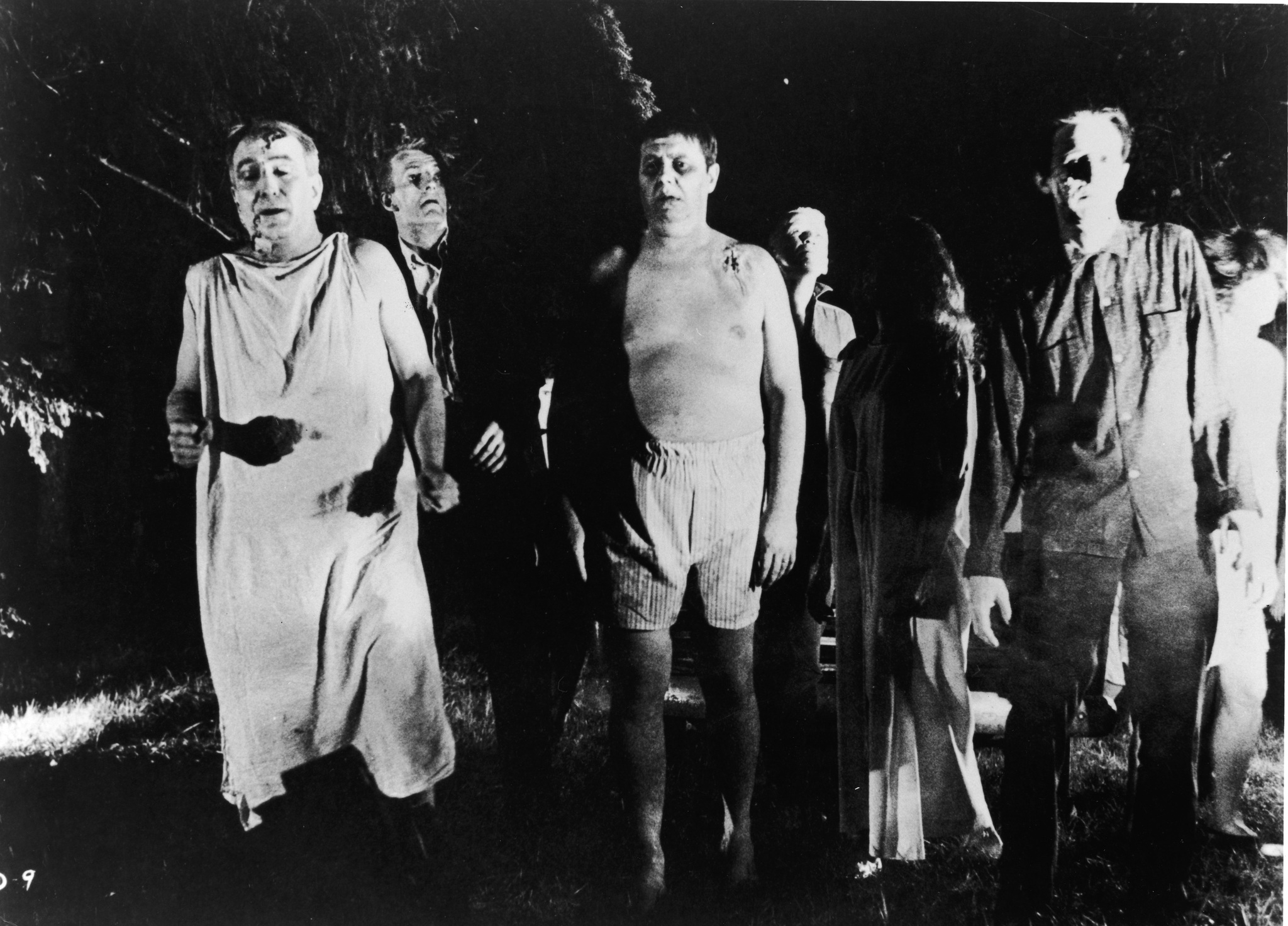
We're coming to get Barbara if you
ever stop writing our stories.
The short answer is this: Because I keep getting paid for writing zombie stories.

The long answer is this: Because I keep finding fun ways to play with the zombie story. Rather than rehash the zombie apocalypse that George Romero did so well, I keep looking for new kinds of stories to tell using a zombie setting. In Zombiesque, I used zombies to explore the nature of art and how love plays into that urge to create. In Pro Se Presents #1, I explored the wedding vow and how can a marriage continue to work in the wake of a zombie uprising. And in Zombies vs. Robots: This Means War, I explored love and marriage again, but in the context of love lost and the second chance that a zombie infestation might bring when one's humanity isn't what it used to be.

And because of that, all of those stories were a great deal of fun to write.

Besides, if I don't, they'll eat my braiiiiiiiiiiins.

Tuesday, May 15, 2012

SEAN TAYLOR: ON ZOMBIES, ROBOTS, RICK RUBY, AND MORE

Lee Houston Junior interviewed me over at the Free Choice E-Zine. Check it out!


http://www.thefreechoice.info/2012/05/farm-fresh-within-these-pages-portrait.html

23 Timeless Quotes About Writing

by Brian A. Klems

While fad advice in the writing world comes and goes, some wisdom is so novel that it’s withstood the test of time. Culled from 91 years of WD [Writers Digest] articles, interviews and essays, here are 23 of our favorite writing quotes of enduring advice and inspiration. Enjoy.

“If you have a story that seems worth telling, and you think you can tell it worthily, then the thing for you to do is to tell it, regardless of whether it has to do with sex, sailors or mounted policemen.”
—Dashiell Hammett, June 1924

“The writing of a novel is taking life as it already exists, not to report it but to make an object, toward the end that the finished work might contain this life inside it and offer it to the reader. The essence will not be, of course, the same thing as the raw material; it is not even of the same family of things. The novel is something that never was before and will not be again.”
—Eudora Welty, February 1970

“You yearn to turn out a book-length, your typewriter is silently shrieking abuse, you are itching to go. First read! Read the work of top-notch writers in your field. They know how! Read first for entertainment, then reread for analysis. Soak yourself in their stuff—for atmosphere, color, technique.”
—Fred East, June 1944

“One thing that helps is to give myself permission to write badly. I tell myself that I’m going to do my five or 10 pages no matter what, and that I can always tear them up the following morning if I want. I’ll have lost nothing—writing and tearing up five pages would leave me no further behind than if I took the day off.”
—Lawrence Block, June 1981

“The trap into which all writers have, will, or should fall into, of writing The Great American Watchamacallit, is such an uncluttered and inviting one that from time to time I’m sure even the greatest have to pull themselves up short by the Shift key to remind themselves that it is story first that they should write.”
—Harlan Ellison, January 1963

“It’s like making a movie: All sorts of accidental things will happen after you’ve set up the cameras. So you get lucky. Something will happen at the edge of the set and perhaps you start to go with that; you get some footage of that. You come into it accidentally. You set the story in motion and as you’re watching this thing begin, all these opportunities will show up. So, in order to exploit one thing or another, you may have to do research. You may have to find out more about Chinese immigrants, or you may have to find out about Halley’s Comet, or whatever, where you didn’t realize that you were going to have Chinese or Halley’s Comet in the story. So you do research on that, and it implies more, and the deeper you get into the story, the more it implies, the more suggestions it makes on the plot. Toward the end, the ending becomes inevitable.”
—Kurt Vonnegut, November 1985

“Don’t expect the puppets of your mind to become the people of your story. If they are not realities in your own mind, there is no mysterious alchemy in ink and paper that will turn wooden figures into flesh and blood.”
—Leslie Gordon Barnard, May 1923

“If you tell the reader that Bull Beezley is a brutal-faced, loose-lipped bully, with snake’s blood in his veins, the reader’s reaction may be, ‘Oh, yeah!’ But if you show the reader Bull Beezley raking the bloodied flanks of his weary, sweat-encrusted pony, and flogging the tottering, red-eyed animal with a quirt, or have him booting in the protruding ribs of a starved mongrel and, boy, the reader believes!”
—Fred East, June 1944

“We writers are apt to forget that, as the gunsmoke fogs and the hero rides wildly to the rescue, although the background of this furious action is fixed indelibly in our own minds, it is not fixed in the mind of the reader. He won’t see or feel it unless you make him—bearing always in mind that you can’t stop the gunfight or the racing horse to do the job.”
—Gunnison Steele, March 1944

“Plot, or evolution, is life responding to environment; and not only is this response always in terms of conflict, but the really great struggle, the epic struggle of creation, is the inner fight of the individual whereby the soul builds up character.”
—William Wallace Cook, July 1923

“Plot is people. Human emotions and desires founded on the realities of life, working at cross purposes, getting hotter and fiercer as they strike against each other until finally there’s an explosion—that’s Plot.”
—Leigh Brackett, July 1943

“You can’t write a novel all at once, any more than you can swallow a whale in one gulp. You do have to break it up into smaller chunks. But those smaller chunks aren’t good old familiar short stories. Novels aren’t built out of short stories. They are built out of scenes.”
—Orson Scott Card, September 1980

“Don’t leave your hero alone very long. Have at least two characters on stage whenever possible and let the conflict spark between them. There can be conflict with nature and your hero can struggle against storm or flood, but use discretion. … You could write a gripping story about a struggle between a lone trapper and a huge, clever wolf. But the wolf is practically humanized in such a story and fills every role of villain. The wolf too wants something and does something about it. A storm doesn’t want anything and that’s why its conflict with man is generally unsatisfactory. It doesn’t produce the rivalry which is the basis of good conflict.”
—Samuel Mines, March 1944

“The first sentence can’t be written until the final sentence is written.”
—Joyce Carol Oates, April 1986

“The writing of a mystery story is more of a sport than a fine art. It is a game between the writer and the reader. If, once in a while, a really fine book comes out of this contest, that is good; but the game’s the thing. If, on Page 4, the reader knows that the soda cracker is spread with butter mixed with arsenic, and later on this is proven to be true, then the reader has won the game. If, however, when the reader finishes the book, he says, ‘I didn’t get it—all the clues were there, plain as who killed Cock-Robin, but I didn’t get it,’ then the author has won the game. The author has to play fair, though. He has to arrange his clues in an orderly manner, so that the reader can see them if he looks hard enough.”
—Polly Simpson Macmanus, January 1962

“Authors of so-called ‘literary’ fiction insist that action, like plot, is vulgar and unworthy of a true artist. Don’t pay any attention to misguided advice of that sort. If you do, you will very likely starve trying to live on your writing income. Besides, the only writers who survive the ages are those who understand the need for action in a novel.”
—Dean R. Koontz, August 1981

“What the young writer is looking for is not a critic who will slap him on the back and say, ‘Greatest thing since O. Henry,’ but rather the one who will toss the manuscript down in disgust, with ‘You know better than that! It’s rotten! Do it all over again!’”
—Henry Sydnor Harrison, March 1923

“Make your novel readable. Make it easy to read, pleasant to read. This doesn’t mean flowery passages, ambitious flights of pyrotechnic verbiage; it means strong, simple, natural sentences.”
—Laurence D’Orsay, October 1929

“When your story is ready for rewrite, cut it to the bone. Get rid of every ounce of excess fat. This is going to hurt; revising a story down to the bare essentials is always a little like murdering children, but it must be done.”
—Stephen King, November 1973

“Loving your subject, you will write about it with the spontaneity and enthusiasm that will transmit itself to your reader. Loving your reader, you will respect him and want to please him. You will not write down to him. You will take infinite pains with your work. You will write well. And if you write well, you will get published.”
—Lee Wyndham, November 1962,

“Genius gives birth, talent delivers.”
—Jack Kerouac, January 1962

“Long patience and application saturated with your heart’s blood—you will either write or you will not—and the only way to find out whether you will or not is to try.”
—Jim Tully, October 1923

From this original link: http://www.writersdigest.com/whats-new/23-timeless-quotes-about-writing

The Writer Will Take Your Questions Now (#166) -- Independent Super Hero Prose

The bulk of super hero prose tales seem to coming be from independent publishers. 
Is this a way getting around the "can't afford an artist" hurdle that keeps many 
out of indie published comics, or is there more to it than that?

While it's true that it's certainly easier for a writer to make a novel for publication rather than deal with the intricacies and headaches of putting together a team for a comic book, this isn't really the reason in most cases.

I believe that we have a generation of writers who grew up loving super heroes and they've realized that they have the ability to tell stories about them with an unlimited special effects budget in the pages of prose tales. They also have learned that there are stories that can be told in prose that just wouldn't work in comic book pages.

As I said in one of my tutorial about writing a few years ago, a picture may tell a thousand words, but sometimes a thousand good words can tell more than a picture.

Monday, May 14, 2012

The Queen of Blüd: The Devin Grayson Interview

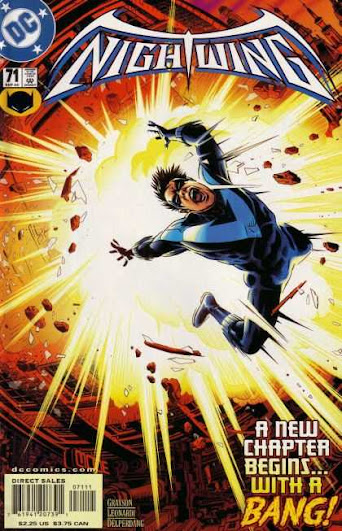
Few writers have affected me more than Devin Grayson. I was inspired by her ability to break into the offices of DC Comics with (of all things) fan fiction. Then I followed from from book to book, enjoying her adventures with Nightwing, Arsenal, the Titans, and most of all Catwoman (her Catwoman run is still one of the seminal ones, as far as I'm concerned). And I was lucky enough to "meet" her online and find her just as warm and real as the characters she was able to put onto the page.

So it's with great honor (and a bit of pride) that I share this interview with one of my favorites, Devin Grayson.

Tell us a bit about your latest work.

The two latest projects I’ve been involved in are very special to me, and happily, both are ongoing.

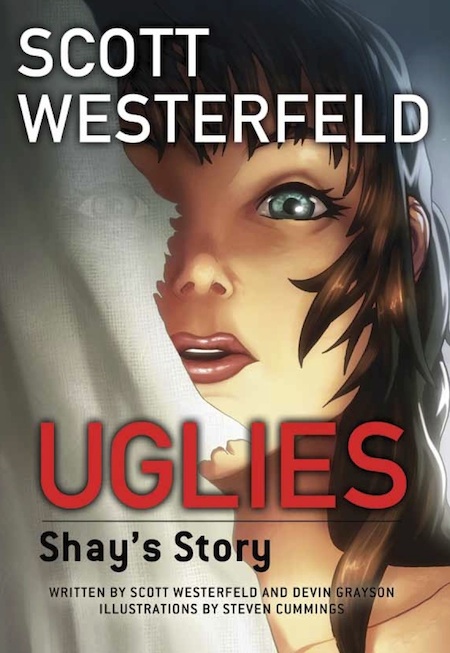
The first, UGLIES: Shay’s Story, is a manga-style graphic novel with artist Steven Cummings based on Scott Westerfeld’s NY Times best-selling YA Uglies series. For readers unfamiliar with Scott’s series, our graphic novel is a great jumping on point, but for the myriad of rabid fans already in Camp Westerfeld, it’s an exciting re-telling of the story through a secondary character’s point-of-view. The book was released last month through Del Rey and has already positioned in the top ten of the New York Times paperback graphic novel bestseller list. That’s probably old hat for Scott, but it’s pretty exciting for Steven and me! And Steven is finishing up the inking on the second graphic novel in the series, UGLIES: The Crims, right now—so more fun is coming!

The second project, Womanthology, hopefully needs no introduction. In addition to being a historically successful Kickstarter comics project, it should by now be everyone’s favorite example of creating space and experience for new artists. I couldn’t be more excited about and proud of the finished project—Womanthology: Heroic—and am already hard at work on a contribution for the all-new upcoming Womanthology: Space

Oh, and for those of you who never got to see the first four pages of the story I did with Eugenia Koumaki, check them out at Womanthology’s blogspot now!: http://womanthology.blogspot.com/


What are the themes and subjects you tend to revisit in your work?

My work is about how we define family and how our families define us. It’s not something I consciously set out to do, but I find myself constantly circling themes about the ways in which family sustains and deprives us, bolsters and traps us, how it influences our sense of identity and our range of social interactions, both for better and for worse. If you ask me about family in my day to day life, I’ll reflect on my current situation and share how fortunate and gratified I feel. But we all have two families – the one we’re born (or adopted or relinquished or welcomed) into and the one we create. And that first one…man…. I’m incredibly fortunate and love and feel very close to my parents, but in my work, family often shows up as a problematic obligation or some kind of shackle to escape. Family lights our way but in so doing, also casts one hell of a shadow.

What would be your dream project?

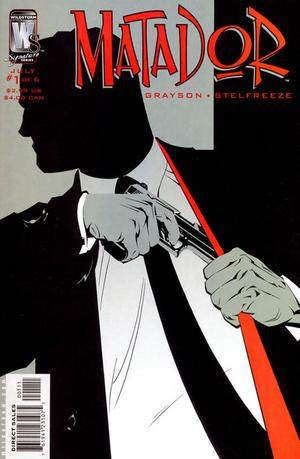
Well, in comics, I’ve already done it. I came into the industry specifically to work with Batman and his family, and I got to do that all the way to the point of being allowed to run with Nightwing and create my own ongoing Bat-series. And then I got excited about being able to do some creator-owned work, and I was able to do that with two of my favorite artists; John Bolton on USER and Brian Stelfreeze on Matador. There are still a gazillion projects in the medium that excite and inspire me, but most of my dreams in the industry have already come true.

So these days my dream project is a prose series. I have one I’ve recently developed that I’m currently showing to a few publishers and agents, but any chance to work with a tight group of characters in an ongoing prose series would rock my world.

If you have any former project to do over to make it better, which one would it be, and what would you do?

Well, I loved every minute on Nightwing up until the very end, when my ambitiously long story-arc dovetailed (or, more correctly, torpedoed) into a huge cross-over event. I’d worked through events like that before, of course, but that time my story and the event in question were on diametrically opposed trajectories. Right when I was all set to have Nightwing save Blüdhaven and completely redeem himself, the people driving the event needed to bomb the city to smithereens. If I had it to do over again, I would keep my storylines shorter and tighter. I feel bad about the way that one ended. There were a lot of plot lines I didn’t get to tie up and issues to which I did not have a chance to bring closure.

What inspires you to write?

Ooh, good question. I’m really not sure—it’s kind of a compulsion. Though it’s indescribably wonderful to have readers, I’d do it even if none of my work ever saw the light of day. I suppose in many ways it’s how I process the world. My nonfiction writing is usually aimed at either teaching or learning something (I know of no better way to learn about something than to research and write about it), but fiction writing is a kind of meditation; an exercise in turning reality into truth.

At a simpler level, I come to love the characters I write about, and as they’re fictional beings, writing is one of the best ways to spend time with them.

What writers have influenced your style and technique?

Probably, at some level, every single piece I’ve read has influenced my writing. But the first writer who inspired me to deliberately try to incorporate some of her style into my own was Anne Rice. Her love of her characters comes shining through, and her descriptive abilities are enthralling. Some of my favorite writers are Haruki Murakami, Nabokov, Milan Kundera, Rilke, A.S. Byatt, Jeffrey Eugenides, Steinbeck and Alessandro Baricco, but I don’t think my writing is anything like any of theirs. I deliberately read a lot, and a lot of very varied material, to make sure I don’t fall into another author’s cadence when I’m writing, but more often I find it works the other way; I’ll read something and feel a sense of kinship, like, “yeah! This is my kind of writing!” I’m nowhere near as strong a plotter, but Laura Joh Rowland’s Sano Ichiro novels are like that for me—not that I feel I could have written them, exactly, but more like I feel that I know how she feels when she’s writing them, and I experience that joy as well as the joy of discovering the story as I go through the books.

In comics, it’s all about who I’ve learned from, and that list is long. The people who work in comics are, by and large, incredibly generous about sharing what they’ve learned about the medium and it would take me ten pages to thank everyone who’s made themselves available to me. But the top of that list would have to include Mark Waid, Denny O’Neil, Scott Peterson, Scott McCloud, Jay Faerber, Brian K. Vaughan, Alan Moore, Chuck Dixon, Greg Rucka and Brian Stelfreeze, not to mention every editor and artist I’ve ever worked with.

Where would you rank writing on the "Is it an art or it is a science continuum?" Why?

Is there someone arguing that writing is a science? I’ve never heard that. I don’t perceive writing as a science at all. There’s a skill and crafting element to it, but I’ve yet to apply the scientific method to a story…though perhaps that’s not such a bad idea! Actually, as I think about it, I guess writing is step four, the experiment. It’s always an experiment. And good stories often start with questions…

But then, is writing an art? Only when done extraordinarily well, right? Shakespeare=art. My fan-fic? Not so much. Writing is a medium, and what we do with that medium is as diverse and unpredictable as we are.

Any other upcoming projects you would like to plug?

As usual with publishing, I can’t talk about the stuff I’m working on right now. But I hope readers are enjoying UGLIES: Shay’s Story and Womanthology: Heroic and stay tuned for UGLIES: The Crims and Womanthology: Space. Thanks!

=====================================================================

To learn more about Devin and her work, visit www.devingrayson.com.

The Writer Will Take Your Questions Now (#165) -- Writing to Length

How is plotting different when you're already given a length for 
an arc and you must either (a) fill it or (b) cut to fit it?

Sometimes I need these.
For me, I tend to write two ways, which I'll call (1) free-form and (2) to a required length.

When I write free-form, I just start with a general idea and have a rough idea of the length the story may end up. This is usually reserved for my mid-length prose short stories somewhere between 2k and 5k words. When I write this way, I don't plot at all. It all starts in my head and just bleeds out on the to word processor. That's a very liberating way to create.

But more often than not, nowadays, my writing tends to be the second option. I'm given a specific length to write. For example, most of my new pulp tales have to be either 10k or 15k words. That's not "no more than" -- that's as close to exact as I can get it, give or take a hundred words.

For comic book scripts, I'm given the number of issues and the number of pages in the comic book. Typically that's 22 pages per issue, and between 3-6 issues for a single story. And let me tell you, those are some specific page breakdowns to get a handle on. If not, you're comic writing career will stall out quickly.

And sometimes I have to use this.
So, how do I do that? I have learned the fine art of full plotting. That means I write out not just the general beats of my plots, but also bits of important dialogue and how each scene leads into the next. My plots have become, in essence, the equivalent of a movie treatment for my stories. Then I break each scene down in to the number of pages (or words) needed to get it done, and then hope the thing balances out in the end. When it doesn't, since I don't have the luxury of additional (or fewer pages), I have to rework the plots, either beefing up core scenes, making lesser scenes more important, or even harder, cutting stuff to make the story fit.

I wish it were as easy as just cutting ten percent from each scene, but I've found that kills the theme and plot and well, story, of the tales.

That's just my way of doing it. Your mileage may differ.