Tuesday, November 6, 2012

The Writer Will Take Your Questions Now (#259) -- The Writing Career

Do you see writing as a career?


Yes. I see writing as a career. However, it doesn't always agree with me on that point.

To be honest, as much as I'd love to see writing as a self-sustaining career, more often than not, it's a career interwoven with other jobs when the pickin' gets slim (particularly between royalty checks). The goal is to continue to build my network and make contacts so that I can attain that level of self-sustaining career that so many others have.

But I'm convinced that in the world of pulp and comics writing, that's becoming more the exception than the rule.

Is it my career? Heck yeah. Is it a bumpy career filled with terrifying moments? Sadly, equally so.

Monday, November 5, 2012

Monster Earth Coming Soon!


Contact: James Palmer
palmerwriter@yahoo.com
http://www.mechanoidpress.com/

FOR IMMEDIATE RELEASE

Monster Earth Coming Soon!

Atlanta, GA—James Palmer, editor and publisher of Mechanoid Press, an independent publishing imprint specializing in New Pulp, science fiction, and more, is proud to announce the upcoming release of its first anthology MONSTER EARTH.

MONSTER EARTH harkens back to the classic giant monsters of yesteryear like Godzilla, Mothra, Gamera, and King Kong, while focusing on the human element and what it would be like to live in such a world where giant monsters terrorize the Earth.

"There have been a few other giant monster anthologies over the years," says Palmer. "But our book is going to be a bit different. It has a unifying concept, as well as a solid pulp style of storytelling."

Developed by MONSTER EARTH co-editor Jim Beard (writer, Captain Action and the Riddle of the Glowing Men), each story in the book takes place in a different decade of the 20th century, which leads to a Cold War fought with giant monsters rather than the threat of nuclear weapons.

"I really wanted all the stories to have an underlying thread that weaves between them all the stories, and Jim really came up with a winner."

The stories in MONSTER EARTH have a strong human angle as well.

"Focusing in on the human beings living in this world is important to me," says Palmer. "The monsters are like forces of nature, with the humans trying to control them. But don’t worry, these aren't just regular human interest stories with a monster thrown in for window dressing. There are plenty of great monster battles and more than enough citywide destruction to please the most discerning kaiju fan – and anyone who loves a good tale.

Palmer and Beard have assembled a great line-up of New Pulp all-stars to give us their visions of a world ruled by giant monsters. MONSTER EARTH will include stories by I.A. Watson (Sherlock Holmes, Blackthorn: Dynasty of Mars), Ed Erdelac (The Merkabah Rider), Nancy Hansen, and newcomer Jeff McGinnis. Beard and Palmer will also provide stories, and there will be a free online bonus tale by Jeff McGinnis coming out shortly before the book's release.

MONSTER EARTH is slated for a Christmas release, and will be available in print and ebook formats.

For more information and updates, including a preview of the cover and table of contents when they are finalized, go to http://www.mechanoidpress.com/ and sign up for our FREE newsletter.
 #

About Mechanoid Press

Mechanoid Press is a new imprint specializing in science fiction, New Pulp, and steampunk ebooks and anthologies. For more, visit http://www.mechanoidpress.com/ or follow the robot revolution on Twitter: www.twitter.com/mechanoidpress. You can also like Mechanoid Press on Facebook.

The Writer Will Take Your Questions Now (#258) -- Negative Feedback

How do you take negative feedback from a story and have you ever agreed with negative feedback?

I cry and scream and throw a hissy fit usually.

Of course not, but sometimes I'd love to.

Any feedback is good feedback, I feel. Like so many others writers have said before, if anyone cares enough about my work to get in touch with me about it, that's a win, whether they praise it or criticize it.

Have I ever agreed with it? Occasionally, but not to the extend of the one making the criticism. For example, when I was writing Gene Simmons Dominatrix (no apostrophe, I know, not my call), several reviewers lamented the T&A factor of the book taking such a forefront. Well, I would have preferred less of that as well as a writer, freeing me to delve into character and plot, but those were the parameters I was given to write. If someone is paying you to write a sonnet, be a professional and don't try to write an epic narrative of rhyming couplets. Luckily, as the book progressed, we were able to move beyond that stereotype bad girl image of the book and really hit the stuff the writer in my wanted to focus on. But had I started it that way, well, for one thing, I wouldn't have kept the job. So it's a matter of doing your job regardless of both the positive and negative feedback.

Sunday, November 4, 2012

The Watson Report: Whose Afraid of Mary Sue?

by I.A. "Ian Sue" Watson

In 1973, Paula Smith published “A Trekkie’s Tale”, a parody of fan-written stories. In it, Mary-Sue, “the youngest lieutenant in Starfleet – only fifteen and a half”, joins the crew of the USS Enterprise, and proves to be essential to the survival of the ship, demonstrating a remarkable competence and claiming a place in the hearts of Kirk, McCoy, and even Spock. The wish-fulfilment character represents the fantasy of a series enthusiast entering and interacting with the series they love.

Since that time, “Mary-Sue” has become a byword for non-satirical author-inserted characters who seem to be fulfilling the writer’s own fantasies, often but not always in an ongoing series that did not originate with them. This character often speaks with the author’s voice, correcting what the author feels are problems with the ongoing story, addressing long term situations and earning the gratitude of regular characters, and even displacing romantic leads to win the heart of a favourite cast member.

We see the phenomena in books and comics. For example, Brian Bendis has faced “Mary-Sue” accusations for his use of Jessica Jones, retconned into Avengers history as a “dear old friend” who has now become an essential staple of the series and romances an established “cool” character.

Other authors write their own primary character as a “Mary-Sue”. This criticism is sometimes aimed at Ian Fleming, for example. James Bond, whom “men want to be and women want”, might be an idealised version of his own younger self. There are many omni-competent and always-right characters in adventure and pulp fiction of whom a similar charge might be made.

But are “Mary-Sues” always a bad thing? Dorothy L. Sayers tended to write versions of herself into her stories. Early Lord Peter Wimsey stories occasionally feature Marjorie Phelps, a young independent woman living a Bohemian life in Chelsea, who occasionally assists Lord Peter with his investigations. Sayers herself had lived a similar life. The strong-willed Oxford graduate Miss Meteyard from “Murder Must Advertise” works at an advertising agency just as Sayers herself did for a decade. Meteyard penetrates Wimsey’s cover and solves the murder before him, but says nothing because “it’s none of her business”. In “The Nine Tailors” fifteen year-old Hilary Thorpe wants to study at Oxford and become a writer. She is “striking looking rather than beautiful”, whip-smart in helping solve the case, and by the end of the novel Lord Peter is her trustee.

Of course, all these pale into insignificance against Miss Harriet Vane, a detective novelist graduated from Oxford, who lived with a poet who claimed he did not believe in marriage then left him when he offered her marriage anyway “like a good-conduct badge”. Sayers herself graduated from Oxford, lived with a poet, and broke from him for the same reasons. Of course, Sayers’ ex-lover was not found murdered in the same way as the victim of her latest book, but Mary-Sues must be allowed some wish fulfilment. Miss Vane’s former inamoratas did perish in such a way, leaving her facing death by hanging unless rescued by Lord Peter Wimsey – who falls desperately in love with her.

Miss Vane appears in four of the Wimsey books. Her debut in “Strong Poison” leaves a powerful impression, but her “screen-time” is limited because she is behind bars. Her second appearance begins with her actually discovering the body in the case. “Have His Carcase” is mostly told from her point of view. “Gaudy Night”, her third appearance, might properly be described as a Harriet Vane mystery with Lord Peter Wimsey appearances. The narrative follows her throughout, with the detective overseas on government work for two-thirds of the book. “Busman’s Honeymoon” describes the discovery of a corpse on the morning after Wimsey marries Harriet, and was described by Sayers herself as “a romance story with detective interruptions”.

From these summaries, a reader not familiar with the Wimsey corpus might conclude that the appearance of Miss Vane wrecked the series, robbing the central hero of the spotlight in favour of an idealised ego-trip character. But this is simply not true; hence my citing it in such detail as an example of Why Mary-Sues Don’t Necessarily Have To Be Bad.

In fact the Vane/Wimsey novels take on a fresh life. It’s clear that Sayers was far more engaged with them than some others she wrote merely to fulfil a publisher’s contract. Even Wimsey’s absence helps the story. We get impressions of him from other cast and his eventual appearance comes with added impact. Harriet is fleshed out in all her tormented complicatedness, and if based on Sayers must have been painful to write. “What does pain matter if it makes a good story?” Wimsey asks Vane at one point. If there’s wish-fulfilment in Harriet’s eventual happy ending with Sayers’ greatest literary creation then it’s paid for in the author’s naked analysis of herself to tell a powerful narrative.

Writers are often advised to “write what you know”. What does a writer know better than themselves? Are not many of our characters drawn from some exaggerated aspect of ourselves, or of whom we would like to be? Who would not like to believe that the best of our personal traits should win us success, love, or acclaim? Which of us does not have personal tragedies that we could mine for story material if only it did not hurt too much?

So, while “Mary-Sue” characters are typically seen as juvenile, amateur, or series-spoiling, I wonder if there is a role for such personally-invested creations in their proper context. Can and should an author project themselves so fully into a character – and what happens then?

Saturday, November 3, 2012

Pro Se's Monsters Are All Aces In My Book!

Pro Se Productions, a cutting edge Publisher of Heroic Fiction and New Pulp, introduces a concept that plunges a Team of Adventurers headlong into cataclysmic conflict with classic horror creatures!  They don’t just hunt Monsters… They Destroy Them! They are the MONSTER ACES!

Having selflessly abandoned their identities, their pasts and their futures, the Monster Aces are all that stand between humanity and the fell creatures that lurk in the shadows. Four men and one woman use their amazing abilities as a team to scour the globe for monsters and bring an end to their unholy existence - whatever the danger, whatever the cost. Through five thrilling tales crafted by some of Heroic Fiction’s most engaging authors you will ride alongside the Aces on the trail of monsters both classic and new. No environment is too severe nor too remote for these adventurers to seek their prey and destroy them forever. The team, lead by a mysterious military veteran, uncover evil in mysterious European villages, in dark forests and fetid swamps, in ancient rivers and on the high seas…monsters are everywhere, but so too are the Monster Aces. Concept creator Jim Beard is joined by writers Ron Fortier, Barry Reese, and Van Plexico for a new twist on the classic monster stories of yore, a unique melding of horror and driving pulp action that will thrill and chill you.

Featuring appropriately creepy and stunning cover art by Terry Pavlet and the always exemplary design and logo work of Sean Ali, MONSTER ACES is equal parts action, horror, and mayhem as Man versus Monster in five titanic tales of terror!

MONSTER ACES is available at Pro Se's Createspace store here.

Get your copy of MONSTER ACES at Amazon here.

Ebook coming SOON!

Friday, November 2, 2012

[Link] Return to the Masculine: The Reemergence of Men's Pulp Fiction in the Age of eBooks

by Keith Rawson

Needless to say, it’s been a long road in trying to figure out what exactly will make a man pick up a book. For the better part of a century, publishing has been scratching their collective heads wondering what the Average Joe likes to read. Was it action and adventure? Was it hard men and women in peril? Was it cowboys and Indians? Was it sports? Was it a weird combo of them all? And during that time, more than a few memorable series characters were created to attract men to reading: Doc Savage, Mike Shayne, Shell Scott, Remo Williams (The Destroyer), Mack Bolan (The Executioner, and its spin-off series, Phoenix Force), Richard Camelion (The Death Merchant), and Nick Carter (Killmaster), just to name a few. But by the mid-nineties (when sales statistics were being gathered and ruthlessly acted upon) the men’s action adventure novel more or less faded from existence.

Now we fast-forward to the here and now, and yes, sales statistics are still being ruthlessly acted upon and the big six still aren’t touching men’s adventure stories with a ten foot poll. But with it being the here and now, who the fuck needs the big six when you can do it yourself, or go through a publisher who has zero problem with taking risks in the age of eBooks?

Introducing Pulp 2.0:

Yes, almost all of the characters I mentioned above were created, for the most part, to attract male readers. But let’s face facts; the books of pulp 2.0 aren’t exclusively geared towards men anymore. (And also, did these books really need to be?) They use the same tropes of series characters/shared universes, the same balls to the wall action, the same tightly written plots, same slim length (most Pulp 2.0 novels are in the 175-to-200-page range) and are meant to be read in one or two sittings, which, as far as I’m concerned, is the perfect length for eReaders. The biggest difference you’ll notice between the new pulp and men’s adventure of old is that none of the new creators even remotely adhere to a single genre.  

Continue reading: http://litreactor.com/columns/return-to-masculine-the-reemergence-of-mens-pulp-fiction-in-the-age-of-e-books-0

The Writer Will Take Your Questions Now (#257) -- Celebrity Encounters

Have you dealt with any celebrities within your career thus
 far, and how are they compared to "regular" people?

Sam.
Several, and for the most part, they're just regular people. A few horror stories, but I won't get into those.

Some of my favorites have included:

1. Meeting Gene Simmons at SDCC when I was writing the Gene Simmons Dominatrix comic. What I learned about Gene is that he supremely values his fans and is willing to piss off anyone who tries to get between them and him. And he's fiercely loyal to a business agreement, even to the point of refusing to sign autographs in the celebrity section and instead signing only at the IDW booth to help support the book.

2. Moderating for Larry Hama. Larry is one of the nicest, more cordial guys I've ever met, and seems to downplay everything that makes him famous, prefering to be just another fanboy of the stuff he loves.

3. Peter David. I first met Peter when he signed some copies of Young Justice for me before I ever wrote my first comic. I had done an interview with him for the now defunct DCU: Next Generation website, and when I mentioned my name, he remembered me. And has since, even greeting me by name when we bump into each other at cons. That says a lot to me.

Ami and Daniel.
4. John Dugan, from Texas Chainsaw Massacre. He's John Dugan, from the John Dugan Show, filmed in a very Duganesque manner, and after a few drinks with him, that's all you need to know. Or remember. Apparently.

5. Robin Shelby, Slimer from Ghostbusters. The very definition of perky. Very warm and friendly, and I look forward to meeting her at many more cons.

6. And saving the best two for last, the lovely Samantha Newark, Jem from well, Jem. Sam's one of the finest people you're ever meet, and is sweet and sassy and a beauty to behold inside and out. And I love how she and her mom really took to Charis and took her under their wings at conventions.

7. Daniel Emery Taylor, Darryl from Return of Swamp Thing, of whom I can only say, I'm so glad he's become such a wonderful friend along with his wife, Ami.

Thursday, November 1, 2012

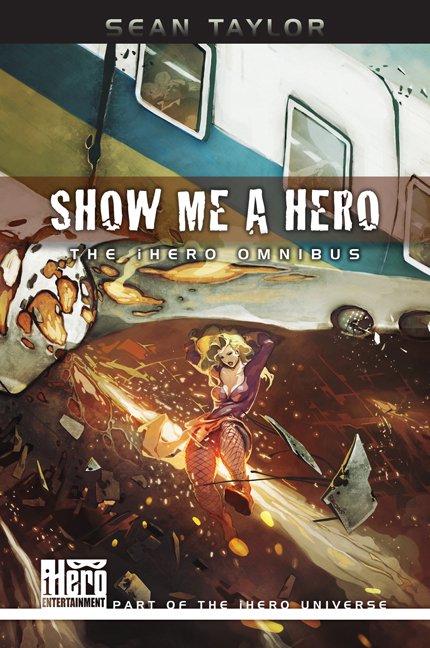
Get a taste of SHOW ME A HERO!


Just as he’d requested in the Mid Town Reporter, the flowers were all made of papier-mâché. They were orange. And green. No other colors. The pall bearers wore suits of black, against which the brightly colored paper looked like a gift from a well-meaning, but naïve child, the kind of gift that a parent couldn’t dream of turning down, but clenched still at the thought of accepting.
   And in a way, they were. Just as surely as Graham Dixon lay in that shiny orange casket, these people, these mourners, they had fathered him and birthed him and given him life. Then they killed him.
   They deserved to wear the stupid fake flowers.
-- From "Foolish Notions"
 

The Senator’s death was a textbook shooting. Muldaine had taken one slug in the temple and died instantly. His body slumped in the leather desk chair, and his head lay back, eyes still open, staring in vain at the office’s high ceiling.
   The intern wasn’t so lucky. His body lay in the doorway, arms and legs spread out like a stomped spider. He had taken eight rounds, three in his chest, one in his right kneecap, two in his face, and the remaining two in his right arm. The bullets that had disfigured his face had done most of the damage. One had taken his left eye and left a bleeding, empty socket in its place. The other had shattered his jaw, exposing the muscle and bone of his cheek. The three chest shots were clean—though none of them had pierced his heart. The shot to the knee had made walking away impossible. With any luck, he had passed out before he died. But judging by the pained grimace on his face, that hadn’t been the case.
   And there was the matter of the word “Atlanta” he had scrawled in his own blood on the hardwood floor.
-- From "Lucky Strikes"


In the movies, bars always have cool names and are filled with happy people chatting up supermodels. Sure there is usually one moping character amid the clamor of noise and festiveness. But Palmer’s wasn’t like that at all. The place was quiet as an unwritten symphony and the crowd—though there couldn’t be more than a dozen people inside, none of whom were remotely close to supermodel status—sipped from their glasses in silence, each too burdened with his or her own business to spare a thought for anyone else’s. The place didn’t even smell like smoke.
-- From "Fear and Frenzy"

The man who killed me wore a tattoo of Santa Claus across his chest. The old elf in the red suit sat in his sleigh, moist with the man’s sweat in spite of the night’s chill, and his reindeer jerked with every shudder my murderer made as the icy breeze kissed his bare skin.
-- From "Sin and Error Pining"

She had never been the type of person to see the world in black and white. There had always been just too damn much, well, gray wherever she looked. In spite of all her private Protestant schoolteachers had done to instill Southern fundamentalist categories of good and evil in her, she just didn’t buy it. It was a load of crap, as far as she was concerned.
   Still, even with all that, even when her mind told her it was just a compartment people had invented for storing ideals they disagreed with, she somehow knew that the man standing over her was plain, through and through evil.
-- From "Farewell" 


Larry Moore stood mixed in the crowd, the wet shoulders of his raincoat bumping against those of the other onlookers as they pushed toward the front of the police line. He smelled the gladiatorial bloodlust as the curious smashed together to witness the city’s demolition crew reduce 2341 Old Smith Street to a few hundred square feet of rubble. Even through the hazy drizzle he could smell it. Like a mixture of soured upholstery and human sweat.
   People always turn out for destruction, he thought with a smirk.
-- From "The Framework Soul"
 

Tony Tanaka fancied himself a gangster in the Hollywood tradition. Born Tanaka Yasuo and so named by his parents, he had long since dropped the Japanese custom of using his family name first and his given name at all in favor of the nickname “Anthony” or usually just “Tony” in order to appear less like just another member of the Yakuza. More prone to grandiose gestures than real bouts of forethought and planning, and more apt to make stupid mistakes that tended to get his movie mentors caught or killed than to keep a low profile and work behind the scenes, he should have been a pushover. An easy kill.
   The only thing was, well, he had played us all for fools. Just like the cliché.
-- From "The Subtraction Agenda"

Something heavy and hard slammed into my back. I tried to twist and roll with the impact but its force kept me careening forward, falling out of the sky, until the cement walkway of Bishop Port Park stopped us both a few feet in front of the statue of Alexander D. Bishop.
   I pushed myself up from the hole I had made and pushed the hair out of my face. I gazed up at the monument of Alex Bishop, I guess to apologize for wrecking his park, and I smiled faintly and shook my head. I stood up and turned around, finally able to see what had taken me out so easily. 
   The top two floors of the Simmons building.
-- From "A Gathering of Angels"

The woman across the table from me wasn’t really a woman at all. She had no real skin to speak of or any kind of humanity other than the feminine shape she had forced her new body of light and energy to look like. Her arms and legs may have been covered up with regular clothes like the rest of us wore, but the way I could see through the parts of her shiny, twinkling form that weren’t covered by clothing reminded me all over again how she was no longer human.
-- From "It's Christmas, Baby, Please Come Home"

I blame it all on Franz Suppé.
   Without his genius, Joanna and I could have lived a world of bickering happiness, filled with soccer games and dance recitals, a life of too many family events and not enough hours to accomplish them. Without his damn overture, we might never have discovered that we were more than normal, less than free.
-- From "Elements and Angels"

Mom,” he said, pointing up at the top of St. Anne’s Cathedral. “It moved.”
   “What moved, honey?”
   He hated it when she called him sweet names like “honey” or “baby.” She never seemed to call him just son or John anymore, not since the accident. And his baby brother, Edward, never got baby names. “The angel moved,” he said, his voice cracking as he fought the spots the sun was putting in his eyes. “The angel on the church.”
-- From "Angels of Our Better Nature"


To order SHOW ME A HERO, click here.

Can White Men Jump? Writing Other Races and Genders Than Your Own.

What is your best advice for writers looking to write characters of other genders, races, economic statuses, etc.? How do you make sure you best portray someone "not you" as accurately as possible when you write him or her?

H. David Blalock: There's only one real way to properly do it. Find someone of the gender, race, belief, or whatever and talk to them. No amount of research online or in books or on TV can compare to the face to face reality of dealing with someone. Answers to those things are personal, not objective. Description cannot equal experience.

William Preston:
Recognize your limitations. Though no character is exactly you, how far outside yourself does your experience extend? (Flannery O'Connor, for example, knew full well that she couldn't write from within black Southern experience; she could, however, portray black characters richly and vividly from the outside, often by viewing them through the bafflement of her white characters.)

Rely on observation, inquiry, and personal interactions. If all or much of what you know of this "other" comes from books, films, and TV that rely on stereotypical characterization and obvious racial and gender "cues" that make white males feel that their prejudices and stereotypes are perfectly acceptable, you need to extend your reading, viewing, and experience (and discard whatever has constrained your comprehension).

Not every characterization requires the foregrounding of, say, race and gender issues, but certain circumstances within a story may force those elements of a person to become primary factors either throughout or at a given moment (and the same may be true of age, sexuality, social class, or any other socially defined component of a person's background and self-definition). Regardless of whether a particular personal element is foregrounded or critical to the story, all such elements contribute to a character's perceptions of the world, thus shaping what they see and how they understand what they see. Every character functions with a set of eyes which are not yours though, again, to accentuate any one of these elements because you are aware of a box you're checking off may do a disservice to the humanity of that character rather than fairly represent him or her.


John Morgan Neal: I try and use my experience with other types of people and my observations. But most importantly of all I use my instincts. Because despite whatever racial, sexual, gender, national or regional differences, we are all human.

Raidou Kazunoha: It really depends on the culture at hand. Some are are more cut and dry than others. I think its very important not to step in the wrong places, when you are writing. There are things you can understand and know, through reading or talking to friends. There are also many things you will never know, and never be able to properly empathize with no matter how hard you try.

I also feel that if you are writing characters of other ethnicity, you should really not describe them as 'so in so race' every time you mention them. To often i will read stories, and they will be described simply as their race, nothing more. Yet the other characters get these glowing descriptions on their hair, and weight and eye colour and all that. That can get really annoying. If you are properly doing your job it will be obvious what your characters' races are.

B. Chris Bell: I think respect is the key. If you know enough about the culture to be able to imagine what it's like to walk in their shoes, know some history, and don't get too hung up on trying to be trendy or follow a stereotype, then it's no problem. The problem of course being the same one the writer has all the time: Is it believable? I lucked out when I picked Crankshaft to be THE BAGMAN'S partner, because the whole point was that he isn't stereotypical. He's based on a number of curmudgeons I've met in my life, some white, some black, and one an old Jewish man. Hell, he's smarter than the hero most of the time!

Linda Drue Hays-Gibbs:
Empathy! The ability to put yourself in someone elses's shoes. Walk a mile in my shoes, research, concern for fellow human beings to feel for them and their circumstances.

Joe Bonadonna: I sort of base the characters on people I know. I also just sit and talk with friends of the opposite sex, of other colors and creeds, and get some insight. Then I try to write as honestly as I can. As far as other races . . . I always say, there's only one race -- the human race, and we all bleed red. That's our common denominator. Human emotions are universal. It's what believe and how we think that divides us. Those are the things I try to get a handle on, to lift me out of writing from the POV of a white man. Don't know if or how well I've succeeded, but the key is: write with honesty.

Marcus Blakeston: I'm writing as a woman at the moment, I just write her as a man with tits. She's a bare knuckle fighter, and it's aimed at men, so I figure I'll probably get away with it.


Mike Pascale: Great question. The easy answer: RESEARCH! No excuse with the 'Net. Go to areas where that group live. Talk to the people you want to represent. Read other fiction by those who either are part of that group or who are known for doing it well; note how they do it before adding your own voice. All that said, though, never forget that people are PEOPLE. Human nature is identical regardless if one lives in Bangladesh, Burma, Boston or Birmingham. Characters are characters. Write the personality first and the specifics later.
 
K Anthony Pagano:
I tend to journal from the POV of the character if I'm having a hard time with the character at that particular moment. It helps me get some perspective on an opinion. Otherwise I stay away from "ethnic" because it's a trap. For the most part people don't define themselves by their skin... or accent... or what have you. They think about it, and defend it, but it's not the only lens. Besides, the best journeys are the ones that bring the character home.

Hannibal Tabu: Research. Even when I deal with other countries I've never visited, I sit down with people, I ask them about their upbringings, the things they like, and look for both contrasts and comparisons in my own experiences. Little details make big impacts. I try to be comprehensive where I know nothing.

Luckily, I've been blessed to meet lots of types of people from lots of ethnicities. Arrogant Indian programmers. Sci fi fans from Kenya. Two very funny Ukranians. Et cetera, and so on. I draw on my time with them, the details I gleaned, the idiosyncracies, and try to see how they would react to the plot's situation.

Ron Fortier:
there is really only one answer to this question;  a writer uses his or her imagination to believe they are that character.  All good writers are ultimately the penultimate actors.  I've written stories, both comic and prose, in first person narrative as a woman.  I didn't find it particularly difficult.  I've never personally tackled being of another ethnicity but again, I would trust my talents of observation and imagination to do it should I make the attempt.   How well I succeeded or fail would be up to the writer to decide.

But research, etc. isn't the key here, we can never truly be someone else in reality... but in our imagination there are no such bounds.

The Writer Will Take Your Questions Now (#256) -- Recommended Reading for Writers

What books do you recommend for writers and artists? 
-- republished from Cyber Age Adventures (iHero Entertainment)

Remember the old RIF commercials? The ones where people would hand out books and tell kids that "reading is fundamental"? Well, don't feel bad. They weren't nearly as catchy as selling Pepsi with shots of the bare midriffs of pop mini-divas. Still, that tag line got stuck in my head and stayed with me: Reading IS fundamental -- especially to writers.

Writers read. There's no way around it. And good writers read a lot. They're the kind of readers who can't eat cereal without reading the back of the box, even when it's full of boring health facts and that pyramid food chart. They're the kind of readers who skim even medical journals or GOOD HOUSEKEEPING (though we prefer HIGHLIGHTS if it's available!) while they're waiting in the doctor's office.

But if you want to bone up on your fiction-writing skills, that Captain Crunch or GOOD HOUSEKEEPING may not be the best use of your reading time. Why not check out a few books on the craft or writing?

The A-List

Four particular volumes no serious writer should be without are:

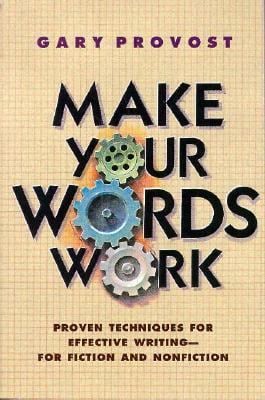
    MAKE YOUR WORDS WORK, by Gary Provost, Writer's Digest Books
    THE KEY: HOW TO WRITE DAMN GOOD FICTION USING THE POWER OF MYTH, by James N. Frey, St. Martin's Press
    THE TRIGGERING TOWN, by Richard Hugo, W. W. Norton & Company (ignore that it's a book about poetry; just read it and see how you learn to listen to your word choices)
    BULLIES, BASTARDS & BITCHES - HOW TO WRITE THE BAD GUYS OF FICTION,  Jessica Page Morrell, Writers Digest Books

Hands down, these are the four most helpful books about writing that I've ever read. Period. And I'm not making a cent off that endorsement.

More Great Writers Guides

Some other great resources I've checked out and recommend include:

    WHAT IF? WRITING EXERCISES FOR FICTION WRITERS, by Anne Bernays and Pamela Painter, HarperPerennial
     THE SCRIBBLER'S GUIDE TO THE LAND OF MYTH: MYTHIC MOTIFS FOR STORYTELLERS, by Sarah Beach
    WRITING FICTION: A GUIDE TO NARRATIVE CRAFT, by Janet Burroway, Harper Collins
    BUILDING FICTION: HOW TO DEVELOP PLOT AND STRUCTURE, by Jesse Lee Kercheval, Story Press
    SELF-EDITING FOR FICTION WRITERS, by Renni Browne, and Dave King, HarperPerennial
    DIALOGUE, by Lewis Turco, Writer's Digest Books
    THE ART AND FORM OF THE SHORT STORY, by Rick DeMarinis, Story Press
    WORD PAINTING, by Rebecca McClanahan, Writer's Digest Books
    WRITING DIALOGUE, by Tom Chiarella, Story Press
    CREATING CHARACTER EMOTIONS, by Ann Hood, Story Press
    THE AGONY AND THE EGO, edited Clare Boylan, Penquin Books
    ON WRITING, by Stephen King, Scribner

Writing in Tights

Some other helpful books for understand the fundamentals of writing comics and/or superheroes (not that the two are the same thing, mind you):

    UNDERSTANDING COMICS, by Scott McCloud, HarperPerennial
    REINVENTING COMICS, by Scott McCloud, HarperPerennial
    COMICS AND SEQUENTIAL ART, by Will Eisner, Poorhouse Press
    GRAPHIC STORYTELLING, by Will Eisner, Poorhouse Press
    HOW TO DRAW COMICS THE MARVEL WAY, Stan Lee and John Buscema, Touchstone
    WRITING COMICS AND GRAPHIC NOVELS WITH PETER DAVID, Peter David, Impact

So, next time you have to hit up the local medical practitioner for an expensive prescription request, don't waste your time on those picked-over copies of PEOPLE from 1986. Take a good book on the craft of writing. After all, with that family of five in line before you, you'll make it through at least three chapters easily.

Wednesday, October 31, 2012

[Link] So Why Pulp: Pulp’s New Frontiers


Yep folks, pulp is here to stay. But that said, it doesn’t mean pulp can’t expand its horizons, grow up, stretch and move forward a bit. In fact it has to, because if we keep doing the same stories the same old timeworn way, we’re only going to serve the nostalgia market, which through attrition, is going to contract a little more every year. If you ask me, it’s time to pack up the old trusty knapsack, put on the hiking boots, and go out and blaze some new trails. In that grand old pulpy tradition, let’s see how far off the undiscovered territory lies, and what kind of secrets those haze covered hills and mist shrouded valleys hold. Along the way, we might even learn something about ourselves.

I believe it’s vitally important that we pulp purveyors not only understand what we’re writing but why we’re doing it, and balance those lofty ideals of what we expect to get out of this with a big dollop of reality. Being clear with yourself is only going to make it easier to get down to work. It’s no big secret that our little corner of publishing exists deep in the murky bottom of the literary world, where only the occasional ray of sunlight from above penetrates to illuminate a particular flashing body, before the roiling waters close in overhead and we’re back to business as usual.

Continue reading: http://www.newpulpfiction.com/2012/10/so-why-pulp-pulps-new-frontiers.html

Happy Halloween!

No Question of the Day today. Go out and enjoy yourselves, Ghouls and Boils.


Tuesday, October 30, 2012

The Gloves Are... On!

GOLDEN GATE GLOVES
(FIGHT CARD)

San Francisco 1951.

Conall O’Quinn grew up at St. Vincent’s Asylum For Boys, a Chicago orphanage where he learned the sweet science of boxing from Father Tim, the battling priest. After a stint in the Army, Conall finds work on the docks of San Francisco – a place where his fists make him the dock champion. Soon, however, he gets on the bad side of a union boss and is set up for a dock side brawl designed to knockout his fighting career. When Conall comes out on top, things go from bad to worse when he is framed for the docks going up in flames.

Along with Benson, his best friend and trainer, Conall heads for the hills in search of a lost treasure in the vicinity of a mine controlled by the union boss. However, where Conall goes trouble follows and he is quickly embroiled in a heated grudge match between fist-happy miners and lumberjacks.

Championing the miners in an all out slugfest, Conall is about to find out there is more to fighting than just swinging fists… giant, hammer-fisted lumberjacks, the mine owner’s beautiful daughter, union flunkies, and mob thugs all want a piece of him… and when the opening bell rings, the entire world appears to be against him…

You can learn more about The Fight Card series at www.fightcardbooks.com.
Listen to Earth Station One’s interview with Paul Bishop here.

The Writer Will Take Your Questions Now (#255) -- White Men Can't Jump?

Can a white author write black characters?
(Even Michael Chabon gets this question)  

I sure hope so, or some of my upcoming stories are really gonna suck.

Actually, I've covered this topic before, and my opinions haven't changed.

As a writer, if I'm going to succeed, I want to -- no, NEED to -- be able to write from the POV of white folks, black folks, hispanic folks, women, men, old people, children, retirees, divorcees, gays, straights, pencil pushers, drug dealers, construction workers, strippers, dogs, lions, and even polka-dotted Sprigtzleglitzs from the planet Murdock VI if the case arises. Period.

Monday, October 29, 2012

[Link] Kickin' The Willy Bobo With: LUCAS GARRETT (part two)

Derrick Ferguson: Do you ever feel uncomfortable with the rampant racism, sexism and stereotypes in Classic Pulp? Do you ever get questioned by your friends and acquaintances on your choice of reading material?

Lucas Garrett: To be honest, I would rather read fiction of that period because it was so honest in their sentiments about race, sex, and class. There was no “political correctness,” and there was nowhere to run and hide. Granted, I don’t care for the blatant racism in books such as Tarzan, Tom Swift, Hugo Drummond, and Fu Manchu. Moreover, the Spicy Pulps of that period were generally horrible towards women. However, the stories were part of that time period. Right or wrong. And those times were very harsh. That’s why characters such as Dillon, Fortune McCall, Mongrel, Diamondback, Damballa, Changa, and Imaro are very important for New Pulp. I feel that one of the greatest literary tragedies of the 1890’s, all the way into the 1940’s, is that black communities throughout the United States did not have their own dime novel and pulp writers to give opposing viewpoints to what was being published at that time. Try to search “black pulp writers” or “African-American pulp writers” in Google and see what you get. Nothing. Nothing at all. And that is a shame.

And the best time for it to have happened would have been the Harlem Renaissance of the 1920’s. That’s why having writers such as Charles Saunders, Milton Davis, and you, Derrick, is very important. We are playing catch up for over a century of racial bigotry and prejudice. Better late, than never. As far as anyone knowing about my interest for pulp literature, they equate it with early adventure/action fiction. It’s nice, but it’s not interesting enough to due proper research. If my father were alive, he would understand the history of pulp literature. Moreover, I think he would realize that I was adding my perspective to that genre, and “redeeming” it to some extent. If that’s possible.

DF: Do you feel New Pulp is addressing and correcting the racism, sexism and stereotypes of Classic Pulp?

LG: Yes. I do. In my opinion, New Pulp represents a multicultural melting pot of characters, and civilizations, that approach perils and situations on a realistic and non-biased perspective. Furthermore, New Pulp use issues such as racism, sexism, and other bigotries and prejudices to reveal layered reasons behind them better than Classic Pulp did during the 1920’s. 1930’s, and 1940’s.

Continue reading: http://dlferguson-bloodandink.blogspot.com/2012/10/kickin-willy-bobo-with-lucas-garrett_24.html?spref=fb

The Writer Will Take Your Questions Now (#254) -- Ch-Ch-Ch-Ch-Changes

Why do you feel as if a GOOD story HAS to involve the character changing?

I think the issue comes into play when people assume the change must be a major one or a changing of personality. Many times, the change is simply that of having gone through the experience and it shaping some growth or pain or refusal to grow in the character. It doesn't mean he or she becomes a different person in a core character sense.

A case in point, my story for The Ruby Files (follow the store link at the top to purchase your copy) has Rick's case affect the way he sees his relationships with the three key women in his life.


Does it change his behavior with them? 

No. 

But it does give him the opportunity to do so. 

In that sense, he changes a bit, if simply because he faced an opportunity to be a slightly different person, and refused to let it change him, instead burying himself in the old life to lament that (although he doesn't see it that way) lack of courage.

That's one of my big issues with series books. You can't have the characters make significant changes because readers expect the characters to remain essentially the same. However, in a series book, the peripheral characters CAN and usually ARE the ones who have the most change.


A caveat: Change added (like a seasoning) simply for the sake of having a change isn't what we're talking about here. That is pointless and unfair to readers. The change should be somewhere at the heart of the story. Changing the "change" should in essence change the story, just like changing the plot or character's personality would. Or so I believe. 

As always, your mileage may vary. 

Sunday, October 28, 2012

Preach It, Sister Flannery!

"The writer can choose what he writes about, but he cannot choose what he is able to make live." 
~ Flannery O'Connor


Part of my "Sean shelf"
A Facebook friend sent this as a comment on a recent discussion (http://seanhtaylor.blogspot.com/2012/10/the-writer-will-take-your-questions-now_16.html) and I have to admit that the truth of this quote really hit me. It's completely beside the point that I'm a huge fan of Flannery O'Connor however. No, really, it has no bearing on it. (Okay, methinks I doth protest too much.)

Anyway, it hit me again as a strong reminder that as writers, we have no control over what actually sticks with readers and what falls by the wayside. Will it be our Holy the Firm or our Pilgrim at Tinker Creek, our As I Lay Dying or our "Rose for Emily"? Will it be the work that makes us look like the best of all saints or the one that makes us look like the worst of all possible sinners?


We simply can't make that decision for our readers. They make it for us. 


As I look back on my own work,is there anything I'm not proud of in the sense that I regret what it says about me? No. Not even the Dominatrix book for Gene Simmons. I'd do it all over again. That book speaks truth. It does. It tells of the emptiness of a person who is driven like the preacher of Ecclesiastes to pursue a path that ultimately ends in vanity and nothing. It doesn't hold back, but it speaks truth.

My pulp work? Nope. Nothing there either. Those tales are filled with sacrificial action and folks risking their lives for others, trying to do the better thing, even when such a course of action is unclear.


So regardless of what sticks, if any of my work even does, I stand ready.


As such, it's important to me that I write what I believe I'm called to write. That I follow the dictates of Scripture to the best of my understanding and the teaching of the spirit of God. That I listen to the still small voice prompting me toward this and away from that. That I remain a true example of being not just who I am in Christ, but who I am period, not putting on airs or writing for a pre-fab submarket so I can be a best-seller by preaching to the choir and not ruffling pharisaic feathers, neither hiding my light under a bushel nor trying to sneak in "spiritual stuff" to fool "the lost" into reading it and suddenly saying the magic prayer.


In short, I have keep walking that straight, narrow line that gets hard to see sometimes and be a fallen man saved by grace through faith telling stories that I hope come from the kind of heart that says something that causes people to pick up some truth to ponder as they read. And if they can get even a little bit of truth from me and my stories, then hopefully, they'll keep reading and find out that old saying about the truth is actually, well, true... the Truth will set you free.

Saturday, October 27, 2012

[Link] Ideas- Blessings... or Locusts?

One of the things I often struggle with as I wander through the myriad alleys and highrises of my rampant (and that is being kind) imagination is the plethora of ideas that I encounter, meet, stumble over, run from, and even sometimes cower in abject fear of.  It has been said by some in the past and indeed the very name of this blog and the All Pulp column of yore that inspired it supports the fact that I very well may be some sort of joke the Cosmos has played on....someone....and might be a veritable two legged idea factory.

This thought both inspires and frightens me.  All at the same time.

Do not get me wrong.  Having these explosions of inspiration in my head that demand to be released in some form to get the life giving attention that ideas and thoughts must have to grow and breathe and develop is truly a hoot.   I have come up with entire novel ideas based on how I see someone hold a fork or the misuse of the word 'affect' as opposed to 'effect'.  I'm not kidding, really I have.  Bits and pieces of useless information pour into my head in disjointed tirades and rambles and blossom and bloom out as somewhat realized storylines and 'What if the guy did this' scenarios.    It is truly wonderful, especially as a creator, to never be bereft of things to dream about and work on.

But then there's the other side.

Continue reading: http://ideaslikebullets.blogspot.com/?spref=fb

Friday, October 26, 2012

Sword and Mythos Guidelines


Sword and Mythos is an anthology paying professional rates (5 cents per word) looking for short fiction of up to 5,000 words which combines the pulp genres of Cthulhu Mythos and sword and sorcery.

What we want

Sword and Mythos. This includes any element of the Cthulhu Mythos (creatures such as shoggoths, characters like the King in Yellow, locations like Leng) combined with sword and sorcery (heroic fantasy). Stories can be told from the viewpoint of sorcerers or other non-traditional heroic characters, although fighters with brawn and brains will also be accepted.

We are looking for a variety of settings and characters (Yes, we are GLBT-friendly). Although much sword and sorcery has utilized a proto-European setting, we’d like to see stories that take place in settings inspired by Middle Eastern, African, Asian, Prehispanic, and other cultures. We will accept secondary world stories and stories set in historical settings with magical elements. For example, Robert E. Howard set his Mythos-inspired “Worms of the Earth” in real-life Great Britain.

We might also consider some sword and planet stories. But no copyrighted characters, please. We can’t afford the lawsuits.

There are many famous sword and sorcery male characters, but we’d also like to see women hacking tentacles. Or summoning Mythos creatures.

Overall, we want to be surprised and inspired to read beyond the first page.

Scenarios which might be fun:

  • A Mayan warrior faces Cthulhu’s own daughter, Cthylla.
  • A crafty thief steals more than she bargained for when she takes a statuette from a Tamil temple.
  • A Kurdish mercenary is hired to rescue the son of a rich merchant from the clutches of a sorcerer in medieval Cairo.
  • An acolyte of Dagon grows tired of his job and seeks new thrills.
  • The sacrificial virgin procured for a certain ceremony proves to be adept at survival.
  • A Maori warrior in the South Pacific fights thawed-out shoggoths from sunken R’lyeh.
  • A Wampanoag builds a stone circle to unspeakable entities, in order to beat back European settlers.
  • A Malian warrior teams up with a shaman in Timbuktu to fight a Black Pharoah from Egypt.
  • In the late Parthian Empire, a pahlavan warrior and a Zoroastrian priestess investigate an alchemist who is raising the dead.
  • Pearl divers hire samurai to fight an undersea race of carnivorous creatures.

Payment

Sword and Mythos pays 5 cents per word. We are asking for First English Anthology Rights. Because we are a very small press, we don’t pay royalties. We do, however, offer to buy the stories on a non-exclusive basis.

Each contributor will receive two physical copies of the anthology and an e-book copy. More copies can be purchased at a discounted rate.

Story length is up to 5,000 words.

Submitting

  • E-mail us at innsmouthfp AT gmail.com. Subject line: Sword, [Title of your Story, Author's Name].
  • Do not send more than one short story.
  • Include a cover letter with the story word count, salient writing credits and any reprint information (if applicable). Yes, we do read cover letters, so include the information.
  • Attach story as an RTF or Word document. Use standard manuscript format. Italics as italics, bold as bold. No fancy fonts.
  • Stories can be sent in English, French, or Spanish.
  • Submissions are accepted from January 15 to February 15, 2013. Do not send anything before or after that date. If you do, we will ignore it.
  • Final story selection will take place in the spring of 2013. Check back for updates.

Additional Information

If you want to learn more about sword and sorcery, you can read the Jirel of Joiry stories, some of Clark Ashton Smith’s short fiction, Charles Saunders’ Imaro and Dossouye compilations, some of the Elric books, Leigh Brackett’s Mars stories, Fritz Leiber’s Fafhrd and Mouser stories, Tanith Lee’s White Witch series, Jennifer Roberson’s Tiger and Del series, Joanna Russ’ Alyx stories, the anthologies Heroic Visions, Sword and Sorceress, Amazons!, Liavek, and Thieves’ World, as well as the magazine, Black Gate. You can also check out Robert E. Howard and Lovecraft’s multitude of stories, in addition to Harold Lamb and Edgar Rice Burroughs.

Keep in mind that pulp sensibilities do not mean pulp stereotypes. We want new takes on the genre, not pastiches or unquestioning homages. Hoary tropes like one-dimensionally exotic savages and rape&revenge will be a hard sell. And we like the original smart and ferocious version of Conan a whole lot better than the later dumb and musclebound comics version.

For more information, visit: http://www.innsmouthfreepress.com/blog/?p=19148

The Writer Will Take Your Questions Now (#253) -- Epilogues

Are epilogues that tie up all your loose ends a bit of a cop out? I'm working on something now, it's basically about a young woman who beats people up for fun and profit but I've got a sub-plot with her mum and dad having a domestic that will need some sort of resolution.

I'd avoid it, personally, and find some way to hint at the subplot's outcome within the main story. Then again, it's all on the strength of the storytelling. If you can do an info epilogue and keep it compelling, readers won't mind, even if fancy writers peg you for it. If it becomes an info-dump though, then it's gonna turn off readers.