BARRY BASKERVILLE SOLVES A CASE
Airship 27 Productions is thrilled to present its first ever title aimed at the children’s book market. “Barry Baskerville Solves a Case,” is by writer Richard Kellogg and is wonderfully illustrated by artist Gary Kato who provides 16 full color illustrations.
The story is about a young boy who wants to just like his hero, the famous detective, Sherlock Holmes. Airship 27 Productions Managing Editor, Ron Fortier, was only too happy to discuss this project. “Part of our publishing goal has always been to bring younger readers to the exciting world of pulp fiction,” he explains. “But for the most part our material was geared to young adults and older. There was an obvious gap missing with children between the ages of 7 and 10.”
The submission of “Barry Baskerville” by Kellogg was exactly what Fortier and his art Director, Rob Davis, had been looking for all along.
“Richard Kellogg is a gifted writer,” Davis applauds, “with a professional background in academics. Once we had his story, we knew Gary Kato was the artist to bring it to visual life for us. And he did an amazing job.”
RICHARD L. KELLOGG - lives in upstate New York and is a Professor Emeritus of Psychology at the SUNY College of Technology in Alfred, New York. He has received grants from the SUNY Research Foundation to develop teaching materials on the Sherlockian methods of problem solving and has delivered conference presentations on Sherlock Holmes at Colby College, the Stevens Institute of Technology, and Alfred University.
Richard is the author of three books about Sherlock Holmes and is a frequent contributor to THE BAKER STREET JOURNAL and THE SERPENTINE MUSE. His most recent book on the Great Detective is a collection of insightful essays titled VIGNETTES OF SHERLOCK HOLMES (Gryphon Books, 2008).
Dr. Kellogg delights in introducing young readers to the magical world of Sherlock Holmes and Dr. John Watson. He hopes that the exploits of Barry Baskerville will encourage children to explore the original tales of detection penned by Sir Arthur Conan Doyle. They will discover that Sherlock Holmes can be a marvelous companion for the rest of their lives.
GARY KATO – A professional graphic artist for the past thirty-five years, Gary is a native of Honolulu, Hawaii, where he has lived all his life. He broke into the comics industry in the mid-70s his art and lettering have appeared in such notable titles as, MS.TREE, ELFQUEST, and Marvel’s DESTROYER DUCK to name a few. Along with writer Ron Fortier, he created the highly popular comedy superhero, MR.JIGSAW, Man of a Thousand Parts, a series thirty years old today and published through Redbud Studios.
Beside his comics work, Gary is professional caricaturists on the islands. He is also considered one of the finest landscape painters of Hawaii, his popular canvases capturing the natural beauty of this tropical paradise he calls home.
“Whereas our Sherlock Holmes titles have always been our biggest sellers,” finishes Fortier, “it only seemed appropriate that our first ever children’s title would be connected with the great consulting detective.”
“Barry Baskerville Solves a Case,” retails for $9.99
Available now at Create Space – (https://www.createspace.com/4232000)
Monday, April 8, 2013
Sunday, April 7, 2013
THE WHITE ROCKET PODCAST EXPANDS NEW PULP COVERAGE
Press Release – For Immediate Release
THE WHITE ROCKET PODCAST EXPANDS NEW PULP COVERAGE
Critically Acclaimed Podcast Adds Additional Features to Serve New Pulp Community
(April 3, 2013) White Rocket Books proudly announces that the critically-acclaimed weekly podcast, The White Rocket Podcast with Van Allen Plexico, immediately will move to a more New Pulp-oriented format and add additional features to more extensively serve writers, artists, publishers and fans of the New Pulp community.
The White Rocket Podcast has proven to be an unquestioned critical and listener success in its five-plus months “on the air,” having received nearly five thousand discrete channel visits and attracting hundreds of ongoing subscribers. It has been publicly recognized for its organization and focus, production values, variety of topics and guests, one-on-one discussion/interview format, and above all for its entertainment and informational value.
After its first month in production, the White Rocket Podcast was invited to join the Earth Station One (ESO) Network of programming, where it has prospered, reaching an additional crossover audience with the New Pulp message and expanding its presence in the market.
Each roughly one-hour-long episode thus far has featured noted New Pulp author and publisher Van Allen Plexico (Sentinels; Lords of Fire) discussing some aspect of popular culture with a special guest. Popular episodes have included the ongoing series on “Superheroes in Novels and Beyond” and interviews with authors working in the superhero pulp genre, such as Jeff Deischer and Ian Healy.
New features will include additional interviews with key figures in the New Pulp community and industry; book reviews; audiobook segments and previews; occasional video interview segments, as pioneered by White Rocket at the 2012 Windy City Pulp and Paperback Convention; and the New Pulp Best Sellers List Discussion, examining that week’s crop of best sellers.
Fans of the show can rest assured that other popular topics, including action movie discussions with film critics such as Mark Bousquet and novel discussions with authors such as Mark Finn, Rick Lai, and James Hickson, will continue.
White Rocket Books is a leader in the New Pulp movement, publishing exciting action and adventure novels and anthologies since 2005, in both traditional and electronic formats. White Rocket books have hit the Amazon.com Top 15-by-Genre and reached #1 on the New Pulp Best-Sellers List, and have garnered praise from everyone from Marvel Comics Vice-President Tom Brevoort to Kirkus Reviews. The White Rocket Podcast, a member of the ESO Network of shows, began in October 2012.
The Podcast can be found on iTunes (White Rocket Podcast) or at White Rocket’s home on the Web: www.whiterocketbooks.com. All past episodes can be found at http://whiterocket.podbean.com.
Follow White Rocket on Twitter: @WhiteRocketBook and on Facebook (White Rocket Books).
Follow Van: @VanAllenPlexico and (Van Allen Plexico) on Facebook.
THE WHITE ROCKET PODCAST EXPANDS NEW PULP COVERAGE
Critically Acclaimed Podcast Adds Additional Features to Serve New Pulp Community
(April 3, 2013) White Rocket Books proudly announces that the critically-acclaimed weekly podcast, The White Rocket Podcast with Van Allen Plexico, immediately will move to a more New Pulp-oriented format and add additional features to more extensively serve writers, artists, publishers and fans of the New Pulp community.
The White Rocket Podcast has proven to be an unquestioned critical and listener success in its five-plus months “on the air,” having received nearly five thousand discrete channel visits and attracting hundreds of ongoing subscribers. It has been publicly recognized for its organization and focus, production values, variety of topics and guests, one-on-one discussion/interview format, and above all for its entertainment and informational value.
After its first month in production, the White Rocket Podcast was invited to join the Earth Station One (ESO) Network of programming, where it has prospered, reaching an additional crossover audience with the New Pulp message and expanding its presence in the market.
Each roughly one-hour-long episode thus far has featured noted New Pulp author and publisher Van Allen Plexico (Sentinels; Lords of Fire) discussing some aspect of popular culture with a special guest. Popular episodes have included the ongoing series on “Superheroes in Novels and Beyond” and interviews with authors working in the superhero pulp genre, such as Jeff Deischer and Ian Healy.
New features will include additional interviews with key figures in the New Pulp community and industry; book reviews; audiobook segments and previews; occasional video interview segments, as pioneered by White Rocket at the 2012 Windy City Pulp and Paperback Convention; and the New Pulp Best Sellers List Discussion, examining that week’s crop of best sellers.
Fans of the show can rest assured that other popular topics, including action movie discussions with film critics such as Mark Bousquet and novel discussions with authors such as Mark Finn, Rick Lai, and James Hickson, will continue.
White Rocket Books is a leader in the New Pulp movement, publishing exciting action and adventure novels and anthologies since 2005, in both traditional and electronic formats. White Rocket books have hit the Amazon.com Top 15-by-Genre and reached #1 on the New Pulp Best-Sellers List, and have garnered praise from everyone from Marvel Comics Vice-President Tom Brevoort to Kirkus Reviews. The White Rocket Podcast, a member of the ESO Network of shows, began in October 2012.
The Podcast can be found on iTunes (White Rocket Podcast) or at White Rocket’s home on the Web: www.whiterocketbooks.com. All past episodes can be found at http://whiterocket.podbean.com.
Follow White Rocket on Twitter: @WhiteRocketBook and on Facebook (White Rocket Books).
Follow Van: @VanAllenPlexico and (Van Allen Plexico) on Facebook.
Saturday, April 6, 2013
New Pulp Writer
By Jim Beard (based on "Paperback Writer" by the Beatles)
With sincere apologies... ;)
New Pulp writer, New Pulp writer
Dear Ron or Tom, will you read my pulp,
It took me hours to write, all in one big gulp,
It's based on a novel by a man named Dent,
And I need a job, so I want to be a New Pulp back writer,
New Pulp writer!
It's a dirty story with some dirty fights,
And a man slinking `round in the dead of night.
His girl remains clueless without fail,
It's a cliché, I know,
But I want to be a New Pulp writer,
New Pulp writer!
It's 60,000 words, give or take a few,
I'll be writing more in a hour or two,
I can make it rougher if you like the style,
I can change the genre,
And I want to be a New Pulp writer,
New Pulp writer!
Even if you like it, I want to keep the rights,
It could make a few bucks for us overnight,
If you must return it you can send it here,
But I need a break,
And I want to be a New Pulp writer,
New Pulp writer!
Pro Se Presents Annouces Big Changes
Pro Se Productions, a leader in the New Pulp Movement, announces today a format change for its award winning magazine as well as a new head for the publication.
The latest issue of Pro Se Presents, the March 2013 #18 issue, will be the last monthly issue of the title. With #19, Pro Se Presents will become a quarterly magazine, but will also double to triple in size, according to Tommy Hancock.
Hancock, Partner in and Editor in Chief of Pro Se explains the reason for this. “Pro Se Presents has proven extremely popular and is considered by many to be an honest to goodness heir to the Pulp Magazines of old. Even with that in mind, though, certain things have to be taken into consideration. One of those is time and the rest of Pro Se’s ever growing schedule.”
“Due to a massive commitment to put out an amazing number of titles this year as well as the amount of time working on a single issue of the magazine consumes, some decisions had to be made. The result is that the magazine will now be quarterly, will contain at least twice the amount of stories, and have some other cosmetic differences that both allow the magazine to continue and for Pro Se staff as a whole to give more time to all the titles being prepared.”
The first quarterly issue of Pro Se Presents will be 19, available in June 2013.
“Other changes,” Hancock stated, “are coming for the magazine as well. Until now, I have included the duties of the magazine as one of my Editor-In-Chief responsibilities. And, as with everything else Pro Se, my time has become stretched thin enough that it’s become imperative to pass the duties of managing the magazine over to someone who’s been training for it for awhile as Chief Editor- Pro Se Presents' new managing editor, Lee Houston, Jr.”
Houston made his New Pulp debut as a contributor to Pro Se’s first line of magazines and moved up quickly to the ranks of novelist with his HUGH MONN and PROJECT ALPHA books, as well as various projects for Pro Se and other companies. Houston has acted initially as an editor and then Chief Editor for the magazine. "Each issue we showcase the best short stories available, just like the classic anthology pulps of yesteryear did." Hancock will maintain company control of the magazine, but for all practical purposes Lee Houston, Jr. as of Issue 19 will be the Managing Editor for the two time Pulp Ark award winning magazine from Pro Se Productions!
Learn more about Pro Se at www.pulpmachine.blogspot.com and www.prose-press.com!
The latest issue of Pro Se Presents, the March 2013 #18 issue, will be the last monthly issue of the title. With #19, Pro Se Presents will become a quarterly magazine, but will also double to triple in size, according to Tommy Hancock.
Hancock, Partner in and Editor in Chief of Pro Se explains the reason for this. “Pro Se Presents has proven extremely popular and is considered by many to be an honest to goodness heir to the Pulp Magazines of old. Even with that in mind, though, certain things have to be taken into consideration. One of those is time and the rest of Pro Se’s ever growing schedule.”
“Due to a massive commitment to put out an amazing number of titles this year as well as the amount of time working on a single issue of the magazine consumes, some decisions had to be made. The result is that the magazine will now be quarterly, will contain at least twice the amount of stories, and have some other cosmetic differences that both allow the magazine to continue and for Pro Se staff as a whole to give more time to all the titles being prepared.”
The first quarterly issue of Pro Se Presents will be 19, available in June 2013.
“Other changes,” Hancock stated, “are coming for the magazine as well. Until now, I have included the duties of the magazine as one of my Editor-In-Chief responsibilities. And, as with everything else Pro Se, my time has become stretched thin enough that it’s become imperative to pass the duties of managing the magazine over to someone who’s been training for it for awhile as Chief Editor- Pro Se Presents' new managing editor, Lee Houston, Jr.”
Houston made his New Pulp debut as a contributor to Pro Se’s first line of magazines and moved up quickly to the ranks of novelist with his HUGH MONN and PROJECT ALPHA books, as well as various projects for Pro Se and other companies. Houston has acted initially as an editor and then Chief Editor for the magazine. "Each issue we showcase the best short stories available, just like the classic anthology pulps of yesteryear did." Hancock will maintain company control of the magazine, but for all practical purposes Lee Houston, Jr. as of Issue 19 will be the Managing Editor for the two time Pulp Ark award winning magazine from Pro Se Productions!
Learn more about Pro Se at www.pulpmachine.blogspot.com and www.prose-press.com!
RIP Carmine Infantino
Carmine Infantino — the man who SAVED BATMAN! — died on Thursday at his home in Manhattan. Mr. Infantino, a celebrated comic-book artist who also drew the Flash, was 87.
His agent, J. David Spurlock, confirmed the death.
Mr. Infantino’s dynamic, avant-garde aesthetic helped usher in the “silver age” of comic books, which held sway from the mid-1950s to about 1970. He was known in particular for his long association with DC Comics, where he began as an artist, became an editor and was later the publisher.
Sleek and streamlined, Mr. Infantino’s work married comic-book art — formerly busier and baggier — to midcentury modernism. He was considered one of the industry’s finest pencilers, as the artist who first gives a story visual form is known. (An inker follows behind, filling in the penciler’s lines.)
As a cover artist Mr. Infantino was a master of motion, and on each of the blizzard of covers he drew for DC, the title character seems to spring from the page, straight toward the viewer.
He was also famed for his death-defying resuscitation of two of DC’s most terminal cases: the Flash, selling poorly at midcentury and threatened with cancellation, and Batman, similarly consigned.
Carmine Michael Infantino was born in Brooklyn on May 24, 1925. As a boy, he adored drawing and dreamed of becoming an architect, but family finances amid the Depression put that calling out of reach.
Continue reading: http://www.nytimes.com/2013/04/06/arts/carmine-infantino-who-revamped-batman-and-the-flash-dies-at-87.html?_r=0
His agent, J. David Spurlock, confirmed the death.Mr. Infantino’s dynamic, avant-garde aesthetic helped usher in the “silver age” of comic books, which held sway from the mid-1950s to about 1970. He was known in particular for his long association with DC Comics, where he began as an artist, became an editor and was later the publisher.
Sleek and streamlined, Mr. Infantino’s work married comic-book art — formerly busier and baggier — to midcentury modernism. He was considered one of the industry’s finest pencilers, as the artist who first gives a story visual form is known. (An inker follows behind, filling in the penciler’s lines.)As a cover artist Mr. Infantino was a master of motion, and on each of the blizzard of covers he drew for DC, the title character seems to spring from the page, straight toward the viewer.
He was also famed for his death-defying resuscitation of two of DC’s most terminal cases: the Flash, selling poorly at midcentury and threatened with cancellation, and Batman, similarly consigned.
Carmine Michael Infantino was born in Brooklyn on May 24, 1925. As a boy, he adored drawing and dreamed of becoming an architect, but family finances amid the Depression put that calling out of reach.
Continue reading: http://www.nytimes.com/2013/04/06/arts/carmine-infantino-who-revamped-batman-and-the-flash-dies-at-87.html?_r=0
![]() |
| An original sketch I got from Carmine years ago. The most cherished piece in my collection. |
Friday, April 5, 2013
[Link] Who pays ‘unpaid’ writers’ bills?
![]() |
| Wasserman |
People who make their living by writing for publication had good reason to follow the recent hoo-hah over publishers who think paying writers for their work is optional.
What happened was that The Atlantic Magazine, a marquee name in the world of words, approached a well-established freelancer named Nate Thayer and asked him about “repurposing” work he’d done for an online site, NKNews.org. The Atlantic was interested in a 1,200-word rendering of a longer article of Thayer’s pegged to ex-basketball star Dennis Rodman’s bizarre visit to North Korea.
When Thayer asked about terms, the magazine indicated it wasn’t proposing to actually pay him, at least not in cash money, but noted that its website reached 13 million readers per month, suggesting that exposure on that scale is worth a lot.
Thayer wasn’t persuaded. He replied: “I am a professional journalist who has made my living by writing for 25 years and am not in the habit of giving my services for free to for-profit media outlets so they can make money by using my work and efforts by removing my ability to pay my bills and feed my children.”
Word of the affair zipped around the Internet, triggering a flood of comment.
Continue reading: http://www.miamiherald.com/2013/03/24/3301364/who-pays-unpaid-writers-bills.html?goback=.gde_62163_member_226182495#storylink=cpy
Thursday, April 4, 2013
Filling Your Basket With Literary Easter Eggs
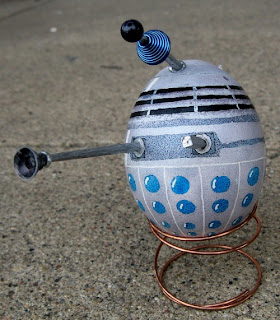
This week's roundtable is a seasonal one (as suggested by my friend Lee Houston Jr.) -- Easter Eggs. You know the little bonuses that companies put on DVD as hidden extras, but what about the fun Easter Eggs we hide in our writing?
What Easter eggs (if any) have you inserted into your works?
Derrick Ferguson: I've hidden song lyrics, movie titles and the names of fictional characters, cities, books and buildings in my writing. For instance, there's a scene in "Dillon and The Voice of Odin" where he is admiring Montoya swords handcrafted by Domingo Montoya who is the father of Inigo Montoya from "The Princess Bride." And in "Dillon and The Pirates of Xonira" Dillon is sent to the island of Xonira on a secret mission by The Braithwaite Group. That's an Easter Egg referring to the classic "Enter The Dragon" where Bruce Lee is sent to the island of Han on a secret mission by a British Intelligence agent named Braithewaite. There's tons more but I think you get the idea. Go look for 'em! And when I needed a name for the gadget filled belt Dillon wears on his adventures I called it a Steranko Belt. In his classic NICK FURY, AGENT OF S.H.I.E.L.D. Jim Steranko always drew Nick Fury wearing these funky belts with all kinds'a gehookas and gizmos attached and hanging. That was the imagery I was going for.
Andrew Salmon: The biggest Easter eggs I've used have been in my Rick Ruby tale, "Wounds". Let's see, we've got WATCHMEN, Star Trek and Mission: Impossible references all over the tale. "Wounds" is the tale I really went to town on. There have been others in other tales but I don't want to reveal all my secrets.
Mark Halegua: I like to use names in my works from other works and genres. In one story, I have names from Marvel comics, a TV sitcom, pulp authors real names, etc.
Ed Erdelac: Merkabah Rider has numerous references both western and genre. In Have Glyphs Will Travel, my quirky medicine peddler and extradimensional blue-clad "angel" Faustus Montague and his brother Misquamacus (himself a Lovecraft character later expanded upon by Graham Masterton) make various very veiled references to their universe of origin, and their natures in that universe (including their true names), which only scholars of the fantasy works of a certain author and Oxford English professor will likely get. In addition, Faustus refers to twelve heroes with two hearts between them (The Doctor), and battling Adon's Creed atop a mesa at Stallions Gate New Mexico (the future site of Dr. Sam Beckett's Quantum Leap project). The forthcoming Once Upon A Time In The Weird West is chock full of easter eggs. In one cantina scene Lin McAdams and High Spade cavort (both from Winchester 73) alongside Oscar Diggs (the Wizard of Oz himself), John Russell (from Hombre), Freddie Sykes (of The Wild Bunch), and Bill owner (a certain Electrician and Adventurer from House II). When competing circuses start springing up around the town of Delirium Tremens, Cooger & Dark's Pandemonium Shadow Show (Something Wicked This Way Comes) vies for customers with The Dunn & Duffy Circus (the circus train from Indiana Jones And The Last Crusade), the latter of which promises thrills from The Flying Grayson Family. In a nod to Merkabah Rider's thematic origins, the rabbi who presided over the Rider's naming ceremony as a baby is Avram Belinsky (Gene Wilder's character from The Frisco Kid) and his best friend's last name was Lillard (making him the son of Harrison Ford's Tommy Lillard). Also, at one point Adon observes a barefoot man, possibly Chinese, playing a bamboo flute.
Chuck Miller: Quite a few of them. In "Blood of the Centipede," "Nora Desmand" is the most obvious-- her experience playing Bloody Mary Jane obviously contributed to her emotional problems, and there's an unsavory history behind the old mansion she holed up in for so long. "Big Jack" Matteo, the LA County Sheriff's Department detective the Centipede crosses swords with, is the father of Lt. Jack Matteo, Carl Kolchak's police nemesis in "The Vampire" episode of "The Night Stalker." On page 62, Percy and the Centipede use some dialog lifted from the "Blind Mellow Jelly" episode of "Sanford and Son." In the "lost chapter," which may see print one day, the Centipede's brief encounter with a young Orson Welles plants a couple of interesting seeds. There are a few others, and the next one, "Black Centipede Confidential" is lousy with 'em.
Don Gates: In the first Challenger Storm novel ("The Isle of Blood"), four of my online friends appear in cameos as MARDL scientists. They were folks who contributed their early feedback when I was developing my ideas and I wanted to thank them for it. I don't think they ever noticed, haha.
Most of my Easter eggs so far have been really stupid. Things from sitcoms have a weird habit of becoming my Easter eggs. There are two references to "The Golden Girls" in "Isle of Blood": the Mortimer Club is an exclusive social club in one episode and it's mentioned in the book, while the names of the Villalobos Brothers (twins Jorge and Esteban) are lifted from a pair of brothers Blanche dated after meeting them at a Jimmy Smits lookalike contest. In the second Storm novel ("The Curse of Poseidon"), sitcoms show up again. When I needed a name for a tiny Greek fishing village that gets destroyed, my wife suggested "Katsopolis" after John Stamos' character's last name on "Full House". Then there's the American tourists on a yacht who discover a mysterious body in the sea... they bear more than a passing resemblance to the cast of "Seinfeld". Also I named a very minor character "Stalfos" after the skeletal enemies in "The Legend of Zelda" video games, purely because I liked the Greek-sounding name.
Billy Craig: In Emerald Death, Hannigan arrives in Africa aboard the African Queen, In the Sky Masters there is chapter title that tips a hat to the most famous of the Hope and Crosby road movies, Ferrari and the Blue Parrot make an appearance, and Rick's Café American is mentioned. Ian Watson will even be making an appearance in The Hand of Evil.
In the Decker P.I. books Willie Nelson is represented in the character of Wally Norwood, the title of the fourth book Smugglers' Blues is a tip of the hat to Miami Vice and Glenn Frey, to name a few.
Jim Beard: In my Star Wars story, "Fallen Star," I had the artist insert a shadowy figure in a few panels. The story concerned a twelve-year-old Luke Skywalker getting into some mischief in Mos Eisley. The background figure is a hooded Ben Kenobi, keeping an eye on the young Jedi-to-be.
I.A. Watson: I put lots of them in my earlier work, far less now. Even tipped a nod at other writers characters and stories sometimes - until that came back to bite me. Not everyone likes the nod. Wrote in characters based on friends or lovers - while they were friends; much harder to go back to those characters when the friend turns out not to be so heroic or the lovers not so loving. Used to make references and in-jokes to other stories I liked until I realised that some people felt I was sneering at them for writing stuff that would "go over their heads" and others fixated so much on the "easter eggs" that they completely ignored the meat of what I wanted to say.
Ron Fortier: I've always loved playing with the names of my friends, both in my comics work and prose. Rob Davis is a night clerk at the morgue in an early Brother Bones story and very recently, Nancy Hansen joined the BB cast as the familiar to a new vampire character I've created. Oh, and Nancy Hanson also pops up again, this time as one of Captain Hazzard's dirigible crew aboard his airship ARGOSY. One of my personal Easter Eggs was putting a 1930s recurring film character, Tugboat Annie, into my fourth Hazzard novel to see if anyone would recognize here. A few readers (the older ones....ha) actually did.
Nancy Hansen: Now and then I'll pop something in, but I tend to go more for characters than references. I'm kind of a visual thinker, so I have to be able to picture something or someone in order to describe them. For instance, Jordyn Orion from The Silver Pentacle series is visually based on David Bowie in Labyrinth. Sameil the Angel of Death is patterned after Rob Zombie on a couple of his album covers. I've used people I know as characters—and especially those I despise often appear as villains. In an upcoming book series I have a modern day wizard named Nigel Gillette who also happens to be an action/adventure writer that tends to research a story by becoming the character he wants to play. In looking for a description, I chose latter day Sam Elliot with the gray hair and that luxurious mustache to be Nigel's avatar. In the same series is a woman referred to as 'The Countess', who is a witch and a writer of how to books, owns her own network, has various estates, and is just about as perfect a person as you can get. Her full name is Gina Jardinere-Duval von Stuart, and she's a conglomerate of cooking expert Ina Garten (The Barefoot Countess ), Carol Duvall (DIY craft programs) and of course Martha Stewart. In fact in that series, my cowriters and I have written ourselves in, because it started as an online bulletin board joke. My sons appear in that series as extras, as does my grandson.
The book I'm working on right now was started when my boys were both young (they're both pushing 30 now). When they asked me what I was writing they asked me if I could write them in as heroes. So whenever it comes out, when you read the story of the orphaned brothers Ethan and Nicholas, you're seeing my Jason and Brian as they wanted to be known 20 something years ago.
Wayne Reinagel: I admit, I've done this once or twice. Just kidding, folks. My novels are loaded with dozens and dozens of basketloads of eggs! As Rick Croxton would say, a whole kitchen sink of them. One day, when I do an annotated version, I have to make a list of them all. It will probably take a whole book just to list them all.
Lee Houston Jr.: My New Adventures of the Eagle story: "A Black Friday In Australia" is not only based upon a real historic event, but I managed to insert a couple of references to J. R. R. Tolkien's The Hobbit within my tale, which was just a recent release at the time the Eagle story occurred. The astute reader will find plenty within my upcoming novel Hugh Monn, Private Detective: Catch A Rising Star. There's even a couple within Project Alpha, if you know where to look. I have others, but can't mention them right now because I don't know when those short stories will be published.
Bobby Nash: I love inserting Easter eggs into my work. From having Tony Stark's parents and Dr. Erskine (creator of the super-soldier serum) attended the opening of Ravenwood's Jazz club to having G-Man Agent Palmer show up in Lance Star: Sky Ranger and The New Adventures of The Eagle. This Agent Palmer is the grandfather of FBI Agent Harold Palmer from my Evil Ways and Evil Intent novels.
The Easter Eggs I'm asked about most often are the items in Mr. Biggs' collection from my Green Hornet story, "A Thing of Beauty." There's a piece of Kryptonite, a Batarang, The Lone Ranger's mask and six-shooters, plus a piece of wreckage from lance Star's experimental plane that was shot down by Baron Blood when young Skip Terrel died.
Not sure if this counts as an Easter egg or not, but since many pulp heroes tend to go up against mobsters, I have created two rival mob families that I've had multiple characters run into. You can follow their stories (out of order, of course) in bits and bites. So far Domino Lady, The Green Ghost, Green Hornet, Secret Agent X, The Rook, Rick Ruby, and Nightbeat's Randy Stone have crossed paths with members of the Tommasso and Manelli Crime Families. I'm sure more characters will run afoul of them in the future as well. I also have an actress, Margaret Grace, appear much the same way. She's appeared in 3 different time frames (and different stages of her career) in Domino lady, Ravenwood, and the upcoming Box 13. It's like revisiting old friends.
Erwin K. Roberts: Most of my fiction is littered with references to real people, places, & fictional ones. 99.99% of the time you don't have to "get" them. The story reads the same way if they were all named John Doe.
For one thing, I write as if just about anything you can think of exists in a common universe. That is why, in Dr. Watson's American Adventure, you are introduced to Robert van Loan who is probably the father of the Phantom Detective. Not to mention Franklin Havens, founder of the Clarion chain of newspapers. (Franklin Havens' great-grandson, Curt van Loan is a childhood friend of my latter day hero, the Voice.) Speaking of newspapers, in my world both William Randolph Hurst and Charles Foster (Citizen) Kane exist.
Also in the book, for no good reason, Dr. Watson works with Detective Walter Brooks who shares the name of the author of the dozens of Freddy The Pig books and was the creator of Mr. Ed.
One of Jim Anthony's regular sources of information in my stories is a fellow who owns and lives behind a cigar store in Manhattan. I'm not sure if anybody has realized that this guy once was Johnston McCulley's hero the Green Ghost.
Not all the references are pulp related, either. Need a reliable taxi in New York City? Probably shouldn't bring in Moe Schrivnitz. So Jim Anthony, Tony Quinn, and others call for Quality Comics Hack O'Hara.
For real people Bob hope appears off-stage in my Moon Man tale. Howard Hughes & Douglas (Wrong-Way) Corrigan appear in the second half of Sons of Thor.
Van Allen Plexico: Everything from very hidden to very overt clues that connect HAWK toLUCIAN to LORDS OF FIRE, and even obscure things like naming a planet "NM-156" in a scene in LORDS inspired by the film "Prometheus." It's a double Easter Egg, actually-- it uses the same "two letters/three numbers" style as the planets in the "Alien" movies and "Prometheus," but "NM-156" specifically is also the name of a Queensryche song I like, which just happened to fit the pattern.
And with the Sentinels novels, I've been dropping things in since very early in the series that pop back up again much, much later. Some of those might not fully qualify as "Easter Eggs" but they're pretty close, because it comes (I think) as quite a surprise when they pop up\ again. For example, the black box that the Blue Skull is escaping with in the very beginning of WHEN STRIKES THE WARLORD... It seems like a nothing bit, but it becomes very, very important later on!
Then there are the comics-creator-inspired names I've used such as the "Moench-Mantlo Prison" for super-villains and the "Kur-Bai" (Kirby)aliens...!
Why did you put them in, or why do you avoid them?
Derrick Ferguson: I put them in mostly to amuse myself as I don't think anybody takes the time to look for them and even if they do they probably wouldn't get the references. They're just fun to drop in and another way for me to keep myself interested when the mechanics of writing a story can be tedious.
Andrew Salmon: They are fun to do and they are a nudge and a wink to readers, a way of saying we're on the same page so to speak.
Mark Halegua: It makes it fun, and I like it when readers email me with notes they've spottted the names they find. No one has managed to find all of the names in my story, "The Night Before Christmas."
Ed Erdelac: Mainly to amuse myself, and, at least in my own mind, tie my characters to other fictional characters I enjoy.
Chuck Miller: I enjoy doing it, and when someone spots one of the more obscure ones, it marks them down as a person of interest.
Don Gates: I guess I put them in there more for my own amusement than anything else, just to have a little fun with it. I'd like to work in more of them in the future, but hopefully not all sitcom stuff. I can't think of any that I'll be working into any of my current projects, but in the future there is something that I'd like to write that cameos a few adventurers from movies.
Billy Craig: Sometimes they are intentional, sometimes they just pop up and fit the story so I leave 'em in. Sometimes I put them in to see if anybody will even notice them.
Jim Beard: Ben had nothing to do with the story, but I thought it made sense that he'd be there, watching. When I started pointing it out to readers, they thought it was pretty cool, so then, for me, it was totally worth it.
I.A. Watson: I'd say about a third of easter eggs are well-considered and effectively used. There's a discipline writers have to exercise at professional level when they self-edit. Is there a good reason for that paragraph, that sentence, that word to be in there? How does it serve the story? If there's no good answer, that bit of the text should be gone.
That's not to say there's no place for hidden references and nostalgic shout-outs. If one is writing a story about a "heritage" character then sometimes its those little treats that show the reader that the author knows his stuff, has "got it". If one is trying to place one's characters in a wider fictional universe then so be it. If the idea is to make the reader go "wow" or smile a little then that's fine.
But often the easter egg breaks the suspension of disbelief. It takes the reader out of the story to consider the reference, reminds them that this is a fictional invention referencing other fiction. For example:
The TV series Arrow is a version of DC's Green Arrow comic, and its quite fun. A few DC universe references get tossed in there for the fanboys, or for versimilitude: the diner's a Big Belly Burger franchise (a subsidiary of Lexcorp); Dinah Laurel Lance's free legal clinic is called the CNRI (=canary; in the comics this character is Black Canary); the main villain trained at Nanda Parbat, a hidden mystic city where in comics Deadman mentor Rama Kushna resides (and Judomaster, Batman, and others also trained at some point), a train arrives from Bludhaven (Nightwing's base of operations), and so on. DC fans get a smile and it does no harm to casual viewers.
But in the most recent episode, "the Saviour", a character returning to her home says of the quick redeye journey "I'll be back to Central City in a flash." (The Flash is based in Central City in the comics) For me that was a joke too far . Another time in another scene I might have smiled, but this was such a self-aware joke, placed in an emotional departure scene where we were supposed to be seeing how much these parting characters were hurting, that it shattered the moment. This was an easter egg too far.
If a story does that, or worse, depends upon someone picking up some obscure reference to help define the character, then that story is the weaker for it.
Information required to understand the protagonists, the plot, or the backstory needs to be there for all. Otherwise that story is elitist and inaccessible. Worse still, constant references trying to tie a story into other works, especially those by other more successful authors, often comes across as trying to hitch on the coat-tails of the greats.
I get annoyed sometimes when critics assume that easter eggs betray a "lesser" work. "Chandler never needed to slip in Doyle references, so his works have authority." I can see the argument; many of the best fictional worlds are complete unto themselves, requiring no support from other creations. But I think there are also gains to be had for "recombinant" world-building. Wayne Reinagel's Viktoriana is a good example, where the easter eggs have escaped the basket and have become the story. And where writers use minor references to connect up their tales to a larger universe they are crafting - as with Moorcock (or Plexico) - then that's really just using detail in service of a wider creative process.
In short, there's a place for easter eggs, but they need to be used as carefully and calculatedly as every other weapon in the writers arsenal. Or, to take the metaphor to extremes, easter eggs can be a treat, but they can also ruin your pants when you sit on them because they've been left to melt in the wrong place.
Ron Fortier: These are always fun to do and just add a little extra to what I write.
Nancy Hansen: In my case it's both as a way to picture what's going on better, and because it's a lot of fun. And when I have an issue with someone, they get killed off in a very nasty way.
Wayne Reinagel: Some are just tilts of the hat, such as creating characters with names of writers or artists from the pulp era, which only hardcore fans would catch. Most are homages or my version of existing (sometimes real-life) characters. But they are ALL in the story for a reason, not merely for the purpose of name-dropping.
Lee Houston Jr.: I don't intentionally set out to insert an Easter Egg into everything I write, but will not hesitate if appropriate, just to have a bit of fun at the keyboard that the readers will enjoy. The best Easter Eggs are the ones that occur to me naturally over the course of working on whatever project I'm writing at the moment. I won't insert one if it doesn't add to the story, or will affect the story in a negative way.
Bobby Nash: I add them because they are fun. I won't add them if they hurt the story, but sometimes these little nods are fun for the reader as well as for myself. I like that, at least for me, these characters all live in the same world. Sometimes I've tied stories together. In All-Star Pulp Comics #1, I have Secret Agent X doubling Claudio Tommasso (as mentioned above) because the mobster is turning state's evidence. Cut to a couple years later and I write a Rick Ruby tale for the upcoming vol. 2 that features a mod run prostitution ring. Who runs that ring? Hello, Claudio. I did a similar thing with the story in Secret Agent X vol. 4. There is a sequel to that story starring Lance Star that appeared in the Lance Star comic book. Each story is stand-alone, but when read together paints a larger picture.
Erwin K. Roberts: I do it because its fun. Often, it is also a hat tip to those that came before.
Van Allen Plexico: If I have to name something, I figure I might as well make the name a little "extra"-interesting. As long as it doesn't distract toogreatly from the story. I actually worried that "Moench-Mantlo" might knock readers out of the story, it's so blatant!
What is your favorite hidden surprise you encountered within someone else's work?
Derrick Ferguson: My favorite hidden surprise was when I realized that Michael Moorcock had his own multiverse and that all his characters were connected in some way. Being a reader of Marvel/DC comics I was familiar with the concept of a multiverse in comics but this was the first time I had read it in prose. It's the reason why most of my stories tend to take place on what I call Earth 59 which is where Dillon, Mongrel, Fortune McCall and most of my other characters live and work.
Andrew Salmon: I don't know if I have a favorite but I do find a smile on my face when I stumble on an egg in someone else's work. Alan Moore is particularly good at inserting these and almost every pulp tale these days has one. And I say, keep 'em coming!
Ed Erdelac: Probably when the characters from Stephen King's The Stand found Christine rusting out in the desert outside Las Vegas.
Chuck Miller: One that springs immediately to mind is a collected edition of some Spider-Man novels by Adam-Troy Castro, "The Sinister Six Combo." It is jam-packed with cool literary and pop culture references, including one from a favorite novel of mine, A Confederacy of Dunces.
Don Gates: My favorite Easter Eggs are the ones hidden in Alex Ross' artwork for DC's Kingdom Come. Every time I read it I find something new.
Billy Craig: Warren Murphy used to be really good at slipping them into The Destroyer books as well as Trace and Digger.
I.A. Watson: There's a few ways that Easter eggs work.
A recent example of an Easter egg folding into the main plot was in the Doctor Who christmas special The Snowmen. This Victorian adventure chronicled the origin of a disembodied and sinister Great Intelligence, which the Doctor defeated and exiled using a tin lunchbox with a map of the 1968 London Underground on it. I was amused that many uninformed reviewers felt it set-up the villain for a sequel adventure, perhaps set in the sixties. In actual fact, the sequel has already been done, in an adventure broadcast in 1968, The Web of Fear, in which the Doctor battles a disembodied Great Intelligence in the London Underground. The sheer cheek of doing a story that turned out to be a prequel to one from 45 years ago took my breath away.
An example of an in-house-joke kind of Easter egg occurs on the final page of Fantastic Four Annual #3, in which two would-be guests are tossed out of Reed and Sue's wedding by SHIELD security. These characters - who refer to each other as Stan and Jack - walk away disgruntled to "get their own back" by "plotting the next issue". It's a sly metatextual moment - much rarer then than now - that tops off an everything-but-the-kitchen-sink celebration story where even Millie the Model gets a cameo - with a smile.
Then there's the subtle "that was a plot point all along and we never noticed it" kind of revelation. A recent episode of How I Met Your Mother pulled this off very effectively. The long-running romance subplot of two regular cast, womanizing Barney Stinson and relation-phobic Robin Sherbotsky, was concluded in a stunning manner in "The Robin". Told with flashbacks to a dozen previous episodes and leading up to a marriage proposal, this tale shows us scenes we had seen before in stories we thought complete - but puts an entirely different spin on them. What we thought we saw wasn't what was actually happening. Very clever stuff with some long-term planning.
Finally, there's the basic "I get that reference" kind of reference. The late lamented animated series Avengers: Earth's Mightiest Heroes was quite good at this. Apart from slyly slipping in additional supporting characters in the background, it also sometimes ventures into mischievous commentary on the comics themselves. Avengers fans may recall how, during Brian Bendis' initial Avengers comics foray, he "killed off" Hawkeye by having the archer's quiver catch fire and the blast arrows inside it exploding. Longtime Clint Barton fans felt this was a poor cheap shock ending for their swashbuckling hero, as well as suggesting remarkably poor professionalism on Hawkeye's part at not having a way to detach an exploding quiver. The cartoon also used this situation. Hawkeye's quiver caught fire and was about to explode. He casually hooked it off and tossed it to take down the bad guys following him and to set up an attack on Baron Struker - with a smirky grin! That's Hawkeye - and a wonderfully subversive Easter egg that made me have a smirky grin too.
Ron Fortier: Martin Powell had me appear as a doctor in one of his early Sherlock Holmes comic books.
Nancy Hansen: I can't say it was a favorite, but it was the most memorable. Well known author Wally Lamb lives in this area. He used a lot of 60s song titles for his book titles and local color in his story. There was a character in the first one (SHE'S COME UNDONE) that I immediately recognized as based on a couple of employees in the school where his wife worked at the time. Wasn't the most flattering portrayal, so it was a bit weird after reading that to face these folks.
Wayne Reinagel: Planetary by Warren Ellis and John Cassady. This series is absolutely fantasic and loaded with references from 60's horror movies, Steampunk era, pulp era, silver age comics and lots more.
Lee Houston Jr.: Within the fifth season premiere of Quantum Leap, Sam Beckett spends practically the whole two hours stuck in Lee Harvey Oswald, because series creator Donald Bellasario never believed the conspiracy and multiple shooters theories surrounding the assassination of President John F. Kennedy. Unable to alter events in the future assassin's timeline, at the crucial moment Sam finally escapes Oswald and leaps into one of the motorcade guards just as the shooting begins. At the hospital, trying to get his bearings, Sam asks his guide Al why all that happened, because he/they couldn't save Kennedy and didn't change anything. That is when Al tells Sam that they did. Because of his leap infected "Swiss cheese memory", Sam doesn't remember that, in the ORIGINAL history, Jacqueline Kennedy was killed too!
Bobby Nash: I was also featured in George Perez's Crimosn Plague comic book. It was a thrill seeing my likeness drawn by such a master artist. I was also on the poster.
Erwin K. Roberts: This goes back awhile, to the first run of DC's Deadman. In one panel there is a group of tall flames. If you held the book almost at a right angle to your eyes the flames spelled out, "Hey, A Jim Steranko Effect!"
Van Allen Plexico: Gene Wolfe's four-volume BOOK OF THE LONG SUN is written entirely in third-person POV... or so it seems for the first two and a half books.And then comes a moment, totally randomly, so quick you could miss it if you blinked, halfway through volume three (CALDE OF THE LONG SUN), where the narrative suddenly uses the word "YOU." I don't recall exactly how it goes and don't have it handy to look up, but this is a close approximation:
MAN! That totally blindsided me. Why? Because it means that rather than a faceless, limited-perspective third-person narrator (like most books have, these days), these books actually were written in SECOND PERSON POV--something you almost NEVER see-- and I simply hadn't had the information to realize that until Wolfe just casually dropped that "you" in there. It meant the story was being TOLD TO US by a CHARACTER ACTUALLY IN THE STORY, and that "WE" (ie YOU) are a character in it, too! Staggering! And just from the use of one little two-letter word. That blew my mind, how it was so easy to totally turn the structure of an entire series upside down with one little word.
What Easter eggs (if any) have you inserted into your works?
Derrick Ferguson: I've hidden song lyrics, movie titles and the names of fictional characters, cities, books and buildings in my writing. For instance, there's a scene in "Dillon and The Voice of Odin" where he is admiring Montoya swords handcrafted by Domingo Montoya who is the father of Inigo Montoya from "The Princess Bride." And in "Dillon and The Pirates of Xonira" Dillon is sent to the island of Xonira on a secret mission by The Braithwaite Group. That's an Easter Egg referring to the classic "Enter The Dragon" where Bruce Lee is sent to the island of Han on a secret mission by a British Intelligence agent named Braithewaite. There's tons more but I think you get the idea. Go look for 'em! And when I needed a name for the gadget filled belt Dillon wears on his adventures I called it a Steranko Belt. In his classic NICK FURY, AGENT OF S.H.I.E.L.D. Jim Steranko always drew Nick Fury wearing these funky belts with all kinds'a gehookas and gizmos attached and hanging. That was the imagery I was going for.
Andrew Salmon: The biggest Easter eggs I've used have been in my Rick Ruby tale, "Wounds". Let's see, we've got WATCHMEN, Star Trek and Mission: Impossible references all over the tale. "Wounds" is the tale I really went to town on. There have been others in other tales but I don't want to reveal all my secrets.
Mark Halegua: I like to use names in my works from other works and genres. In one story, I have names from Marvel comics, a TV sitcom, pulp authors real names, etc.
Ed Erdelac: Merkabah Rider has numerous references both western and genre. In Have Glyphs Will Travel, my quirky medicine peddler and extradimensional blue-clad "angel" Faustus Montague and his brother Misquamacus (himself a Lovecraft character later expanded upon by Graham Masterton) make various very veiled references to their universe of origin, and their natures in that universe (including their true names), which only scholars of the fantasy works of a certain author and Oxford English professor will likely get. In addition, Faustus refers to twelve heroes with two hearts between them (The Doctor), and battling Adon's Creed atop a mesa at Stallions Gate New Mexico (the future site of Dr. Sam Beckett's Quantum Leap project). The forthcoming Once Upon A Time In The Weird West is chock full of easter eggs. In one cantina scene Lin McAdams and High Spade cavort (both from Winchester 73) alongside Oscar Diggs (the Wizard of Oz himself), John Russell (from Hombre), Freddie Sykes (of The Wild Bunch), and Bill owner (a certain Electrician and Adventurer from House II). When competing circuses start springing up around the town of Delirium Tremens, Cooger & Dark's Pandemonium Shadow Show (Something Wicked This Way Comes) vies for customers with The Dunn & Duffy Circus (the circus train from Indiana Jones And The Last Crusade), the latter of which promises thrills from The Flying Grayson Family. In a nod to Merkabah Rider's thematic origins, the rabbi who presided over the Rider's naming ceremony as a baby is Avram Belinsky (Gene Wilder's character from The Frisco Kid) and his best friend's last name was Lillard (making him the son of Harrison Ford's Tommy Lillard). Also, at one point Adon observes a barefoot man, possibly Chinese, playing a bamboo flute.
Chuck Miller: Quite a few of them. In "Blood of the Centipede," "Nora Desmand" is the most obvious-- her experience playing Bloody Mary Jane obviously contributed to her emotional problems, and there's an unsavory history behind the old mansion she holed up in for so long. "Big Jack" Matteo, the LA County Sheriff's Department detective the Centipede crosses swords with, is the father of Lt. Jack Matteo, Carl Kolchak's police nemesis in "The Vampire" episode of "The Night Stalker." On page 62, Percy and the Centipede use some dialog lifted from the "Blind Mellow Jelly" episode of "Sanford and Son." In the "lost chapter," which may see print one day, the Centipede's brief encounter with a young Orson Welles plants a couple of interesting seeds. There are a few others, and the next one, "Black Centipede Confidential" is lousy with 'em.
Don Gates: In the first Challenger Storm novel ("The Isle of Blood"), four of my online friends appear in cameos as MARDL scientists. They were folks who contributed their early feedback when I was developing my ideas and I wanted to thank them for it. I don't think they ever noticed, haha.
Most of my Easter eggs so far have been really stupid. Things from sitcoms have a weird habit of becoming my Easter eggs. There are two references to "The Golden Girls" in "Isle of Blood": the Mortimer Club is an exclusive social club in one episode and it's mentioned in the book, while the names of the Villalobos Brothers (twins Jorge and Esteban) are lifted from a pair of brothers Blanche dated after meeting them at a Jimmy Smits lookalike contest. In the second Storm novel ("The Curse of Poseidon"), sitcoms show up again. When I needed a name for a tiny Greek fishing village that gets destroyed, my wife suggested "Katsopolis" after John Stamos' character's last name on "Full House". Then there's the American tourists on a yacht who discover a mysterious body in the sea... they bear more than a passing resemblance to the cast of "Seinfeld". Also I named a very minor character "Stalfos" after the skeletal enemies in "The Legend of Zelda" video games, purely because I liked the Greek-sounding name.
Billy Craig: In Emerald Death, Hannigan arrives in Africa aboard the African Queen, In the Sky Masters there is chapter title that tips a hat to the most famous of the Hope and Crosby road movies, Ferrari and the Blue Parrot make an appearance, and Rick's Café American is mentioned. Ian Watson will even be making an appearance in The Hand of Evil.
In the Decker P.I. books Willie Nelson is represented in the character of Wally Norwood, the title of the fourth book Smugglers' Blues is a tip of the hat to Miami Vice and Glenn Frey, to name a few.
Jim Beard: In my Star Wars story, "Fallen Star," I had the artist insert a shadowy figure in a few panels. The story concerned a twelve-year-old Luke Skywalker getting into some mischief in Mos Eisley. The background figure is a hooded Ben Kenobi, keeping an eye on the young Jedi-to-be.I.A. Watson: I put lots of them in my earlier work, far less now. Even tipped a nod at other writers characters and stories sometimes - until that came back to bite me. Not everyone likes the nod. Wrote in characters based on friends or lovers - while they were friends; much harder to go back to those characters when the friend turns out not to be so heroic or the lovers not so loving. Used to make references and in-jokes to other stories I liked until I realised that some people felt I was sneering at them for writing stuff that would "go over their heads" and others fixated so much on the "easter eggs" that they completely ignored the meat of what I wanted to say.
Ron Fortier: I've always loved playing with the names of my friends, both in my comics work and prose. Rob Davis is a night clerk at the morgue in an early Brother Bones story and very recently, Nancy Hansen joined the BB cast as the familiar to a new vampire character I've created. Oh, and Nancy Hanson also pops up again, this time as one of Captain Hazzard's dirigible crew aboard his airship ARGOSY. One of my personal Easter Eggs was putting a 1930s recurring film character, Tugboat Annie, into my fourth Hazzard novel to see if anyone would recognize here. A few readers (the older ones....ha) actually did.
Nancy Hansen: Now and then I'll pop something in, but I tend to go more for characters than references. I'm kind of a visual thinker, so I have to be able to picture something or someone in order to describe them. For instance, Jordyn Orion from The Silver Pentacle series is visually based on David Bowie in Labyrinth. Sameil the Angel of Death is patterned after Rob Zombie on a couple of his album covers. I've used people I know as characters—and especially those I despise often appear as villains. In an upcoming book series I have a modern day wizard named Nigel Gillette who also happens to be an action/adventure writer that tends to research a story by becoming the character he wants to play. In looking for a description, I chose latter day Sam Elliot with the gray hair and that luxurious mustache to be Nigel's avatar. In the same series is a woman referred to as 'The Countess', who is a witch and a writer of how to books, owns her own network, has various estates, and is just about as perfect a person as you can get. Her full name is Gina Jardinere-Duval von Stuart, and she's a conglomerate of cooking expert Ina Garten (The Barefoot Countess ), Carol Duvall (DIY craft programs) and of course Martha Stewart. In fact in that series, my cowriters and I have written ourselves in, because it started as an online bulletin board joke. My sons appear in that series as extras, as does my grandson.
The book I'm working on right now was started when my boys were both young (they're both pushing 30 now). When they asked me what I was writing they asked me if I could write them in as heroes. So whenever it comes out, when you read the story of the orphaned brothers Ethan and Nicholas, you're seeing my Jason and Brian as they wanted to be known 20 something years ago.
Wayne Reinagel: I admit, I've done this once or twice. Just kidding, folks. My novels are loaded with dozens and dozens of basketloads of eggs! As Rick Croxton would say, a whole kitchen sink of them. One day, when I do an annotated version, I have to make a list of them all. It will probably take a whole book just to list them all.
Lee Houston Jr.: My New Adventures of the Eagle story: "A Black Friday In Australia" is not only based upon a real historic event, but I managed to insert a couple of references to J. R. R. Tolkien's The Hobbit within my tale, which was just a recent release at the time the Eagle story occurred. The astute reader will find plenty within my upcoming novel Hugh Monn, Private Detective: Catch A Rising Star. There's even a couple within Project Alpha, if you know where to look. I have others, but can't mention them right now because I don't know when those short stories will be published.
Bobby Nash: I love inserting Easter eggs into my work. From having Tony Stark's parents and Dr. Erskine (creator of the super-soldier serum) attended the opening of Ravenwood's Jazz club to having G-Man Agent Palmer show up in Lance Star: Sky Ranger and The New Adventures of The Eagle. This Agent Palmer is the grandfather of FBI Agent Harold Palmer from my Evil Ways and Evil Intent novels.
The Easter Eggs I'm asked about most often are the items in Mr. Biggs' collection from my Green Hornet story, "A Thing of Beauty." There's a piece of Kryptonite, a Batarang, The Lone Ranger's mask and six-shooters, plus a piece of wreckage from lance Star's experimental plane that was shot down by Baron Blood when young Skip Terrel died.
Not sure if this counts as an Easter egg or not, but since many pulp heroes tend to go up against mobsters, I have created two rival mob families that I've had multiple characters run into. You can follow their stories (out of order, of course) in bits and bites. So far Domino Lady, The Green Ghost, Green Hornet, Secret Agent X, The Rook, Rick Ruby, and Nightbeat's Randy Stone have crossed paths with members of the Tommasso and Manelli Crime Families. I'm sure more characters will run afoul of them in the future as well. I also have an actress, Margaret Grace, appear much the same way. She's appeared in 3 different time frames (and different stages of her career) in Domino lady, Ravenwood, and the upcoming Box 13. It's like revisiting old friends.
Erwin K. Roberts: Most of my fiction is littered with references to real people, places, & fictional ones. 99.99% of the time you don't have to "get" them. The story reads the same way if they were all named John Doe.
For one thing, I write as if just about anything you can think of exists in a common universe. That is why, in Dr. Watson's American Adventure, you are introduced to Robert van Loan who is probably the father of the Phantom Detective. Not to mention Franklin Havens, founder of the Clarion chain of newspapers. (Franklin Havens' great-grandson, Curt van Loan is a childhood friend of my latter day hero, the Voice.) Speaking of newspapers, in my world both William Randolph Hurst and Charles Foster (Citizen) Kane exist.
Also in the book, for no good reason, Dr. Watson works with Detective Walter Brooks who shares the name of the author of the dozens of Freddy The Pig books and was the creator of Mr. Ed.
One of Jim Anthony's regular sources of information in my stories is a fellow who owns and lives behind a cigar store in Manhattan. I'm not sure if anybody has realized that this guy once was Johnston McCulley's hero the Green Ghost.
Not all the references are pulp related, either. Need a reliable taxi in New York City? Probably shouldn't bring in Moe Schrivnitz. So Jim Anthony, Tony Quinn, and others call for Quality Comics Hack O'Hara.
For real people Bob hope appears off-stage in my Moon Man tale. Howard Hughes & Douglas (Wrong-Way) Corrigan appear in the second half of Sons of Thor.
Van Allen Plexico: Everything from very hidden to very overt clues that connect HAWK toLUCIAN to LORDS OF FIRE, and even obscure things like naming a planet "NM-156" in a scene in LORDS inspired by the film "Prometheus." It's a double Easter Egg, actually-- it uses the same "two letters/three numbers" style as the planets in the "Alien" movies and "Prometheus," but "NM-156" specifically is also the name of a Queensryche song I like, which just happened to fit the pattern.
And with the Sentinels novels, I've been dropping things in since very early in the series that pop back up again much, much later. Some of those might not fully qualify as "Easter Eggs" but they're pretty close, because it comes (I think) as quite a surprise when they pop up\ again. For example, the black box that the Blue Skull is escaping with in the very beginning of WHEN STRIKES THE WARLORD... It seems like a nothing bit, but it becomes very, very important later on!
Then there are the comics-creator-inspired names I've used such as the "Moench-Mantlo Prison" for super-villains and the "Kur-Bai" (Kirby)aliens...!
Why did you put them in, or why do you avoid them?
Derrick Ferguson: I put them in mostly to amuse myself as I don't think anybody takes the time to look for them and even if they do they probably wouldn't get the references. They're just fun to drop in and another way for me to keep myself interested when the mechanics of writing a story can be tedious.Andrew Salmon: They are fun to do and they are a nudge and a wink to readers, a way of saying we're on the same page so to speak.
Mark Halegua: It makes it fun, and I like it when readers email me with notes they've spottted the names they find. No one has managed to find all of the names in my story, "The Night Before Christmas."
Ed Erdelac: Mainly to amuse myself, and, at least in my own mind, tie my characters to other fictional characters I enjoy.
Chuck Miller: I enjoy doing it, and when someone spots one of the more obscure ones, it marks them down as a person of interest.
Don Gates: I guess I put them in there more for my own amusement than anything else, just to have a little fun with it. I'd like to work in more of them in the future, but hopefully not all sitcom stuff. I can't think of any that I'll be working into any of my current projects, but in the future there is something that I'd like to write that cameos a few adventurers from movies.
Billy Craig: Sometimes they are intentional, sometimes they just pop up and fit the story so I leave 'em in. Sometimes I put them in to see if anybody will even notice them.
Jim Beard: Ben had nothing to do with the story, but I thought it made sense that he'd be there, watching. When I started pointing it out to readers, they thought it was pretty cool, so then, for me, it was totally worth it.
I.A. Watson: I'd say about a third of easter eggs are well-considered and effectively used. There's a discipline writers have to exercise at professional level when they self-edit. Is there a good reason for that paragraph, that sentence, that word to be in there? How does it serve the story? If there's no good answer, that bit of the text should be gone.
That's not to say there's no place for hidden references and nostalgic shout-outs. If one is writing a story about a "heritage" character then sometimes its those little treats that show the reader that the author knows his stuff, has "got it". If one is trying to place one's characters in a wider fictional universe then so be it. If the idea is to make the reader go "wow" or smile a little then that's fine.
But often the easter egg breaks the suspension of disbelief. It takes the reader out of the story to consider the reference, reminds them that this is a fictional invention referencing other fiction. For example:
The TV series Arrow is a version of DC's Green Arrow comic, and its quite fun. A few DC universe references get tossed in there for the fanboys, or for versimilitude: the diner's a Big Belly Burger franchise (a subsidiary of Lexcorp); Dinah Laurel Lance's free legal clinic is called the CNRI (=canary; in the comics this character is Black Canary); the main villain trained at Nanda Parbat, a hidden mystic city where in comics Deadman mentor Rama Kushna resides (and Judomaster, Batman, and others also trained at some point), a train arrives from Bludhaven (Nightwing's base of operations), and so on. DC fans get a smile and it does no harm to casual viewers.
But in the most recent episode, "the Saviour", a character returning to her home says of the quick redeye journey "I'll be back to Central City in a flash." (The Flash is based in Central City in the comics) For me that was a joke too far . Another time in another scene I might have smiled, but this was such a self-aware joke, placed in an emotional departure scene where we were supposed to be seeing how much these parting characters were hurting, that it shattered the moment. This was an easter egg too far.
If a story does that, or worse, depends upon someone picking up some obscure reference to help define the character, then that story is the weaker for it.
Information required to understand the protagonists, the plot, or the backstory needs to be there for all. Otherwise that story is elitist and inaccessible. Worse still, constant references trying to tie a story into other works, especially those by other more successful authors, often comes across as trying to hitch on the coat-tails of the greats.
I get annoyed sometimes when critics assume that easter eggs betray a "lesser" work. "Chandler never needed to slip in Doyle references, so his works have authority." I can see the argument; many of the best fictional worlds are complete unto themselves, requiring no support from other creations. But I think there are also gains to be had for "recombinant" world-building. Wayne Reinagel's Viktoriana is a good example, where the easter eggs have escaped the basket and have become the story. And where writers use minor references to connect up their tales to a larger universe they are crafting - as with Moorcock (or Plexico) - then that's really just using detail in service of a wider creative process.
In short, there's a place for easter eggs, but they need to be used as carefully and calculatedly as every other weapon in the writers arsenal. Or, to take the metaphor to extremes, easter eggs can be a treat, but they can also ruin your pants when you sit on them because they've been left to melt in the wrong place.
Ron Fortier: These are always fun to do and just add a little extra to what I write.
Nancy Hansen: In my case it's both as a way to picture what's going on better, and because it's a lot of fun. And when I have an issue with someone, they get killed off in a very nasty way.
Wayne Reinagel: Some are just tilts of the hat, such as creating characters with names of writers or artists from the pulp era, which only hardcore fans would catch. Most are homages or my version of existing (sometimes real-life) characters. But they are ALL in the story for a reason, not merely for the purpose of name-dropping.
Lee Houston Jr.: I don't intentionally set out to insert an Easter Egg into everything I write, but will not hesitate if appropriate, just to have a bit of fun at the keyboard that the readers will enjoy. The best Easter Eggs are the ones that occur to me naturally over the course of working on whatever project I'm writing at the moment. I won't insert one if it doesn't add to the story, or will affect the story in a negative way.Bobby Nash: I add them because they are fun. I won't add them if they hurt the story, but sometimes these little nods are fun for the reader as well as for myself. I like that, at least for me, these characters all live in the same world. Sometimes I've tied stories together. In All-Star Pulp Comics #1, I have Secret Agent X doubling Claudio Tommasso (as mentioned above) because the mobster is turning state's evidence. Cut to a couple years later and I write a Rick Ruby tale for the upcoming vol. 2 that features a mod run prostitution ring. Who runs that ring? Hello, Claudio. I did a similar thing with the story in Secret Agent X vol. 4. There is a sequel to that story starring Lance Star that appeared in the Lance Star comic book. Each story is stand-alone, but when read together paints a larger picture.
Erwin K. Roberts: I do it because its fun. Often, it is also a hat tip to those that came before.
Van Allen Plexico: If I have to name something, I figure I might as well make the name a little "extra"-interesting. As long as it doesn't distract toogreatly from the story. I actually worried that "Moench-Mantlo" might knock readers out of the story, it's so blatant!
What is your favorite hidden surprise you encountered within someone else's work?
Derrick Ferguson: My favorite hidden surprise was when I realized that Michael Moorcock had his own multiverse and that all his characters were connected in some way. Being a reader of Marvel/DC comics I was familiar with the concept of a multiverse in comics but this was the first time I had read it in prose. It's the reason why most of my stories tend to take place on what I call Earth 59 which is where Dillon, Mongrel, Fortune McCall and most of my other characters live and work.
Andrew Salmon: I don't know if I have a favorite but I do find a smile on my face when I stumble on an egg in someone else's work. Alan Moore is particularly good at inserting these and almost every pulp tale these days has one. And I say, keep 'em coming!
Ed Erdelac: Probably when the characters from Stephen King's The Stand found Christine rusting out in the desert outside Las Vegas.
Chuck Miller: One that springs immediately to mind is a collected edition of some Spider-Man novels by Adam-Troy Castro, "The Sinister Six Combo." It is jam-packed with cool literary and pop culture references, including one from a favorite novel of mine, A Confederacy of Dunces.
Don Gates: My favorite Easter Eggs are the ones hidden in Alex Ross' artwork for DC's Kingdom Come. Every time I read it I find something new.
Billy Craig: Warren Murphy used to be really good at slipping them into The Destroyer books as well as Trace and Digger.
I.A. Watson: There's a few ways that Easter eggs work.
A recent example of an Easter egg folding into the main plot was in the Doctor Who christmas special The Snowmen. This Victorian adventure chronicled the origin of a disembodied and sinister Great Intelligence, which the Doctor defeated and exiled using a tin lunchbox with a map of the 1968 London Underground on it. I was amused that many uninformed reviewers felt it set-up the villain for a sequel adventure, perhaps set in the sixties. In actual fact, the sequel has already been done, in an adventure broadcast in 1968, The Web of Fear, in which the Doctor battles a disembodied Great Intelligence in the London Underground. The sheer cheek of doing a story that turned out to be a prequel to one from 45 years ago took my breath away.
An example of an in-house-joke kind of Easter egg occurs on the final page of Fantastic Four Annual #3, in which two would-be guests are tossed out of Reed and Sue's wedding by SHIELD security. These characters - who refer to each other as Stan and Jack - walk away disgruntled to "get their own back" by "plotting the next issue". It's a sly metatextual moment - much rarer then than now - that tops off an everything-but-the-kitchen-sink celebration story where even Millie the Model gets a cameo - with a smile.Then there's the subtle "that was a plot point all along and we never noticed it" kind of revelation. A recent episode of How I Met Your Mother pulled this off very effectively. The long-running romance subplot of two regular cast, womanizing Barney Stinson and relation-phobic Robin Sherbotsky, was concluded in a stunning manner in "The Robin". Told with flashbacks to a dozen previous episodes and leading up to a marriage proposal, this tale shows us scenes we had seen before in stories we thought complete - but puts an entirely different spin on them. What we thought we saw wasn't what was actually happening. Very clever stuff with some long-term planning.
Finally, there's the basic "I get that reference" kind of reference. The late lamented animated series Avengers: Earth's Mightiest Heroes was quite good at this. Apart from slyly slipping in additional supporting characters in the background, it also sometimes ventures into mischievous commentary on the comics themselves. Avengers fans may recall how, during Brian Bendis' initial Avengers comics foray, he "killed off" Hawkeye by having the archer's quiver catch fire and the blast arrows inside it exploding. Longtime Clint Barton fans felt this was a poor cheap shock ending for their swashbuckling hero, as well as suggesting remarkably poor professionalism on Hawkeye's part at not having a way to detach an exploding quiver. The cartoon also used this situation. Hawkeye's quiver caught fire and was about to explode. He casually hooked it off and tossed it to take down the bad guys following him and to set up an attack on Baron Struker - with a smirky grin! That's Hawkeye - and a wonderfully subversive Easter egg that made me have a smirky grin too.
Ron Fortier: Martin Powell had me appear as a doctor in one of his early Sherlock Holmes comic books.
Nancy Hansen: I can't say it was a favorite, but it was the most memorable. Well known author Wally Lamb lives in this area. He used a lot of 60s song titles for his book titles and local color in his story. There was a character in the first one (SHE'S COME UNDONE) that I immediately recognized as based on a couple of employees in the school where his wife worked at the time. Wasn't the most flattering portrayal, so it was a bit weird after reading that to face these folks.
Wayne Reinagel: Planetary by Warren Ellis and John Cassady. This series is absolutely fantasic and loaded with references from 60's horror movies, Steampunk era, pulp era, silver age comics and lots more.
Lee Houston Jr.: Within the fifth season premiere of Quantum Leap, Sam Beckett spends practically the whole two hours stuck in Lee Harvey Oswald, because series creator Donald Bellasario never believed the conspiracy and multiple shooters theories surrounding the assassination of President John F. Kennedy. Unable to alter events in the future assassin's timeline, at the crucial moment Sam finally escapes Oswald and leaps into one of the motorcade guards just as the shooting begins. At the hospital, trying to get his bearings, Sam asks his guide Al why all that happened, because he/they couldn't save Kennedy and didn't change anything. That is when Al tells Sam that they did. Because of his leap infected "Swiss cheese memory", Sam doesn't remember that, in the ORIGINAL history, Jacqueline Kennedy was killed too!
Bobby Nash: I was also featured in George Perez's Crimosn Plague comic book. It was a thrill seeing my likeness drawn by such a master artist. I was also on the poster.
Erwin K. Roberts: This goes back awhile, to the first run of DC's Deadman. In one panel there is a group of tall flames. If you held the book almost at a right angle to your eyes the flames spelled out, "Hey, A Jim Steranko Effect!"
Van Allen Plexico: Gene Wolfe's four-volume BOOK OF THE LONG SUN is written entirely in third-person POV... or so it seems for the first two and a half books.And then comes a moment, totally randomly, so quick you could miss it if you blinked, halfway through volume three (CALDE OF THE LONG SUN), where the narrative suddenly uses the word "YOU." I don't recall exactly how it goes and don't have it handy to look up, but this is a close approximation:
Patera Silk climbed down the wall and exited the fortress. And then you came around the corner and greeted him. And Patera Silk said...
MAN! That totally blindsided me. Why? Because it means that rather than a faceless, limited-perspective third-person narrator (like most books have, these days), these books actually were written in SECOND PERSON POV--something you almost NEVER see-- and I simply hadn't had the information to realize that until Wolfe just casually dropped that "you" in there. It meant the story was being TOLD TO US by a CHARACTER ACTUALLY IN THE STORY, and that "WE" (ie YOU) are a character in it, too! Staggering! And just from the use of one little two-letter word. That blew my mind, how it was so easy to totally turn the structure of an entire series upside down with one little word.
Wednesday, April 3, 2013
Turra Gun Angel the movie!
Contact Information:
Lys Fulda
Lys@sphinxgroup.com
(Memphis, Tennessee-April 1, 2013)
Marshal Pictures and Maw Productions announced a joint effort to bring indy comic book heroine Turra to life. The character originated withinthe pages of Maw Productions Jetta Tales of the Toshigawa graphic novel series and carried her own in her book Turra: Bombs and Betrayal. With an established cult following and a film company who excels in genre movies as an art form, the obvious next step was to bring Turra to the big screen. Budding ingénue, Rachel Alig has been cast in the lead role and a plethora of rewards make this a crowdsourcing drive to watch. Getting in at the ground level of a kick ass action movie has never been easier! Donate to the campaign at http://www.indiegogo.com/projects/turra-gun-angel-feature-opening-scene
About Turra: Gun Angel:
Turra has been raised as a ninja assassin and is burnt out on the endless training and constant killing. She leaves Japan to become a bounty hunter in America. After the particularly brazen extraction of a target from a night club, Turra is visited by an elder member of the Japanese Mafia who offers her a job she can’t refuse. Being Turra, however, she does refuse and she soon lands in the middle of Yakuza Civil War!
Renown artist, Jamal Y Igle (Supergirl, Nightwing) also gave his support, "Martheus [Turra's Creator] is a fantastic talent and taking such a huge leap like this, bringing Turra to life is a bold, worthy endeavor. We have to do what we can to help this project get the funding it needs, and add to the diversity of voices in the film industry."
Want to find out more visit www.turragunangel.comLike Marshal Pictures at https://www.facebook.com/marshal.picturesFollow Marshal Pictures on twitter at https://twitter.com/@MarshalPicturesLike MAW Productions at https://www.facebook.com/groups/157217357709159/Follow MAW Productions at https://twitter.com/MartheusAW
About Marshal Pictures:The folks at Marshal Pictures love making movies. No matter how big or small the budget, their goals are always the same: produce movies that entertain people, give donors a great experience for their generous support and provide the best possible ROI for investors.
About MAW productions:
MAW productions is a small indy graphic novel publisher who punches well above their weight. Headed by Martheus Wade (Oxygen Network's Bad Girls Club, Jetta: Takes of the Toshigawa) MAW productions has mastered a heady blend of Asian cultural lore, strong female role models, and modern high speed action. Their titles include Turra: Gun Angel and Jetta: Tales of the Toshigawa.
Lys Fulda
Lys@sphinxgroup.com
SHOOTING LIKE A GIRL HAS NEVER BEEN SO DEADLYTurra:Gun Angel Indieagogo campaign is LIVE
Marshal Pictures and Maw Productions announced a joint effort to bring indy comic book heroine Turra to life. The character originated withinthe pages of Maw Productions Jetta Tales of the Toshigawa graphic novel series and carried her own in her book Turra: Bombs and Betrayal. With an established cult following and a film company who excels in genre movies as an art form, the obvious next step was to bring Turra to the big screen. Budding ingénue, Rachel Alig has been cast in the lead role and a plethora of rewards make this a crowdsourcing drive to watch. Getting in at the ground level of a kick ass action movie has never been easier! Donate to the campaign at http://www.indiegogo.com/projects/turra-gun-angel-feature-opening-scene
About Turra: Gun Angel:
Turra has been raised as a ninja assassin and is burnt out on the endless training and constant killing. She leaves Japan to become a bounty hunter in America. After the particularly brazen extraction of a target from a night club, Turra is visited by an elder member of the Japanese Mafia who offers her a job she can’t refuse. Being Turra, however, she does refuse and she soon lands in the middle of Yakuza Civil War!
Renown artist, Jamal Y Igle (Supergirl, Nightwing) also gave his support, "Martheus [Turra's Creator] is a fantastic talent and taking such a huge leap like this, bringing Turra to life is a bold, worthy endeavor. We have to do what we can to help this project get the funding it needs, and add to the diversity of voices in the film industry."
Want to find out more visit www.turragunangel.comLike Marshal Pictures at https://www.facebook.com/marshal.picturesFollow Marshal Pictures on twitter at https://twitter.com/@MarshalPicturesLike MAW Productions at https://www.facebook.com/groups/157217357709159/Follow MAW Productions at https://twitter.com/MartheusAW
About Marshal Pictures:The folks at Marshal Pictures love making movies. No matter how big or small the budget, their goals are always the same: produce movies that entertain people, give donors a great experience for their generous support and provide the best possible ROI for investors.
About MAW productions:
MAW productions is a small indy graphic novel publisher who punches well above their weight. Headed by Martheus Wade (Oxygen Network's Bad Girls Club, Jetta: Takes of the Toshigawa) MAW productions has mastered a heady blend of Asian cultural lore, strong female role models, and modern high speed action. Their titles include Turra: Gun Angel and Jetta: Tales of the Toshigawa.
How To Write
by Jeff DeischerPART 1: BEFORE YOU BEGIN
Before you begin writing, there are a few things you ought to know about your story: The story premise, your characters, the setting and the genre.
Unlike what you see in movies and TV shows, you don’t just sit down at your computer and begin typing, not even, I think, if you’ve given what you want to write a lot of thought. Personally, I outline anything over a few thousand words, and sometimes even works shorter than that. Even if I don’t strictly need to – I can write a short story from scratch with just a few plot points in my head – I find that my work is better when I have a plan beforehand; I’ve worked out little plot devices and details that I would probably miss by just writing off the top of my head. Writing is one endeavor where the more thought you give it, the better the end result will be.
STORY IDEA
Of course, you have to know what your story will be about. This is probably where you’ll normally -- thought not necessarily always -- start. What is your story about? Story ideas are easy to come by; your story could about anything that interests you -- a machine that can do something interesting; a friendship or romance between two people; a battle; etc. You should be able to describe your basic story idea in a sentence or two.
One thing you need to do at this time is decide the scope or boundaries of your story, though this may actually change once you really begin thinking about things. For example, not every World War II story is about the entire war; some are about a small group of people in a particular place over a short period of time. That brings us to Setting.
SETTING
Setting is the where and when of the story. This might be determined by your story idea, but maybe not. Some ideas will fit in many places or many times. It is important to pick a setting that you can write convincingly about; this makes your story more realistic. You can learn about settings through personal experience (places you have been); movies or books that you liked (a Western, for example) or by research. For an authentic flavor, read something by someone who was at the setting you want to write about, if possible. For example, if you want to write a story about the moon landing, read accounts of people involved in that. This is not crucial, but sometimes it is helpful. You don’t necessarily want to copy their account, as it may not be very interesting; writing styles have changed over time, and you are writing for people who are living and reading now. The advantage of fiction is that you can add or delete information to make your account more interesting.
CHARACTERS
Of course, you have to know who is in your story. Events happened to or because of people – individual people. Telling the story of a town that was wiped out by a flood is so much more interesting if it is told from the perspective of one person, or a small group. People are as interesting as events. I can’t overstate how important that is to remember. So many stories would have been less interesting with uninteresting characters.
Characters have: personality traits (habits they have or things they like or dislike), history (what did they do before the story?) and relationships (friends, family, etc.). And don’t forget names. Some writers give their characters that mean something. For example, lawyer Perry Mason parries attacks against his client while building a case. Other authors choose names based on how they sound.
GENRE
Genre is something to think about once you get used to writing, I think. In the beginning, just write what interests you. A genre is a broad subject of setting: Western, Science Fiction, Romance, etc. When someone tells you that they have Western, you expect certain things: Cowboys or gunfighters or Indians, in the U.S. in the 19th century. If you ever write seriously, hoping to sell stories, you must be conscious of genres. Each genre has its own conventions, what a reader expects when reading a book in that genre. For a (traditional) murder mystery, a reader expects to have all the suspects introduced early in the story, and a meeting at the end of the book where the detective names the murderer. In James Bond (or many action-adventure hero stories), the villain doesn’t kill Bond when he has the chance to -- instead he keeps the hero around and explains what his scheme is. These are just two examples -- and simple ones -- of genre convention.
PART 2: PLOT
As I said, it is fairly easy to come up with story ideas. The hard part is turning them into stories. After you’ve decided on setting and developed your characters, the next step is plot: What happens when, and to whom. One event leads into another. The longer the story, the more complex the plot. In a short story, plots can be very simple. Stories are composed of three parts: Beginning, Middle and End. In the beginning, you introduce all the characters and the situation that they must deal with. In the middle, they deal with the problem -- that is the essence of a story, people dealing with problems. How does your original story idea cause or solve a problem? The problem is solved in the end, all the questions answered; readers should not be wondering about anything in the story once they reach the end, generally speaking. Of course, there’s an exception to almost every rule, but let’s stick with the basics for now.
A lot of plotting is choreography – figuring out who is where and what they are doing – which leads to later actions in the story.
PART 3: STYLE
Everything in a story must serve a purpose: It must either advance the plot or must tell the reader about the characters. Not every story does this in equal parts. Some stories have very little happening, but we get to know the characters very well. This describes the so-called “women’s movies”, or “chick flicks” (also known as “dramas”). In this type of story, it is expected that a character is changed by events of the story. This is sometimes called “serious” fiction.
Other stories are almost all action -- one event quickly leading into the next, each one a step towards solving the problem of the story -- with very little characterization. Do we ever know much more about James Bond at the end of a movie than we did at the beginning? Sometimes a little, but usually not much. This is what I was saying about character: Bond is an interesting character so we want to watch him do things.
NARRATION AND DIALOGUE
Writing in stories is composed of two parts: Narration and dialogue. Narration is the text that describes what is happening, and dialogue what people say.
Anyone can narrate a story; usually it is the “third person” -- an unidentified “someone” who knows everything that is happening. Some stories are told by a person in the story; this is “first-person”. This is literally as if he is telling the story to the reader.
Good dialogue is difficult for a beginning writer to write. It is common to make all of your characters to speak like you do. If you can, try to recall how different people you know speak. Some use certain words that most people don’t. Some speak in slang. Some emphasize certain words differently than others. This is not something you should expect to get right right away, so just do your best.
Characterization is essential. People want to read about interesting characters. What constitutes “interesting” is in the eye of the beholder, but your characters must be distinct and predictable – by the end of a novel, readers should have a good idea of how your major characters are going to act, how they are going to respond to certain situations.
STYLENot all writing involves narration – for example, scripts for movies or TV only need clear, unembellished descriptions of action and dialogue. All prose uses narration. Although different writers have styles that you can easily recognize, there are a few “rules” to writing:
1. Vary your sentence structure. Use some simple sentences. Start some sentences with clauses, end others with them. If you use all simple sentences, your story will sound like a children’s book. Needless to say, this not very interesting for adult readers.
2. When writing action, use shorter sentences and more simple sentences. This makes it seem as though the action is happening more quickly, because readers are going through actions more quickly due to the shorter sentences.
3. You don’t want your paragraphs too short or too long. A paragraph describes one idea. That is the rule of thumb. Sometimes you may not know what that idea is until you’ve written the paragraph and realize that you actually should have two, for example.
4. Often, you will have to describe the same person or thing over and over in a story. Try not to use the same word again and again. Find words that mean the same thing and vary them from sentence to sentence. And you want to try not to use the same noun, verb or adjective in two sentences in a row.
EDITING
It is okay to write whatever comes into your mind as you write, following your plot. You have time to go back and fix things after you are done. It is better to write too much and remove some later than not to write enough and not clearly explain everything to the reader.
PART 4: PRACTICE
Practice, practice, practice! That means write whenever you can. I know it may sound silly, but practice at writing will make you a better writer. You will naturally come to find your own style as a writer, become better at plot and dialogue. The more you write, the more quickly you will become a better writer.
(c) 2013 Jeff Deischer
===================================================
Jeff Deischer is a writer of adventure fiction and of non-fiction about adventure fiction. His passions are his wife, writing, his cat Gray Mouser, pulp fiction and Silver Age Marvel comics and doing the right thing ... not necessarily in that order. For more information, visit http://jeffdeischer.blogspot.com/
Tuesday, April 2, 2013
The Best Graphic Novels Ever #1 -- Camelot 3000
1. Camelot 3000
by Mike Barr and Brian Bolland
Published by DC Comics
Here we are, folks. My pick for the #1 graphic novel story of all time. After months of crawling through this list we have finally arrived, and this one is a doozy.
Camelot 3000 is not only the first maxi-series published by DC (and one of the first Direct projects), but it's also the story that re-taught comic book writers how to tell a complete, long-form, limited series with a beginning, middle, and and end. It gives readers all the joys of an ongoing comic with cliffhanger ending between issues and yet a solid, cohesive tale that wraps up the plots AND subplots.
It also renewed interest among comic book readers in the Arthurian legends, but that's neither here nor there.
This book pushed the limits for the time it was published in its content with gender issues, homosexual relationships, real-life drama, and a smattering of hotbed political issues from election to monarchy to using violence to achieve political ends.
If Camelot 3000 isn't a perfect comic book, then I don't of any book that's closer to it.
And that's it, folks. See you soon for our next countdown list here on the blog. Feel free to email me with any suggestions.
by Mike Barr and Brian Bolland
Published by DC Comics
Here we are, folks. My pick for the #1 graphic novel story of all time. After months of crawling through this list we have finally arrived, and this one is a doozy.
Camelot 3000 is not only the first maxi-series published by DC (and one of the first Direct projects), but it's also the story that re-taught comic book writers how to tell a complete, long-form, limited series with a beginning, middle, and and end. It gives readers all the joys of an ongoing comic with cliffhanger ending between issues and yet a solid, cohesive tale that wraps up the plots AND subplots.
It also renewed interest among comic book readers in the Arthurian legends, but that's neither here nor there.
This book pushed the limits for the time it was published in its content with gender issues, homosexual relationships, real-life drama, and a smattering of hotbed political issues from election to monarchy to using violence to achieve political ends.
If Camelot 3000 isn't a perfect comic book, then I don't of any book that's closer to it.
And that's it, folks. See you soon for our next countdown list here on the blog. Feel free to email me with any suggestions.
Monday, April 1, 2013
The Best Graphic Novels Ever #1 -- Spider-Man: The Complete Clone Saga Epic
1. Spider-Man: The Complete Clone Saga Epic
by Tom DeFalco, J. M. Dematteis, Terry Kavanagh, Howard Mackie, Tom Lyle, Liam Sharp, Sal Buscema, John Romita Jr., Phil Gosier, Tom Palmer, Steven Butler, Ron Lim, Mark Bagley
Published by Marvel Comic
Yeah, yeah. I know what you're thinking. You're thinking, "That's it! You've completely lost your mind, Sean. I'm never reading your blog again."
But bear with me. (Not "bare with me," no matter how often Facebook and Twitter uses don't understand the difference a few transposed letters make.)
I implore you, nay, beg you to try to see the Clone Saga in a new light. Come at it a little from the left or right instead of straight on and you'll see that this is the story that gaves us Ben Reilly, created the fan-favorite Kaine, and got more people reading Spider-Man than leaving it. (Kinda like Superior Spider-Man has done now.)
Without this book, we wouldn't have a best-selling Scarlet Spider series. Period.
And let's face the truth, a story with this many writers shouldn't have such a cohesive and amazing read going for it. For having around a half a dozen writers, this story is almost as well-structured and together and mutually supportive as other books like it -- say, perhaps The Bible.
And it's filled with the kind of drama that comic book were designed to tell.
Just give the Spider Clones another shot folks. You'll have a renewed appreciation for it.
by Tom DeFalco, J. M. Dematteis, Terry Kavanagh, Howard Mackie, Tom Lyle, Liam Sharp, Sal Buscema, John Romita Jr., Phil Gosier, Tom Palmer, Steven Butler, Ron Lim, Mark Bagley
Published by Marvel Comic
Yeah, yeah. I know what you're thinking. You're thinking, "That's it! You've completely lost your mind, Sean. I'm never reading your blog again."
But bear with me. (Not "bare with me," no matter how often Facebook and Twitter uses don't understand the difference a few transposed letters make.)
I implore you, nay, beg you to try to see the Clone Saga in a new light. Come at it a little from the left or right instead of straight on and you'll see that this is the story that gaves us Ben Reilly, created the fan-favorite Kaine, and got more people reading Spider-Man than leaving it. (Kinda like Superior Spider-Man has done now.)
Without this book, we wouldn't have a best-selling Scarlet Spider series. Period.
And let's face the truth, a story with this many writers shouldn't have such a cohesive and amazing read going for it. For having around a half a dozen writers, this story is almost as well-structured and together and mutually supportive as other books like it -- say, perhaps The Bible.
And it's filled with the kind of drama that comic book were designed to tell.
Just give the Spider Clones another shot folks. You'll have a renewed appreciation for it.
And for the record, I hope everyone is
having a wonderful April Fools Day!
Sunday, March 31, 2013
The 30 Best Graphic Novels Ever -- Recap
As we get ready for tomorrow's revelation of my choice for the number one graphic novel, let's take today to recap the previous 29 best-worthy books -- a little something old, something new, something mainstream, something you've probably never heard of...
30. The Lump
by Chris Wisnia
Published Salt Peter Press
29. Harpe
by Chad Crawford Kinkle and Adam Shaw
Published by Cave in Rock
28. Children of the Grave
by Tom Waltz and Casey Maloney
Published by IDW Publishing
27. Earth X
by Alex Ross and Jim Krueger
Published by Marvel Comics
26. Legion of Super-Heroes: The Greak Darkness Saga
by Paul Levitz and Keith Giffen
Published by DC Comics
25. I Am Legend
by Richard Matheson, adapted by Steven Niles and Elman Brown
Published by IDW Publishing
24. Sandman: Preludes and Nocturnes
by Neil Gaiman and Sam Keith
Published by DC Comics
23. Batman: The Killing Joke
by Alan Moore and Brian Bolland
Published by DC Comics
22. The Infinity Gauntlet
by Jim Starlin, George Perez and Ron Lim
Published by Marvel Comics
21.Astro City: Life in the Big City
by Kurt Busiek and Brent Anderson
Published by Wildstorm
20. Punk Rock Jesus
by Sean Murphy
Published by Vertigo Comics
19. Minor Miracles
by Will Eisner
Published by DC Comics
18. Crisis on Infinite Earths
by Marv Wolfman and George Perez
Published by DC Comics
17. The League of Extraordinary Gentlemen
by Alan Moore and Kevin O'Neill
Published by Vertigo Comics
16. Fables: Legends in Exile
by Bill Willingham and Lan Medina
Published by Vertigo Comics
15. Sin City: That Yellow Bastard
by Frank Miller
Published by Dark Horse Comics
14. The Crusades
by Steve Seagle and Kelley Jones
Published by Vertigo Comics
13. Blankets
by Craig Thompson
Published by Top Shelf Productions
12. The Building
by Will Eisner
Published by W. W. Norton & Company
11. The Complete Bone
by Jeff Smith
Published by Cartoon Books
10. Maus
by Art Spiegelman
Published by Pantheon
9. V for Vendetta
by Alan Moore and David Lloyd
Published by Vertigo Comics
8. The Dark Knight Returns
by Frank Miller
Published by DC Comics
7. Sandman: A Doll's House
by Neil Gaiman and various artists
Published by Vertigo Comics
6. Watchmen
by Alan Moore and Dave Gibbons
Published by DC Comics
5. X-Men: God Loves, Man Kills
by Chris Claremont and Brent Anderson
Published by Marvel Comics
4. A Contract with God and Other Tenement Stories
by Will Eisner
Published by W. W. Norton & Company
3. From Hell
by Alan Moore and Eddie Campbell
Published by Top Shelf Productions
2. Squadron Supreme
by Mark Gruenwald and various artists
Published by Marvel Comics
And now, with so many great titles already accounted for, what, oh what could be #1? Find out tomorrow. Same Bat-Time. Same Bat-Station.
30. The Lumpby Chris Wisnia
Published Salt Peter Press
29. Harpe
by Chad Crawford Kinkle and Adam Shaw
Published by Cave in Rock
28. Children of the Grave
by Tom Waltz and Casey Maloney
Published by IDW Publishing
27. Earth X
by Alex Ross and Jim Krueger
Published by Marvel Comics
26. Legion of Super-Heroes: The Greak Darkness Saga
by Paul Levitz and Keith Giffen
Published by DC Comics
25. I Am Legend
by Richard Matheson, adapted by Steven Niles and Elman Brown
Published by IDW Publishing
24. Sandman: Preludes and Nocturnes
by Neil Gaiman and Sam Keith
Published by DC Comics
23. Batman: The Killing Joke
by Alan Moore and Brian Bolland
Published by DC Comics
22. The Infinity Gauntlet
by Jim Starlin, George Perez and Ron Lim
Published by Marvel Comics
21.Astro City: Life in the Big City
by Kurt Busiek and Brent Anderson
Published by Wildstorm
20. Punk Rock Jesus
by Sean Murphy
Published by Vertigo Comics
19. Minor Miracles
by Will Eisner
Published by DC Comics
18. Crisis on Infinite Earths
by Marv Wolfman and George Perez
Published by DC Comics
17. The League of Extraordinary Gentlemen
by Alan Moore and Kevin O'Neill
Published by Vertigo Comics
16. Fables: Legends in Exile
by Bill Willingham and Lan Medina
Published by Vertigo Comics
15. Sin City: That Yellow Bastard
by Frank Miller
Published by Dark Horse Comics
14. The Crusades
by Steve Seagle and Kelley Jones
Published by Vertigo Comics
13. Blankets
by Craig Thompson
Published by Top Shelf Productions
12. The Building
by Will Eisner
Published by W. W. Norton & Company
11. The Complete Bone
by Jeff Smith
Published by Cartoon Books
10. Maus
by Art Spiegelman
Published by Pantheon
9. V for Vendetta
by Alan Moore and David Lloyd
Published by Vertigo Comics
8. The Dark Knight Returns
by Frank Miller
Published by DC Comics
7. Sandman: A Doll's House
by Neil Gaiman and various artists
Published by Vertigo Comics
6. Watchmen
by Alan Moore and Dave Gibbons
Published by DC Comics
5. X-Men: God Loves, Man Kills
by Chris Claremont and Brent Anderson
Published by Marvel Comics
4. A Contract with God and Other Tenement Stories
by Will Eisner
Published by W. W. Norton & Company
3. From Hell
by Alan Moore and Eddie Campbell
Published by Top Shelf Productions
2. Squadron Supreme
by Mark Gruenwald and various artists
Published by Marvel Comics
And now, with so many great titles already accounted for, what, oh what could be #1? Find out tomorrow. Same Bat-Time. Same Bat-Station.
Saturday, March 30, 2013
Gravedigger is here!
Pro Se Productions, a leader in Action Adventure and Genre Fiction,
proudly announces the latest release from its first author centered
imprint and one of the best Pulp writers today! Multiple award winning
author Barry Reese has created yet another hero to add to his own modern
Pulp Pantheon, which already includes such New Pulp standards as The
Rook and Lazarus Gray. Reese Unlimited, an imprint of Pro Se, presents
THE ADVENTURES OF GRAVEDIGGER VOLUME ONE, the latest entry into Pro Se's
Sovereign City Project.
Her Life Began The Day She Died.
The Adventures of Gravedigger introduces the latest masked warrior to inherit the mantle of Gravedigger. A lost soul who has returned from the grave to take up a mission of justice and vengeance, Gravedigger stalks the streets of Sovereign City assisted by her faithful agents and surprising familiar allies! She is the last defense against the criminals, madmen, and bizarre creatures that prowl in the shadows!
According to Tommy Hancock, Partner in and Editor in Chief of Pro Se, "Barry consistently brings his best to each new project. What makes GRAVEDIGGER more than just the next Reese Unlimited title, though, is the fact that it's a new tale he's telling, new to him and to us. Very few people instill personal excitement and passion for a concept into their work the way Barry does and it definitely carries over onto the written page."
"I wanted," Reese states, "to create something that would continue the theme of personal rebirth that populates a lot of my work but I also wanted to do something a little bit different from The Rook and Lazarus Gray. I think I accomplished both with Gravedigger. She and her allies were really near and dear to my heart by the end of the book, I considered them all to be personal friends. I hope readers will react in the same way."
Gravedigger walks the streets of Sovereign City with Barry's Lazarus Gray and Derrick Ferguson's Fortune McCall, but brings a whole new flavor to that project. Hancock, the creator of Sovereign City explains. "Sovereign City is the best and worst of every large settlement of human beings you can imagine. In that sort of mix, there has to be heroes and villains will pop up. What Sovereign hasn't had is an equalizer of sorts, someone who, while definitely a hero by definition, is not cast in the traditional Sovereign City mold for such. Barry delivers that with Gravedigger in spades, which will be needed to bury the bodies she leaves behind."
Featuring a stunning cover by award winning Pulp Artist George Sellas and mind blowing interiors by renowned artist Will Meugniot. THE ADVENTURES OF GRAVEDIGGER is a stunning, horrifying new addition to Pulp! From Author Barry Reese, Edited by David White, with Format and Design by Sean Ali! THE ADVENTURES OF GRAVEDIGGER VOLUME ONE from Reese Unlimited and Pro Se Productions!
Available in print for $15.00 from Pro Se at https://www.createspace.com/4216431 and via Amazon at http://tinyurl.com/cnelfld ! Coming soon in digital format!
Her Life Began The Day She Died.
The Adventures of Gravedigger introduces the latest masked warrior to inherit the mantle of Gravedigger. A lost soul who has returned from the grave to take up a mission of justice and vengeance, Gravedigger stalks the streets of Sovereign City assisted by her faithful agents and surprising familiar allies! She is the last defense against the criminals, madmen, and bizarre creatures that prowl in the shadows!
According to Tommy Hancock, Partner in and Editor in Chief of Pro Se, "Barry consistently brings his best to each new project. What makes GRAVEDIGGER more than just the next Reese Unlimited title, though, is the fact that it's a new tale he's telling, new to him and to us. Very few people instill personal excitement and passion for a concept into their work the way Barry does and it definitely carries over onto the written page."
"I wanted," Reese states, "to create something that would continue the theme of personal rebirth that populates a lot of my work but I also wanted to do something a little bit different from The Rook and Lazarus Gray. I think I accomplished both with Gravedigger. She and her allies were really near and dear to my heart by the end of the book, I considered them all to be personal friends. I hope readers will react in the same way."
Gravedigger walks the streets of Sovereign City with Barry's Lazarus Gray and Derrick Ferguson's Fortune McCall, but brings a whole new flavor to that project. Hancock, the creator of Sovereign City explains. "Sovereign City is the best and worst of every large settlement of human beings you can imagine. In that sort of mix, there has to be heroes and villains will pop up. What Sovereign hasn't had is an equalizer of sorts, someone who, while definitely a hero by definition, is not cast in the traditional Sovereign City mold for such. Barry delivers that with Gravedigger in spades, which will be needed to bury the bodies she leaves behind."
Featuring a stunning cover by award winning Pulp Artist George Sellas and mind blowing interiors by renowned artist Will Meugniot. THE ADVENTURES OF GRAVEDIGGER is a stunning, horrifying new addition to Pulp! From Author Barry Reese, Edited by David White, with Format and Design by Sean Ali! THE ADVENTURES OF GRAVEDIGGER VOLUME ONE from Reese Unlimited and Pro Se Productions!
Available in print for $15.00 from Pro Se at https://www.createspace.com/4216431 and via Amazon at http://tinyurl.com/cnelfld ! Coming soon in digital format!
Friday, March 29, 2013
[Link] What Do I Think Goes Into Making Characters Interesting?
by Derrick Ferguson
Since I started this boulder rolling downhill with talking about how I create my characters I figured I’d keep right on going a talk for a bit about what I think goes into making characters interesting and how I do it. As always, feel free to steal any of this you think will help and anything you think is bullshit, keep it to yourself. Okay? Okay. Have a seat and we’ll jaw jack for a bit.
For me, a story begins and ends with character. If the characters aren't interesting and if what they're doing doesn't interest me I don't care how mind-blowing the ideas behind the story is. There are writers who can pull off an idea driven story and I've read many of those over the years but as a rule, those types of stories don't put the sugar in my coffee. I'm more drawn to character driven stories.
And the characters don't have to be likable In fact, I'm more intrigued when a writer can present me with an unlikable character and during the course of the story I grow to sympathize with him or her. My DIAMONDBACK novel; “It Seemed Like A Good Idea At The Time” was partially an exercise to see if I could write a novel length story where 99% percent of the characters were backstabbing, unrepentant cold-blooded bastards (especially the lead character) and still make them compelling characters you wanted to know more about and find out what happens to them.
That's why most of the time when you start to read a story of mine, I'll open with the character doing whatever it is he does best. Dillon is a globetrotting adventurer so I'll usually start a story with him in the middle of an adventure. If I write a story where a murderer is the lead character, I'll start with him murdering somebody. For me, nothing gets you into a character faster than showing him or her doing whatever it is they do. And I can do that because before I sit down to write I know the lead character so well that a lot of the indecision about what they would do in a given situation is gone. And I sincerely believe you have to know your characters well before you sit down to write and you have to care about them one way or another because as a writer you're the first audience for your story and if it's not interesting and exciting to you then why should it excite or interest a reader?
Continue reading: http://dlferguson-bloodandink.blogspot.com/2013/03/what-do-i-think-goes-into-making.html?spref=fb
Since I started this boulder rolling downhill with talking about how I create my characters I figured I’d keep right on going a talk for a bit about what I think goes into making characters interesting and how I do it. As always, feel free to steal any of this you think will help and anything you think is bullshit, keep it to yourself. Okay? Okay. Have a seat and we’ll jaw jack for a bit.
For me, a story begins and ends with character. If the characters aren't interesting and if what they're doing doesn't interest me I don't care how mind-blowing the ideas behind the story is. There are writers who can pull off an idea driven story and I've read many of those over the years but as a rule, those types of stories don't put the sugar in my coffee. I'm more drawn to character driven stories.
And the characters don't have to be likable In fact, I'm more intrigued when a writer can present me with an unlikable character and during the course of the story I grow to sympathize with him or her. My DIAMONDBACK novel; “It Seemed Like A Good Idea At The Time” was partially an exercise to see if I could write a novel length story where 99% percent of the characters were backstabbing, unrepentant cold-blooded bastards (especially the lead character) and still make them compelling characters you wanted to know more about and find out what happens to them.
That's why most of the time when you start to read a story of mine, I'll open with the character doing whatever it is he does best. Dillon is a globetrotting adventurer so I'll usually start a story with him in the middle of an adventure. If I write a story where a murderer is the lead character, I'll start with him murdering somebody. For me, nothing gets you into a character faster than showing him or her doing whatever it is they do. And I can do that because before I sit down to write I know the lead character so well that a lot of the indecision about what they would do in a given situation is gone. And I sincerely believe you have to know your characters well before you sit down to write and you have to care about them one way or another because as a writer you're the first audience for your story and if it's not interesting and exciting to you then why should it excite or interest a reader?
Continue reading: http://dlferguson-bloodandink.blogspot.com/2013/03/what-do-i-think-goes-into-making.html?spref=fb
PRO SE OPENS SUBMISSIONS FOR NEW PULP EXPERIMENT!
Classic Pulp Fiction was known as a proving ground for not only up and coming
writers, but also new takes on genre fiction and experimenting with the style of
writing Pulp. New Pulp as a field and style is no different than its ancestor
and one of the leading companies focused on pushing the boundaries of genre
fiction, in both content and presentation, is Pro Se Productions! To that end,
Pro Se announces today a daring new collection is now open for submissions!
RAT-A-TAT!: Short Blasts of Pulp! Is a book that will spotlight extremely short
pieces, popularly known as ‘flash fiction’ that, regardless of genre, will be
Pulp in nature. Pieces accepted for this collection must be no shorter than
500 words, but no longer than 3,000 words. Also, the requirements are that
these be complete stories, not scenes or excerpts from larger pieces. Also, the
pieces must be heretofore unpublished. Each story will be read and reviewed and
acceptance will be determined by the above standards as well as the
determination of whether or not the story qualifies as Pulp.
“Flash Fiction,” Tommy Hancock, Partner in and Pro Se Editor in Chief says, “is
a neat style all its own and to apply that to Pulp will be interesting. The
Classic Pulps, although not filled with them, ran shorts within the lengths
we’ll have in this collection, so it’s not a new ground we’re breaking. But to
take these short pieces, to challenge writers to tell complete tales in a
smattering of words, and to then bind all the genres, all the writers, all the
stories into one collection, that’s a new take on things, a bit of an
experiment, and a risk that Pro Se is more than ready to take.”
Hancock also stated that due to the fact there could potentially be nearly 100
authors in this collection, each contributor will get 1 print copy and 10
digital copies of the book, regardless of how many stories a writer submits.
Hancock said that multiple submissions by individual writers are accepted, but
the intent is to have as wide a variety of authors as the book will have of
stories.
RAT-A-TAT! : Short Blasts of Pulp! Will be open for submissions until June 1st
or until the word count of 60,000 words is met. Submissions must be COMPLETE
stories, no proposals or queries. Send submissions to Morgan Minor, Pro Se
Director of Corporate Operations at Tommyhancockpulp@yahoo.com. Direct any
questions to that address as well.
Subscribe to:
Posts (Atom)


