Showing posts with label Batman. Show all posts

Sunday, February 25, 2024

Rest in Power, Ramona Fradon

Ramona Fradon (October 2, 1926 – February 24, 2024), a comics artist for more than 70 years, has died at 97. She retired just last month. Fradon’s death was shared by Catskill Comics, a comic book art dealer, on Facebook.

She began her career in 1950, beginning to work for DC Comics early on. She’s best known as an artist on “Aquaman” and co-creator of the superhero Metamorpho, set to be played by “Barry” actor Anthony Carrigan in James Gunn’s forthcoming “Superman: Legacy” next year.

Catskill Comics posted, “It comes with great sadness to announced that Ramona Fradon has passed away a few moments ago. Ramona was 97 and had a long career in the comic book industry and was still drawing just a few days ago.”

“She was a remarkable person in so many ways. I will miss all the great conversations and laughs we had. I am blessed that I was able to work with her on a professional level, but also able to call her my friend. If anyone who wishes to send a card to the family, Please feel free to send them to Catskill Comics and I’ll be happy to pass them along.”

Fradon announced her retirement on Jan. 9 via Catskill Comics. A post on the art dealer’s site read, “After an extremely long run in the comic industry, at 97, Ramona has decided it’s time for her to retire. She will no longer be doing commissions. She apologizes to all the fans who have been waiting patiently on her wait list to get one. She did say though from time to time she’ll do a drawing or two to put up for sale on the website.”

“Ramona Fradon started her career in 1950. She has worked for DC Comics, drawing ‘Aquaman,’ for which she co-created the character Metamorpho. She has also worked other DC titles such as ‘Superman,’ ‘Batman’ and ‘Plastic Man’ along with comic strip Brenda Starr.”

Fradon was born on Oct. 2, 1926, in Chicago, Illinois, and grew up in New York City. She graduated from Parsons School of Design in 1950 and was hired by DC Comics in 1951. Fradon began working on “Aquaman” comics that year, and she also cocreated the characters Aqualad and Metamorpho. She paused her career in 1965 to raise her daughter, but returned to DC in 1972.

She took over as the lead artist on “Brenda Starr, Reporter” in 1980 and continued to work on the series until 1995. From there, Fradon began working on art commissioned through Catskill Comics.

Monday, November 17, 2014

The Writer Will Take Your Questions Now #303 -- World Building in Action Stories

How important is world building to an adventure story?

World building means different things to different writers, I believe. To me, it means simply creating a believable setting in which a story can take place. In that sense, world building is paramount, crucial, and a story can only suffer in its absence.

However, applying world building to an adventure story must follow different rules from the ones established in turn of the century literature or epic fantasy, I think. In those kinds of stories, readers are often looking for a more verbose sense of writing style or a "grander" way to telling and/or showing the tale. But in adventure writing, readers don't want a lot of description of place and the symbolism of a particular color of curtains to get in the way of the more quickly moving action.

But, the little details you choose as a writer can and will make the setting more real, and should. If a setting feels generic, I know that I've failed as a writer. A reader almost needs to be able to smell the smoke from the Jazz club or feel the desolate rocky surfaces of the lost valley in order to really emote during reading.

Perhaps three of the best examples of setting made real through details are:

  1. Philip Marlowe's Los Angeles. Sure, it's a real place already, but it feels more real when Chandler writes it.
  2. Gotham City. I'm convinced that place is completely real. It HAS to be. 
  3. Opal City from the pages of James Robinson's Starman series -- masterfully skilled world building in that one. Jack Knight wouldn't be Jack Knight if he lived any other place.

Monday, May 12, 2014

The Writer Will Take Your Questions Now #288 -- Character and World in Pulp Fiction

How much should character and world interrelate in pulps? 
What's more important, building the world or creating the character?

I love this question. I really do. I'm a huge fan of making the world (or you can call it the setting if you feel like it) a genuine character in the story. It's why I absolutely adore the Starman series by James Robinson, and it's also why my favorite Batman stories are not the ones actually about Batman himself, but instead the ones about Gotham City and its inhabitants and how Gotham shapes who its people (good and evil and otherwise) are.

So, to apply all that to pulps (which both of those series have a lot in common with, to be fair), I think the world should help shape the character of the, well, character. I feel that if a character (main or secondary or even foil) could be moved from setting to setting without that fundamentally changing who that character is, then that's a failure of the writer to make the setting crucial to the story and to make the character unique to the setting. In that sense, neither is important.

A case in point... When you take a character like Rick Ruby out of New York, it should affect him some way. A story with Rick Ruby in Chicago or L.A. would change the way he works, would throw him off his game, would cause him to think differently, cause him to be a different (in effect) Rick Ruby than he usually is. And it is the writer's job to make that visible to the reader.

I think this is a point where a lot of the more poorly written pulps of the classic era and today's New Pulp era break down and become what some refer to as "mere" pulp. I think there's a wealth of writers both classic and new who are able to take the world-building aspect of writer literature (but not with a snotty capital 'L') and apply it to pulp fiction in a way that raises the standard from "mere" pulp to the best pulp.

Tuesday, March 26, 2013

The Writer Will Take Your Questions Now #276 -- Worst Comic Book Movies

What are the bottom five super-hero movies based on comic book characters, the ones that should have never been made? (Thanks to Tyler Hicks for the question.)

Well, let's be honest, there are a lot of bad comic book movies out there, and many of them come from the 70s made for TV set. But to be fair, I'm not going to count those. I'm only going to include the ones that hit the theaters and were supposed to be something great.

And NO, HOWARD THE DUCK IS NOT ON MY LIST. I actually like that movie. Don't ask, and I won't tell. It's better that way. Trust me.

1. Superman IV -- What could have been a really cool Superman flick turns into pure camp and pure propaganda. And not good camp or good propaganda.

2. Superman III -- While I love Richard Prior in most of his flicks, particularly The Toy and Brewster's Millions, he ruins this turkey of a film.

3. Batman and Robin -- I won't waste your time with an explanation on this one.

4. Superman Returns -- This one is worse than the Green Lantern movie. I mean really, did the writers even know who the characters were?

5. Steel/Spawn (tie) -- How did they mess up these? The source material was awesome.

Why wasn't ____________________ on your list?

1. Catwoman -- Sure it wasn't about Catwoman, but if you start over from the title and tweak the dialog, you're got a watchable movie.

2. Green Lantern -- It had big green explosions. I wasn't really looking for much more than that.

3. Daredevil -- Ben Affleck isn't the greatest actor known to the industry, but this movie wasn't that bad. Slow at times, and the normally wonderful Jennifer Garner was out of place as Elektra, but not nearly as bad as people make it seem.

4. Howard the Duck -- Shut up. This movie is fun.

5. League of Extraordinary Gentlemen -- Nothing like the book. I get that, but like Catwoman, if you stop thinking of it in terms of the source material, it's not so bad at all. Kinda fun, actually.

Wednesday, December 19, 2012

The Best Graphic Novels Ever #23 -- Batman: The Killing Joke

23. Batman: The Killing Joke
by Alan Moore and Brian Bolland
Published by DC Comics

Say what you want about Death in the Family, but I'm firmly convinced The Killing Joke is the quintessential Joker story. Little else in the litany of Joker tales does as much to capture the sheer mania and psychosis of this classic (and perhaps greatest) Batman villian.

Why is this book important to comic book history? Let's see...

Joker shooting and paralyzing Batgirl Barbara Gordon? Check. The redefining of the Joker origin? Check. One heck of a story by Moore and Bolland? Check.

Friday, March 30, 2012

Chuck Dixon: The Best Damn Comic Book Writer Ever

I first met Chuck Dixon not in Chicago at my first Wizard World Chicago Convention, but in the pages of all of my favorite comic books. You see, I may be slow on the uptake, but eventually I started to notice something they all tended to have one thing in common. It was this name in the "written by" part of the credits. Chuck Dixon.

Then my friend Scott McCullar, who was doing Chuck's website (www.dixonverse.net) at the time, offered to introduce me to him if I wanted to make the trek from Atlanta to Chicago one summer. Thankfully, I had the cash on hand for a flight.

What can I say about Chuck that hasn't been said already? Precious little, I'm sure, but I will say this. His work is the textbook definition of how to write an enjoyable, action-oriented comic book that never lets a reader down. Call his style a formula or a knack, it doesn't matter -- because it rarely (and by rarely I really mean never) makes you feel as though you've wasted your money on one of his books.

But enough of my gushing. It's time for Chuck to speak on his own behalf.


Tell us a bit about your latest work.

I’m kind of all over the place at the moment. I just wrapped up a script for an issue of the Simpsons. I’m working on my third novel about the Navy SEALs and I started the first issue of a Lone Ranger limited series. I’m also helping out on some dialogue for a computer game. That’s coming in piecemeal so I work on it when it arrives.

What are the themes and subjects you tend to revisit in your work?

I don’t really tie myself to any one theme or genre. I take what comes be it action adventure to SpongeBob. It’s the comic book medium that’s always fascinated me. Within that realm I feel free to create anything. 

What would be your dream project?

 An unlikely one; a long run (a year or more) on the Fantastic Four.

If you have any former project to do over to make it better, which one would it be, and what would you do?

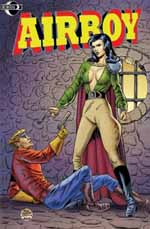
There was a long arc at the end of my run on Airboy that I felt at the time could have been presented better. The conclusion (with art by Adam and Andy Kubert) worked out great, but the lead-up to it didn’t come out the way I’d envisioned it.

What inspires you to write?

Everything. I’m a compulsive writer. I read recently where David Mamet said, “All prolific writers are lazy.” I think the fear of having to do actual manual labor drives me to write.

What writers have influenced your style and technique?

Archie Goodwin would be number one. Then Larry Hama, Harvey Kurtzman. Carl Barks, John Stanley and Frank Robbins.

Where would you rank writing on the "Is it an art or it is a science continuum?" Why?

It’s a craft. It can be art but not if you set out to make art. You learn what works and what doesn’t and spend your life (if you’re serious about it) trying to warp the rules to come up with something new. Even if you fail, the endeavor is what it’s all about.

Any other upcoming projects you would like to plug?

Well, I’m still on GI Joe and Snake Eyes over at IDW. I do a half dozen stories a year for Simpsons and Spongebob. In addition to that I’m adapting Robert Jordan’s Wheel of Time cycle to comics. And I’d like everyone to go see Dark Knight Rises a dozen times.

========================================

For more information about Chuck Dixon, step inside a comic book shop and ask for the best damn story ever. If you need more info than that, go to his website.