Showing posts with label literary fiction. Show all posts

Saturday, October 7, 2023

[Link] 24 Approachable Literary Journals


by Emily Harstone

If you are just starting to submit your work to literary journals, or perhaps you just want to avoid rejection, this list is for you.

All of the literary journals in this list accept between 20 and 80% of what is submitted to them, and a few have a higher acceptance rate. So the odds of your work being accepted just went up.

These are not the most prestigious journals; publication in them, in all likelihood, will not change your writing life in any way, but they are not a bad place to start if you are new to submitting your writing.

Make sure to read the guidelines before submitting to know if your work fits. Just because they are approachable, doesn’t mean that they will accept angry poetry when they only publish nature poetry. They will not.

Not all literary journals in this list are currently open to submissions, but most are. It is also important to note that this information is subject to change. Sometimes a journal that was once easy to get into no longer is, so if you are seeing this list long after it was published, please keep that in mind. This list is in no particular order. 

All of the information used to ascertain if the market is approachable or not was found through research done at the websites Duotrope and The (Submission) Grinder.

Read the full article for the listing: https://authorspublish.com/24-approachable-literary-journals/ 

Wednesday, July 1, 2015

Nugget #57 -- Mixing Fiction

Mixing the "high ideals" of literary fiction, with 
its focus on characterization, meaningful symbolism, 
and grand themes, and putting those ideals into the 
"common writing" of adventure fiction, likewise, really 
gets me motivated. There's nothing in the rule book 
that says a genre writer should write poorly 
or ignore the history of classic fiction.

Tuesday, July 15, 2014

Nuggets #14 -- Literary Subtlety

I can still exercise my literary subtlety from time to time, but never at the expense of comprehension.


Friday, April 25, 2014

[Link] Why I hate the term "Genre Fiction"

by K.S. Daniels

People in the literary scene like to throw around the phrase "Genre Fiction". When they do this, its usually in the context of "Oh, but that's genre fiction" (you'll have to imagine the condescending tone for yourself). You see, the term is an insult. Any novel that isn't, according to some literary or academic snob, high-art (definition in a bit) is garbage or smut. Its genre fiction.

Read the rest: http://ksdaniels.blogspot.com/2013/01/why-i-hate-term-genre-fiction.html

Sunday, March 18, 2012

The Writer Will Take Your Questions Now (#113) -- Literature (With a Capital 'L')

A few days ago, you said you incorporated literary fiction into your genre writing.
What do you mean specifically when you refer to literary fiction?

Front and back of the Nobel Prize for Literature.
That's actually part of what I was saying in my previous blog post, only without coming out and actually asking the question. If so-called "literary" stuff is all over genre fiction, then what's the distinction anymore? That's my take, anyway.

But, to actually try to answer the question wholesale for the sake of this question in particular, I'll first share the answers that I've experienced during in my writing career, the ones that aren't taught per se, but implied with great and fervent gusto.

1. Literary fiction is what they teach in school.

2. Literary fiction is the opposite of genre fiction.

3. Literary fiction is intrinsically better than all other forms of fiction.

Of course, I disagree strongly all three of these statements.

My personal definition is this:

Literary fiction is that work that transcends its immediate classification or genre to resonate with a generation to the point that it becomes ingrained as part of that culture. Because of that, it outlives the rest of the fiction of its time.

Okay, you ask, but what does it look like? What does that usually entail?

1. It usually seems to be set in the contemporary time of its generation (Gatsby, For Whom the Bell Tolls, The Americans, Seven Gables,etc.).

2. It begins as a "genre" work of its time and doesn't set out to be "literary" for the sake of being "literary."

3. It usually breaks the "genre rules" to the degree that it also connects with those who don't normally read that genre (Oates' doomed romance of Black Water, family drama of Smiley's A Thousand Acres, horror of Faulkner's "A Rose for Miss Emily," the southern fiction of Hurston's Their Eyes Were Watching God, the sci-fi of Bradbury's Fahrenheit 451).

4. It only becomes "literary" after the fact because the people with whom it resonated become teachers and professors and make it so by teaching it as such.

5. Although it gels with a single generation to become "canon" it has the ability to live on and still impact and affect subsequent generations too. If not it within a generation or two or three, it fades from it's "literary" podium and becomes forgotten (as many have, including several that I grew up having to read that my kids and the generation between them and me have never heard of and are no longer taught).

6. Much of what is touted as "literary fiction" within a current generation will fade away. It is simply a classification to sell books without having to subject them to the stigma of what genre they actually are -- romantic drama or coming of age stories or thrillers (etc.)

But that's just my opinion on it. You're mileage may vary.

Friday, March 16, 2012

The Writer Will Take Your Questions Now (#111) -- Literary Genre Writing

A few days ago, you posted about applying literary 
technique to genre fiction. What did you mean by that?

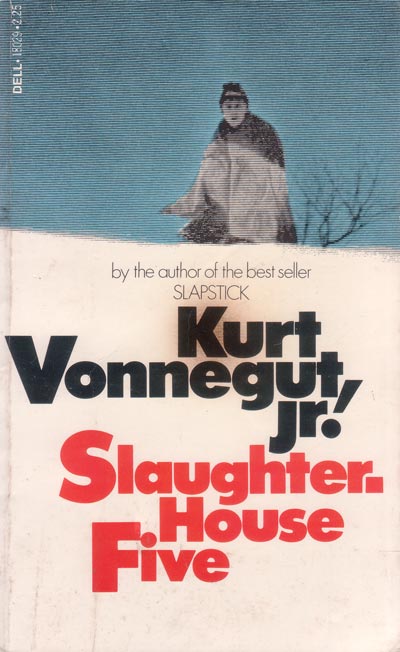
I think Ray Bradbury and Kurt Vonnegut are excellent examples of writers who elevated the genre in which they wrote. Fahrenheit 451 is a great action story, but it's deeper than that. Slaughterhouse Five is an amazing time travel story, but so much more than that.

Why?

Because the story had substance beyond the mere plot. The characters resonated with readers because of WHO they were, not WHAT they were. The themes spoke to fears and ambitions common to most of the readers. The stories made statements, but not at the expense of a great yarn.

In short, they did the same thing Hemingway and Faulkner and O'Hara were doing, but they did it in a "lesser" genre known as science fiction. They didn't get caught up in the genre vs. literary hang up publishers and writers have today. They borrowed and mish-mashed stuff together right and left and made both the worlds of both genre and literary writing better because of it. 

I want to do the same with whatever genre or format or setting in which I write, from comics (a format, not a genre) to pulp and horror (genres) or super heroes and steampunk (settings). I just want to continue to tell good stories that hopefully have meaning beyond just the surface action.

Saturday, March 10, 2012

The Writer Will Take Your Questions Now (#105) -- Literary No More?

Do you ever plan to write literary fiction again, or do 
you consider that part of your writing career over?

Maybe. Maybe not. However, that doesn't mean I've abandoned the things that writing lit fic taught me. Even in pulp or comics or horror or steampunk stories, I tend to return to the tools of the literary tradition and fill my stories with symbols, characterization, and action beyond the mere physical to the emotional/psychological. I still prefer to write my characters as realistically as possible, rather than be satisfied with mere stereotypes (even in a genre like pulp that relies heavily on such stereotypes).

I'm of the belief that there's a place for literary horror tales, literary super hero tales, literary pulp, literary steampunk, etc., even it it's not billed that way.

And chances are, it will most likely come out that way when I write it, simply because it's being filtered through the sum of my writing experiences.  Considering I got my start on the tales of Hemingway, Faulkner, O'Connor, Welty, Morrison, Hurston, Fitzgerald, Vonnegut, and Carver, that probably isn't really any big surprise to anyone who knows me.

That said, I do have a folder of unfinished lit fic short stories I'd like to finish and publish as a collection one day.