Showing posts with label Nikki Nelson-Hicks. Show all posts

Thursday, March 26, 2026

Bear with me... (guest column by Nikki Nelson-Hicks)

This might all be horseshit

by Nikki Nelson-Hicks


Today, I hit a wall of disappointment.

Way back in October, a friend sent me info on an open submission call to an anthology that, if I were to get into, would really skyrocket my writing career.

“This is so up your alley, Nik!”

So, I wrote a story. I put everything on hold and worked on this mamajama for months and months. Sent it to friends who read it, gave me editing input, rewrote the whole goddamn thing again and again until it was finished.

And I submitted and waited. Every day, I’d check to see if my story had been accepted.

That was the perspective I used. ACCEPTED. Not, ‘Hey, has it been rejected yet?”

ACCEPTED. Putting out positive vibes into the Universe. Just like all the Motivational Posters tell me to do.

Today, I got the email: Thanks, no thanks. REJECTED, ya loser.

I swallowed my bile and went on with my day. I’m a busy bitch. I ain’t got time for none of that.

But it was still there. No matter how much I ignored it. The hurt. The shame. The OH FUCK, I SUCK.

But I went on with my day.

Until... a little voice in my head piped up, “Look at you, grinding your teeth. Why? Because of one little rejection?

Fuck those guys.

Look, let’s settle this, right now. Answer this question: What are you writing for? Why? Who are you writing for?

Because, sweetpea, here’s the real deal.

If you are writing for publication, then you need to study the market, see what sells, and write to please the Market.

If you write to tell a story that you want to share with the world…well, sweetpea, you just write what you want. Publish it. Put it in a sock drawer, fuck. It’s yours to do with as you wish.

What do you want?

If you want possible financial success, popularity, literary stardom, pursue the Marketing Path. It’s a Whore’s path, but accept it if you want. I’m not judging. You do you. Nothing is real, anyway.

If you want to have fun making up stuff and writing stories that you find challenging and might entertain a handful of friends, then pursue the Artist Path. It’s gonna suck. You’ll probably die alone, unknown. Your kids will inherit boxes and moth-eaten journals of all your stories, finished and unfinished, and probably throw the whole thing into a rubbish heap, but them’s the breaks, sweetpea.

Both paths are fine in their own way. Just, for the love of the moon above, decide where you want to walk, stop moping about one stupid story and get to work.

Damn.”

Yeah. My Guide is a tough broad.

(Originally published on Nikki's Substack.)

Thursday, October 23, 2025

Discovering Yourself In and Through Your Writing


Just one question for this next writer roundtable.

Flannery O'Connor wrote, “I write to discover what I know" and “I write because I don’t know what I think until I read what I say.”

How has being a writer and telling stories helped you discover who you are and what you know?


Nikki Nelson-Hicks: Very interesting question. For me, some of my stories have helped me to touch on emotions that I didn't realize I had inside. Very much poking a blister and letting some stuff ooze out. I have also enjoyed creating characters who have the bravery I wish I had. That's also very insightful.

Jessica Nettles:
Being a writer as a kid helped me embrace my differences from the other kids at school. It gave me a space where it didn’t matter that I was the youngest or the smallest or weird. It was the first thing I felt confident was mine.

As an adult, it helped me rediscover myself after a really shitty marriage in my twenties. I found this spooky girl in the middle of the debris who needed to explore the darkness, my darkness. I learned my dark parts were okay and just as important as being good. I love that spooky, magic-loving girl. I learned that I have a voice that people actually enjoy (still shocked by this) and that I’m funny. Mostly, I learned that writing is who I am. I do many things, but at my core, I am my words. That’s my magic.

Lainey Kennedy: Writing has helped me explore the human conditions by creating characters that are both over the top but rooted in little bits of everyone I know. The adventures are the escapism, but the characters are what I know.

Fay Shlanda: My writing has helped me a lot as a person. I write poetry about my relationship with the world around me, which is mostly about mental illness and being broken.
I have discovered that I have much to say on the subject and that overcoming my hardships is something I would not trade in for an easier life. They have shaped me into someone I like and I use my knowledge to help others.

October Santerelli: I wanted to be a writer as soon as I heard it was a job you could have. I was in 7th grade, and I went home that night and told my parents that was what I wanted to do. And after that, writing became a lifeline, a way to express what I couldn't say, feelings I didn't even know I had. Writing helped me understand myself, like holding up a mirror and seeing with fresh eyes.

Thursday, November 21, 2024

The Influence of Folklore on Genre Fiction


I did a panel with several wonderful, super-intelligent folks at Multiverse Con. It was so inspiring that I wanted to bring the topic over to the blog and open it up to our writing community at large. 

The panel was on folk magic/folk horror, (as evidenced by films such as Midsommar, The Village, The VVitch, etc.) but I think it applies to general genre fiction throughout as well. So, that's where we're going. 

Ready?

Folk magic and folklore began with the common people (folks), or as author Jessica Nettles put it on the panel, "As long as there are people, there is folklore." With so much emphasis in fiction having been spent on the rich or leisurely class, how has this notion of the commonplace protagonist influenced your writing?

Danielle Procter Piper: I shall admit a wealthy protagonist is not often necessary, but written as such for convenience sake. So many stories involve characters doing things while not at a regular job, that it's easiest to explain it away by making them wealthy/important enough to be free for whatever adventure the story calls for. That said, I love the new wave of stories I'm seeing where characters do have fairly regular Joe lives and there are consequences for vanishing to save the world or what have you when school or work is imperative. 

Nikki Nelson-Hicks: The first thing that comes to mind is Alan Moore and John Constantine. He said he wanted to make a magic user that was from the streets and not some lofty white tower. I’ve always loved that.

As for my work, the best examples of folk magic are in my Jake Istenhegyi stories. Jake, the protag, doesn’t use it as much as he gets used by it. The stories are set in 1930’s New Orleans so, of course, vodun, is the first thing to play with but I was able to dip my pen into Golems and Alchemy. While doing research into some of the folk tales of the swamp, I came across the Boodaddy and I used it albeit I did take some creative license with the creature.

A story I am working on currently, Crown of Feathers, is about a boy on the brink of losing his mother but, against the advice of the granny witches that live on the hill, he finds a way to snatch her from the claws of death. Although it doesn’t work out the way he plans. I’ve been doing a lot of research into Appalachian death culture and hedgewitchery.

So, yeah. Long story short, folk magic always somehow influences me.

Jessica Nettles: I feel like my characters are commonplace almost always, probably because I see myself as pretty commonplace. In that space of the commonplace there is the folklore. As a Southern woman, folklore is part of my infrastructure. We are taught it from the time we can hear stories and learn what's important. This feeling of being commonplace and being "not the lady or the Southern Belle" has made me aware of the people who farm the land and are the plain folk. I was raised not only around women like my granny, who taught me how to pick peas and read, but also around my daddy, who took me fishing, taught me to fix old furniture, and to also watch where I put my hands and feet in the woods. My characters often are those sorts of people instead of the well-off. I know those people best.

Kay Iscah: Far more of us are common people than wealthy. We may enjoy the fantasy of wealth, but we’re more likely to relate to people who remind us of ourselves or at least the challenges we face. However, I think there’s a distinctly rural aspect to the term folklore that implies a degree of isolation and being on the edge of nature. Particularly if you’re urban or suburban, visiting rural relatives takes on a magical aspect because you’re so much closer to the edge where you can step out of one world and into another.

In the two Before the Fairytale coming-of-age stories that I’ve written, early on the characters from humble backgrounds pass through the same forest as a significant passage in their journey, though they’re headed in different directions. The back and forth between the safety of civilization and the mystery and danger of the wilds is something believed at the heart of much folklore.

Sean Taylor: I've always preferred the common folk when I write. Even when I write Pulp stories, whose stable of heroes come from the richest and most leisurely people, I tend to want to surround them with the common folk. When I create my own, such as with Rick Ruby, it was important not to make him independent and wealthy, which is typical of a Hammett and Chandler hero, but also to put him in a culture not his own, a white guy in a black world, where every one of his preconceptions is challenged. 

I don't tend to use a lot of magic or spiritual power unless I'm specifically writing fantasy, but I love the notion of the "dark" being looming and mysterious and dangerous, and I picked that up from reading both Gothic lit and fairy tales. 

Lots of folklore comes from people who have been "othered" by those in power, for example, by race, poverty, or gender. Folklore-inspired tales give power back to those people (often for vengeance in horror, for instance). How do you use othering and the empowerment of the "other" in your work?

Danielle Procter Piper: In my sci-fi series, the hero becomes everything he despises and fears...and while many believe he has become a villain... he actually still works for good, but on a much grander scale. In a way, it suggests God doesn't do enough little things because perhaps He's busy with even bigger things...and that's not an excuse to ignore the plight of those who struggle. In my Medieval fantasy series, the hero is about to achieve something uncommon that should be beneficial...but which drives him to push his limits to overcome mockery and protect others similarly mistreated. Eventually, he must give in and become something dreadfully fearful just to save innocent others. In both cases, my heroes must learn to accept and embrace dark things that not only terrify them but completely change them in the eyes of others—even those close to or who love them, sacrificing who they are as they learn how to use these new identities for good no matter the consequences to themselves. 

Kay Iscah: Continuing with the two characters already mentioned. One is an orphan who thinks she’s been abandoned, and the other is an abandoned child who thinks he is orphaned. I’m definitely a fan of clever protagonists, so both work their way up to better positions or at least respectable work with a mix of luck, skill, and determination. But both also make decisions to walk away from situations that might have given them material gain for moral reasons. I had not intentionally set up that parallel, but I see it now. I certainly think there’s a theme of how far you’re willing to go to find acceptance. Are you willing to walk away from power, community, or comfort if it compromises who you are? They both take completely different paths. One walks away from society completely to essentially become the witch in the wilderness, and other works his way up to management and then a royal court position. I don’t think either is wrong or better, but it’s different paths to empowerment. One creates her own space, and the other moves to a position where he might be able to influence larger-scale social change.

Sean Taylor: I love to either set stories in "othered" places, like with Rick Ruby mentioned above or to look for the "other" even in characters who don't immediately seem like an "other." For example, when I wrote Agara, a sort of female Conan for Black Pulp II, I wanted her to be disconnected from everyone else. I wanted to explore someone who exists outside of community but still must live within one. A lot of super hero fiction deals with this as well, I've found. They only pretend to be part of it, but in reality, they have a unique set of problems and issues "normies" can't possibly understand. 

One of my favorite aspects is how the power balance is restored and even tipped to the "other," whether my story has genuine folkloric elements or not. Agara wins, but at the expense of community, which she remains distant from. Rick Ruby's world influences him far more than he influences it. Even in my horror tales, the true power tends to reside in those who are outside the norm. 

Nikki Nelson-Hicks: In the collection of short stories I am working on, Politics of Children and Other Stories of Revenge, I play with this idea in quite a few of them. In, "A Beautiful Thing," a Golem is able to get revenge against the murderer of his protector with the help of some furry friends. In Sweet Revenge, a witch gets revenge against the bank president who finagled the foreclosure of her candy shop.

Magic is a way for the powerless to feel as if they have some kind of say in a game that is rigged against them from day one. I am guilty of that. I have two altars in my office. One is for blessings; I keep it to the right of me, close and under the care of Bridgid. The other is way back in the left side of my office, under the care of Maeve, is where I collect my hex jars. Do I believe that these quaint little jars hold any real power? Is it all just a psychological tool to deal with life with a dose of magical thinking? Maybe. Maybe not. Either way, it gives me comfort.

But in fiction, all things are possible. And I can take revenge with absolute impunity.

As for themes, folklore typically includes what DL Wainwright called (on the panel) "strangeness and wonder." In its origins, it often involved the encroachment of the dark and mysterious (often the forest or night) on the so-called normal world of the village or daylight. Does that encroachment of dark upon light weave into your work? Howso?

Danielle Procter Piper: All of my writing deals with heroes encountering and learning to function within the darkness of life. It's just a metaphor for dealing with all that life throws at you and discerning if there's anything good that may be wrought from it.

Jessica Nettles: I don't think the folklore comes from being "othered." The folklore comes from people who have their own primary cultures that are not ours so we don't understand (and in some cases don't want to understand) the importance and power of those stories to "those people over there." In Menlo Park, my witch, Deborah, has been othered because she comes from Romani roots and people fear her witchy powers (she is a VERY powerful witch). Her back story lands her in one of the asylums in New York City because no one knows what else to do with her. Her true power comes in her ability to love and believe in what she knows is true when no one else can. She's not powerful because she's Romani. She's powerful because she loves and is loved by her created family and that grounds her magic. She still believes in her folklore and the magic of her folklore, but in a way, she has created her own branch in her folklore.

Sean Taylor: Now this is a theme I can really get behind. My entire horror short story collection A Crowd in Babylon is based on the fuzzy line that happens where normality and strangeness & wonder meet. One of the stories went back to Indigenous Peoples legends. Another combines folk magic with the quantum mechanics ideas of M-Theory. And one of my favorites goes back to the metaphor of the crossroads and the Blues but removes the crossroads and puts the story in a dive bar in the middle of nowhere. One I'm currently working on involves a couple getting an unbelievable deal on a house... as long as they don't remove the dead squirrel in a jar in the cellar -- a sort of folkloric protection or ward. 

Nikki Nelson-Hicks: The hedgewitches in my Crown of Feathers story are representatives of the Furies: Alecto (mother), Tisiphone (maiden) and Megaera (Crone). Alecto and Meg, the Mother and the Crone) often fight about their responsibilities to help the Protag since he started the whole mess. Meg isn’t one to mess around with. She has no patience and enjoys the taste of a young boy’s flesh.

I like to entangle what might be consider Dark into the Light of my fiction. Mainly because Anger, which is always seen as somehow negative, gets shit done.

But I’ve always been drawn to the antihero.

Jamais Jochim: This is sort of what I'm playing with my Vella book. Folk stories are how we explain the weirdness in our lives while looking at the existence of the awesome and the profane, and how they are sides of the same coin.

Kay Iscah: I think I skipped ahead with my first answer, but yes. The first scene that pops to mind is young Phillip making a nest in a tree, and unable to sleep, he listens to the night noises around him. He’s very aware of his vulnerability and has a similar moment of hyper-awareness when he takes shelter with a tanner in an isolated cabin. There’s another scene where he encounters fireflies for the first time and I think it shows how nature can inspire certain myths about fairies and other creatures of folklore. If I remember correctly both of the bandit attacks that dramatically changed his life happened in daylight in an isolated place. He also encounters actual magic for the first time in daylight, so it’s a bit of flipping the script on his expectations. The girl’s story by contrast is constantly setting up tropes to sidestep them. She is a shapeshifter, the fairy, and a strange old lady who lives alone, so night does not tend to intimidate her to the same degree. She often finds comfort in it; “The stars hummed a lullaby… dreams lack all restrictions. So that night she could be small as a bug or big as a mountain.”

One of my favorite quotes from the panel comes from Dee Norman. "That's how folk magic survives -- through efficacy, not explanation," she explains. How do your magical or belief systems in your work, more commonly fantasy, horror, or some more esoteric sci-fi, line up against this notion of folk magic being more a practice than a doctrine?

Kay Iscah: In the world of Seventh Night where my examples come from, I describe magic in terms of rhythm and song. It’s based on the more scientific idea that everything vibrates, but with the more mystic idea that these vibrations can be harnessed and shifted to produce almost any desired effect. I do think this ties into common magic tropes of saying the right word or humming the right tune. There’s also an element of potion-making, which ties to understanding the potential effects of the ingredients. It’s a blend of science and art.

I do distinguish magic/sorcery and witchcraft as separate practices. The first has more to do with rhythms and is not seen as a spiritual practice by those who practice it. Witchcraft by contrast utilizes spirits, and there’s a stronger taboo against it. Laymen may confuse the two.

Jessica Nettles: Dark and light must always push and pull against one another. In my stories, there is always that element. There is the small town that seems very familiar and the people seem so nice, but there something swimming in the undercurrent you can't see, but can sense. If we're honest, this is more true than not, but most of the time, no one wants to say that out loud. My Eulaila stories explore those small spaces--those towns and areas where things seem off by about two steps, but maybe to the drive-thru tourist, on their way to Panama City, might just guess at. In my Three Sisters stories (y'all ain seen them yet) there is also this same push of darkness and light with the sisters witching their way against various dark elements that seem drawn to their small town for reasons they haven't figured out yet.

Nikki Nelson-Hicks: This reminds me of the dichotomy of Wizards and Witches in Discworld. The Wizards go to a college and spend all their time debating and studying the idea of magic. Witches just WITCH and get shit done.

I tend to waver between ritual and natural magic practices in my fiction.

In my story, "What the Cat Dragged In," the witch in that story is highly ritualistic. Her hex jars are meticulously prepared. Plus she has jars with Kabbalistic sigils on her shelf. Not something a hodge podge hedgewitch would have sitting around.

In the story, "A Beautiful Thing," the Golem has to follow strict rituals as does the John Dee Wanna-Be wizard that it has to fight against.

I prefer the more hodge podge sort of magic that my girls in Crown of Feathers deal out but that’s probably more due to my ADHD than anything else. I don’t have the attention span for ritual.

Danielle Procter Piper: My Medieval fantasy is watching "magic" struggle to thrive in a world where religion and reason fight to suppress both the average person from obtaining what they need on their own and to drive away magical beings and creatures that prove there's another way of getting what you desire that does not rely on obeisance to others. In order to control the masses, you must strip them of their ability to get what they need on their own and convince them that what you say and do is the only way to accomplish things. You introduce government, capitalism, and religion to provide for yourself and those you deem worthy on the backs of innocent others you break with rules that only work so long as you keep throwing them crumbs. The self-empowered person is considered radical and potentially dangerous for what if he or she showed people there's another way? You lose everything you worked so hard to build by letting the commoners know they had the ability to provide for themselves all along—they just needed the knowledge you've worked so hard to convince them was unsafe poppycock.

Sean Taylor: I avoid doctrine in my work as much as possible. I love the idea of loosey-goosey belief systems because, honestly, that's what even most of our entrenched religions were before they were voted on and codified and made safe at the state level (Constantine). And it's so much fun to play in that area where "good Christian people" will argue about a dead squirrel ward in a house for protection or a suburban family will continue to wait up on the night of a new birth in the family for the spirit of an ancestor to show up for a blessing (that's another currently in progress). It's also fun to see ardent atheists encounter something supernatural that sends their world into a spin even if it doesn't trigger any kind of faith. Just the tailspin of supernatural stuff is enough for a good story, especially if it comes from a place intrinsic to their family's past that they thought they were so far beyond having to deal with as modern people in a real, scientific world. 

Jessica Nettles: Deborah would agree with Dee. Magic is practice. It's everyday living for her. It's in her music when she plays her cimbalom between shows, or when she sings as she makes tea. She sees it in the way Thomas, her husband, smiles and his eyes light up when she teases him about the way he likes too much sugar in his tea. It's the way she and her son Seth connect over his dreams. Sometimes it just the way a meal comes together at the end of a very long day. Magic has to be practical in nature and connect to something that applies to life. Doctrine doesn't do that. Those are just rules. Practical magic is a daily, living thing.

What are stories, novels, short stories, or graphic novels, that best highlight the ideas of folkloric influence that you would recommend to others who want to learn how to include such themes in their work?

Danielle Procter Piper: Fairy tales, the ones most of us heard as children, are the best springboard for jumping into folklore as many of these stories are centuries old...but please don't write another variation on any of them. I've read dozens and dozens of variations of Snow White and Cinderella and the lot and most are drivel with very few introducing anything new. It's much cooler if you forge your own fantasy world.

Nikki Nelson-Hicks: Check out the Witches and Wizards in the Discworld series. My favorites are: Lords and Ladies, Witches Abroad, and Carpe Jugulum. For Wizards: Interesting Times and The Colour of Magic.

Graphic Novels: Hellblazer and Promethea or anything done by Alan Moore. He’s a maniac and an actual wizard. Very interesting ideas on magic.

Jessica Nettles: Start with the basics: Read your mythos. Which ones? All of them? As many as you can learn about. I started reading Greek mythology when I was very young (I look back and realize that it was probably too young). Then I learned about other mythos and read them too. Why do that? Because this gives a better understanding about what people believe and why some magic works certain ways. Read good books with strong magic systems, like Wheel of Time (okay, I'm not a huge fan, but the magic system is pretty consistent), Jonathan Strange and Mr. Morrell, the Sandman (yes, Gaiman has issues, but his magic systems are spectacular and his writing is worth studying), read Dr. Strange and some of the other Marvel titles that deal with cosmic magic (once again, somethings are problematic, but also there are a lot of really cool things that happen in this magic system that are worth studying, plus they play around a lot with mythos and their takes on folklore). Also read things from people who don't look like you. It's really easy to fall into reading information filtered through those who are part of your culture. When you do that, you miss all the nuances of the culture you are learning about. It's one thing to learn about Anasi from a very Western point of view than it is to learn about Anasi from the African or even West Indies point of view. Same with magic. If you are going to learn about magic of certain cultures--talk to the folk who practice it or find books by the folk who practice it. I recommend reading folks like Nicole Givens Kurtz, Milton Davis, Geneve Flynn, L. Marie Wood. You will get schooled.

Sean Taylor: I think there have been some amazing comic books and graphic novels exploring folkloric themes. The Writer from Dark Horse looks into Jewish folklore and mysteries. Harrow County is hands-down my favorite take on mountain haints and spellcraft. Obviously lots are drawn from folklore in The Sandman, even if Gaiman himself is a bit tarnished. Image Comic's I Hate This Place begins as a sort of homage to folk horror before sliding off into Lovecraftian themes. 

As for books, no one does this better than Angela Carter in The Bloody Chamber or Shirley Jackson in "The Lottery." 

Kay Iscah: Definitely Brothers Grimm Folklore and Fairytale collection for my work as I borrow elements of the folklore style, particularly in The Girl With No Name. But I think it’s good to read broadly. I lost my African folklore collection in a housefire, so can’t give you the title, but it’s a big influence on one of my works in progress. I make a reference to Bringing the Rain to Kapiti Plain, which is a retelling of Nandi folklore. In Seventh Night there’s also a nod to Legend of Zelda.

A lot of folklore is retelling of older myths with a local flavor thrown in, which may be hard to recognize if you don't know the older myths. Reading The Mabinogion before rereading Brothers Grimm helped me start connecting several of the Grimm stories to older myths, Celtic, Greek, and Bible stories. I think the more you dig into mythology, the more you see the patterns as stories are told and retold.

Tuesday, November 19, 2024

Nikki Nelson-Hicks: Opening a Vein of Anger

In second-grade, Nikki was tagged as being gifted when she attempted to check out a book on bats and it was discovered she read at a fourth-grade level. The truth of the matter was that she believed bats could turn into people.

When Nikki was in sixth grade, she wrote and performed a play, The Hunt for Bigfoot, and later created the Monster Hunter’s Club which entered a cryptozoology exhibit, the first of its kind, in the annual school fair.

It won an honorable mention.

After that, things started to get weird. 

Meet Nikki Nelson-Hicks.

Tell us a bit about your latest work.

Since 2022, I have been working on a collection of short stories that circle around the theme of revenge titled, Politics of Children and Other Stories of Revenge. These stories range from the black and white vision of children in Politics of Children, to justice being meted out by the desperate in Brother Marvel’s Old Time Revival, to how the vengeance of a protector can last eons in A Beautiful Thing to a modern retelling of Poe’s Cask of Amontillado in Black Cherry. There’s also a quick bit of body horror in Sweet Revenge that I threw in there for fun. If the editing process continues for as long as I fear it will, I might also add the story, What the Cat Dragged In, that was published in 2023 by St. Rooster in the horror comedy anthology, Razor Blade in Fun Size Candy.

Hopefully this will come out sometime in 2024.  Sometimes, persistence is more valuable than talent in this game. 

What are the themes and subjects you tend to revisit in your work?

Years ago, a writing teacher told me during a review that everything I write has a vein of anger in it. “If you wrote about kittens, they’d be angry kittens. What’s up with that?”

So, yeah. There’s a lot of anger in my work. Also, loneliness, isolation and injustice.

Just like the real world which, let’s face it, is a shitshow.

SO, as the Creator of my own little worlds, I like to dispense justice as I see fit. Call me an Agent of Nemesis. In my stories, the bad get gutted and the good get what they deserve.

Oh, and monsters because they are fun. 

What happened in your life that prompted you to become a writer? 

My therapist told me that most people who survived a childhood like mine ended up either as an alcoholic, a drug addict, or a prostitute.

I took another path. I became a reader. 

I read as a form of self-defense. I shielded myself in fantasy and story to survive. 

That’s why I write stories. To give people that sort of shelter and diversion to help them cope.  I write stories to give people distractions for when they need one, say, at the doctor’s office, riding the bus or on the toilet. It’s a lofty goal.

What inspires you to write? 

I’m not sure how to answer this. 

If you mean, “What inspires you to sit down, tap on the keyboard and write stories?” I guess it would be the simple answer of  “To maintain my sanity.” When I don’t write or pour myself into something creative, I tend to go dark and that isn’t good for anyone.

If you mean, “What inspires my stories?” Well, that is hard to answer cohesively. Many of my stories that are out there so far were created because I was challenged by a publisher to do them. 

“Give me a story about a fairytale creature versus a historical Wild West person.” The Problem at Gruff Springs 

“Take two cryptids and make them fight.” Rumble 

“Write me a pulp detective story that involves chickens.” A Chick, A Dick and a Witch Walk Into a Barn (The first of the Jake Istenhegy stories)

OR

I’ll read something and have a question: “Why do all the women in Poe’s life die?” The Perverse Muse

OR

A few years ago, my son popped his head in my office and asked, “Hey….if rats ate a golem, would they become the golem? Like a flesh golem made of rats?” Well, HELL! That story rolled around in my brain and I’ve been working on it ever since. It’s the core root of my story, A Beautiful Thing, that will be in the Politics of Children and Other Stories of Revenge

In the end, I must blame this compulsion on either poor mental health or just a stubborn competitive edge. 

What would be your dream project?

I don’t really have a dream project. I start every story as if it were my Breakout Work. So far, it’s not happened but, who knows….maybe the next one will be it. And if it’s not. Oh well. Keep on trucking. 

But, if we’re going to dream, let’s dream big.

My favorite daydream is where, out of the blue, I get a phone call from Mike Flanagan. 

“Hey, Nikki, this is Mike Flanagan. My brother, Jeremy, met you last year at Authorcon and was so impressed by you at the panel you two did together (editor’s note: this part is true. Jeremy Flanagan and I were on a panel together and I made him laugh. Twice. It was the highlight of the weekend for me.) that he bought all your books and, well, I read them and, damn, girl! You are good! Want to team up and make some movies from your books?”

We’d make movies that would be blockbusters and we’d become BFFs.

The end.

If you have any former project to do over to make it better, which one would it be, and what would you do?

It’s the Creator’s Dilemma, isn’t it? You look back on past work and see nothing but faults and how you’d do it better now because you’ve grown and changed since the time you created that story.

When I got all the rights back to my Jake Istenhegyi stories, I spent a year rewriting and recrafting that world. Trying to make it better and more polished. 

I suppose the same could be done for all my stories but…that’s okay. I like them to stay the way they are. They show my growth as a writer. 

They are all my babies, lumpy and imperfect as they are, and I love them.

What writers have influenced your style and technique?

Terry Pratchett, Flannery O’Connor, Stephen King, Rod Serling, Sharyn McCrumb, E.A. Poe, Octavia Butler, Josephine Tey (The Daughter of Time…excellent), Neil Gaiman, et al. 

Where would you rank writing on the "Is it an art or it is a science continuum?" Why?

Writing is a form of magic. Almost necromancy, in a way. I can talk to dead people, hear their voices in my head when I read their work. So, it’s a dab of art and a dash of science.

What is the most difficult part of your artistic process? 

Getting out of my goddamn way.

Did you know, neuroscience has found the Sweet Spot of Creativity? And, yes, it includes alcohol. 

They found that a BAC 0.075 was the magic number when it came to creativity. Why? It was *just enough* to lower inhibitions, shut off your temporal cortex enough so it quieted the inner editor but left you still cognizant enough to actually create something worthwhile. 

AMAZING! 

How do your writer friends help you become a better writer? Or do they not? 

Healthy competition is a wonderful thing. However, more than not, my writer buds have talked me off the ledge more times than I can count. Writers need a special kind of tribe that keep them encouraged and strong enough to put up with the shit we get from publishers, critics and general trolls. 

Plus, it’s good to be with people that understand the struggle. They get how hard it is to create a world from nothing. 

What does literary success look like to you? 

When I was a kid, the idea of getting published was the cherry on top of everything. HAHAHA! Sweet summer child.

Now, as a grizzled old fart, I’d really like a royalty statement that has more in the front of the decimal than the back. 

Sure, I crave external validation, awards and opportunities but, but, in the end, it comes down to writing a story that you believe in, and you know, in your heart of hearts, is a *good* story.  

Although having someone give me the thumbs up is nice too. 

Any other upcoming projects you would like to plug?  

No, Politics of Children and Other Stories of Revenge is taking up a lot of 2024. I really want this collection to be good. Maybe even Stoker quality good. Aim high!

I’m not doing too much in the con circuit this year but I will be at Authorcon in Williamsburg, VA from April 11-14. 

OH! I am the Co-Chairperson for the Horror Writers Association, Tennessee Chapter and if anyone in the Tennessee would like to become a member, reach out! We are a new branch with 20 people strong and would love to add more members. 

For more information, visit: 

Nikki's Altars:


Hecate

Bridgid

Maeve

Tuesday, June 14, 2022

Balancing Backlog: When the Well Overflows


Let's talk about balancing ideas and projects. I can't think of a single writer I know who doesn't have ideas that float around in their head to wake them up or keep them up at night -- and typically ideas not related to the current WIP. Oh, what's a poor writer to do?

Are you the type of writer who has a massive backlog of ideas to explore in your stories or the type who deals with one idea at a time and then turns on the idea machine afterward? How do store that backlog, whether digital or on paper?

Marian Allen: I have so many projects already in the pipeline, I don't have the brain capacity to do anything with new ones. EXCEPT! I do Story A Day May every year, and those flashes of ideas are great to prompt daily stories. I also have a big folder with story ideas in it, and, in the rare times when I need something to write, I dig into that. I've used it for many stories.

Jay Requard: Massive backlog. It is currently all in notebooks but I'm transcribing one part to digital after the baby got a hold of it.

Elizabeth Donald: Ideas are fleeting little butterflies that need to be captured in jars before they get away. I keep a folder on my computer titled “Marinade” where I put the stray ideas. They have to sit there and think about what they’ve done, and when I need help I go for a walk through the folder. My first novel is in there, in all its drafts going back to the utterly dreadful high school novella, and there are reasons why it’s never seen the light of day. The next oldest file in there is from 2002 and may not actually be translatable now, but why would I let it get away? If I’m not near my computer when an idea strikes, I will use voice-to-text to stick it in my phone until I can translate it to my Marinade file. If I tried to keep it on paper, I would inevitably lose it, and there goes my Pulitzer.

Bobby Nash: Depends on your idea of massive. There are many ideas tucked away for future use. Some I will never get to, I suspect as new ideas keep working their way into my brain. One of the best things about having these ideas sitting in writer limbo is that sometimes, I realize that two of them are part of the same story and blend them together.

Nikki Nelson-Hicks: I have a backlog of ideas. All of them swarming around in my brain. I keep them in journals or post-it notes that I have stuck all around my desk top. What percentage actually gets done? I don't know, man. if I start keeping score, I'll just get constipated and never do another damn thing. I just keep trucking. If the idea is good enough, it'll last until it's time to get inked.

B. Clay Moore: I have a huge backlog of ideas, and now and then one pops back into my head to either inform a new idea or as the impetus to rework it in a new direction.

John French: I have a legal pad on my desk, with separate pages for each "project". On these pages, I write notes, story and character ideas, etc. Right now I'm about 10-15K away from finishing one with five more warming up in the bullpen waiting to get the call.

Good ol' fashioned notepad.
Ef Deal: When I started writing, I had a character arc that consumed me, and I'm not through with her yet after 35 years. In those pre-computer days, I filled blank books and spiral notebooks and steno pads. I just kept writing. I couldn't stop. She's a rich mine of stories. I've written a lot of flash pieces and other short stories in the meantime, but I keep coming back to her and that universe. I really hope she sees print one day because she's a fantastic badass. When I started this new series The Twins of Bellesfées, I found myself picturing the twins in so many steampunk / paranormal crossover situations I couldn't stop writing. The more I researched the more ideas for novels I got. 

Michael Dean Jackson: Oh, hells, yeah! I have a Word document listing a dream schedule of almost 20 projects, only half a dozen of which have been completed. I have worked on a few of them off and on, I have sketched thumbnails of potential book covers. They're all there in my mind floating around. Every once in a while I grab one and wrestle it to completion (but not as often as I'd like! The Dream Schedule is seeming more and more like a dream the longer it takes to actually get them to completion.)

My unwritten ideas sometimes seem more attractive than the one I'm working on, but they usually behave.

HC Playa: I feel like maybe I'm weird 😂. I hyperfocus on a WIP...maybe. I literally avoid going into that musing headspace of new ideas until I have a rough draft down for whatever I am working on. I don't mind at all doing edits on one while creating another.

Ernest Russell: In my story ideas folder there are 35-40 ideas, from a couple of sentences to a pitch to an outline because I really want to recall where I was going with it. The journal I carry with me has story ideas, notes on current projects, notes from panels and lectures, turn of phrase I heard/saw that I liked. No sketches though, my stick people look sick and trees look more like cotton swabs.

Jonathan Sweet: Definitely a massive backlog. I've done a better job lately of storing them -- I keep a running file on my phone so I can get them down when I think of them. (I tend to find they come up when I'm off doing something else, so my previous goal of "I'll remember them when I get back to my desk" never seemed to work.)

How big a distraction do your unwritten ideas become when you are on another project? How do you balance their demands with those of the primary stories?

Teel James Glenn: I'm pretty good at controlling the 'I've gotta do this' with "I owe this to a publisher'-- the hardest is that I need to have short story 'space' between novels' so they can circulate while the months of working on the next novel...

Ernest Russell: Jot it down. If I can't seem to let go, I'll write a synopsis or an outline to revisit. Then back into the current projects. When I finish a project, if there is nothing pressing, I'll look through the ideas and dust one off.

Starting to get out of hand, huh?
Spencer Moore: I have no “process.” But I have like, a zillion different narrative bits that I’m always fooling with in my head, like an 800-pound Rubic's Cube with about a million different sides… Seriously, I’m locked and loaded for whenever the money guys come a’knockin’.

B. Clay Moore: My last Aftershock book, Miles To Go, combined two different ideas I'd had around forever, and *also* included a scene I'd written 15 years ago for a graphic novel I never finished, based on a real experience.

Jay Requard: I outline my ideas if they have any real pull with me, so once that outline is filed away I go about what I'm working on which is usually 1-2 manuscripts and an editorial project but I'm actually reading again for. Part of the hard answer to your question that might rankle people is psychological: why would an idea bother me when it's the next thing I can do? If you have this idea in your head that there is no real rest in this *life* as an author, then you finish one project and immediately go on to the next. Having that backlog keeps the work going and the chance of making it continue.

Timothy Joe Kirk: Middling, sometimes I've got to make a note right now but can write it and go back.

Jonathan Sweet: They can be a distraction when the writing isn’t going well on my current project. They’re that bright shiny object over there … I try to balance the demands by jotting down notes as those story points come to me and then jumping back over to the current project

Bobby Nash: When something new hits, I jot down some notes to return to later. If it's an idea related to one of the projects in some form of production, I go ahead and start writing it down. Yesterday, oddly enough, I wrote a chapter for the 3rd Sheriff Myers book, which I technically haven't started writing yet. The chapter was so vivid in my mind I went ahead and wrote it. Unusual for me as I don't generally write my first draft out of order, but I knew if I didn't, I would forget it. Or, at least part of it.

Elizabeth Donald: My ideas are never a distraction. Unfortunately, sometimes they grow into fully-fledged stories with plots and twists and characters and all those lovely nuances just waiting for me to hamhandedly put them on the screen. When they reach maturity but I don’t have time to write them, it gets annoying. I was just telling a colleague last week that I have Novel A at the nine-tenths mark with a publisher waiting, Novel B plotted but not written, Collection A half-written and Collection B at the one-quarter mark, and all of these are potentially paying projects, plus a burgeoning master’s thesis. So what’s occupying my mind when I’m two minutes from falling sleep? Novel C, which no one wants and isn’t on anyone’s schedule. Stop it, Novel C! Wait your turn!

Let's be honest, what percentage of your ideas, at least those interesting enough to record for "one day," ever really make it to the forefront of your brain and get worked on as potential stories? How do you prioritize what becomes a valid new project versus what must remain in the "not yet" pile in your inventory of ideas?

Michael Dean Jackson: Honestly, I don't know how many of the dream projects will ever see the light of day. On a good day, I'd say maybe half, but realistically I'd have to say four...maybe five... and only because I have actually taken a stab at writing those

Ef Deal: My head is full of stories all the time, but they don't interfere with my writing. If I get stuck on a piece, I turn to another idea for a bit. Then I see an anthology opening, and five new ideas pop into my head, and I write them.

What do I work on next?
Roger Stegman: From 1997 to 2006, I had more ideas than I could write, so I posted them on bulletin boards. I posted at least an idea a day, and most years I posted from 50 to 400 extra ideas a year. Going through some at one time or another, one or two a month were really good. Most were drivel, but I never knew that until long after it was posted.

Jonathan Sweet: A pretty small percentage. The ideas keep coming because that’s the easy part for me. The unused story idea is the wonderful, perfect, unspoiled nugget. Sitting down and cranking out the stories are always more of a challenge. I’ve accepted that a lot of these ideas will never make it to full story form.

HC Playa: I don't really have extensive notes. I might scribble an outline, some brainstorming plot, and conflict ideas, but I tend to keep it all in my head until I build a world that is too complex. Sometimes I'll get a story started, run into a plot issue and set it aside, but that's the extent of my "idea" log.

Ernest Russell: To date, I've had three accepted and are awaiting publishing. There are perhaps half a dozen with progress made on them. Currently, I have nothing on a deadline. I've been working in collaboration on a novel, I have a sequel to a novella started, and an ongoing story a friend and I share just for the fun of it. Once the first draft of the novel is completed I have a collection I've worked on here and there, I want to concentrate on it. It's the furthest along of my different WIPs. It has the benefit that I already know there is interest in it. Beyond that, Whichever one strikes my interest. When it does, magic happens. Sometimes, nothing happens.

Bobby Nash: I don't know numbers, but there are germs of ideas that will probably never go beyond that unless another idea comes along that adds to that idea. Ideas are always flying at me, but there's more to a good story than just an idea. Sometimes, you have to wait for the right idea and character to meet.

Elizabeth Donald: I’d say maybe 30 percent of my ideas eventually come to fruition, but they may linger in the Marinade file for years. One concept went through five iterations before it morphed into the project that I sold. And really, that last part is what’s key to which ideas become a valid new project and which ideas go to the back of the line. Harlan Ellison once asked me how many stories I had sold, and I flubbed the question because Harlan made me nervous. But it occurred to me later that he didn’t ask how many ideas I’d had, or even how many stories I’d finished to my satisfaction. He asked me how many I had sold. Because when you do this for a living, that’s how you pay the rent. I’ve been told that perhaps I focus too much on the salability of a project, perhaps to the detriment of the art. That’s possibly true, but there’s also a lot of privilege to the idea that we should do art first and market second. When you have the rent paid by other means, maybe you can do art first. But when you feed your family by the written word, you need to prioritize what you can sell and keep your work out where the eyeballs can find it. So call me a craven commercialist, but buy enough of my books so I can go write Novel C, would you? That book won’t shut up.

B. Clay Moore: Just had a new book approved with a publisher, and should be outlining it while waiting on the contract, but another old idea that I'd partially developed with an artist a decade ago jumped up and bit me, and I'm now polishing that to pitch. 

If an idea is good but doesn't fly, I always keep it in the back of my busy brain.

My organization is more like "dis-"

Jay Requard: I would refer to the answer in my second question, but basically if it sticks with me for a bit I finally get to writing it down in an outline. I do have outlines I will never touch in that notebook, but I also sold three stories last year from something I wrote two years ago in it. I'm also proud to say I've completed a number of them as well.

Timothy Joe Kirk: Quite a few, sometimes I find a better way to approach the idea later.

Matt Hiebert: Three novel-length ideas in the background. If I start something I have to finish… at least a first draft. I plan to finish at least two of the novels.

Tuesday, February 8, 2022

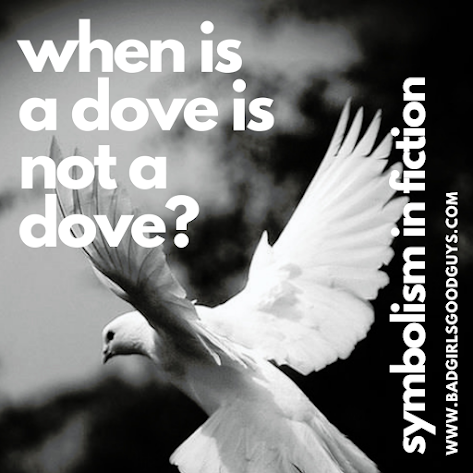
When is a dove not a dove? Symbolism in fiction.


We've heard it all before. 

"It's never just rain. It's baptism."

"Sometimes rain is just rain."

"Two brothers fighting is always a reference to Cain and Abel."

"No. They just happen to be on opposite sides of a civil war." 

Symbolism. It colors so much of our writing. And yet we are so divided by it. Some embrace it. Some claim it ruined reading for them. Some say it's everywhere. Some say most of it is hogwash. 

This week we're looking at how we writers balance our straightforward plot writing with our metaphorical and symbolic writing -- if at all.

Where would you rate your work on a scale from "the plot IS the story" to "the true meaning is hidden in the symbolism"? Why?

Maya Preisler: I’m very close to the end of the spectrum where the true meaning of my writing is hidden in the symbolism because that’s how my brain functions. I analyze and over analyze the world around me so my writing does the same in reverse. I want to invite my readers on a journey that can go as deep as they are comfortable taking it. I like the idea of rewarding the very clever ones with extra information other people never figured out, like the ultimate Easter egg.

Bobby Nash: I sometimes pepper my stories with symbolism, but for the most part, the story is the story. My stories tend to be more character focused/driven. Sadly, I’m not that deep.

Ef Deal: The plot is the story, yes, but the plot is played out by characters whose motivations touch a deeper level. Book 1, for example, has the vicious Count Draganov, who has no compunction about stealing the souls of the dead, just as his son had no compunction about raping my MC and leaving her for dead. Book 2 has a vampire pursuing my MC, and the MC has to reckon with her position as someone who is vulnerable. And so forth... I think a novel should operate on three levels: action, character, and audience. Symbolism helps connect to the audience.

Nancy Hansen: I'm on the lower end of the scale as a writer because I really don't make much effort to consciously work symbolism into my writing. If it appears it's simply part of the characterization or the plot. I'm not a big planner when it comes to writing, most of my stuff just evolves from some seminal idea as I bang on the keyboard.

John French: Some people who have read my stories have found meaning in them I did not consciously put in. On hearing that, I decided to let my subconscious do the heavy lifting while I just write the stories.

Nikki Nelson-Hicks: I tend to allow symbols to grow organically. If I try too hard, it just becomes too twee.

John L. Taylor: I tend to overkill on symbolism. I find it to be an effective method of commentary without being blatant about it. Some of my imagery is more obscure and cryptic than others, but the use of symbolism serves me well and makes my work more satisfying to myself. Perhaps that's the greatest downfall there, writing becoming self gratifying to the extreme. But I say don't fear to use symbolism, especially in horror fiction.

Elizabeth Donald: Before approaching my MFA program and exploring literary fiction, I'd definitely put myself higher on plot than symbolism. To a certain extent, I hold the same beliefs now: I feel that if you're trying for symbolism, if you have to force the True Meaning of This Story, you're probably writing a boring story.

Do you typically use symbols to highlight the themes and tones of your work? What are the common ones (flags for dead military family members, boxed away wedding band for divorced/dear spouses, etc.) you find yourself using?

Gary Phillips: These are some deep questions to ponder. But definitely used some symbism in the new novel coming out. Set in '63, a Korean war vet turned crime photographer inherits a Speed Graphic in the war after the correspondent profiling his squad is killed in combat.

Ef Deal: Yes, I use the description of the settings to serve as symbols; the decaying elephant in the Place de la Bastille, the weather-tattered crepe-paper, the colors of the sky at dawn or dusk. I have a character my MC doesn't trust, and his eyes "gleamed in the gaslights of the Rue St. Jacques." The choice of words in a description conveys the entire tone of a scene: Is the sunrise golden or a glaring yellow? Is the sunset a gentle lilac or the lurid purple of a bruise? Do the masts of the moored ships reach into the sky, or do they claw the sky? Do they resemble a long-dead forest? There's so much that can be conveyed in these kinds of 

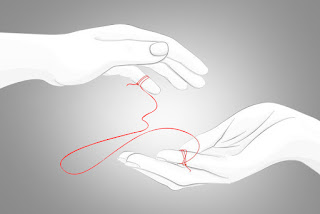
Maya Preisler: Yes, I absolutely use symbols to highlight the themes and tones in my work. I tend to use ravens and crows for connections to the underworld/afterlife and red threads for fate or destiny.

Elizabeth Donald: Sometimes the curtains are blue because that's what the writer saw when they looked out the window, and not because they were attempting some kind of existential philosophy about depression or deep water or bluebells which really mean Texas... That said, the best fiction is the fiction that makes you think and feel, and even changes your mind. You can't read a novel by Toni Morrison without considering what she is really saying about racism and classism in America, and exploring the meaning behind "blue eyes" in THE BLUEST EYE is a necessary part of understanding the novel. 

Nancy Hansen: Now and then I will give a character a name that in whatever language it's from means something representing the character's attitude or looks. Especially if the character is based on someone I don't like in real life. <EVIL GRIN> Most of the time, that's more for my sake than the readers. If they get it—great! Whatever goes into a story I write is there to add to the flavor and move the plot forward, so I'm not giving it a ton of thought.

Bobby Nash: I focus on things that are important to the characters so it’s different for each, but I do use common themes and tones per character.

If you tend to avoid symbolism in your work, why do you prefer not to use it? 

Elizabeth Donald: I still don't actively try for symbolism, to use an image or object to stand in for something else... but if I'm doing my job, if I'm using the language well and drawing on the reader's intelligence as well as emotion, then the symbolism will organically appear in the prose.

Nancy Hansen: I'm not avoiding using symbolism, it's just something I don't think too heavily about. Writing is kind of organic for me, I sit down and get ideas on a page, and then develop and refine them as I go along until the entire plot makes sense.

John French: Back in high school literature class, we had a long discussion about whether the writers and poets we were reading actually meant what we were reading into them. It ended with the teacher saying something like "We'll probably never know but, for the test, if I say it's bird imagery then it's bird imagery." 

Bobby Nash: I’m more of a straightforward kind of storyteller so I don’t spend a lot of time thinking about symbolism. It’s just not something I think about.

Maya Preisler: Doesn’t apply to me, but to answer your question in reverse, I prefer to use symbolism because that’s how my English teachers taught me to dissect the classics so it makes sense to build my written worlds with those same blocks.

Do you have other writers you consider the great masters of symbolic writing or tight plot-based writing? What makes their work so fantastic?

Nancy Hansen: This is tough for me because I am such an eclectic reader and so I delve into a variety of books and stories. I read for enjoyment and don't care too much to overanalyze what I'm reading. One of the things that ruined upper grade English classes for me was having to dissect books and look for deeper meanings. Sometimes a story is just supposed to be entertaining and maybe somewhat enlightening. I'm good with that.

Maya Preisler: Several classic writers come to mind (thank you high school English teachers): Shelly, Hurston, Fitzgerald, and Dickens being the first. By contrast, the realm of speculative fiction seems to be more plot driven, though some like Mercedes Lackey use both plot and symbolism to drive their stories. I find those to be most satisfying because I enjoy picking apart the threads of the tales and finding the hidden gems within them.

Ef Deal: Early French novels through the 20th century at least are all about the symbols, and I majored in French so I am spoiled by them. Gregory Frost and A.C. Wise use powerful similes and metaphors to enrich their works. Gregory Maguire, at his best, does the same, but I find his work hit-or-miss. Jane Yolen and CJ Cherryh weave symbols so eloquently into their plots, I come away breathless sometimes.

Tuesday, March 16, 2021

Why Do You Write... Horror?


Just one question this week, folks. And it's for the horror writers.


Why Do You Write... Horror?

Nikki Nelson-Hicks:

I have a theory that writers write because they subconsciously want to save...or kill...someone over and over again. As for me, horror gives me a way to not only be an agent of Nemesis and give justice to people who are wronged but it also gives me the opportunity to see the crime from the other side when I dive into the antagonist's POV. While this makes me more empathetic, it doesn't do much for my anxiety.

Also, it's just a lot of fun. I love monsters and ghost stories.


Nicole Givens Kurtz:

I write horror to engage in stories and emotions that are often viewed as negative when displayed in real life. Horror gives me permission to be angry, to be vengeful and to be afraid. When I write horror, I am free to run the gambit of emotions without fear of reproach. Writing horror for me is freedom to be truly creative.


Selah Janel:

I think it’s natural to seek a catharsis that we might not get in real life, especially during times of stress and chaos. It doesn’t even have to have a happy ending - being able to immerse myself in a story where I control the outcome and can explore terrifying possibilities is a powerful position to be in. I’ve always been intrigued by the fear and intrigue that warred inside me any time I read or watched something in the horror genre. As a kid, it freaked me out, but as an adult there’s a certain freedom in being able to toy with plot elements that delve into the darker parts of the psyche. With so many sub genres, there’s a lot of fun to be had and a lot of topics to explore. Horror naturally puts a reader in a point of view situation, so there’s also the chance to explore empathy for people who aren’t in my situation. There’s a lot of freedom in the horror genre and sub genres, and a lot of power over terrible things in a controlled environment.


Bill Craig:

For me, turning to the horror genre was a natural extension from writing mysteries. There are many ways to explore the supernatural and the various forms of race/species available in those things that go bump in the night.


Sean Taylor:

I write horror for the same reasons I write super heroes. I write horror for the same reasons I write new pulp. It's all about finding the right story to put my characters through hell.

Horror has always been, at least for me, a way of pushing my characters. I believe that the best way to create a compelling story is to make your characters face the worst thing that can happen to them -- whether romantically, philosophically, emotionally, or physically. That's why for me the best horror has always had more at stake than mere death or dismemberment or gore. It operates on a deeper level at a higher kind of loss. Losing to the spirit, zombie, creature, etc. must always mean losing something of the character's self -- a chance to make things right with someone, the opportunity to finally become someone important, that one last break to talk to your parents before you die. If the only thing they have to lose is their lives, then ultimately (at least for horror stories) there's not enough at stake.


Ralph Wheat:

I enjoy writing horror for the simple fact I like to scare myself and others. Creating characters is fun and intriguing. Breathing life into beings that came from my demented mind, a story from stray thoughts, interesting stories I happen to click to on tv, cable, or an article in the paper ( and yes, I still read those) and a germ of a idea germinated into a spark for a short story. As a matter of fact, an idea I was ruminating about lately, brightened to a fiery glow of creative fire as I riding in a car by a cemetery. Suddenly, I had the framework for a terrifying horror story. I wanted to do for my character, Malcolm Hellbourne, Occult Detective. I've written a few short stories with him. First time I introduced him to a select few, is when in my technology school for computer programming had a school paper. They wanted the students to submit a story and I did. The students and faculty loved it. That's when I knew I could write. Then when I worked at the World Trade Center, before its tragic end, I put a couple of his shorts together and sold them on the Commodities Exchange's Floor for $2. I made $50 bucks! Also, I found myself elated, full of pride and respected. Here were grown men and women reading my stories, some of them acting out some of Malcolm's hand gestures to perform spells doing them in real-life. Brought a smile to my face. And many, saying they enjoyed very much, wanted more stories. Later, I found out since I sold my work, I was a published author. I finally, brought all the stories of Malcolm in one series and hopefully soon to get it published. So horror stories are good for the heart rate and keep you up late at night.


Robert Freese:

Why do I write horror? I write more than just horror, but with horror I feel a real connection. Horror movies were huge when I was a kid and I just gravitated toward them. Fangoria magazine opened a world of horror movies as well as horror novels. At the time, Stephen King was insanely popular, but I read guys like John Russo, Richard Laymon, Gary Brandner, Guy Smith, James Herbert. Horror is like the coolest club to belong to.  I am currently writing a new horror novel and I'm having a ball. I get to revisit a wonderful world where anything can happen. I don't want to explore man's heart of darkness or any of that jazz. I enjoy writing what I call "drive-in horror," horror stories that works like a Roger Corman drive-in horror movie. You can use a horror story to tell a bigger story, give the characters real depth. I also see it as a challenge to use words like magic tricks. Robert Bloch did that with his twist endings. How can you seem to show something to your reader and then flip it and give them a little jolt? I love that. When I write other stuff I tend to always write one character who is a fan of horror movies and novels, just so I can still play in that world a bit. I think at this point it's in my blood.


Bobby Nash:
I like to do the spooky from time to time. It's fun writing scares.


DK Perlmutter:


In my case, it's to follow the advice of my idol of G.K. Chesterton, who said the purpose of fairy tales was not to tell people that dragons exist, but that they could be killed.


Daniel Emery Taylor: 

I tend to write a lot about outcasts - which I don't suppose is particularly unique - and the choices they make in light of their hardships. So, someone is bullied as a child - does that make them more likely to become a hero, because they know what it's like to be victimized and they want to save others from the same fate, or do they become a villain, because they want the world to suffer as they did? Really, it could go either way, depending on a variety of other factors. We each have choices to make in life and it is fascinating just how quickly our entire situation can change based solely on our reaction to it. Plus, there is the splendid duplicity of man - the fact that most humans are basically good but also carry within them the potential for the gravest forms of evil. I'm not saying we're just a bad day away from becoming homicidal maniacs ... but I think we would be shocked to discover what we would be able to do given the right set of unfortunate circumstances.


James Quinn: 

I wouldn’t consider myself a horror writer to anyone’s imagination, but not because I don’t like horror I just don’t want to put into a genre-box that many writers like Stephen King have struggled with. Had I been asked a few years ago about the horror genre, I’d say I wasn’t all that into it but considering all the horror movies I’ve enjoyed watching and the Stephen King titles I’ve read, I realized that I liked the genre more than I’m aware of. Why is horror so fascinating to me? 

To clear the air, I want to be fully honest and say I am not what most would consider a professional writer. I’ve just last year begun writing my first novel, I’ve only had 6 poems published on literary websites and literary journals, and I am currently running a geek-centered blog site of my own construction. I am by no means a “professional” on the status of most well-known and established authors. However, I do still write, and I am on the road to becoming what I would to imagine a…. black Harlan Ellison. A genre-fiction writer of the ages!

With that bit of honest professionalism out of the way for context, I do write continuously and the projects I’ve written so far that have been published and just written have been horror related. My first love is always going to be science-fiction, a genre that imagines humanities future in whatever good or bad form that takes, and my second is superhero comics. Is it possible to even have a third love? Horror, although I don’t speak on it all the time has always creeped up in my work so far. The first short story that I ever tried to professionally publish was a horror story about a woman being haunted by the spirit of her dead daughter in hell. The first poem I had ever gotten published is called “Smoke-Town Zombies” and is about a shy black kid that slowly decays mentally and physically into a zombie. Even the first script I had written was based on that previously mentioned horror poem. In November of 2020, I had started working on my first novel which is going to be a horror story. Despite considering horror a third favorite genre, I’ve certainly found myself coming back to the genre time after time. 

Why do I write horror? Why do I write science fiction sometimes? Science fiction is a genre I look to envision a future for myself and the world around me. The future might be taken over by robots, or we might be enslaved by an alien race in the future, but there’s still a future, nonetheless. Superhero comics are power fantasies that inspire me to envision better and more helpful versions of myself. But what about horror? Horror, as I consume it, investigates our darker halves and evil intentions so that we’re aware of the awful things we’re capable. The best horror fiction is always an exploration of our fears and how those fears shape into monsters or shape us into monsters. Fear is a driving force in all our lives, and it leads me into the driving force behind my fear: my identity. 

As a queer African American, I live in a country/world that is always working against me; that’s not to say that I specifically am facing any hardships currently, but as a race in this country it’s hard to not conclude that black bodies are always targets for hate.  I live in Louisville, Kentucky and when I had started writing my horror novel last year (currently we’re in the editing and re-structuring phase) we had several major protests during the summer concerning the murder of Breonna Taylor by the Louisville Metro Police Department. Despite the angry chants, the protests, the looting downtown, the threats to destroy the city, despite the cries for justice against a woman that didn’t deserve to have her life taken away, Kentucky law opted to not arrest the cops that killed Breonna Taylor. To add insult to injury, Kentucky senate passed a bill that would make illegal for anyone to insult cops which was also met by protest. The state and the overall United States have made themselves clear about how they feel about black lives: they don’t care. By not arresting the cops that killed Breonna Taylor, Kentucky sent out the message that the police can come into any black person’s house, kill them, and not face any punishment for it. Not to mention the other countless black lives that have been lost the to the American Police force. America has always had black bodies in a state of fear, and even though I’m one of the few black people to be privileged enough so far to avoid these obstacles, but that’s not the reality for a lot of people that look like me or identify as I do.

The world is a horror story for black people, from our history down to the current events on the news through the African diaspora. Black bodies are always in a state of danger. When I write horror, I tend to write from this perspective. As a writer I believe fiction is the ultimate way for those to gain empathy and sympathy from people who are different from you; to gain a perspective one might not have previously had. It’s why I love writing and consuming fiction; it holds a mirror to us to reveal human truths. If I can make others understand the fear of black people through my horror stories, maybe others will understand why so many of us hate this country and want to dismantle it for a better one. Or at least I hope so.