Showing posts with label covers. Show all posts

Thursday, January 22, 2026

Tuesday, May 14, 2024

The Cover Story: Crime Fiction Now and Then and Now Again


Let's talk crime novel covers. My, how they've changed over the years. Don't believe me? Let's go back to the (almost) beginning (we'll skip over Sherlock Holmes who-dun-its for this article). The that, we need to visit the pulp mags. 

The Pulp Era


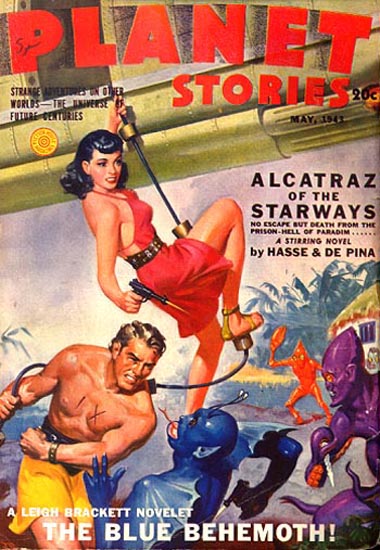
The covers of the classic pulp era stand alone as works of "cheap," "vulgar," and "violent" art -- just to mention some of the adjectives thrown at them. But works of art they remain. They knew how to attract a reader with scenes of danger and drama (and more than a little sexual titillation, of course). 

In fact, because of the patriarchal views (some might say misogynistic) of the time, it was hard to find covers that didn't have some helpless woman in various states of either torture or undress. However, even when they didn't have such covers, the images were always high points of action (maybe or maybe not related to one of the stories between the covers) or danger or violence. 

Suspense was the key question when you saw one of these covers. Will the hero save the day? Will the beautiful dame get shishkabobbed? 

These covers screamed and begged you to drop a few cents and find out. And they did it very, very well. 


The Contemporary Summer Bestseller 


Things have changed between then and now. Book covers, even thriller and crime novel covers, are more about mood and tone than telling a story it seems. That's not a judgment, just an acknowledgment. On the plus side, we're no longer inundated with helpless women and burly men saving the day or gore-adjacent covers or some of the darker pulp mags, but I'm not sure the covers to many contemporary mysteries are doing the job they're supposed to (at least supposed to in my opinion). 

As I look at the covers below, I'm not sure I can tell you what the story is actually about. Or, honestly, I don't think I would recognize the book as a mystery/crime book if it weren't shelved in that section of the bookstore. 

Modern covers, while great examples of color, texture, and typographic art, don't feel as immediate to me. I don't get a sense of why I need to open the book oftentimes. I don't feel pressured to ask the questions that make me want to see what happens. 

A quick glance below says these books could just as easily be literary bestsellers or romantic dramas as they could be any other genre of fiction. (On a related but different note, not even the titles convince me they're thrillers, but that's an article for another day.)


Original Novels and the Hard-Boiled Pastiches


Let's step back a few decades now, shall we? Inspired by the pulp mags, novels of the '30s and '40s through the '60s and '70s tried to recapture the awesome of the pulp aesthetic without the awful of the pulp aesthetic. Violence was back. Sex was back. And danger was once again front and center. 

Now, the violence and sex tended to be far more subdued, maybe even subtle, as it the semi-open door (still locked) or the look of fear for The Glass Key, but it was there. And it while it also conveyed mood, it didn't shy away from actually teasing the story. There was no way you didn't know what kind of novel you were buying based on the covers on the paperback racks (or most of the hardcovers over earlier years). 

The genre grew up and became procedurals in addition to private eyes. Big thrillers replaced small-scale-one-man-against-the-bad-guys of Key Largo. And the covers grew with them, distancing themselves from the "thing of the past" ideals and values of yesteryear (as you move into the '70s particularly), but the hints were there to see what you were getting into. There was no confusing even the semi-vagueness of these spinner rack covers with a copy of a literary classic or a contemporary lit hit. 


Hard Case Crime 


Hands down, my favorite publisher nowadays is the retro-pulp, hard-boiled, noirish, crime story, private dick publisher Hard Case Crime. The stories are often reminiscent of early crime novels but updated for the present or written with modern sensibilities (sometimes not). And their cover game is top-notch. They do the best job I've seen of capturing the story sensibilities of the early pulp-inspired novels of the '30s and '40s and even tease it a bit with the voyeurism of the original pulp covers before Werthem's Seduction of the Innocent shut down the fun machine. 

To be fair, a lot of these covers do play up the big strong man trope and you see a lot of sexy women on the covers, but they are rarely women in peril. More often than not, they're holding either the gun or all the cards. 

But the thing that really draws me to Hard Case Crime is how I can usually tell exactly what I need to know about the book before I buy it. I can see it in a catalog or on a shell, and bam, I know the kind of story I'm about to spend good money on. To me, that's the main job of a cover. 


And That Leaves Us...


A cavaet: There's always an exception for every rule, and for every cover I've shown here, there a several that make an equal and opposite statement to prove me wrong. You can find vague, artsy '60s paperback covers or even pulpy cover versions of classic literature. You can find gripping, story-driven contemporary covers for thrillers that don't hide the genre in colorful photographic dreamscapes. But for this article, I'm addressing the generality, so don't feel the need to play the "what about" card. I'm not taking the bait. 

Let me reiterate, these are just my opinions about covers for mystery thrillers. Your mileage may vary. You may prefer pretty covers that tease the eye like an impressionist painting or a soft-palette photo of a beautiful tree. If that works for you, fine. You do you, boo. 

Personally, I'd like to see crime fiction return to the style of the paperback racks before the sort of homogenous look took over publishing. I like the covers that tell the story to sell the story. Now, that doesn't mean I want to see a return to the ideals and patronizing and patriarchal values of the '30s and the '40s those old covers may have reflected, just that storytelling style. 

But, as they say, if wishes were horses... 

Saturday, August 6, 2022

[Link] 50 Pulp Cover Treatments of Classic Works of Literature

Guns, Broads, Beefcake, Literariness

by Emily Temple


Last month at CrimeReads, Rebecca Romney looked at a few classic detective novels that had, at one time or another, gotten makeovers as sexy pulps—because as we all know, the easiest way to sell something is to make it look salacious (whether it actually is or not). But it isn’t only great detective novels that have gotten the pulp treatment. Classic works of literary fiction have existed as pulps from the very beginning of pulp—the new paperback publishers of the 1940s and 50s printed them right along with classic crime and some genuinely lowbrow (and sometimes quite lurid) new novels, often commissioning the very same artists to design their covers. Below, I dug up a few of these pulpified classics (not including the Pulp! The Classics imprint)—many of which I found through the excellent resource Pulp Covers. Some are true pulp covers—with overtly sexy women and tantalizing movie-esque taglines—while others are just amusingly lowbrow mass market treatments of highbrow novels. Either way, they’re even better than you’d expect.

Read the full article and see the pretty pictures: https://lithub.com/50-pulp-cover-treatments-of-classic-works-of-literature

Thursday, May 11, 2017

Baby Makes Her Back Cover Talk (With Apologies to Dr. Hook)


What sells books? Covers? Yes. Big advertising budgets? Well, most likely you don't have access to that. What sells you a book in a bookstore or online when the cover has already caught your attention? That's right... The back cover blurb. 

What makes a back cover blurb effective?

Perry Constantine: You have to approach it as a sales pitch, not a description. Entice the reader just enough to want to find out more about the book.

Amy Leigh Strickland: What would entice you to pick up this book? You’ll want to make a list of the essential plot elements, the core bits of the conflict. I don’t want to hear every twist and turn. I’ll read the book for that. Those twists are only interesting in the context of the story when I’ve gotten to know the characters. I don’t want to know every subplot at this phase of the purchasing process... If you’re rambling on about multiple characters, telling me every twist and turn of your plot, you’re doing it wrong. If you’re giving me the entire history of your world, you’re doing it wrong. If I hear the phrase, “but it turns out, she’s the chosen one,” you’re definitely doing it wrong.

Looking for a few good... examples of back cover copy.
Bobby Nash: The back cover copy is important because it is the 2nd look a person has at the book to decide if he or she wants to pick it up. In a bookstore, a potential customer sees the cover, it grabs their attention. The reader picks it up, turns it over, and reads the back cover. If that grabs them, they might open it up and read a few lines. In on-line sales, the same is true, except that information is all on the screen.

L. Andrew Cooper: A back cover blurb is one of a book’s most important pitches -- the pitch to the audience who doesn’t know what they might be getting and needs help to decide. It has to have a hook, a sense of character and story (or subject and thesis, for nonfiction) in a short enough sound bite to grab attention and say, “This is the kind of book you like to read, but not so much like those books you’ve read that it’ll be too familiar!” It’s also got to say something about the author, something to make the reader think the author has what it takes to sustain interest for however hefty a time the weight of the book suggests. A snippet from a bio or a review to go along with the tempting sound bite… everything short, neat, packaged, glittering and beautiful. Good blurbs are hard work!

Bill Craig: The back cover blurb has to work in conjunction with the cover to grab the reader's interest and imagination.

Kristi Morgan: What makes a back cover blurb effective? Keywords that explain the genre and content effectively. Short, engaging. Not a long blocky paragraph with too much description. Just enough info to tell what the book is about, build some interest and intrigue but don't give away any spoilers.

For the changing, highly ebook-driven market, is back-cover copy as important as it used to be?

Kristi Morgan:  I think so. Most people use the back cover blurb as the Amazon listing description, so it's important.

L. Andrew Cooper: Blurbs are as important as ever, if not moreso, because the copy from the back of the book usually ends up being the copy that sells the book on Amazon and other sites, too, so it’s going to support the “product” across formats. For e-books, buyers might not be able to hold the book and do a flip test, but they can read whatever blurb information the authors and/or publishers have provided, so a lot of pressure falls on a small amount of text.

Bobby Nash: Absolutely. It may not be on the back cover in this scenario, but that information is still relevant and helpful to the reader so it becomes part of the description on the page.

Bill Craig: I would say the back cover copy or description is even more essential in the field of e-books because there are so many out there. That copy is an essential hook to grab a reader and get them to buy the book.

Perry Constantine: If by the text you put on the back cover of a paperback, then no, that's not important because most of us won't be in bookstores to begin with. But if you're talking about the description on your book page, then that is crucial. The first thing that will get someone to click on your book is the cover. If the cover gets them to click on it, the very next thing they'll look at is the description. It's the second most important tool in your marketing arsenal.

The back cover of The Ruby Files Vol. 1. 
What advice do you have for those writers asked to help create back cover copy or self-publishers looking to improve their blurbs?

Bobby Nash: Look at the type of books you like to read. Look at how those publishers handle back cover copy and blurbs. Use that as your starting base. Remember, tease the readers so they want to buy the book. Don't spoil your secrets or get bogged down in details on back cover copy. Just give it the pitch. Blurbs may or may not help. I don't have any real data there. If the reader trusts the opinion of the person giving the blurb, then it probably helps.

Kristi Morgan: It's not just the content that matters. The layout is important, too. I have seen some really great front covers with poorly designed back covers. Don't skimp on the back or the spine. Choose a color scheme and font that looks professional.

Perry Constantine: Approach it as a copywriter, not an author. Look at other successful books in your genre and see what they're doing with their descriptions. Compare them to yours to see what you're doing wrong. Libbie Hawker's Gotta Read It! is a great resource for writing effective descriptions.

Bill Craig: Lead with action! You want a hook to grab potential readers and make them want to read it!

Amy Leigh Strickland: If you’re at a loss for how to write a book description, get your butt to the DVD section at Target and walk around reading the backs of movie boxes. What catches your attention? What drives you away? What tense are they writing in? What tone? How long are the blurbs?

L. Andrew Cooper: A big mistake is confusing a blurb with a synopsis—you’re not summarizing the story, or even giving a rough overview of how the story gets going. Some story orientation might be part of a blurb, but a blurb might also be a snippet from a scene followed by very brief commentary about how the qualified author has opened up a new world of adventure/horror/romance/whatever. A blurb is not what the author wants to see shown off about what’s inside the book. It’s whatever you can say about the book that makes sense on its own and still grabs a reader to say, “Let’s go.” Also, publishers will (in this writer’s experience) often ask you to write potential blurb copy and then use it as one of several sources for the final blurb. Use the opportunity: find something genuinely fetching about your book, highlight it with your best prose, and turn in the best blurb you can. Your good work is likely to give you more control of what your marketing (your blurb and everything related to it) looks like.

Tuesday, December 29, 2015

The Cover Story (Part 2) -- The Woman's Rise to Pulp Power

by Sean Taylor

Last week we covered (no pun intended) all the ways pulp magazine covers portrayed women as victims and powerless and little more than a damsel in distress with no more function in the story that to be rescued by the strapping young (or crazy old) hero.

This week we're going in a different direction. For all the ways pulp covers depowered and dehumanized woman, they also portrayed them in positions of power -- even over heroic men!

The (Not So Helpless) Damsel in Distress


As they say in the movie WHAT ABOUT BOB, baby steps. And baby steps from last week's covers would most definitely have to be when the stereotypical damsel in distress fights back (with or without the help of the hero). They may still be (mostly) at the mercy of the villain, but not going gently and ladylike into that role.


The Vixen


Enter the true woman of power -- The Bad Girl! This empowered woman could defeat the hero because her lust for evil gave her strength to ignore society's rules and get her own way. She maintained her power at the point of a blade or the business end of a pistol. But, only for so long. In the end, the hero did have to one-up her (and often try to redeem her back to the soft, little lady who follows the rules).


The Girl Friday


Sometimes even the good girl gets to experience some power, even if she is relegated to the sidekick role. Regardless, her importance grew from damsel in distress to the Girl Friday without whom the hero would be lost. This was still a good first step out of the dark ages and into truly heroic women of some level of ability.


The Goddess


Now we're getting somewhere. This woman has the kind of power that makes the hero take notice. (But it's okay, she's just a fantasy.) The goddess holds absolute sway over the hearts and wills of almost all who see her -- or she takes their worship by force. But... as a fantasy of a woman with ultimate power, she can usually only hold it in her place of power (as in She Who Must Be Obeyed) or risk losing it all to find love with the hero. Except for those rare opportunities in which she gets to be the heroine and the hero at the same time.


The Solo Adventurer


The ultimate growth for the female heroes. This adventurer could hold her own with the boys. She tamed the west. She explored the galaxies. She solved the case before the cops. She bent the jungle cats to her will.

She may have often been paired with a male hero, but it was clear she didn't need him. She saved as much as, or even more than she needed to be saved. She fired as many bullets or lazers as the good guy at her side (or not at her side). In some cases, she also had her own male foil as a sidekick, a "guy Friday" if you will.

The times were a'changin' and it was her time to shine.


What the Future Holds...


Next week we'll look at what pulp covers got right to help little boys grow up to be confident, stalwart men.

So, until next time, keep it pulpy.