Showing posts with label Medieval Lit. Show all posts

Thursday, May 11, 2023

Swords, Magic, and the Armor of Author David Wright

A Georgia Bulldog and Atlanta United fan living in Middle Tennessee, David Wright grew up on comic books and Swords & Sorcery novels, where he gained an early passion for storytelling. Ever since he read Dragons of Autumn Twilight by Margaret Weis and Tracy Hickman in 1984, he knew he wanted to write an epic medieval fantasy series. He's also a friend, and I think you should get to know him too!

What prompted you to start this series?

David: Well, I've had a lifelong love for swords & sorcery fantasy and Arthurian legends. This includes playing 1st Ed. AD&D and Red Box/Keep on the Borderlands Basic D&D in the early 80s at the very height of the "Satanic Panic" media scare surrounding the game at the time. I found all the hoopla ridiculous because as a player I knew how innocent and fun the game was.

Now fast forward 20 years and the Lord of the Rings movies are being praised for their (alleged) Christian themes by some of the same type of conservative watchdog groups that once condemned Dungeons & Dragons. I found that hilariously ironic and also as equally ridiculous as the early 80s scare.

In other words, I didn't see the Devil in D&D and I didn't see Jesus in Lord of the Rings. Now, I know it's possible to play a very dark campaign, but I also know it is not intrinsic to the game and there's room for something quite the opposite. I've always seen D&D as an exercise in collaborative improv storytelling and that always appealed to me.

Now I should make it clear that I am a professing Christian and I do my best every day to live accordingly (with full acknowledgment that I fail often and sometimes spectacularly so), but it is quite interesting to me that so many conservative groups and a subset of Christians have such discomfort with the entire genre of Fantasy. I've spent time pondering that. How is a fantastic story blasphemous or threatening to the Faith? It's interesting how quickly the conversation then turns to the idea of religion or the common use in Fantasy of a polytheistic pantheon. There just seemed to be *something* that intertwines the subjects of Fantasy and spirituality in people's minds, for whatever reason that I can't explain.

I simply felt like this disconnect and this discomfort was where the dramatic conflict could be. I wanted to lean into the idea of Christianity existing in a fantasy world where magic is real. I wanted to set out to disprove the Satanic Panic of the early 80s while knowing full well the Bible warns us strongly against witchcraft and divination.

By the mid-80s I was an assistant DM and helped develop the original campaign setting that we used. In 1984, the original Dragonlance Chronicles came out and I knew right away that I wanted to one day adapt D&D adventures into a novel. Now, it was in no way a Christian-themed campaign. It wasn't until the LOTR movies that I started considering writing a novel, but once I did hit upon the idea of that central dramatic conflict, I remembered our old campaign setting.

So very quickly I had a theme and a setting. And I even brought in three characters that were PCs in our mid-80s campaign. The rest of the cast (including the main character) and all of the plot were created after I started developing the novel series. This included role-playing sessions with just me and a single player, a friend of mine who helped me develop the main character. And through our game sessions, many of the series' action set pieces were devised and improvised.

I developed story ideas throughout the first half of the 2000s, spending all of that time not thinking it was very realistic to actually put out a novel. That all changed with Van Allen Plexico launching White Rocket Books and publishing his Sentinels series, beginning (I believe) in 2006. Suddenly, a novel seemed very realistic and that really lit my fire and I finally got serious about it all. I ended up getting a tremendous amount of support and encouragement from Van, and it is likely none of these books would have ever seen the light of day without him. So big shout out to Van!

Is there something in particular about knights and the genre that draws you to it? What is that?

David: There must be, but I'm not sure I can articulate it. I saw a production of Camelot at a young age and my Dad raised me on Errol Flynn's Adventures of Robin Hood and the Robert Taylor Ivanhoe film. I just always loved that romanticized idea of the Age of Chivalry. I was particularly drawn to the King Arthur and Robin Hood stories. But then you add in fantasy elements like wizards, dragons, and magic swords and how can anyone resist? Having a great D&D group at the right impressionable age probably really cemented things for me.

It's rich ground for themes revolving around duty and honor and other heroic ideals. It also lends itself easily to epic stories with the fates of entire kingdoms often at stake. What's not to like? Knights are cool.

You have said before that you wanted to write something that talked about faith but not as a direct allegory, such as Lewis, or to a lesser degree, Tolkien. Why did you want to avoid that and what did you want to say about the life of faith?

David: Well, to clarify, while I do not think I've written in allegory, I've also not done anything to hide the idea that this story very much is set in a world that has had Christianity introduced to it. The backstory is that at the fall of Camelot, Merlin cast the final act of magic our world would ever see to send Sir Galahad away. Galahad is the knight of the round table that found the Holy Grail and in my version of the story, Mordred was after it in that final battle at Camelot that saw him kill King Arthur. Honoring Arthur's final wish, Merlin kept the Grail safe by sending it with Galahad through a hastily summoned portal.  That portal took the knight to the world of Lanis and he happened to have his Bible with him.

My story opens several hundred years after that and we see that Galahad spent the rest of his days traveling and spreading the Word and now there is some form of his religion from the World of Adam that has taken root and grown prevalent. Before he died, he was given a vision of basically a global reboot, similar to the Great Flood account in Genesis in which the world is all but destroyed for the purpose of starting over. This prophecy of his became known as Galahad's Doom.

But I did write the story to not be preachy, to not be some kid-friendly, contrite Sunday School lesson. I very much was concerned with writing an epic-scale action-adventure that would appeal to everyone regardless of their beliefs, or absence of beliefs. Partially to that end, the names God and Jesus never appear in the books. The words Christianity and Bible never appear in the books. It's not that these ideas are avoided, but that different nomenclature has taken root in this world of Lanis.

This is a cool action adventure first, albeit one that just happens to be informed by my personal faith. This is not written at a juvenile level; I wrote for me. The story I wanted to read didn't exist, so I wrote it. There's a large cast, a complex plot with multiple subplots, and shades-of-gray characters. Not every good guy is a believer, and not every believer is a good guy.

Think of it like this: Krynn -- the world featured in the Dragonlance series-- includes gods such as Paladine and Reorx that I do not actually believe in. Yet, I'm able to accept that they are the gods of that story and I'm still able to very much enjoy it. If someone out there believes in Jesus about as much as they believe in Paladine then they can still enjoy my story, just like we all do with Dragonlance. It doesn't have to be any different than that and, by the way, the story is awesome. I'm especially proud of the third book in the trilogy, The Armor of God, that just came out. If you'll come along for the ride, I promise you'll be blown away. I'm just so extremely pleased with how the final book turned out and how the whole series ends. It is so worth the investment of reading the first two books to get to it. The best part is I am 100 percent convinced that every single member of my large cast got exactly the right ending. I can't wait to hear back from readers.

As for what I want to say about the life of faith, my themes are universal, dealing with duty, honor, temptation, corruption, and redemption. And in Galen Griffon, I have a protagonist who struggles with feelings of unworthiness and is forced to choose between serving his god or his king. Church or State.

His arc in the first book, My Brother's Keeper, is very much a metaphor for my own journey. (Even though I've never had a magic sword. As far as I know.)

What is your work schedule during the time you bust out a novel the length of these?

David: Ha! Well, for anyone who's been following along, it's no secret that years and years have gone by between each of my novels. That's one reason I'm so happy to have completed the trilogy: now, all the delays are behind me and people can start the series and not be left hanging.

I wrote the first book in just under a year during a time when I was traveling a lot for my job. Hours and days spent in airports and hotels, away from my family, gave me plenty of time to work rather quickly.

By the time of the second book, I had a different job and had a regular life of coming home to a family every day who needed me for the boring real-life stuff.  So I just wrote when I could and never really figured out a good writing schedule.

With this third book, I developed an idea for a new workflow approach that I think could have helped me a lot, but as it turned out I didn't need it, so I haven't tested this idea yet. So my biggest challenge with sitting down to write is having the time to go back over my notes and what has been written before and just needing a long ramp to tap back into that creative vibe to be able to start knocking out scenes again. I came up with an approach to minimize or possibly eliminate that long ramp. Maybe detailing that idea could be a subject for a different interview, but suffice it to say that the third book came to me so easily that "ramping up" was never an issue.

While this third book has come out several years after the previous one, it was actually written in a trio of 60-day bursts. I first cracked the story in 2018 and wrote about 30k words in just a couple of months. Then a bunch of Real Life happened. I got a new job which involved a big move to a different state and I also lost my laptop. I knew I had backed up my work to Dropbox but I couldn't restore access to that account so for a long time I thought my work was lost. Luckily, that got resolved. Then in early 2020, I opened up the project again and it all just started pouring out of me. I couldn't type fast enough. It all came to me so fully realized that I just had to get it all down... until I got to the end of the second act.

Then I came to a screeching halt. I had two ways in my head for possible endings, but I also didn't know what role my large supporting cast could have in the final act. So I walked away and trusted my characters to solve it for me. I was not the creator of this story, I have been merely the reporter. All this stuff has really happened, it has just been my job to discover it and present it in the coolest way possible. Eventually, a character whispered the answer in my ear one night and I was off to the races again.

I've never had writing go so easily for me as with the writing of The Armor of God. As the third installment, it was just a race to the finish line and the pace of the book is exactly that. It's just relentless with the only levity coming from my bard character's storyline. I'm proud of that one. A true bard's adventure where winning the day requires writing the perfect song. (If it all lent itself to dozens of hidden Beach Boys references, well, I just can't help that. I'm just the reporter, after all.)

What are the books and who are the authors who influenced you in your growth as a writer?

David: My four main inspirations for the Galahad's Doom series are: L'morte d'Artur by Sir Thomas Malory, The Lord of the Rings by J.R.R. Tolkien, The Chronicles of Narnia by C.S. Lewis, and The Dragonlance Chronicles by Weis and Hickman.

(I pay homage to all of these with a quartet of redshirts named Malory, Lewis, Reuel, and Krynn).

I also owe a huge debt to Van Allen Plexico and all the New Pulp and indie authors I know.

I have studied Joseph Campbell and also found studying short stories to be an easy way to discern story structure. To that end, I read a lot of Poe and O Henry.

Tell us about your other work too.

David: The books in my Galahad's Doom trilogy (My Brother's Keeper, Marching As To War, and The Armor of God) are my first three novels. In addition to those, I have had short stories included in The Sentinels: Alternate Visions and Gideon Cain: Demon Hunter by White Rocket books and in Hero's Best Friend from Seventh Star Press.

We'll see what's next. I have both Untold Tale-style short story ideas and prequel novel ideas for the world of Galahad's Doom. I'm also definitely open to the idea of inviting other writers into my sandbox for an anthology. So if that sounds good to any writers out there (including you, Sean!) then reach out and let me know.

In addition to my writing, I have a YouTube channel called American Soccer Quick Kicks where I discuss the Men's National Team, MLS, and the rules of the game to casual fans of the sport, or just soccer-curious sports fans. It's all short-form content: no deep dives, usually just ten minutes or so to keep you updated and then get you back to your day.

Where can we find out more about you and your work?

David: My website is http://www.galahadsdoom.com

My YouTube is http://www.youtube.com/@americansoccerquickkicks

On Twitter, I am @defdave

Now that the series is complete, I hope to devote more time and effort to marketing. I thank you for this interview. I'm open to other bloggers and podcasters out there and I'll be looking at getting into whatever library shows, lit fairs, and retailer expos I can manage to find regionally.

What's the best advice you ever received about writing?

David: Observe life. Our world is too rich to ever have boring characters.

Also, make sure writing stays fun. Take pleasure in language. Relish it, savor it. Wield it like a scalpel... or maybe a Sword +2.

But what really unlocked me as a writer was understanding story structure. Take that seriously. Understand what makes stories work. Once I got my head around structure, the rest came easy for me.

Thursday, December 13, 2018

The Watson Report: The Medieval Final Girl

I.A. Watson
by I.A. Watson 

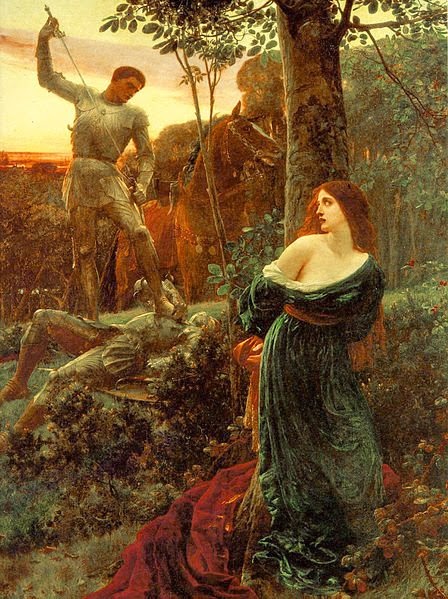
The slasher horror tradition of a monster preying on young women until the last one somehow manages to destroy him is a lot older than schlock cinema.

I refer you to Child’s Ballads, collected in the 19th century but containing folklore going well back into the Middle Ages. It is from Child’s work that we have the oldest known Robin Hood stories, and ballad #4 is a prime example of the sort of predator vs. girl victim story that was a very popular strand of balladeering.

The song is most often called The Outlandish Knight (literally a knight from the outlands, the debatable and turbulent border between England and Scotland where reavers preyed), but it appears in many other forms across Europe, including the English ballads May Colvin or False Sir John, Lady Isabel and the Elf Knight, The Gowans Sae Gae, Pretty Polly, and The Water o’ Wearie's Well. Possibly the oldest version is the Dutch folk tale of Heer Halewijn, dated back at least to the 13th century.

Here is the Child version, with interjected comments from me:

    An Outlandish knight came from the North lands,
    And he came a wooing to me;
    He told me he'd take me unto the North lands,
    And there he would marry me. 

There’s a load of medieval romance stories where a mysterious stranger turns up to sweep a young girl off her feet (and into bed). Quite a lot of them don’t end well (c.f. Little Red Riding Hood)

    'Come, fetch me some of your father's gold,
    And some of your mother's fee;
    And two of the best nags out of the stable,
    Where they stand thirty and three.'
    She fetched him some of her father's gold,
    And some of the mother's fee;
    And two of the best nags out of the stable,
    Where they stood thirty and three.
    She mounted her on her milk-white steed,
    He on the dapple grey;
    They rode till they came unto the sea side,
    Three hours before it was day.

Medieval stories of this kind often had cautionary tales woven in, like “wolves may lurk in many guise”. “Beware strangers who encourage you to elope with them and your parents’ money and goods” is right there in the bullseye.

    'Light off, light off thy milk-white steed,
    And deliver it unto me;
    Six pretty maids have I drowned here,
    And thou the seventh shall be.

Yes, he’s a mass-murderer.

This ballad also strays into Bluebeard-type tropes of a husband or lover who disposes of his partner. There is an undercurrent of sexual violence and sexual marital violence in many old folk stories. Perhaps that’s not surprising since European law allowed a man to have sex with his wife at any time he chose, regardless of her consent (a law which was repealed in the UK in the 1970s!); it was legally impossible for a husband to rape his wife, and it was hard for him to be convicted of assault if he claimed he was simply enforcing his conjugal rights.

    'Pull off, pull off thy silken gown,
    And deliver it unto me,
    Methinks it looks too rich and too gay
    To rot in the salt sea.
    'Pull off, pull of thy silken stays,
    And deliver them unto me;
    Methinks they are too fine and gay
    To rot in the salt sea.
    'Pull off, pull off thy Holland smock,
    And deliver it unto me;
    Methinks it looks too rich and gay,
    To rot in the salt sea.'

The victim having to strip is another common element of ballads. We see it again in the traditional versions of Red Riding Hood, where the wolf commands her to take off her garments one by one and throw them in the fire, since she “won’t need them anymore.”

    'If I must pull off my Holland smock,
    Pray turn thy back unto me,
    For it is not fitting that such a ruffian
    A naked woman should see.'

Perhaps she should relieve him of his "sword."
Now we come to the turning point, the equivalent of those movie scenes where a female protagonist uses her gender against her captor. In some variants of this folktale it is the man who removes his garments so as not to ruin them with bloodstains, and turns his back to do so.

    He turned his back towards her,
    And viewed the leaves so green;
    She catched him round the middle so small,
    And tumbled him into the stream.

It’s interesting that in a culture where the heroes were usually male and the heroines were mostly there to be rescued by them there is a whole subculture of women menaced by men who then rescue themselves.

    He dropped high, and he dropped low,
    Until he came to the side, -
    'Catch hold of my hand, my pretty maiden,
    And I will make you my bride.'

In many of the corpus of medieval tales of unfaithful male spouses, or indifferent lovers who have impregnated a girl and then fled, or greedy conmen who have moved on to richer prey, at the point where the abused heroine finally gets the better of her tormentor he undergoes a change of heart, begs her forgiveness, and amends his ways. Most modern readers would probably prefer the heroine to kick him in the balls.

    'Lie there, lie there, you false-hearted man,
    Lie there instead of me;
    Six pretty maids have you drowned here,
    And the seventh has drowned thee.'

Here’s the payoff on this most popular version, though. She wins, he dies. Take that Freddy and Jason!

    She mounted on her milk-white steed,
    And led the dapple grey,
    She rode till she came to her own father's hall,
    Three hours before it was day.

That’s the main action, but now we come to a strange codicil. Sometimes in these stories the heroine heads home and nobody ever realises that she has had an adventure. It is an entirely private matter that she attempted elopement, faced betrayal, survived a murder attempt, and killed her tormentor. There’s something cultural in there, but I can’t quite fathom what.

    The parrot being in the window so high,
    Hearing the lady, did say,
'    I'm afraid that some ruffian has led you astray,
    That you have tarried so long away.'
    'Don't prittle nor prattle, my pretty parrot,
    Nor tell no tales of me;
    Thy cage shall be made of the glittering gold,
    Although it is made of a tree.'

 And then we have the bargaining with some creature to keep the whole ordeal secret.

    The king being in the chamber so high,
    And hearing the parrot, did say,
    'What ails you, what ails you, my pretty parrot,
    That you prattle so long before day?'
    'It's no laughing matter,' the parrot did say,
    'But so loudly I call unto thee;
    For the cats have got into the window so high,
    And I'm afraid they will have me.'
    'Well turned, well turned, my pretty parrot,
    Well turned, well turned for me;
    Thy cage shall be made of the glittering gold,
    And the door of the best ivory.'

There is a whole class of medieval tales about young women overcoming murderous suitors, and another about young women seduced by villains and brought to a bad end. The association we often see in horror films where having sex seems to always lead to dying in some horrible manner leads back to this puritanical idea that the non-virgin is more likely to die and deserve it than the chaste girl. Seduction as a precursor to death manifests in many of the oldest fairy tales (again, Red Riding Hood) and we still see the idea today in vampire movies.

The ‘final girl’ facing down the serial killer is a lot older story than we might think.

Tuesday, December 12, 2017

The Watson Report: Only the Brave Deserve the Fair – the Arthurian Gulf

by I.W. Watson 

One of the firmest tenets of adventure fiction right back to our most ancient myths is that when the hero does his deeds and rescues the damsel, he wins the girl. It is an almost-universal trope, from Perseus with Andromeda to James Bond and his heroine-de-jour. Sometimes the hero lives happily ever after and sometimes happily until breakfast, but until the modern age it has been an unchallenged expectation that the hero should have access to his rescued heroine by right of conquest, whether he avails himself of the privilege or rides off into the sunset leaving her yearning. If he saves her, she has to give him her heart - and possibly other parts.

Our modern perspective has evolved. Against that narrative, historical, and even modern social pressure is an understanding of a woman’s right to choose whom she sleeps with. It isn’t decided by her father, or by treaty, or by trial by combat. It isn’t a necessity to secure a strong provider for her and her children. The bravest and strongest are not necessarily the best life partners – or even the best bed partners.

And yet somewhere in our unquestioned cultural expectations, as expressed in much of our literature, there is still the idea that, to put it bluntly, if the hero saves the heroine from being raped by the villain, she ‘owes’ him that which he stopped the bad guy from taking.

This is never less disguised than in Arthurian literature and the fairy tales it has informed. I’m hard-pressed to think of any major heroine from the Matter of Britain who has not been “won” by a hero through deeds of arms, often with a rescue. Gareth saved his Lynette’s kingdom from the terrible Red Knight who sought her treasure and virtue. Tristan rescued Isolde’s father from shame, and then later Isolde from her husband. Even Guinevere’s affair with Lancelot was pushed finally into adultery after his rescue of her from her would-be ravager Meliagrant. Rescue equals bed and may equal marriage.

This offers a problem for contemporary stories featuring Arthurian material. The heroic rescue is so ingrained in the fabric of it that it is impossible to extract without losing a main flavour of the genre. So any use of the trope has to be sensitive to both the original narrative and to modern sensibilities.

The case in point I’ve been wrestling with today is The Knight of the Lion, a Welsh Arthurian tale of Sir Yvaine le Blanche-Mains (the Fair-Handed), and its European counterpart version by Chrétien de Troyes, Yvain. The first part of the plot centres upon a mysterious magic fountain guarded by a black knight. Anyone who uses the fountain causes a supernatural storm and must then fight the champion. Yvaine’s cousin Colgrevance does this and loses badly, so Yvain determines to try the adventure and avenge him.

Yvaine fights and defeats the black knight, giving him a mortal wound, of which the
champion dies within a day. So far so good. But in defeating the black knight, Yvaine must now become the new guardian of the magic fountain, inheriting the black knight’s lands, castle, and, um, widow. Countess Laudine, whom Yvaine first spies as she leads her late husband’s funeral procession, is now encouraged and expected to become his mistress or wife in payment for him taking on her husband’s duties.

The medieval source material has no problem with this. Yvaine is drooling over the widowed Countess as soon as he sees her mourning at the funeral, declaring her the love of his life. European version Laudine requires about two scenes of convincing by her maid that she should go to bed with her husband’s killer. Welsh version Laudine is all for it from the start. In both instances she’s married to Yvaine within the week and they are very happy together. After all, Yvaine is clearly a stronger knight that her previous match, so obviously she would love him more. As Laudine’s maid says in Yvain, “I can irrefutably prove to you that he who defeated your lord is better than he was himself. He beat him…” It’s the Arthurian way.

Women have often been considered as property to be given, purchased, stolen, or won. This has sometimes been codified in law, for example in the Indian concept of a "Rakshasa wedding" or the Norman "Danish marriage" where a woman taken as a prisoner of war became a subordinate sexual chattel of a conqueror's household.

Occasionally a wicked stepmother gets in the way of the process and tries to prevent the lady from succeeding her parents. This never ends well for the stepmother.

I once wrote an essay on the medieval concept of raptio, which was a significantly different crime from how we would define modern rape. Though often transcribed as "rape," raptio is having sexual intercourse with a woman without permission of the male who would grant that permission - usually a father, brother, or husband. The legal principle does not distinguish between whether the female consented or not; the point of law is whether her guardian did. By extension of that principle, a husband cannot rape his wife because he has the right to grant himself permission to have sex with her at any time; a right that was only finally overturned in British law in 1991 and became a crime across the whole US in 1993 (except for South Carolina, where there must be “excessive force/violence… of a high and aggravated nature” for it to be illegal).

There were stiff medieval penalties for raptio, but the emphasis of the redress was about compensating the father, brother, or husband of the woman for the value she had lost. The law also encouraged that where possible the rapist should be expected to marry his victim, which placed her and her fortune permanently under his control. This is the actual historical basis for marriages by force majeure, by which kidnapped heiresses were raped into legal subordinate relationships with their assailant – and of fiction where the heroine must be saved from such a fate.

This kind of thinking permeates the story of The Knight of the Fountain and its variants. The authors do not approve of such behaviour, but they expect that it is so customary as to explain motivations of many of the cast.

In addition to Sir Yvaine’s interactions with Countess Laudine there are several other women who are sexually threatened by villains seeking their bodies and fortunes. Wicked Count Alier is turned down by the Lady of Norison, so attacks and conquers her estates one by one until she is helpless to deny him; except that Yvaine shows up. She offers the hero herself and her estates but is politely declined.

An unnamed Baron denies his unnamed daughter to the monstrous giant bandit Harpin of the Mountains, but Harpin captures the Baron’s six sons, slaughters two of them, and will kill the others if the daughter is not surrendered to him – not now for his own lusts, but to “give her over to be the sport of the vilest and lewdest fellows in his house, for he would scorn to take her now for himself… She shall be constantly beset by a thousand lousy and ragged knaves, vacant wretches, and scullery boys, who all shall lay hands on her.” Yvaine arrives to overcome the giant but demurs from the Baron’s offer of his daughter as his reward.


Then Yvaine encounters the town of Pesme Avanture, where two brothers, “the sons of imps” were forcing the local king to surrender to them thirty maidens annually, whom they held in slavery. Three hundred such women were captive, “…such was their poverty, that many of them wore no girdle, and looked slovenly, because so poor; and their garments were torn about their breasts and at the elbows, and their shifts were soiled about their necks. Their necks were thin, and their faces pale with hunger and privation… and they weep, and are unable for some time to do anything or to raise their eyes from the ground, so bowed down they are with woe.”

The Lord of the town seeks Yvaine’s help, offering his own daughter to the knight as reward. “She was not yet sixteen years old, and was so fair and full of grace that the god of Love would have devoted himself entirely to her service, if he had seen her, and would never have made her fall in love with anybody except himself.” says Chrétien de Troyes of her. In the pattern of many fairy tale quests her father tells Yvaine, “He who can defeat the two, who are about to attack you, must by right receive my castle, and all my land, and my daughter as his wife.” Yvaine slays the imps and sends the captive ladies home with all the riches of their captors.

The problem, from a modern writing perspective, is that all these women are effectively objects, not protagonists. They are the winning tokens in a game of capture the flag with some potential rape attached. One feels that the story included them only to show how bad the villain is and how noble the hero. Otherwise sacks of gold would have served much the same narrative purpose.

Not only is it assumed that noble fathers would naturally bestow their (usually virgin) daughters on a great hero, but that the daughters would naturally obey and go to the bed they are sent to. A rare exception is the one out of fifty of the Thespiads who did not want to sleep with Hercules and who remained as the virgin priestess of his temple thereafter. She is unusual enough to be remarked.

Greek myth also gives us the Danaids, the fifty daughters of exiled Egyptian king Daneus, who were forced by treaty after war into marriage with the fifty sons of his brother Aegyplus. By their father’s command they went to their husband’s beds, but as the men slept after satisfying themselves, each wife drew a bodkin and murdered her husband – also at their father’s command. The exception was Hypermnestra, who pleaded with her bridegroom Lyncaus that she remain a maiden and whose wishes Lyncaus respected. Hypermnestra therefore disobeyed her father and spared Lyncaus, and would have been cruelly punished by Daneus except that Aphrodite intervened. The other daughters took new husbands decided by footraces – really – but were punished in Tartarus by having to fill a leaking bath with sieves of water for all eternity. Lyncaus and Hypermnestra had a long, happy life together, ruled Argos, and founded the line of Argive kings, the Danaid dynasty.

The Classical and medieval assumption of patriarchal of husbandly rights to assign women as bedmates probably most manifests in three tropes: the right of conquest/rescue, the “bestowal” as a favour or to form an alliance, and the payment of a debt or ransom-tribute.

Historically, many powerful men cemented their relationships with allies, rivals, or key subordinates through marrying their womenfolk off. Many such alliances were “sight unseen” until the bride arrived veiled on her wedding day (Henry VIII wanted to send back his fourth wife, Anne of Cleves, saying, “She is nothing so fair as she hath been reported”; their marriage was never consummated and was eventually annulled – Anne outlived Henry and all his other spouses). So there are many actual cases of women being major components of political and financial treaties. Wars and marriages were both extensions of diplomacy.

Likewise, there is precedent for the ‘theft’ of women as casus beli far beyond the legendary Helen of Troy. Some ladies of high value, such as tragic and exploited Mary, Queen of Scots, had lives resembling or worse than Penelope Pitstop (given that Penny was never actually raped into marriage by the Hooded Claw).

And then there is the infamous droit de signeur, the “lord’s right” to bed any woman of his dominion, and the right of prima nocte, “the first night”, where a bride must first yield her virginity to her liege lord before sleeping with her husband. Both these practices are now questioned by modern historians as possible fictions from over-imaginative 18th century writers, but there are legendary examples such as King Conchobar in the Irish Ulster Cycle. Cu Chulainn’s refusal to yield up his new wife Emer to Conchobar brought Ireland to the brink of war that required druidic interference to avert.

Two thousand years of European literature are written on a historical backdrop where women might be trade goods. The best female characters are noted because they are remarkable in demanding agency, in being proactive in a society that discourages such initiative in women. The stand-out Arthurian heroines (in the sense of female heroes) are people like Lynette, who does as much to overcome the evil Red Knight as does Sir
Gareth, the hero she recruits; and for her sharp tongue and quick wits she is dubbed the Damosel Sauvage.


But for every Lynette there are a score of Laudines, whose role is to be sufficiently attractive, helpless, and biddable to encourage a brave strong male to protect her. And thank goodness, nowadays that feels… lacking.

This kind of thinking doesn’t translate well to today’s readership. There’s narrative whiplash, a kind of “Wait, she’s doing what?” response that can break suspension of disbelief worse than an attack of dragons. Yvaine, who is generally treated in the Matter of Britain as one of the fairer-minded and kindly of Arthur’s knights (despite being Morgan le Fay’s only child) does not come out of his sudden acquiring of Laudine well when viewed through modern lenses.

But honestly, it isn’t possible to treat this story today without addressing that whole heroine-winning concept, without offering some plausible emotional progression to explain what is otherwise a very cynical or exploitative transaction. Something must be done. Acknowledging the problem is the first step.

I.A. Watson is a novelist and columnist from Yorkshire, England. Amongst his published works are Labours of Hercules (which covers the Thespiads), Women of Myth, and the essay volume Where Stories Dwell (which has much more to say about this). A full list of his fifty or so works is available at http://www.chillwater.org.uk/writing/iawatsonhome.htm