- Rick Ruby
- Lance Star
- Agara, Goddess of the Dark Lands
- Ulysses King
- The Peregrine
- Armless O'Neil
- The world of The New Deal
- Aym Geronimo and the Post-Modern Pioneers
- Blackthorn
Friday, March 14, 2025
Taylorverse Books releases BAD GIRLS, GOOD GUYS AND TWO-FISTED ACTION!
Saturday, October 26, 2024
[Link] Why I Write: Let Me See About Getting the Words Right
by Gary Phillips
I write because I can’t draw. Growing up in South Central back in the day, me and the fellas read and traded Marvel comics. You might sneak in a DC book now and then—say, an issue of Green Lantern rendered in the fluid style of Gil Kane. But certainly not a goofy Batman book. This was before writer Denny O’Neil and artist Neal Adams brought back the hardcore Batman, the template for The Dark Knight.
Marvel, however, was different. Beneath Spider-Man’s mask, the teenage angst was plain on Peter Parker’s face. The Hulk’s internal struggle was unending, involving both his horror at reverting to “puny” Bruce Banner and Banner’s own at becoming the man-monster. In the pages of Fantastic Four, meanwhile, Stan Lee and Jack Kirby introduced the Black Panther and the scientifically advanced kingdom of Wakanda. Mesmerized by those monthly adventures, made vivid by the art of Kirby and Steve Ditko, my younger self desperately wanted to write and draw my own comic books.Harrowing real-life occurrences also captivated me. In my neighborhood barbershop, as well as other barber shops and beauty parlors in the hood, various kinds of stories were told by patrons and haircutters. Often, they involved brothers who had run afoul of the cops out of 77th Division, which patrolled our area. The comics and the community: this would be the transmutable clay out of which I’d later mold my novels.
The desire to tell stories led me to reach out as a teenager. Before the internet, like-minded youngsters would get together to produce comics with their own characters. Maybe a hundred copies would be reproduced on a desktop Gestetner duplicator. Or, if enough money was raised, offset printed. Trying to get my work into those fanzines, I stumbled across mystery and crime mass-market paperbacks, as well as science fiction, all of it available on the spinner racks at the Thrifty drugstore. Dashiell Hammett, Chester Himes, Andre Norton, and those Bantam reprints of 1930s Doc Savage pulps with eye-catching covers by James Bama.
A few more years would go by before it finally sank in that drawing comics wasn’t going to be my vocation. Yet even as I picked up a slew of rejections for my art, a few of the letters I got back did note that the writing wasn’t bad. Well, OK, then, let me see about getting the words right. This period dovetailed with my burgeoning community activism, which focused on the matter of questionable policing in my own and other Black and Brown neighborhoods.
Protesting police abuses led me to the anti-apartheid movement, which in turn fueled my participation in direct actions against the contra war, financed by the Reagan administration. From there, I went on, among other endeavors, to become a labor organizer and the outreach director for a community foundation. I found myself reflecting on these undertakings in nonfiction pieces for newsletters. Somewhere along the line, I started writing weekly op-eds for a community newspaper and a progressive media service. This discipline of writing on deadline proved useful to me when it came time to tackle writing a novel.
To write a book at first felt daunting. But looking back, it was an organic development.
Read the full article: https://www.altaonline.com/california-book-club/a61958649/why-i-write-gary-phillips/
Friday, September 22, 2023
Friday, July 15, 2022
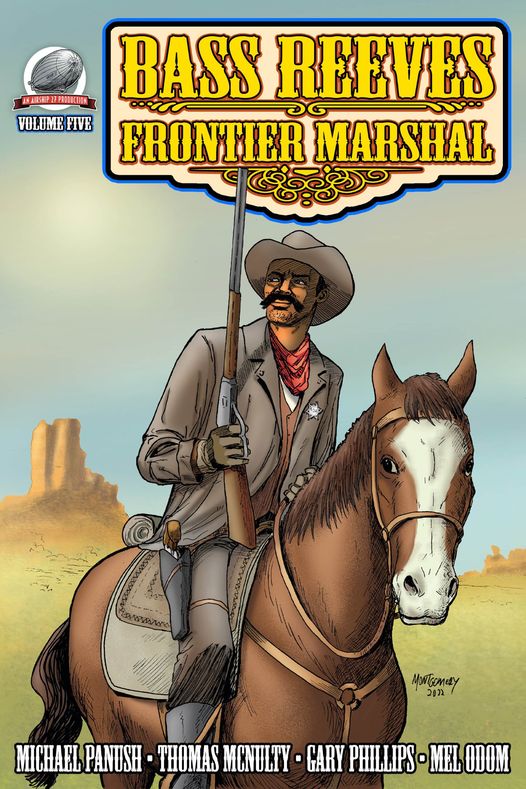
Airship 27 Production Presents Bass Reeves – Frontier Marshal Vol 5
Airship 27 Production is proud to present the fifth volume in its best-selling series featuring U.S. Deputy Marshal, Bass Reeves whose career spanned thirty years under Judge Isaac Parker.
In this volume, the legendary black lawman faces another four challenges as he rides the badlands of Oklahoma before it became a state. From the curse of a Mexican witch to chasing a renegade Indian Chief, Reeves is relentless in his pursuit of lawbreakers and totally devoted to justice.“What with two known Hollywood projects in the works, it seems Bass Reeves’ story is finally getting the recognition is deserves,” says Airship 27 Production Managing Editor Ron Fortier. “Both Paramount Plus and HBO have simultaneous western series now in development featuring Reeves,” Fortier reports. “Aside from the bogus fabrication of Reeves ever being an inspiration for the Lone Ranger radio show, the man’s factual career is more fantastic than any scriptwriter could have ever devised. We’re thrilled that our pulp scribes have jumped at the chance of writing new stories of this larger-than-life American hero.”
Artist Warren Montgomery provides the cover and Rob Davis interior illustrations. Writers Michael Panush, Thomas McNulty, Gary Phillips, and Mel Odom offer up tales of the frontier as seen through the eyes of the greatest lawman of them all. This is old fashion, western action as only these gritty pulp scribes can deliver. So saddle up and get ready to ride in adventure.
AIRSHIP 27 PRODUCTION – PULP FICTION FOR A NEW GENERATION!
Available now from Amazon in paperback and soon on Kindle.
Tuesday, February 8, 2022
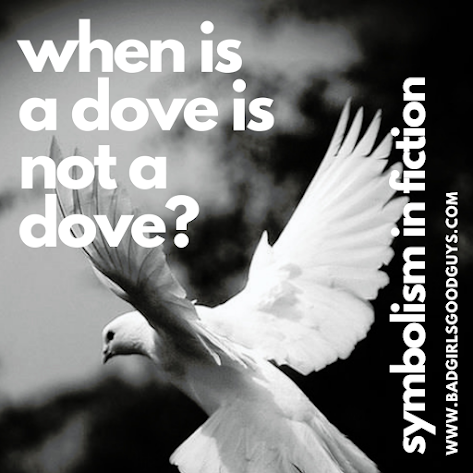
When is a dove not a dove? Symbolism in fiction.
We've heard it all before.
"It's never just rain. It's baptism."
"Sometimes rain is just rain."
"Two brothers fighting is always a reference to Cain and Abel."
"No. They just happen to be on opposite sides of a civil war."
Symbolism. It colors so much of our writing. And yet we are so divided by it. Some embrace it. Some claim it ruined reading for them. Some say it's everywhere. Some say most of it is hogwash.
This week we're looking at how we writers balance our straightforward plot writing with our metaphorical and symbolic writing -- if at all.
Where would you rate your work on a scale from "the plot IS the story" to "the true meaning is hidden in the symbolism"? Why?
Maya Preisler: I’m very close to the end of the spectrum where the true meaning of my writing is hidden in the symbolism because that’s how my brain functions. I analyze and over analyze the world around me so my writing does the same in reverse. I want to invite my readers on a journey that can go as deep as they are comfortable taking it. I like the idea of rewarding the very clever ones with extra information other people never figured out, like the ultimate Easter egg.
Bobby Nash: I sometimes pepper my stories with symbolism, but for the most part, the story is the story. My stories tend to be more character focused/driven. Sadly, I’m not that deep.
Ef Deal: The plot is the story, yes, but the plot is played out by characters whose motivations touch a deeper level. Book 1, for example, has the vicious Count Draganov, who has no compunction about stealing the souls of the dead, just as his son had no compunction about raping my MC and leaving her for dead. Book 2 has a vampire pursuing my MC, and the MC has to reckon with her position as someone who is vulnerable. And so forth... I think a novel should operate on three levels: action, character, and audience. Symbolism helps connect to the audience.
Nancy Hansen: I'm on the lower end of the scale as a writer because I really don't make much effort to consciously work symbolism into my writing. If it appears it's simply part of the characterization or the plot. I'm not a big planner when it comes to writing, most of my stuff just evolves from some seminal idea as I bang on the keyboard.
John French: Some people who have read my stories have found meaning in them I did not consciously put in. On hearing that, I decided to let my subconscious do the heavy lifting while I just write the stories.
Elizabeth Donald: Before approaching my MFA program and exploring literary fiction, I'd definitely put myself higher on plot than symbolism. To a certain extent, I hold the same beliefs now: I feel that if you're trying for symbolism, if you have to force the True Meaning of This Story, you're probably writing a boring story.
Do you typically use symbols to highlight the themes and tones of your work? What are the common ones (flags for dead military family members, boxed away wedding band for divorced/dear spouses, etc.) you find yourself using?
Gary Phillips: These are some deep questions to ponder. But definitely used some symbism in the new novel coming out. Set in '63, a Korean war vet turned crime photographer inherits a Speed Graphic in the war after the correspondent profiling his squad is killed in combat.
Ef Deal: Yes, I use the description of the settings to serve as symbols; the decaying elephant in the Place de la Bastille, the weather-tattered crepe-paper, the colors of the sky at dawn or dusk. I have a character my MC doesn't trust, and his eyes "gleamed in the gaslights of the Rue St. Jacques." The choice of words in a description conveys the entire tone of a scene: Is the sunrise golden or a glaring yellow? Is the sunset a gentle lilac or the lurid purple of a bruise? Do the masts of the moored ships reach into the sky, or do they claw the sky? Do they resemble a long-dead forest? There's so much that can be conveyed in these kinds of
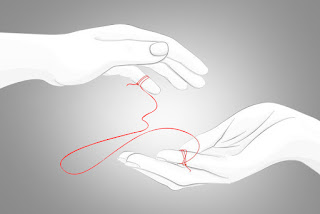
Maya Preisler: Yes, I absolutely use symbols to highlight the themes and tones in my work. I tend to use ravens and crows for connections to the underworld/afterlife and red threads for fate or destiny.
Elizabeth Donald: Sometimes the curtains are blue because that's what the writer saw when they looked out the window, and not because they were attempting some kind of existential philosophy about depression or deep water or bluebells which really mean Texas... That said, the best fiction is the fiction that makes you think and feel, and even changes your mind. You can't read a novel by Toni Morrison without considering what she is really saying about racism and classism in America, and exploring the meaning behind "blue eyes" in THE BLUEST EYE is a necessary part of understanding the novel.
Nancy Hansen: Now and then I will give a character a name that in whatever language it's from means something representing the character's attitude or looks. Especially if the character is based on someone I don't like in real life. <EVIL GRIN> Most of the time, that's more for my sake than the readers. If they get it—great! Whatever goes into a story I write is there to add to the flavor and move the plot forward, so I'm not giving it a ton of thought.
Bobby Nash: I focus on things that are important to the characters so it’s different for each, but I do use common themes and tones per character.
If you tend to avoid symbolism in your work, why do you prefer not to use it?
Elizabeth Donald: I still don't actively try for symbolism, to use an image or object to stand in for something else... but if I'm doing my job, if I'm using the language well and drawing on the reader's intelligence as well as emotion, then the symbolism will organically appear in the prose.
Nancy Hansen: I'm not avoiding using symbolism, it's just something I don't think too heavily about. Writing is kind of organic for me, I sit down and get ideas on a page, and then develop and refine them as I go along until the entire plot makes sense.
John French: Back in high school literature class, we had a long discussion about whether the writers and poets we were reading actually meant what we were reading into them. It ended with the teacher saying something like "We'll probably never know but, for the test, if I say it's bird imagery then it's bird imagery."
Bobby Nash: I’m more of a straightforward kind of storyteller so I don’t spend a lot of time thinking about symbolism. It’s just not something I think about.
Maya Preisler: Doesn’t apply to me, but to answer your question in reverse, I prefer to use symbolism because that’s how my English teachers taught me to dissect the classics so it makes sense to build my written worlds with those same blocks.
Do you have other writers you consider the great masters of symbolic writing or tight plot-based writing? What makes their work so fantastic?
Nancy Hansen: This is tough for me because I am such an eclectic reader and so I delve into a variety of books and stories. I read for enjoyment and don't care too much to overanalyze what I'm reading. One of the things that ruined upper grade English classes for me was having to dissect books and look for deeper meanings. Sometimes a story is just supposed to be entertaining and maybe somewhat enlightening. I'm good with that.
Maya Preisler: Several classic writers come to mind (thank you high school English teachers): Shelly, Hurston, Fitzgerald, and Dickens being the first. By contrast, the realm of speculative fiction seems to be more plot driven, though some like Mercedes Lackey use both plot and symbolism to drive their stories. I find those to be most satisfying because I enjoy picking apart the threads of the tales and finding the hidden gems within them.
Ef Deal: Early French novels through the 20th century at least are all about the symbols, and I majored in French so I am spoiled by them. Gregory Frost and A.C. Wise use powerful similes and metaphors to enrich their works. Gregory Maguire, at his best, does the same, but I find his work hit-or-miss. Jane Yolen and CJ Cherryh weave symbols so eloquently into their plots, I come away breathless sometimes.
Saturday, April 17, 2021
[Link] The Writers Collective Life
by Gary Phillips
If you’re just starting out as a writer, you could do worse than strip your television’s electric plug-wire, wrap a spike around it, and then stick it back into the wall. See what blows, and how far. Just an idea.
— Stephen King
Writing is not always that dangerous, though for journalists in various parts of the world it is, but it is a lonely business. Writing is counter-intuitive to the idea of the cooperative process. Even if you were copywriter in a busy office, envisioning yourself as a modern day Don Draper, mesmerizing the potential client with your ability at word pictures, selling them on how you’ll sell their doo-dad over martinis at lunch. But eventually you have to bang out the copy, then pass it around to others to get their notes, their edits, their rewrites, picked over, beat up, then handed back to you.
But we all still write alone. We are still the first and final judge on what we compose.
In the old days you stole time from your job and family to write at night or on the weekends to produce the Great American Novel or at least your version of that ideal. If you were a genre writer, maybe you were influenced by the likes of Mr. King who was once so broke that he was living in his car; yet still churning out his stories. Maybe devoted family man, Orrie Hitt, struck a chord as he cranked out his sleaze paperback titles like Naked Flesh and Man-Hungry Female sitting at his kitchen table 12-14 hours a day. Or you might have been inspired by the likes of Ray Bradbury, who wrote Fahrenheit 451 ––his classic sci-fi novel about censorship –– while renting the use of a typewriter in the basement of UCLA’s Powell Library for a dime each half hour. Total reported expense: $9.80.
All this before the internet, before Amazon, before the marriage between digital printing and a bindery machine. Before it all changed.
Read the full article: https://drpop.org/the-writers-collective-life/
Tuesday, March 23, 2021
New and Classic: The Pulp Conundrum
New Pulp is a term accepted/embraced by lots of writers today, from Chuck Wendig to Adam Christopher, and among the new publishers that identify with that marketing/genre terminology. But what does it mean? This week on the blog, we go straight to the sources to find out how the classic and the new compare.
Other than the one being old and the other being new (in terms of the historical timeline), what are the chief differences between classic pulp and New Pulp?
Gordon Dymowski: I think the main difference between "classic" Pulp and new Pulp is perspective. Many classic Pulp tales were written specifically for immediate publication and reflected the values of their times. New Pulp, however, manages to reflect current values while staying true to the original spirit of classic Pulp. It also helps that New Pulp tends to be better written and edited, and can incorporate influences that were not available back in the classic Pulp era. We have a more complex understanding of certain issues and tropes when writing (gender representation, racial stereotypes, and others).
Gary Phillips: To be brief, New Pulp certainly has switched up the POV. People of Color in the background are now in the foreground. Too, more women are in the Pat Savage mold. Also more inclusive of actual events from then.
Ron Fortier: The truth of the matter is 90 percent of Old Pulp was badly written. Not that we still don't love it, but the fact remains the majority of people before the 1040s only had a grade school education at best. Their knowledge of literature and grammar was limited and when pulps first burst onto the scene by the mid-20s, the editor's primary job was to fill pages and to that end they accepted whatever was sent to them. Period. Thus the dreg and why a pencil salesman named Edgar Rice Burroughs could read an issue of "Argosy" and say it was junk and "I can write better than this." Today we live an overly educated society, whether that is a good or bad thing is not for me to say. But what I do realize is that writing today, across the board is a hell of a lot better and even the weakest amateur at it can outshine what was done in the past. So New Pulp is elevated prose by all standards and it shows in the remarkable talents who write it today.
Nancy Hansen: To me what New Pulp means is stories told in the fast paced and adventuresome manner as the classic era pulps, but with an eye toward the current reading market's larger diversity and some sensitivity toward being more inclusive.
Sean Taylor: The coolest part of New Pulp for me is that I can have the freedom to be a little more "literary" than the original pulp writers had license to be. I get to actually use the full writers toolbox with real characterization and more than the two-dimensional good guys in white hats (or black fedoras) that were so popular at the time. Also, I can flex my symbolism muscles a little from time to time and play around with things like POV. I don't think that's a limitation of those earlier writers' abilities for the most part (though maybe for a rare few just like for a few New Pulpers too -- that's just the nature of the beast) but instead I think it's a facet of the changing audience for pulp action stories. Readers are used to and expect a deeper story than "Black Bat shoots gang leader." Again, not that those stories aren't fun -- they just aren't what most modern readers are looking for anymore.
Not only that, but as Gary and Gordon mentioned, New Pulp isn't trapped by the same cultural mores and values, and that means New Pulp stories can look into the darker shadows of pulp storytelling and previously ignored cultures within pulp pages to say something a little deeper and a lot more enlightened.
What are the commonalities between them?
Gary Phillips: I'd venture the commonality is still derring-do and larger than life characters.
Nancy Hansen: The big commonalities are in the pacing of the stories with the emphasis on action/adventure and the genres that make that work. The major difference besides the more inclusive atmosphere of characters from diverse backgrounds are that the characters are often more fleshed out. At least that's my take on it.
Ron Fortier: Those are the set pieces required in any story to be called pulp and that means tons of action/adventure, colorful heroes, dastardly villains, exotic locales. That is evidence in the fact that pulp writers like Max Allan Collins, Stephen King and the late Clive Cussler can make the NYT bestseller lists time after time. Why, because today New Pulp is great story telling and finally accepted by the literary community, not only the masses back in the day.
Sean Taylor: What's that saying? The more things change... That's certainly true for pulp style storytelling. Both classic and new are more direct narratively, more focused on action, and start with caricatures and stereotypes for their broad stroke story beats. And there's still that some of "slam-bang" delivery that doesn't spend pages on what the mountains look like. (I'm looking at you Tolkien.) And the characters are still going to be initially based on stereotypes -- at least before the New Pulp writer either starts to adapt that stereotype with characterization.Gordon Dymowski: Both have a strong sense of narrative drive with short, punchy sentences. They also share an emotional immediacy and *drive* (it's hard *not* to get caught up in a story) with vivid characters and higher stakes. Although both types of Pulp can sometimes strive towards more literary efforts, both use down-to-earth language to tell their stories.
Friday, December 21, 2018
HOLLYWOOD’S AFRICAN AMERICAN SINGING COWBOY RIDES AGAIN IN PROSE! ‘THE ADVENTURES OF THE BRONZE BUCKAROO’ DEBUTS
From out of the Wild West, gun on his hip, song on his lips, returns a historic hero of the silver screen in brand new stories. THE ADVENTURES OF THE BRONZE BUCKAROO is now available in print and digital formats from Pro Se Productions.
Portrayed by singer/actor Herb Jeffries, The Bronze Buckaroo, Bob Blake, appeared on screens in 1939 as the first African American singing cowboy. Cast in the mold of Gene Autry and Roy Rogers, The Buckaroos’ films had one major difference. They sported largely African American casts and were produced by African American companies. With four films usually listed as the Buckaroo’s legacy, this truly great moment in cinema history has been largely forgotten, except for film experts and fans of great stories. THE ADVENTURES OF THE BRONZE BUCKAROO features Robert J. Randisi, John Lutz, Gary Phillips, Christopher Alan Chambers, Frankie Y. Bailey, Michael Gonzales, and Percy Spurlark Parker, each giving their own take on the most unique Singing Cowboy to ever ride into a theater! Load your sixguns, saddle up, and get ready to charge into two-fisted matinee movie action with THE ADVENTURES OF THE BRONZE BUCKAROO!
With a rip-roaring cover and logo design by Jeffrey Hayes and print formatting by Marzia Marina and Antonino Lo Iacono, THE ADVENTURES OF THE BRONZE BUCKAROO is available now at Amazon and Pro Se’s own store for 11.99.
This unique anthology celebrating one of Hollywood’s best-kept secrets is also available as an Ebook, designed and formatted by Lo Iacono and Marina for only $2.99 for the Kindle. The book is also available on Kindle Unlimited, which means Kindle Unlimited Members can read for free.
For more information on this title, interviews with the author, or digital copies to review this book, contact Pro Se Productions’ Director of Corporate Operations, Kristi King-Morgan at directorofcorporateoperations@prose-press.com.
To learn more about Pro Se Productions, go to www.prose-press.com. Like Pro Se on Facebook at www.facebook.com/ProSeProductions.
Sunday, December 9, 2018
GARY PHILLIPS’ HARD BOILED DETECTIVE RETURNS TO GRITTY ACTION IN ‘HOLLIS FOR HIRE’ NOW AVAILABLE FOR DIGITAL PRE ORDER!
Award-winning author Gary Phillips put his own mark on the Private Eye genre with his creation of Nate Hollis. Originally a comic character, Nate made the transition to prose and to Pro Se Productions in HOLLIS, P.I. Hollis returns in a brand new collection set to debut December 13. GARY PHILLIPS’ HOLLIS FOR HIRE is now available for pre-order in digital format.
New York Times bestseller Sara Paretsky, Edgar winner Naomi Hirahara, Deadly Ink nominee Sarah M. Chen, hardboiled adept Scott Adlerberg, and new pulpster Phillip Drayer Duncan along with Hollis’ creator and Anthony Award Winner Gary Phillips (Black Pulp, Peepland) deliver tales of a P.I. who Kevin Burton Smith in Mystery Scene magazine called “Slick as spit, big-shouldered Hollis walks the walk and talks the talk…” This edition also includes two previously published Hollis stories by Phillips, “King Cow” and “Hollywood Killer.”
GARY PHILLIPS’ HOLLIS FOR HIRE, featuring a great cover by Jeffrey Hayes and digital formatting by Antonino Lo Iacono and Marzia Marina, is available for pre-order in ebook format for $2.99 at https://www.amazon.com/Gary-Phillips-Hollis-Hire-ebook/dp/B07L2HQCVW/ref=sr_1_1?ie=UTF8&qid=1543971249&sr=8-1&keywords=hollis+for+hire.
Both the print and digital copies will be available on December 13th, 2018 via Amazon and the Pro Se store at www.prose-press.com.
Sunday, July 1, 2018
[Link] From the Pulps to Modern Blockbusters: A Brief History of Noir & Neo-Noir
Neo-noir (from the Greek neo, which means new; and the French noir, meaning black) is a contemporary dark fiction subgenre with long roots in publishing and film history. It can be found in many different genres, including drama, fantasy, sci-fi and horror. In recent years, we’ve seen it in feature films (Blade Runner 2049, Road to Perdition), TV (Westworld, Better Call Saul) comic books (Southern Bastards, Kill or Be Killed) and novels (Gone Girl, Penny Dreadful). I spoke with Road to Perdition author Max Allan Collins, comic book writer Christa Faust, and crime author Gary Phillips about the ever-popular subgenre.
“Noir is a term that derives from the French Série Noire publications,” said Collins, referring to an imprint based in Paris that released hardboiled detective thrillers. Collins credits American writers like James M. Cain, Dashiell Hammett, Raymond Chandler and Mickey Spillane with promulgating the genre.Noir’s roots can be found in the hard-boiled crime fiction of the pulps — cheaply made magazines that saw record sales during the Great Depression and the beginning of World War II.
In the 1920s and ’30s, when readers could go to the newsstand to pick up a copy of a crime pulp, such as Black Mask, they’d discover private detectives with a penchant for alcohol, trench coats and fedoras. They’d find gangsters with pistols, cold eyes and hot tempers. They’d be immersed in shadowy atmospheres, and they’d meet male characters preoccupied with mysterious, seductive women known as femme fatales. Commonly written in first-person, the stories often highlighted the real-world issues of the prohibition years.
Due to a paper shortage during World War II, publishing costs rose and the pulps failed to make a profit. By the end of the war, many publications were closing their doors.
Meanwhile, however, other mediums flourished — especially film. Books like The Postman Always Rings Twice, The Big Sleep and Thieves Like Us were adapted to film noir in the mid to late ’40s. Under budget and time constraints, filmmakers used ingenuity to create a style that produced the core elements of film noir. Collins said, “The ’40s black-and-white crime films that most identify as noir had to do with cost-cutting — using dramatic lighting effects to disguise scant sets — but also are heavily influenced by popular crime writers.”
In addition to financial constraints, filmmakers were limited by the Hays Code of 1930. The code restricted or outright banned perverse terminology as well as sexual acts between unmarried, interracial, or same-sex couples. To get around this, filmmakers implied off-screen scenes of violence and sexual content that would’ve otherwise broken the code. This gave rise to the voiceover narrative in a dim, smoky setting, which became iconic characteristics of film noir.
Read the full article: https://www.crixeo.com/neo-noir/
Wednesday, November 2, 2016
Nugget #84 -- Why Comics?
Thursday, October 6, 2016
White by Default? A Character Assumption Roundtable
The key kernal for this discussion comes from an exchange my fellow pulp writer I.A. Watson had with one of his editors, and is as follows:
Editor: About this villain, Ms Zeuzi. Why is she White? Aren’t there enough White characters in your book?
I.A. Watson: Where do I say she’s White? I don’t describe her appearance at all, except her business suit and mannerisms.
Editor: You don’t say she’s not White. You could have mentioned she’s African American or Latino. You don’t.
IW: There’s lots of characters in the book, some of whom are White, but I don’t say they are Caucasian or put in a description of their skin colour. Why do I need to specify that Ms Zeuzi is non-White if it doesn’t come up in the story?
Editor: Readers default assume characters are White if you don’t say otherwise.
I’m really not sure about this. Advice?
Is this true in your experience? Why do you think that?
Lee Houston Jr.: Only in regards to classic characters created before the late 1960s, and the writers of the day didn't dare challenge the "social norms" of their time.
Erwin K. Roberts: Before "enlightenment" came to the various media, there were occasional stealth minority characters. In his book, Space Cadet, Robert Heinlein's three protagonists were a kid from Des Moines, a wild & wooly Texan, and a quiet fellow from colonial Venus. One presumes they all had white skin. After they finish training, the three spend a year or so on a spaceship with a crew of about a dozen. What is not revealed, until after they leave the ship, is that one of the ship's officers was "as black as the ace of Spades." Not exactly politically correct, but I'm sure a lot of younger readers circa 1950, or so, were shocked by the revelation.
Kristi Morgan: This is true, and applies to writing that has more than just humans in it too. I am in the middle of editing stories for a collection that contains humans, elves, dwarves, and kobolds. Every story started of with dialogue or what their characters were doing, but nothing about what they looked like. My mind assumed they were human and probably white unless the writer said otherwise, and most of them never did. Readers are not mind readers. Unless you describe the characters, we will make up our own descriptions in our mind.
Van Allen Plexico: I think readers consciously or subconsciously look for cues, even tiny ones, that tell them more about a character. Those cues can come via outright descriptions of appearance, yes. But also via tiny comments during dialogue, manner of speech, name, and so on. And those don't even have to be intentional or conscious decisions on the part of the author in some cases, I think.So, no, I don't think all readers default all characters to white as long as there are any reasons not to... But likely some do.
Alan Lewis: In most cases, I'd say it is true. Or maybe, more to the point, we like to make the characters like ourselves, so we default many characters to our own race.
Lucy Blue: I know as a reader, i do this, and I always assumed that everybody just defaulted to their own race until told otherwise. But of course, that isn't true--readers of color have gotten so used to white being the "default setting" in fiction that they make that assumption, too. (May that someday not be so.) So yeah, as a writer, I struggle with this. I don't want to point out every character's race as soon as they're introduced, but if a character's race is important to the story, I want the reader to have a clear picture of them. That's one great thing about writing science fiction and fantasy; in those worlds, a lot of the time it doesn't matter what skin tone the characters have; readers can picture characters however they choose. But in writing any kind of contemporary or "realistic" fiction, it's definitely a concern.
Rose Johnson Streif: This is weird, but the characters tend to remain somewhat amorphous to me until they are described, or begin to take shape. I have a highly visual mind, but I want to see what the writer sees when I am reading someone else's work. I'll fill in the blanks as time goes by, but I want to see their world, not impose my own. (That's for my own work.)
And so, as to race, I'll pick up cues, wait until the author says it outright, or just not assume. But if it goes on for too long without description, I probably will default to white, because the author probably did too. (And I dislike not having descriptions. I don't need info dump, but show me these people you created, d@mmit.)
Marian Allen: I think it's true. If somebody's ethnicity doesn't matter to your third-person story or doesn't impose itself on your first-person narrator's consciousness, don't bother with it.
Herika Raymer: I usually default to the race of the writer, not sure who else does. It's usually the correct assumption, unless otherwise stated.
Gary Phillips: I once wrote a novel giving hints as to various characters' race -- she was a natural blonde, his name was Kurasawa and so on, but deliberately gave no indication of the main charater's race. And being black but with a "whitebread" name, left my photo off the back Of, and the anti-hero, the main guy is only called O'Conner, though plenty of black folks have Irish sounding last names.
How do you handles such descriptions of ethnicity or do you prefer to let the reader default to their preconceptions?
Erwin K. Roberts: I tend to sprinkle minority characters around my stories. But only if the story is not slowed down by explaining how and why the character happens to be there.
Sometimes there is a compelling reason for a minority character, or group, to be included, even it such a thing was not common to the period. In my Sons of Thor the first section is set in World War One. The French need a battalion of Infantry to provide security for a very important meeting. There can not, must not, be any German sympathizers or spies among them. Who they gonna call?
Well, there's this Regiment that the U.S. Army dumped on them. The Yanks just couldn't figure out what to do with the unit calling themselves The Men of Bronze. The 369th Infantry Regiment is best known as The Hellfighters From Harlem. How many Germans are in an all African-American (to include some of the officers) unit? This retired Missouri National Guardsman was proud to shine some fictional light on the former 15th New York Infantry Regiment.
Marian Allen: GENERALLY SPEAKING, I don't think of characters as being a particular ethnicity or race so much as I think of them as individuals OF a particular ethnicity, race, or background. I might specify this lady has milky skin and red-gold hair, or this guy might have tightly curled black hair, brown eyes, skin the color of bittersweet chocolate .... If there were no such thing as the concept of "race," or if we understood that "ethnicity" doesn't mean "everybody but white," how would we describe characters? That's what I try to do. It kind of pisses me off when writers don't describe characters unless the characters are people of color, or when writers do describe characters UNLESS they're people of color, in which case they're "black" or "Oriental" or some nonsense.
Alan Lewis: I only feel that the color of a character's skin should be important if it is a factor in the story.For example, in my Black Wolf stories, the lead character is a black man, living in 1930's South Carolina. He lives in a predominantly black neighborhood and is always dealing with racist attitudes when he ventures into the white parts of town. He dates a young white woman, which was very taboo in those days. All these factors come into play in the stories, telling the daily struggles with racism while the man is simply trying to do his job.
Now take away the prejudice and time period and drop him into a contemporary setting, and those issues of race are greatly reduced. Therefore, the color of his skin isn’t an issue and doesn’t need to be made part of the story.
Van Allen Plexico: I will admit I do feel a responsibility to make the casts of my stories at least somewhat diverse in terms of race and gender, rather than monochrome and all guys. I don't do this out of any sense of trying to be "PC", but because it makes the story more interesting and more appealing to more people, and it's more logical in a world of diverse people, particularly one set in the future. The fact that it is the right thing to do is only a happy side effect.
To convey this, I try to provide as many cues as reasonably possible (short of doing any harm to the narrative) to make the characters "visible" in the minds of the readers as close to how I've imagined them as possible.
As a made-up example:
Hawk drew off his glove and stared down at his olive-skinned hand, flexing it carefully.
Hawk glanced over at Falcon, then ran his hand back through his thick, black hair.
I generally follow Roger Zelazny's rule that you should provide no more than three outright physical descriptions of a character when you introduce him or her (more than that and they get fuzzy in the reader's mind, rather than clearer), and then fill in any remaining visual blanks during the course of the narrative or dialogue later, as needed, as you go.
Tuesday, February 10, 2015
Gary Phillips -- The Pulpster Soul of Angeltown
Tell us a bit about your latest work.
I’m very happy with my latest, a collection of six original short stories featuring Nate Hollis, a modern day, rough and tumble private eye in the big, bad City of Angels, Los Angeles. He began in comics a few years back for a DC/Vertigo miniseries, Angeltown. In fact that sequential effort was collected under one volume brought out by Moonstone.
But this new prose anthology from our friends at Pro Se, Hollis, P.I., has two new stories by me, one of them featuring not Nate but his sometimes rival, the bounty hunter Irma Ducett, aka Irma Deuce. But my buddy, New York Times bestseller Juliet Blackwell (the Witchcraft Mystery series) wrote a Hollis story, as did acclaimed young crime writer Aaron Philip Clark (A Healthy Fear of Man) and new pulp heavyweights Bobby Nash (Domino Lady: Money Shot) and Derrick Ferguson (Four Bullets for Dillon).
What are the themes and subjects you tend to revisit in your work?I think genre and so-called mainstream writers wrestle with themes of redemption and sacrifice, selfishness and obsessions. That all of us are capable of both good and bad, that there are days we might engage in both in big or small way and though writing fiction we capture the big acts in our characters.
What would be your dream project?
Writing the short story, novel, graphic novel, radio script and screenplay, each chronicling a part of the overall adventure of one of my characters – one big story arc across those various mediums.
If you have any former project to do over to make it better, which one would it be, and what would you do?
If I could do a reboot of my first novel, Violent Spring, which introduced my other private eye character, Ivan Monk, back in the ‘90s, that’s the one I’d like to write over. Since I wrote that book I think I’ve gotten a better handle on how a mystery should flow, unfold, and sharper dialogue.
What inspires you to write?

Writing is therapy. If I can’t write or think about what I want to write, I’d go nuts. I guess then keeping what passes for my mental health keeps me writing.
What writers have influenced your style and technique?
The one that always come to mind are Dashiell Hammett, Richard Wright, Ross Macdonald and Jack Kirby – I mean, the King did write but it was his visuals that inspired me to want to write and draw comics that set me on the road to prose.
Where would you rank writing on the "Is it an art or it is a science continuum?" Why?
That’s an interesting question. I teach in a MFA writing program part-time. As I’m the genre guy, I get those who either write that stuff or want to try their hand at it from writing the supposed mainstream work. As Raymond Chandler advised long ago, there are only something like 8 or 9 plots when you boil it all down. Then you figure the human factor; greed, lust, guilt, and so on. We know too a mystery or crime novel or pulp demands certain convention yet you also know you have to make it fresh, somehow different enough so the reader comes away entertained and dare I say, possibly even think about the work afterward.. Now with the aforementioned in mind, since I have to take apart my student’s work and explain what works and what doesn’t, it has forced me to be more critical of what I write.
Part of that can be broken down into an equation, x amount of action versus introspection, how much narrative versus dialogue. But each story is its own thing, so we also know conventions are made to be broken and should be routinely in writing. The story’s pace and flow emerges and takes us along and that’s the trick, that’s the art; doe sit feel like it works the way you’ve written the tale?
Any other upcoming projects you would like to plug?I have a short story, “Bulletville” in the, wait for it, 50 Shades of a Gray Fedora anthology out in e-book initially this February from the newly formed Dagger imprint of Riverdale Avenue Books to capitalize of the infamous 50 Shades movie version also debuting in February. In March, will have out Day of the Destroyers. This is a linked anthology I edited featuring Jimmie Flint, Secret Agent X-11 as he battles coup plotters out to overthrow FDR. The Green Lama,. the Phantom Detective and the Black Bat guest star. In hardback and trade paperback from Moonstone.
And since I’m plugging, for more of my work, folks can check out my website at: www.gdphillips.com.
Saturday, December 13, 2014
“GARY PHILLIPS’ HOLLIS P.I.” DEBUTS FROM PRO SE PRODUCTIONS
COMIC PRIVATE EYE LEAPS TO PROSE IN NEW COLLECTION!
An innovative Publisher of cutting edge Genre Fiction and New Pulp, Pro Se Productions announces the release of a short story collection featuring one of the best modern hard boiled private investigators to ever grace a page. Birthed full-blown several years ago in the comics mini-series Angeltown, L.A. private eye Nate Hollis, created by noted Genre Fiction author Gary Phillips, makes the jump to prose in six new short stories in Gary Phillips’ Hollis, P.I.
“I couldn’t be more pleased that Hollis returns in prose from Pro Se Productions,” Phillips said. “Readers are in for some hardboiled thrills as we put the redoubtable private eye through his paces -- from a ritual killing, the hunt for long-hidden swag, attack dogs in the dark, to the machinations of crooked politicians…tough guys and tougher women.”
Gary Phillips has penned short stories for Moonstone’s Kolchak: The Night Stalker Casebook, the Avenger Chronicles, the Green Hornet Casefiles and The Spider: Extreme Prejudice anthologies. His most current novel is Warlord of Willow Ridge. He also has out the eBook novella, The Essex Man: 10 Seconds to Death, a homage to ‘70s era paperback vigilantes. Additionally he is one of the editors for Pro Se's BLACK PULP volume, and any and all follow ups to that collection. In addition to editing and contributing to Hollis, P.I. for Pro Se, he also has for the press stories upcoming in Asian Pulp and Black Pulp II. He recently wrote the graphic novel Big Water, about the fight by a municipality to save its water from privatization; has a steamy story not for kids in 50 Shades of a Fedora; and is editor and contributor to the upcoming Day of the Destroyers, a collection of linked stories wherein Jimmie Flint, Secret Agent X-11 battles to stop internal forces out to overthrow the presidency of FDR during the Great Depression.
New York Times bestseller Juliet Blackwell (the Witchcraft Mystery series), acclaimed up-and-coming crime writer Aaron Philip Clark (A Healthy Fear of Man) new pulp luminaries Derrick Ferguson (Four Bullets for Dillon) and Pulp Ark award winner Bobby Nash join Phillips in penning these new gritty tales. Five stories feature Nate Hollis with a sixth featuring his sometimes ally, bounty hunter Irma Deuce. The streets are mean, but they don’t hold a stick of dynamite to Gary Phillips’ Hollis, P.I.
“PI Nate Hollis,” says T. Jefferson Parker, author of The Famous and the Dead, “originally sprang from the rich imagination of LA-based writer Gary Phillips, but he’s so real and tactile he could climb off the page and buy you a bourbon. Now, four other authors are getting a piece of Nate, too, and this latest collection of Nate stories is wonderful. This is contemporary noir at its best, offering all the familiar pleasures of the genre, but giving them a modern makeover. Yes, this is a violent world that Nate inhabits, but he steers a true and moral course through the layers of deception, skullduggery and sometimes worse that make these stories such high-density entertainment. Nate’s a great character and these stories do him justice and more. “
Gary Phillips’ Hollis P.I., features evocative and action packed cover art and logo design by Jeffrey Hayes. With print formatting by Percival Constantine, the collection is available from Amazon and Pro Se’s own store for $12.00. This modern mystery collection is also available as an eBook for the Kindle http://tinyurl.com/nje4y36 and in most formats from Smashwords for only $2.99.
For more information on this title, interviews with the author, or digital copies for review, contact Morgan McKay, Pro Se’s Director of Corporate Operations, at directorofcorporateoperations@prose-press.com.
To learn more about Pro Se Productions, go to www.prose-press.com. Like Pro Se on Face book at www.facebook.com/ProSeProductions.
Wednesday, June 26, 2013
On B-Boys and Pulp Culture
Planet Hip-Hop has always overflowed with folks into various forms of pulp culture. Over the years, I’ve interviewed many rap artists and producers who shared their love for Star Wars, crime movies, karate flicks and the novels of Iceberg Slim and Donald Goines. Still, I was surprised when Queensbridge legend Nas told me in 1999 that he had once created a Black Pulp hero when he was a kid.
“I used to used to draw my own character called Sea God,” Nas told me. “I copied the body of Conan the Barbarian, but had him standing on the corner instead of in the forest.” Without a doubt, I’m sure Nas isn’t the only one with a stash of drawings and/or writings detailing the bugged adventures of urban champions.
Last year, when respected crime novelist/comic book writer Gary Phillips invited me to contribute a short story to his latest project Black Pulp (Pro Se, 2013), co-edited with Tommy Hancock, I immediately thought of that long ago conversation with Nas and decided I too wanted to create a hood hero.Leaning back in my office chair, I closed my eyes and thought of my own pulp filled childhood growing-up in Harlem: of listening to old Shadow radio programs that were released on records, watching blaxploitation and kung-fu flicks every weekend, devouring the Marshall Rodgers/Steve Englehart’s version of Batman, discovering the weird worlds of Edgar Rice Burroughs and Robert E. Howard, watching Buck Rogers/Flash Gordon serials on PBS and falling in love with the work of pulp artist supreme Howard Chaykin, the dude George Lucas requested to illustrate the first Star Wars comic book.
After an hour of drifting on those dusty memories, quicker than I could say, “Batman and Robin, Green Hornet and Kato or Easy Rawlins and Mouse,” my own pulp heroes Jaguar and Shep were born. The lead character Coltrane (Jaguar) Jones owns a Harlem rap club called the Bassment and drives through Harlem cool as Super Fly in a fly sports car. His murderous friend Shep, who just got out of prison, becomes his badass sidekick as the two self-appointed crime fighters go in search of a music minded kidnapper.
Although I’ve never been big on constructing strict outlines for fiction, I knew that I wanted the period to be 1988, the last year Mayor Koch was in office. Crack was at its height, Public Enemy’s brilliant It Takes a Nation of Millions was rockin’ the boulevards, Dapper Dan was creating his bugged designer fashions and New York City was still on the verge exploding.
Recalling Fab 5 Freddy, who also appears in the story, telling me about the jazz/hip-hop shows he did with Max Roach at the Mudd Club in the 1980s, the finished story told the tale of a be-bop lover trying to rid b-boys and their music from the streets of Sugar Hill. While working on the story, I consulted with my good friend Robert (Bob) Morales, himself an accomplished comic book writer, co-creator of the black Captain America graphic novel The Truth and a pulp culture aficionado. Although he was working on a graphic novel about Orson Welles at the time, he always found the time to talk. Once, when I thought the Paul Pope/John Carpenter-Escape from New York inspired climax might be too crazy, Bob reminded me, “It’s a pulp story…there’s no such thing as too wild.”
So, after several weeks of calling Bob, sometimes a few times a day, and writing, “Jaguar and the Jungleland Boogie” was finally finished. Sadly, Bob Morales died suddenly on April 17, so I’d like to dedicate the story to him.
In addition to my b-boy/be-bop tale, Black Pulp has a cool line-up of creators of color that include famed novelist Walter Mosley, who penned the introduction, Gar Anthony Heywood, Christopher Chambers, Kimberly Richardson, Mel Odom and others.
Buy Black Pulp: http://www.amazon.com/dp/1484135717
Walter Mosley introduction: http://www.huffingtonpost.com/walter-mosley/post_4876_b_3346575.html
Friday, February 1, 2013
Pro Se Announces Black Pulp Collection!
![]() |
| Cover for BLACK PULP by Adam Shaw |
Black Pulp is a collection of stories featuring African characters in leading roles in stories running the genre gamut. Pulp Fiction of the early 20th Century rarely, if ever, focused on characters of color and the handful of black characters in these stories were typically portrayed as racial stereotypes. Black Pulp, a concept developed by noted crime novelist Gary Phillips, brings some of today’s best authors together with up and coming writers to craft adventure tales, mysteries, and more, all with black characters at the forefront.
Also co-editor of Black Pulp, Phillips observed, “While revisionism is not history, as Django Unchained signifies, nonetheless historical matters find their way into popular fiction. This is certainly the case with new pulp as it handles such issues as race with a modern take, even though stories can be set in a retro context. Black Pulp then offers exciting tales of derring-do and clear-eyed heroes and heroines of darker hues appealing to all.”
Black Pulp features a new original essay on the nature of Pulp, both classic and modern, by award winning author Walter Mosley. Known for his bestselling Easy Rawlins novel series as well as books featuring Private Eye Leonid McGill, Mosley is widely published in fiction, both literary and genre, and non-fiction. Mosley has received several honors, including a Grammy, PEN America’s Lifetime Achievement Award, and an O. Henry award.
![]() |
| Black Pulp Co-Editor, Contributor, and Idea Bringer Gary Phillips |
Other contributing writers include Chester Himes Award winner Phillips, two time Shamus Award winner Gar Anthony Heywood, noted author Kimberly Richardson who currently has two works enlisted for Pulitzer Prize nomination, Dixon Medal winner Christopher Chambers, critically acclaimed novelist Mel Odom, hip-hop chronicler Michael Gonzales, Pulp Factory and Pulp Ark Award winner Ron Fortier, Pulp Factory Award winner Charles Saunders, Pulp Ark Award winners Derrick Ferguson and Tommy Hancock (also Publisher co-editor of Black Pulp), and noted writers Michael Gonzales and Alan D. Lewis.
Black Pulp is slated for print and digital release in early 2013 and features an original cover by Adam Shaw. For more information concerning Black Pulp and Pro Se Productions, contact proseproductions@earthlink.net.
Sunday, December 16, 2012
PRO SE ANNOUNCES LICENSING DEAL WITH NOTED CRIME AUTHOR
Angeltown
The Nate Hollis Investigations
Moonstone 2011
|