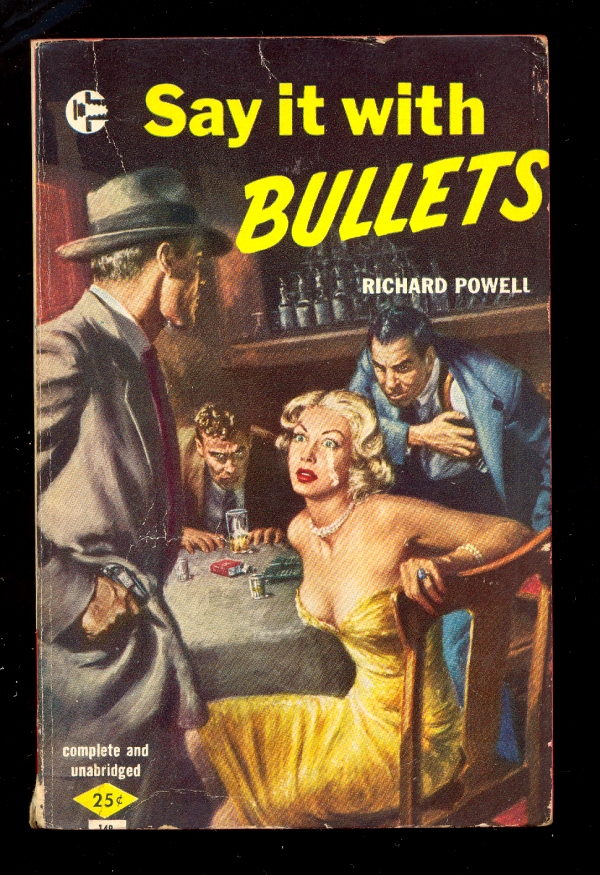
Showing posts with label Noir. Show all posts

Thursday, July 24, 2025

Mission Accomplished! Achievement Unlocked! A Novel in 8 Weeks!

Some of you who also follow my social media in addition to the blog may be aware that I have been working this summer to write my first novel. 

Surprising, right? Most people just assume that I've written novels with 35 years of professional writing behind me, but no, my career has primarily been in short stories with a few novelettes and even fewer novellas. So, for me, this was a big deal. 

I've started several novels before but never finished them. 

However, I'm thrilled to say that this one is done. Finished. Finito. The end. Over and out. 

If you've been a regular reader of the blog, you may also know that I use mock-up covers to help keep me focused and excited about my stories. For this new novel, called Another Dangerous Driver, here is the mock-up I put together. 

Not that I'd ever be one to try to get snotty or above my station as a write (/sarcasm), but my goal for this novel is to find not only a sweet spot between cozy and hard-boiled, but also to be as true to Fitzgerald's characters as possible and capture the social consciousness of Zora Neale Hurston and Langston Hughes in terms of the treatment of women and minorities, sort of like Gary Phillips and Walter Mosley did with hard-boiled in their mysteries. That intersection of Agatha Christie, Raymond Chandler, F. Scott Fitzgerald, and Langston Hughes is a tricky place to aim for. (And that means a lot of room to fail, sadly. We'll have to see.)

Just to tease you a bit, Another Dangerous Driver picks up the story of Jordan Baker, yes, THAT Jordan Baker from The Great Gatsby. During a golf tournament in Charleston, while trying to deal with the emotional fallout from what she called The New York Incident, and the subtle trauma it has triggered, she stumbles across a body floating in the water hazard that brings all the drama crashing back into her mind. Of course, when she is implicated in the crime, she must try to solve the mystery to clear her name. 

Folks, just in case you don't realize the magnitude of the joy I'm experiencing right now, I gave myself a goal to write a novel during my summer break. I'm a teacher and I get roughly eight weeks of summer break. I am pleased to say that it is done. 

I have graduated from novel starter to novel finisher. 

Viva la Sean! (And thanks, Jordan. I couldn't have done it if you hadn't been so much fun to write.)


Note: For those interested in the "behind the scenes" stuff, as I'm pictured Jordan Baker for the novel, I saw a lot more of Lois Chiles from 1974 than Elizabeth Debicki from 2013. A large part of that is because Debicki looks more like Miss Fischer, and if I see her that way, then that colors my voice when I write her. Her attitude also comes more from the 1974 film as well since Jordan's role was severely downplayed, in my opinion, in the 2013 movie -- regardless of how amazing the actress was. Of course, the bulk of the attitude comes from F. Scott Fitzgerald's book and my own speculation on how Jordan might have changed after the events of New York.

Wednesday, March 20, 2024

Movie Reviews for Writers: Mike Hammer's Mickey Spillane


If you are a fan of pulp fiction or hard-boiled detectives in particular, Mickey Spillane isn't a name you're unfamiliar with. This documentary, written by Mickey's oft-time writing partner Max Allen Collins, can tell you all the reasons why that's true. 

"Mike Hammer was not the first fictional private eye," says Otto Penzler. "While Dashiell Hammett and Raymond Chandler were successful and well-known, they never approached the kind of success in terms of readership numbers or magnitude of recognition that Mickey had. If it weren't for Mickey Spillane creating the basic mold, the other writers would have had a hard time inventing it. 

"You were influenced by Mickey Spillane whether you've read him or not," says author Parnall Hall, "because every other private eye writer is influenced by Mickey Spillane."

As true as that is, I prefer the way author Miriam Ann Moore phrases the same idea: "Nobody ever hit a noun against a verb like Mickey Spillane." 

So, what can such a renowned writer teach us?

Write your own kind of moral code


Remember that you don't answer to anyone but yourself. You are not beholden to your church or parents' religion, or even the community standards in which you live. You do you, as the cliche goes. 

But, be warned, that kind of freedom can get you in trouble with that church, those parents, or that community.

Says Penzler, 

"In the mid-1950s an author named Frederick Wortham wrote a book called Seduction of the Innocent which primarily attacked comic books as supposedly a cause of juvenile delinquency. The only author he attacked aside from comic book writers was Mickey." 

And it wasn't just Wortham. Spillane was catching hell from lots of different critics, as the narrator expounds over clips from his movies. 

There was a storm of controversy over Spillane's strong sexual content and violent action scenes. Along with comic books and rock and roll, Spillane was blamed by commentators as a prime cause of juvenile delinquency. Spillane was blasted as a prime mover in America's moral decline.

 Loren Estleman, author of The Amos Walker Mysteries, explains futher.

We were a very Puritan Nation right up through the 1950s, and it was only at that point that the old standards and barriers began to fall, and I think it was through people like Mickey Spillane getting out there and effectively butting his head against the wall that made those walls collapse. It wasn't violence or sex for the sake of violence and sex. It was there to propel the characters and to propel the story along.

Mickey himself makes it clear that he was never one to shy away from sex or violence. "Sex and violence are punctuation marks in the story," he says. And not just those two topics either. He also didn't shy away from addressing politics in his work, according to Penzler: "He was not afraid to write about politics, and he was not afraid to write about politics from a point of view that was not necessarily the most popular in the say, Eastern establishment of New York publishing."

All of that way of thinking (and of writing) made its way into Spillane's work because it came from his background. He wasn't an ivory tower author, but a regular Joe who wrote. As he says:

It's kind of like a blue-collar existentialist where you're talking about people trying to think about what's right and wrong, but on the everyday level of the "Who's on my ass today?" or "Who's going to, you know, kill me?" or "What what kind of decision can I make uh to keep my myself alive and still try to do the right thing?" 


Look for opportunities


As a blue-collar writer, Mickey was always on the lookout for paying work. Never one to rest on his laurels of Mike Hammer's success, he also turned to short, two-page detective yarns in the backs of comic books. 

There was some postal regulation that in order for them to get mailing permits for the subscriptions on the comic books they had to have a certain amount amount of text material. Now you got 25 bucks a shot for two pages of these things. Now this usually would take about 10 minutes to write, 20 minutes to write, but at that time 25 bucks was a lot of money, and you could write four a day you're getting $100 a day when a hardworking man out there is making 35 a week.

(Personally, I'd love to track some of these.)
 

Something will define your work


Spillane knew his work well enough to know and accept the fact that there would be certain trademarks or habits would mark it as his own. He didn't try to fight those kinds of identifiers or re-invent himself to keep fans and critics surprised. He accepted both his style and any limitations and wrote the way he knew Mickey Spillane could write. 

One of those marks, as the narrator recounts over a scene from I, the Jury, was his endings, which began as early as I, the Jury. 

"The swift violence of Mike Hammer's retribution was matched only by Mickey Spillane's abrupt punch to the solar plexus endings." 

It's something Mickey was proud of. 

Baby, when you're writing a story, think of it like a joke with a great punchline. Get the great ending, then write up to it. 

The ending was a make-or-break moment for him, says Collins. "One thing Mickey was very clear on in his work and even enunciated was that the first chapter sells the book the last chapter sells the next book."

Spillane cared so much about the importance of his story endings that he once put $1000 on the line in a bet with his editor. 

I said a perfect book is written with the climax on the last word of the last page, so if you took the last word away you wouldn't know what the book was about. When I turned in Vengeance, I turned it in without the last word on the last page he just asked, 'What was that word? What was the word?' 'Give me a thousand bucks. He gave me a thousand bucks. I gave him the word."

Screw the critics


According to Penzler, Mickey was able to speak directly to readers so critics despised him. They not only thought of him as low-brow and common, but also vulgar in his writing. It was a sentiment Mickey didn't allow to get him down. In fact, he often turned in back in his critics faces. Says he:

I went to a tea party, if you can imagine me at a tea party, you know, but anyway there they had this funny little guy who was a very self-important fellow. He came to me, and he said what terrible commentary in the reading habit of the American public that you have seven, the seven top best sellers in America today. Whatt I could think of to say but was, well, you're lucky I didn't write three more."

He knew that critics didn't call the shots, not really. It's the readers. "Critics don't decide anything," he says. "Publishers don't decide anything. No, no, the public is the one who decides everything."

He was equally hard on the writers in that equation. "Writers don't have talent. Writers have mechanical aptitude."

Everything must be done with the reader in mind. 

Don't get full of yourself


But that idea of being tough on the writer kept him humble, kept him true to his blue-collar way of approaching his life and his work. Sure, he was a best-seller. He was a movie star even. But he never embraced the kind of highfaluting way of letting that think himself any kind of star. In fact, he didn't even like to refer to himself as an author.

I am not an author. I am a writer. A writer is on a day-today job all the time. He's writing. This is a job for him. He's making money to keep the smoke coming out the chimney. I don't want to go out and dig ditches every day of the week.

I think we could use a lot more Mickey Spillane's in this business. 

Saturday, January 27, 2024

[Link] The 5 Essential Rules of Film Noir

Editor's Note: This applies also to you folks writing Noir-inspired fiction, not just to the films themselves.

by Jonathan Crow

“That’s life. Whichever way you turn, Fate sticks out a foot to trip you.”

– Al Robert (Tom Neal), Detour

Film Noir. When you think that phrase, the mind is immediately drawn to images of leggy ice queens, rumbled losers in fedoras, guns, neon and certain deadpan cynicism. Film Noir wasn’t a self conscious movement in the way the French New Wave was. It wasn’t a brand name like a Marvel superhero epic. But it did tap into something dark in the American postwar zeitgeist and became for a spell hugely popular. It also created some of the most unforgettable images in film history.

Film Noir hit its zenith in the late ‘40s, a time when veterans were returning home in droves after having witnessed unimaginable horrors. Under the weight of war trauma, men felt the brittle veneer of traditional masculinity – strong, stoic and dominant — crack and crumble. Film Noir tapped into this anxiety. It’s no accident that film scholars have called Film Noir the male weepy.

Read the full article: https://www.openculture.com/2014/06/the-5-rules-of-film-noir.html

Tuesday, July 27, 2021

Blog Re-Run: Femme Fatales—An Obsession Dissected

 Here's the original blast from the past... The very first article that ran on this blog. Enjoy!

=========================================

 Like the hard-boiled hero, the femme fatale dates to classic myth. An example is Circe, who turned Odysseus' men into swine in Book X of The Odyssey and the Sirens, whose beauty and alluring song attracted his sailors in Book XII. … In the Middle Ages, Christianity refashioned this archetype as a devil, called the succubus. -- Characteristics of Hard-Boiled Fiction: The Femme Fatale (http://www.detnovel.com/FemmeFatale.html)

If you read my writing at all, you know I’m obsessed with writing femme fatales into my stories. In defense, giving the hero an equal and opposite makes for strong storytelling, but surely I could just give him a straight up villain for that role, right? Yes and no.

While a villain needs to be a fully realized character just as much as the hero, the femme fatales (at least to me) are something different, something special, the proverbial monkey wrench (though drenched in curves and slinky sex appeal) thrown into the machine. It’s her role to play Jiminy Cricket in a way, but more for the dark side, but not completely dark, but dark enough to fight dirty and to throw society’s conventions to the wind. She’s the little voice trying to seduce the hero to true independence from being pure good. She’s the test, at least in my mind, that reminds the hero that he (or she) has feet of clay and to never take that for granted.


A Few of My Favorite Femmes

Femme fatales abound in classic films, of course, and many of my favorite actresses played them at one point or another in their careers, such as Marlene Dietrich, Rita Hayworth, Veronica Lake, Lizabeth Scott, Lauren Bacall, Gene Tierney, and Ann Savage, and some, such as Barbara Stanwyck all but made playing them their bread and butter roles.

But many of my favorites exist outside of classic noir films. In comics, particularly, Catwoman has to be the ultimate femme fatale, the temptation for Batman to dirty his cowl and cape by letting her go and subsequently trying to tame her time and time again. In many ways, Poison Ivy serves that role to, but with a darker shade of fatale than Selina. Many of today’s comic book heroes got their start that way, from Scarlet Witch to Black Widow.

In Christa Faust’s Money Shot, Angel Dare is in effect both the hero and the femme fatale as the same time.  Even classic fantasy has its share, including the women who oppose and test and support Thomas Covenant in his adventures written by Stephen Donaldson.

While she was most certainly on the side of right and good, even Emma Peel was clearly built (pun intended) on the model of the classic femme fatale, as if dressing up the heroine from the bad girl’s closet would engender the show to a greater demographic—which it did. Even Doctor Who got into the act with the addition of River Song, who is clearly the Doctor’s equal, and clearly less concerned about society’s moral impositions than the stodgy Doc. If anything, she’s a modern creation, the femme fatale with the heart of gold (somewhere underneath all the shooting and jail-breaking.

And modern films and TV are full of them too, including the Indiana Jones series, Decker’s obsession with Rachael in Blade RunnerAngel’s Drusilla, Darla, and later Illyria, and one of my favorites, Captain Mal’s “wife” of multiple names played by gorgeous Christina Hendrix.


What’s Fates Got To Do With It?

 No. That’s not a typo. It’s not fate, like destiny, but fates, like the three Greek mythic women. Just look at Hammetts’s The Maltese Falcon:
“There Sam Spade is attracted to three women, a motif that echoes the ancient Greek Fates, who tell men the future. He is involved in an adulterous affair with his partner's wife, Iva Archer. His secretary, Effie Perrine, is a tom-boyish, competent girl-next-door who would make the perfect spouse. Brigid O'Shaughnessy, the femme fatale, seems to promise sensuality and wealth, but Spade sees through her – and uses her when she thinks she is using him. The novel's end leaves Spade alienated from Effie, who is, ironically, mad that he rejected the "romance" of Brigid, while Iva knocks at the door. It is a grim morality play about making your bed and lying in it.” (http://www.detnovel.com/FemmeFatale.html)
I had forgotten about this at the time, but realize now it’s the same thing Bobby Nash and I did when we put together the story bible for The Ruby Files for publisher Airship 27. Our own 1930’s private gumshoe has his own trio of beauties to contend with—his good girl secretary who wants to save his soul, his bad girl interracial lover, and the socialite who wants to tie him down to marriage—not to mention the femmes he meets from story to story. I’m sure one smarter than I am could make an id, ego, and superego reference to those three female archetypes as well.

“Of the three types of noir women, the femme fatale represents the most direct attack on traditional womanhood and the nuclear family. She refuses to play the role of devoted wife and loving mother that mainstream society prescribes for women. She finds marriage to be confining, loveless, sexless, and dull, and she uses all of her cunning and sexual attractiveness to gain her independence. … She remains fiercely independent even when faced with her own destruction. And in spite of her inevitable death, she leaves behind the image of a strong, exciting, and unrepentant woman who defies the control of men and rejects the institution of the family.” (www.lib.berkeley.edu/MRC/noir/np05ff.html)

“Critics tend to classify the women of film noir into two categories identified by Janey Place: the "rejuvenating redeemer" or "good" woman and the "spider woman" or femme fatale. But noir films also feature a third type of female character, the "marrying type" — a woman who poses a threat to the hero by pressuring him to marry her and "settle down" into his traditional role as breadwinner, husband, and father.” (www.lib.berkeley.edu/MRC/noir/np05ff.html­)

I really like that term “spider woman” and not because it makes me think of a certain friendly neighborhood wall-crawler. To me it really defines the type of woman I’m addressing here—she spins a web and you will get caught in it if you get to close. And chances are, she will eat you up, whether literally or symbolically, before the tale has come to an end. 

Or as Marlene Dietrich sang in The Blue Angel in the song "Fallling in Love Again":
"Men cluster to me like moths around a flame
And if their wings burn, I know I'm not to blame"
She does her thing because it’s her thing to do. No one can tell her differently and no man can tame her.

In the majority of noir films, however, the femme fatale remains committed to her independence, seldom allowing herself to be converted by the hero or captured by the police. She refuses to be defined by the male hero or submit her sexuality to the male-dominated institution of the family; instead, she defines herself and resists all efforts by the hero to "put her in her place." (www.lib.berkeley.edu/MRC/noir/np05ff.html)

And just now, as I’m typing this post, it hits me that I’ve subconsciously done the same thing in my story “City of Relics” for the Blackthorn: Thunder on Mars sci-fi anthology for White Rocket Books. The bad girl, the one who falls in love and could settle down (if the difference in species would allow for it), and the companion good girl, all together again in a pulp space adventure. The fates reunited on Mars for another book tour, so to speak.

So you see how these archetypes just work their way into you as a writer and become sort of second nature. Good stories are good stories, and so many of them have their basis way back in the myths and legends of the ancient world, even for something as future-seeking as Martian sci-fi or as tied to the early 20th Century American life as gritty pulp noir.

All well and good, of course, but the one who interests me is the bad girl with the heart of gold. She may ultimately fight on the side of right and good, but doesn’t mind getting her hands dirty or playing a game of “seduce the hero” while fighting the good fight.


Thank You, Barbara Stanwyck!

But really, you may say, all this is just a way to cover up the fact that you want to write sexy, violent women without people thinking you’re some kind of delinquent pervert.

Well, one thing I’ve learned is that people will think what they damn well please, and I try my best not to care what they think.

When I was writing the Gene Simmons Dominatrix comic book for IDW Publishing (of which I was thrilled to find Broken Frontiers called in a review “the pulpiest pulp on the stands”) I wrote a few pages of dialog between Dominique and her handler/client Doug that I think sums up my fascination with the femme fatale role and why I write them so frequently into everything from sci-fi to super-heroes to fantasy to action stories.

While Dom is threatening to throw Doug out of her house painfully, he blurts out the simple words, “Barbara Stanwyck.”

Dom replies: “What?”

Doug: “Barbara Stanwyck. She got me into this.”

Dom: "The woman from The Big Valley got you interested in conspiracies?"

Doug: "Doesn’t anyone under forty watch classic films anymore? Lady of BurlesqueMartha IversDouble Indemnity? Ringing any bells here? I watched her movies when I was a kid. I guess I sort of fell in love with strong women because of that."

Dom: "Fine, but don’t try to turn this into some kind of bad movie moment."

I was trying to explain Doug’s nature to readers at the time, but the more I go back and read the Dominatrix trade paperback, I find that I was inadvertently writing myself into the story at that point. It was Barbara Stanwyck who defined the role of the femme fatale for me, and I’ve been writing her into so much of what I create without even realizing it.

Even in her more dramatic (Meet John Doe) and comedic (The Lady Eve) roles, her characters were tough as nails and played by their own rules.


My Own Twist

I’ll admit it. I hated the movie Pretty Woman. I just can’t buy into the hooker with a heart of gold theme. Maybe it’s my fascination with noir. Everything should be dirty, tainted of original (and some new and unique) sin.

In spite of that, I do however love to write the femme fatale with the heart of gold—or at least with a heart of something slightly less valuable than gold. For me, the pinnacle of my fatale creations is Monique San Diablo (also called the “Saint Devil”), whom I created for my story “A Dance with the Devil” in Lance Star: Sky Ranger Volume 3. She plays both sides of the fence, freely admits to being a thief when it suits her, and a British agent when her special skills are needed On top of that, she’s more than willing to sully poor Lance’s reputation with his good girl Betty—if she can convince him to take her for a ride. She’ll do what it takes, but she’ll also do what she wants, all the while saving the day—when she feels like it.  

And there you have it.

Hi. My name is Sean, and I’m obsessed with writing femme fatales. But I didn’t spill my guts so I could quit like some 12-step program because… What’s that saying? … Oh yeah, 12-step programs are for quitters, and well, me and my femme fatales, we’re in it for the long haul.

So pipe down and back off, before they fill you full of lead, you big galoot.
_________________________________________________________________________________

And in case this post has gotten you interested, here’s a list of “The Greatest Femme Fatales in Noir Film”: http://www.filmsite.org/femmesfatales.html

Sunday, April 25, 2021

[Link] WHY CLASSIC CRIME FICTION WAS OBSESSED WITH FASHION

by Via Berkley

Early in my career as a novelist, I received a critical review of my work complaining that I described, in too much detail, the garments worn by my characters. It may have been fair comment. I was in my twenties at the time, a debut crime novelist. My writing instinct was correct, though, if perhaps not my delivery, and twelve books later, I’d like to explain why:

Furnishing the reader with details of the appearance of characters, and perhaps especially their clothes, makes good storytelling sense. More even than the shape of a face, or a glint in the eye, the cut, quality and state of a character’s garments, their footwear, the state of a suit and the quality of a piece of jewellery reveal important details about the history, social class, financial position, personality and in some cases intent of a character. As a mid-century vintage nerd, occasional dressmaker and former fashion model I am well placed on the details of garments, with my interest being particularly focussed on the time period I am currently writing about—post-WWII—so it is entirely appropriate that I have given my new 1946 PI heroine Billie Walker a keen eye for seams and collars, brooches and brogues. But before you disregard this attention to detail as the skewed interest of a female writer, as that early reviewer did, I’d like to point out that this descriptive technique has form with one Raymond Chandler, creator of one that most enduring and observant character, Phillip Marlowe—not a fashion victim but a hardboiled PI. Chandler’s novels are filled with detailed descriptions of bouncers in pink suspenders, authors in white flannel suits and violet scarves, and even speculation on the fashion choices of a man who furnished an office: “The fellow who decorated that room was not a man to let colors scare him. He probably wore a pimento shirt, mulberry slacks, zebra shoes, and vermilion drawers with his initials on them in a nice Mandarin orange.”

Just feast your eyes on this sartorially splendid scene from The Long Goodbye:

“She was slim and quite tall in a white linen tailormade with a black and white polka-dotted scarf around her throat. Her hair was the pale gold of a fairy princess. There was a small hat on it into which the pale gold hair nestled like a bird in its nest. Her eyes were cornflower blue, a rare color, and the lashes were long and almost too pale. She reached the table across the way and was pulling off a white gauntleted glove and the old waiter had the table pulled out in a way no waiter ever will pull a table out for me…”

Marlowe (and his creator) notice the clothes, the hairstyle, the gloves and what they signal about the person wearing them. This is no mere description, not simply the delightful painting of an aesthetic picture, but a type of cheat sheet for every character Marlowe encounters. It’s true that in hard-boiled we are accustomed to descriptions of hard men and femme fatales with faces like angels, but the clothing takes us a necessary step further.

Read the full article: https://crimereads.com/why-classic-crime-fiction-was-obsessed-with-fashion/

Tuesday, July 31, 2018

[Link] Queen of noir: The mysteries of Dorothy B. Hughes

by Molly Boyle

Fiesta. The time of celebration, of release from gloom, from the specter of evil. But under celebration was evil; the feast was rooted in blood, in the Spanish conquering of the Indian. It was a memory of death and destruction. ... A memory of peace, but before peace, death and destruction. Indian, Spaniard, Gringo; the outsider, the paler face. One in Fiesta.”
     — Dorothy B. Hughes, Ride the Pink Horse


Mystery writer and Santa Fe resident Dorothy B. Hughes, whose 1946 novel Ride the Pink Horse is among a handful of books she set here, seems to have harbored complicated feelings about the city. Ride the Pink Horse, which is rife with details about Santa Fe’s complex history, centers on a Chicago hoodlum named Sailor who tracks a vacationing Illinois senator to the Plaza during Fiesta. Sailor initially sneers at the small town (which he repeatedly calls a “dump”), its diverse citizenry, and especially its strange rituals — the burning of Zozobra, Fiesta’s garish carnival ambience — even as he enlists the guidance of a Hispano-Indian carousel operator and an enigmatic San Ildefonso Pueblo teenager. Through the course of the novel, as the capital city’s traditions make an impression on Sailor’s callous modernity, Santa Fe itself becomes a kind of phantom character. One wonders what, exactly, the book’s author may have felt about the annual celebration of Fiesta — or even about the town as a whole.

“She hated Santa Fe. She was from Kansas City, which was a bigger place,” said Suzy Sarna, Hughes’ youngest daughter. “I think she thought Santa Fe was beneath her. She didn’t like that it snowed, it was hot in the summer, it was dry. But she lived there for a long time.”

In addition to her cult-hero status among fans of dark midcentury crime fiction, Hughes’ name may ring bells for cinephiles — two notable films are adapted from her books: Ride the Pink Horse (1947), directed by and starring Robert Montgomery, and In a Lonely Place (1950), directed by Nicholas Ray and featuring Humphrey Bogart and Gloria Grahame. “It seems like she’s perennially ripe for rediscovery,” says film historian Imogen Sara Smith in the commentary for the Criterion Collection’s 2015 DVD of Ride the Pink Horse. “Periodically some of her books are reprinted, and people write about them and say, ‘Why is she not better known?’ She’s very interested in the relationship between characters and their environments. She’s very interested in class and race and what things like class envy and intolerance do to people’s inner lives and their moral development.”

Read the full article: http://www.santafenewmexican.com/pasatiempo/books/queen-of-noir-the-mysteries-of-dorothy-b-hughes/article_e017a402-5d08-5a02-ab50-ab5b61bd1ab0.html?utm_medium=social&utm_source=facebook&utm_campaign=user-share

Sunday, July 1, 2018

[Link] From the Pulps to Modern Blockbusters: A Brief History of Noir & Neo-Noir

by Dustin LaValley

Neo-noir (from the Greek neo, which means new; and the French noir, meaning black) is a contemporary dark fiction subgenre with long roots in publishing and film history. It can be found in many different genres, including drama, fantasy, sci-fi and horror. In recent years, we’ve seen it in feature films (Blade Runner 2049, Road to Perdition), TV (Westworld, Better Call Saul) comic books (Southern Bastards, Kill or Be Killed) and novels (Gone Girl, Penny Dreadful). I spoke with Road to Perdition author Max Allan Collins, comic book writer Christa Faust, and crime author Gary Phillips about the ever-popular subgenre.

“Noir is a term that derives from the French Série Noire publications,” said Collins, referring to an imprint based in Paris that released hardboiled detective thrillers. Collins credits American writers like James M. Cain, Dashiell Hammett, Raymond Chandler and Mickey Spillane with promulgating the genre.

Noir’s roots can be found in the hard-boiled crime fiction of the pulps — cheaply made magazines that saw record sales during the Great Depression and the beginning of World War II.

In the 1920s and ’30s, when readers could go to the newsstand to pick up a copy of a crime pulp, such as Black Mask, they’d discover private detectives with a penchant for alcohol, trench coats and fedoras. They’d find gangsters with pistols, cold eyes and hot tempers. They’d be immersed in shadowy atmospheres, and they’d meet male characters preoccupied with mysterious, seductive women known as femme fatales. Commonly written in first-person, the stories often highlighted the real-world issues of the prohibition years.

Due to a paper shortage during World War II, publishing costs rose and the pulps failed to make a profit. By the end of the war, many publications were closing their doors.

Meanwhile, however, other mediums flourished — especially film. Books like The Postman Always Rings Twice, The Big Sleep and Thieves Like Us were adapted to film noir in the mid to late ’40s. Under budget and time constraints, filmmakers used ingenuity to create a style that produced the core elements of film noir. Collins said, “The ’40s black-and-white crime films that most identify as noir had to do with cost-cutting — using dramatic lighting effects to disguise scant sets — but also are heavily influenced by popular crime writers.”

In addition to financial constraints, filmmakers were limited by the Hays Code of 1930. The code restricted or outright banned perverse terminology as well as sexual acts between unmarried, interracial, or same-sex couples. To get around this, filmmakers implied off-screen scenes of violence and sexual content that would’ve otherwise broken the code. This gave rise to the voiceover narrative in a dim, smoky setting, which became iconic characteristics of film noir.

Read the full article: https://www.crixeo.com/neo-noir/

Thursday, February 1, 2018

[Link] Noir Fiction

by Warren Bull

I’ve been asked what inspires me to write noir fiction.

“Noir” (black in French) was reportedly first used by film critic Nino Franklin in 1946 to describe the downbeat, bleak themes of American crime movies released in France such as The Maltese Falcon, Murder My Sweet and Double Indemnity. Those films reflected the anxieties and disillusionment of the times. They stand out in contrast to the optimistic comedies and musicals also made at the time.

Writers like Dashiell Hammett, Cornell Woolridge, and James M. Cain helped to establish the form. Hard-boiled detective stories often portrayed a cynical, underappreciated man dealing with lying clients, threats and violent hard cases in a corrupt world. The primary difference between hard-boiled and noir fiction is that the hard-boiled detective has an ethical core, even if no one else does. The ending may or may not be happy, but the central figure is definitely heroic. As Otto Penzler has written, in noir there are no heroes and no happy endings. The focus is on “losers” driven by destructive impulses such as greed, lust or revenge who make choices that lead them further along a downward spiral toward doom. Although sometimes described as hyper-masculine writing, Patricia Highsmith and Dorothy B. Hughes among other women writers produced excellent noir fiction.

Noir continues to evolve over time expanding to locations, eras, and characters beyond what the originators of the form imagined.

Read the full article: https://www.goread.com/buzz/warren-bull/article/noir-fiction/

Sunday, June 25, 2017

RICK RUBY RETURNS IN THE RUBY FILES VOL. TWO! NOW ON SALE!

RUBY IS BACK!

Cover Art: Mark Wheatley

Art: Nik Poliwko
Airship 27 Productions is thrilled to present the second Rick Ruby anthology as created by writers Bobby Nash and Sean Taylor. New York City is private eye’s Rick Ruby beat and beautiful women his weakness. All Ruby ever wants to do is earn enough to get by and stay out of trouble.  But no matter how hard he tries to keep his nose clean, trouble has a way of finding him.

From spies, to gang wars, hangings and cold blooded murder, writers Alan J. Porter, Ron Fortier, Bobby Nash and Sean Taylor put Ruby through his paces. But in the end, the smart mouth shamus knows, to survive, he’s going to need a little help from his friends.

Art: Nik Poliwko
“Ruby is a classic private eye of the old school,” says Airship 27 Productions’ Managing Editor Ron Fortier. “I’ve always loved these characters from Sam Spade to Philip Marlowe. So when Bobby and Sean proposed this series to us, I was on board immediately. Volume one was lots of fun and our mystery fans wanted more.  We were only too happy to provide them with this second volume. I even joined in the fun contributing my own Rick Ruby story.”

Well known popular artist Mark Wheatley returns for a second, stunning cover while Nik Poliwko turned in the nine beautiful interior illustrations. A super package then assembled by Airship 27 Productions’ Art Director, Rob Davis, for as yet another great quartet of P.I. adventures.

Mystery lovers will rejoice when they crack open The Ruby Files, Volume Two.

AIRSHIP 27 PRODUCTIONS – PULP FICTION FOR A NEW GENERATION!

Available now in paperback from AmazonCreatespace, and soon on Kindle.

Amazon (paperback)
Createspace (paperback)

See below for more information on The Ruby Files Vol. 1, still available.

THE RUBY FILES VOL. 1 - STILL ON SALE!

THE RUBY FILES VOL. 1
A pulp/noir anthology

2013 PULP ARK WINNER- BEST NEW CHARACTER

2013 PULP FACTORY AWARD WINNER- BEST PULP INTERIOR ILLUSTRATIONS BY ROB MORAN.

2013 PULP ARK NOMINEE - BEST COLLECTION/ANTHOLOGY

2013 PULP ARK NOMINEE - BEST SHORT STORY - Die Giftig Lillie, Sean Taylor from The Ruby Files, Airship 27 Productions

2013 PULP ARK NOMINEE - BEST SHORT STORY - Tulsa Blackie’s Last Dive by William Patrick Maynard from The Ruby Files, Airship 27 Productions

2013 PULP ARK NOMINEE - BEST COVER ART

2013 PULP ARK NOMINEE - BEST INTERIOR ART

2013 PULP FACTORY AWARD NOMINEE FOR BEST PULP SHORT STORY,
“CASE OF THE WAYWARD BROTHER” BY BOBBY NASH.

2013 PULP FACTORY AWARD NOMINEE FOR BEST PULP SHORT STORY, “DIE GIFTIG LILIE” BY SEAN TAYLOR.

2013 PULP FACTORY AWARD NOMINEE FOR BEST PULP SHORT STORY, “WOUNDS” BY ANDREW SALMON.

2013 PULP FACTORY AWARD NOMINEE FOR BEST PULP COVER BY MARK WHEATLEY.

2013 PULP FACTORY AWARD NOMINEE FOR BEST PULP INTERIOR ILLUSTRATIONS BY ROB MORAN.

Airship 27 Productions dons its tough-guy mantle, as it premieres its newest pulp star in THE RUBY FILES.

It was the 1930s and America was locked in the grip of the Great Depression. Gangsters controlled the major cities while outlaws roamed the rural back country. It was a time of Speak Easy gin-joints, Tommy-guns, fast cars and even faster dames. This is the world of New York-based Private Investigator Rick Ruby, a world he is all too familiar with. From the back alleys of Gotham to the gold-laden boulevards of Hollywood, Ruby is the shamus with a nose for trouble and an insatiable appetite for justice. So if you’ve got a taste for hot lead and knuckle sandwiches, tug your cuffs, adjust your fedora and light up a Lucky, a brand new pulp detective is coming your way.

Created by pulp masters, Bobby Nash & Sean Taylor, Rick Ruby echoes the tales of Sam Spade and Philip Marlowe while offering up his own brand of two-fisted action. Joined by fellow pulp smiths Andrew Salmon & William Patrick Maynard, these modern scribes of purple prose present a quartet of tales to delight any true lover of private eye fiction. This instant classic features a gorgeous Mark Wheatley cover and eight evocative black and white illustrations by Rob Moran.

This is a book that harkens back to the classic black and white Warner Brothers gangster movies that featured James Cagney, Humphrey Bogart and Edward G. Robinson to name a few. The atmosphere is gritty with a no-nonsense hero pulp fans are going to applaud from the first story to the last. And when that last tale comes to a close, you can bet we haven’t seen the last of Rick Ruby, Private Eye.

Bobby’s story is called “The Case of the Wayward Brother”

On the surface, the case seemed simple enough. All Rick Ruby had to do was track down the runaway brother of the sexy socialite from California then collect his fee. Of course, in Rick Ruby’s world, even the simplest case is never that simple.

Sean's story is called "Die Giftig Lilie"

A German scientist wants to defect, but when politics turn to murder, could it all be a ruse?

Sunday, May 7, 2017

Dark Regions Press Announces Lovecraftian Noir Tribute to C.J. Henderson!

We are very happy to announce our new C. J. Henderson tribute anthology: Arkham Detective Agency! Edited by Brian M. Sammons, this anthology features all-original noir weird fiction stories by Joseph S. Pulver, Sr., Sam Gafford, David Dunwoody, Don Webb and many more with multiple reprint stories by the late great C. J. Henderson.

This volume will be available for preorder in both ebook and paperback in our upcoming May 2nd 2017 Cthulhu Mythos Books Campaign!

Read more: https://darkregions.com/blogs/news/may-2nd-cthulhu-mythos-books-campaign-up-to-six-new-titles-from-dark-regions-press

Thursday, December 29, 2016

Pulp, Noir, and Hard-Boiled: You Got Your Chocolate in My Peanut Butter!

Obviously, as pulp and adventure writers we all know that Noir is a film term and that pulps helped birth hard-boiled stories, but there is no denying that the terms get sort of all mixed into the batter of a detective-ish cake -- and even by folks who are "masters" of the medium such as film critics and fiction reviewers. So, in light of that, I figured it was time to talk about why and how the grandchild of the group (Noir) reached back up the line and influenced the future of it forebears.

Pulp, Noir, and hard-boiled... Academics and casual fans alike blend them together like ingredients in the same soup. Why is that so easy to do?

Pj Lozito: "Noir" is a film term, really. Although the French had Série Noire books most of the folks who (mis)use the term never heard of that. I'm sure we all have ! Film Noir was named after it. "Pulp" was fiction-delivery system. It contained many types of fiction, Western and romance being the most popular. You could even say science fiction was the next most popular as ASTOUNDING is still with us as ANALOG. Certain pulp mystery stories were filmed and came be called "film noir" (after the fact). But other film noir, like KEY LARGO, derived from a play. I had a film professor who held HIGH NOON can be seen as flim noir. He had us go see BODY HEAT, as a modern noir. So they are noir without being pulp. Other pulp was filmed, The Shadow and The Spider, for example, and have nothing to do with noir. "Hard boiled" fiction was grown in the pulps but a hard-boiled writer like James M. Cain were never in pulps.

Scott Rogers: It's easier to blend them together - visuals are similar, character archetypes are similar, many of the stories fall under the thriller or crime category.

Gordon Dymowski: I think all three genres have the same basic ingredient: stripped-down, straight-ahead prose. All three are "gut" literature, focusing more on direct emotions than, say, their more literary cousins.

Of the three, in regard to writing prose fiction, let's talk about Noir. What allowed it to jump from film into prose? What are the elements that separate it from the other two?

Gordon Dymowski: Unlike pulp and hard-boiled, I think noir tends to be "darker", focusing on more base emotions and hard-scrabble lives. Noir also has a greater moral complexity to it - pulp and hard-boiled tend to focus on the "good-guys-must-always-win", while noir tends to have more pessimistic events play out.

The other distinctive aspect of noir is where it happens - in the shadows, in smoky out-of-the-way places, on the streets. Pulp can handle grand tableaus, and hard-boiled literature can have a wide range of settings....but noir is best kept on a "street" level, focusing on people trying to make their way in a very tough, harsh world. Writing from a more psychological perspective often leads to stronger, more atmospheric writing.

Scott Rogers: The theme of noir "no good deed goes unpunished"

What are the elements of Noir-storytelling that attract you as a writer? 

Scott Rogers: My favorite trope of noir is the voice over or narration. Although many hate it, it's my favorite part of Blade Runner and think it's what pushes it into noir territory.

Gordon Dymowski: One of the reasons why I enjoy writing noir is that it's easier to focus on character and setting rather than plot and narrative. At times, writing about people struggling and getting by can be liberating, even if the story is heading for disaster. Plus, noir allows for some nuance in character - many of the characters share some form of moral compromise, and so it provides an opportunity to explore the darker side of character.

How do those elements make you a better writer?

Scott Rogers: It helps me get into the character's head.

Gordon Dymowski: Focusing on more complicated morality and richer character exploration means that, as a writer, I have to make more of an effort to craft a three-dimensional experience. It's easy to throw in random "noir" elements (smoky bar, femme fatale, etc) - it's much harder to create and maintain a world that "feels" real. (While pulp and hard-boiled don't necessarily need to be "realistic", noir demands a form of realism.)

What works of both screen and prose would you recommend to writers looking to to develop a better understanding of and appreciation for Noir storytelling?

Scott Rogers: Dashiell Hammett, Frank Miller, Jim Thompson, Elmore Leonard, Jonathan Latimer, Billy Wilder

Gordon Dymowski: For writing, Jim Thompson - even if the only novel he wrote was THE KILLER INSIDE ME, he would still be a noir grandmaster. However, Thompson has a great body of work that *demands* you read it...and is definitely worth reading.

Another recommendation - CLEAN BREAK by Lionel White. It's a pretty taut example of noir (it was adapted by Kubrick & Thompson into the movie THE KILLING) and not coincidentally, available for download via Manybooks.net http://manybooks.net/titles/whitelother10clean_break.html

Thursday, February 18, 2016

Pulp Education #4 -- These forgotten female crime writers had no time for femme fatales or dowdy housewives

by Brigit Katz

When detective Philip Marlowe first encounters Vivian Regan in The Big Sleep, Raymond Chandler’s beloved 1939 detective novel, she has draped herself provocatively over a sofa, beautiful legs on full display. Marlowe immediately sizes her up as “trouble.” Vivian’s husband has gone missing under mysterious circumstances, and she asks far too many questions for Marlowe’s liking. “I don’t mind your showing me your legs,” he says. “They’re swell legs, and it’s a pleasure to make their acquaintance … But don’t waste your time trying to cross examine me.”

This framing of the genders — dastardly dames, inscrutable P.I.s — is typical of classic American crime fiction, which by and large was written by men, about men, for the purpose of reaffirming masculine identity in the wake of two devastating world wars. Starting in the 1920s, the likes of Dashiell Hammett, James M. Cain, and Raymond Chandler pioneered the now-archetypal hardboiled detective, who moved through sordid cityscapes with gruff cynicism and determined solitude. The most interesting women characters inevitably emerged as femme fatales: sultry, dangerous, and never a true match for the detective’s steely resolve.

Many readers may not know that while male giants of the genre were writing about hardened gumshoes and fiery femmes, a slew of female authors were producing rollicking crime fiction that often presented a very different perspective on the genders. These books were well-received in their day, but faded into obscurity as time wore on. Fortunately, a recently published anthology brings the forgotten foremothers of American crime fiction back into the spotlight. Women Crime Writers collects little-known novels that were written by female authors in the 1940s and 50s. The anthology’s origins are, appropriately, rooted in a bit of mystery.

Read the full article: http://nytlive.nytimes.com/womenintheworld/2015/12/02/these-forgotten-female-crime-writers-had-no-time-for-femme-fatals-or-dowdy-housewives/

Wednesday, February 17, 2016

Pulp Education #3 -- No Place for a Woman: The Family in Film Noir -- The Femme Fatale

by John Blaser

Of the three types of noir women, the femme fatale represents the most direct attack on traditional womanhood and the nuclear family. She refuses to play the role of devoted wife and loving mother that mainstream society prescribes for women. She finds marriage to be confining, loveless, sexless, and dull, and she uses all of her cunning and sexual attractiveness to gain her independence. As Janey Place points out, "She is not often won over and pacified by love for the hero, as is the strong heroine of the forties who is significantly less sexual than the film noir woman." 26 She remains fiercely independent even when faced with her own destruction. And in spite of her inevitable death, she leaves behind the image of a strong, exciting, and unrepentant woman who defies the control of men and rejects the institution of the family.

The classic femme fatale resorts to murder to free herself from an unbearable relationship with a man who would try to possess and control her, as if she were a piece of property or a pet. According to Sylvia Harvey, the women of film noir are "[p]resented as prizes, desirable objects" 27 for the men of these films, and men's treatment of women as mere possessions is a recurring theme in film noir. In a telling scene from an early noir thriller, I Wake Up Screaming (1941), three men sit in a bar lamenting their unsuccessful attempts to seduce the femme fatale, clearly resenting her inexplicable refusal to be possessed. When one man complains that "Women are all alike," another responds simply, "Well, you've got to have them around — they're standard equipment."

Read the full article: http://www.lib.berkeley.edu/MRC/noir/np05ff.html

Monday, February 15, 2016

Pulp Education #1 -- FILM NOIR AND THE HARD-BOILED DETECTIVE HERO

by John J. Blaser and Stephanie L.M. Blaser

The American hard-boiled detective film began to appear in the early 1940s, providing an alternative to the traditional murder mystery that had dominated detective films throughout the silent era and into the 1930s. These films represented an artistic effort to break the rules of the game laid down by countless movies about Sherlock Holmes and Philo Vance, and by the ongoing "Thin Man" series. Embracing the techniques and outlook of film noir, which the hard-boiled detective film would come to represent, the people who made these films set out to create on the motion picture screen a different kind of world, and to provide it with a darker, more cynical interpretation.

The makers of this new type of detective film seemed to recognize that if they were going to create a new cinematic view of the world, they also would have to create a completely new hero to exist in that world. Yet, they did not all create the same type of hero, nor did the film noir hero remain static during his entire run. Instead, the hard-boiled detective films of the 1940s supplied a surprisingly diverse set of heroes, each offering a variation on the common theme of crime and detection in the dark urban scene.

Although the new hard-boiled detective genre may seem to have emerged already fully developed in The Maltese Falcon (Warner Bros., 1941), many of the elements that in Maltese Falcon Humphrey Bogart established the archetypal film noir detective-hero. The Maltese Falcon (1941) combination would define this and later films can be found separately in earlier films. Probably the most obvious as well as the most influential example of early film noir is Citizen Kane (RKO, 1941). Among other contributions to the hard-boiled detective genre, it perfected and used on a grand scale such techniques as high-contrast lighting (revealing certain characters in bright, almost washed-out light, while casting others into almost total shadow, for example); low-angle camera setups (making the subject seem taller and more powerful); and deep focus (a new technology at the time, allowing the camera to maintain in focus objects and characters in both the background and foreground in the same shot). Citizen Kane, along with Alfred Hitchcock's Rebecca (United Artists, 1940), also used the narrative technique of introducing a central character after his death, then reconstructing the events of his life to develop his character through the rest of the film. Variations on this method would later be used in many of the hard-boiled detective films.

Read the full article: http://www.filmnoirstudies.com/essays/detective_hero.asp

Thursday, February 11, 2016

THE STEREOTYPE WORE BLACK: AVOIDING THE CLICHES THAT STAIN YOUR PULP AND NOIR MYSTERIES

Sure, we all know that good pulp and Noir fiction (like any good genre fiction) is built on the recurring types of characters that inhabit the classic stories. But how do authors avoid complete stereotypes and cliches while being true to the tropes that are necessary for good pulp and Noir?
 

To find out, I went to a few hand-picked authors I really respect who handled their fiction deftly and with originality among the tropes.

Everyone knows of the hard-boiled loner. We've seen it too many times to count. What should writers avoid when crafting their protagonist for period piece detective fiction? What can they do to make more original and creative protagonists?

Derrick Ferguson: I don’t think writers have much of a problem coming up with original and creative protagonists for period piece detective fiction. At least not the ones I’ve read. I think it’s the readers of that particular genre (or any other for that matter) who don’t want the original and creative protagonists. I think the readers are expecting the Sam Spade/Philip Marlowe knock-off because that’s what they know and it’s as comfortable to slip into as those ten-year old jeans they won’t let their spouses throw out, no matter how ragged and holey they get.

And don’t get me wrong… I’m not playing the game of “I Blame The Reader Because I’m Not Outselling James Patterson.” I think Our Faithful Readers know exactly what they want, Odin bless ‘em. It’s just that a lot of the time they don’t know what they want until they see it. There’s a lot of satisfaction in reading about the hardboiled, hard-drinking, two fisted trenchcoated gumshoe who walks the mean streets alone. It’s what the fans of a genre know. It’s what they like. It’s what they want more of (how else to explain the subgenre of Tolkien-influenced fantasy that began back in the 1970s and is still going on to this day?)

But that’s not what you asked me. So what should writers avoid when crafting their protagonists? How about getting rid of the alcoholic ex-cop turned private dick still grieving over his marriage and ex-wife? This is one that infects not only period piece detective fiction but modern day detective fiction as well. How about a detective who is actually successful and makes money at his job? One of my favorite things about the “Chinatown” sequel “The Two Jakes” was seeing that Jake Gittes has prospered.

Tommy Hancock: When something is done over and over again, it usually becomes cliché. The trick that any creator runs into is how to do something that has been done in some form before, but to not have it seen as derivative, as cliché.  That’s a sticky wicket when the genre itself is founded on and even built continually around characteristics that are, in and of themselves, already cliché’d to the point of lampoon.  So, the question for me really is less what should be avoided and more about how writers handle the characters they are creating, and in a sense, copying, depending on the story and cliché in question.

It’s like the age old issue with eyewitnesses.  You can have ten people witness the same event, standing within inches of each other, all of them having almost the same visual experience play out before them. Then, interview them not three minutes after the event and you will get at least 8 different versions, if not 10, of what all of them just saw.

Writing in a genre replete with established archetypes and situations that sometimes have to be beats in every story of that type is similar.  The character is there, in front of us all. We see him, the hard boiled loner detective.  Yet, how we respond to him should be different for each one of us.  Our own experiences should impact how we write him. Also, interpretation, how we feel about aspects of his character will also impact that. We have to make a conscious decision NOT to cling to the cliché, but to fill the outline that provides with things of us, our differences and our nuances.  

After we do that, then we may even need to make a conscious effort to shave away some of the obvious edges of the expected.  If you’re guy keeps a bottle in the bottom left hand desk drawer of his desk only because every other private dick you’ve ever read does, then leave the drawer empty. Take that affectation away.  But, when/if you do, let taking it away impact the creation and execution of the character.  Don’t just have him not have a bottle, make it important, even if you don’t talk about it. Make the absence of the cliché’d aspects of characters work for you by them just being absent.

Ron Fortier: Before I get too far into this, let me say I’m not one of those writers who avoids clichés like the plague. There is a point in any genre that certain elements should always be present to validate the genre.  Making a 1930s detective an intellectual who is afraid of physical violence only to purposely go against iconic typing dooms one’s tale as a gimmick. End of story.  Embrace clichés…and then embellish them.  So your detective is tough as nails, a World War One weary vet who has seen life’s worst.  That’s the cliché place to start and from there add an ex-wife he still loves but couldn’t take his constant nightmares and ultimate drinking.  What if he was a police dick who lost an arm in the war and now, due to city regulations, can’t be on the force so he opens his own private agency.  Again, use your setting, research the times in which your protagonist exist and from it draw your inspiration to tweak those tried-and-true clichés into something new and intriguing.  Hmm, I just invented a character I may have to come back to one of these days.

Nikki Nelson-Hicks: For period pieces, read history. Learn all the things they didn't have that we take for granted. OR all the things they did have that we no longer have or need. Americans love to learn but they hate being taught SO they like learning stuff in stories. If you can slip in a educational fun fact, their subconscious loves that and eats it up.

As for the loner, I like loners. I am a loner. It comes from a lifetime of moving around and never setting down roots. People who are still in my life after a year or so confuse me a little bit. I'm like, 'Are you still here? Why?" HOWEVER, loners are not always unhappy. I'm not unhappy, generally.  So, to answer your question, perhaps show introverts and solitary folks as happy people? Not alcoholic losers mourning some lost something?  Although, the doe eyed 16 year old girl in me loves those Byronic dipshits.

On second thought, forget it. You're never going to erase that kind of character. We love those dark eyed, haunted, gunslinger, cowboy, gumshoes. They fulfill an ID wish we all have to do what we want and fuck the consequences.


Bobby Nash: No matter what genre you write, there are going to be tropes that are overused and clichés waiting to leap out at your writing from all corners. In creating a protagonist, or the antagonist, for that matter, it all starts with character. Yes, we’ve all seen the hardboiled loner type character, but if I’m creating a character that needs to be a loner, the first question I ask is what can I, as the writer, bring to this character that is unique to me and my writing? Once I have that hook, I have a better insight into the character and can hopefully elevate him, her, or it above the cliché of that type of character. Knowing your character is key.

Let's talk villains and dames. Sexy struts and legs up to there. Gunmen with speech affectations. How can writers avoid the done to death cliches?

Nikki Nelson-Hicks: Just don't don't them! Go outside. Watch real people. You want characters? Just go to the mall or Wal-mart, hang around there and watch people. Or, if you are really brave, talk to people. I'm one of those cursed bastards that has  face people feel comfortable spilling out their life stories to. It can get really uncomfortable sometimes but, DAMN...it is fodder crazy.

OR read history. I'm a huge fan of reading old newspapers and crime blogs.

As for sexy dames, i know it's hard to write female characters in a traditionally male genre that don't use their sexuality to push ahead. Most of the women in Jake Istenhegyi are evil or pawns. How cliche is that? I'm introducing a new female protagonist in Jake #4 (coming out in March, hopefully) that breaks the mold for that story even though she still doesn't pass the Bechdal test because she's there to save a guy.

Women are hard to write because we're crazy. My mind is racing and thinking on 15 levels, all the time.  And in a genre like pulp where it's basically action packed fun filled BOOMBOOMBOOM kind of writing, nobody has time for that shit.  This isn't the place for that. Go read Barbara Kingsolver.

Ron Fortier: How you are ever going to write a grim, noire detective yarn without an alluring, desirable, oh so sexy femme fatale is beyond me.  Femme Fatales are as much a part of classic pulp mysteries as “the butler did it.”  And I would personally find any such story or book lacking even one hot tomato, boring as all get out. Whereas I think you can take the basic premise of a beautiful woman who bewitches your hero and find new ways to add new and original spice to the mix.  Try an angle where, after being jaded by so many men, this leggy broad suddenly finds herself actually falling for the detective thus complicating the mystery.  Falling in love with the killer can do wonders to any plot, look at the recipe whipped up in the Maltese Falcon.  Then again, there’s nothing wrong with having the female lead a war widow raising a rebellions teenage daughter, or a down and out waitress looking for some sunshine in a rainy world.  One of my own ploys in writing the opposite sex has been to imbue these women with traits I’ve found in the women in my own life, past and present.  Even if she’s drop dead gorgeous, a writer needs to humanize his little sexpot or else risk writing a caricature with no real impact on the story at all.

As for Bozo tough guys, I personally love writing their dialogue.  For the most part, gunmen are generally school dropout bullies and the fact that they come in cookie cutter dozens is a real hurdle to overcome.  My favorite detective writer of all time, Ed McBain, often overcame this stereotype by injecting ridiculous, silly humor in his characterization of the tough-guy henchmen. Their dialogue rang with personal bits of idiosyncrasies that in the end made each stand out from the crowd as a truly unique, one of a kind character. Taken to cinematic life when Quentin Tarentino had two dumb gunmen talking foreign Big Macs in Pulp Fiction.  Again, villains should be allowed to come in all shapes and sizes… and pedigree.

Tommy Hancock: It’s pretty simple. Don’t do them.  Or, if you absolutely have to have the albino assassin or the dragon lady, then inform them with different information and characteristics than what the cliché’ offers.  Characters in themselves are not the cliché’, but it’s their attributes, their characteristics that often are, or even their back stories. Make why the albino became an assassin different than all the other albino assassins before him… or her, there’s a difference.  Don’t worry over the character being cliché’d.   Because, you do that, and eventually you realize every character type has been represented and you can’t write anything if you’re afraid of cliché’ because in essence, any character type could be considered such, depending on who you ask.

Bobby Nash: My rule of thumb is if it makes me cringe when I write it then it needs to go. Cliches exist and it is so easy to fall into them. If I write something cliché, I can generally tell because it doesn’t feel quite right. Just like with the protagonist, your villain and the sexy dames and femme fatales that make up this world have to feel like real characters. If I can make them real to me then they should, hopefully, feel real to the readers.

Derrick Ferguson: See, here’s where I scratch my head when it comes to clichés. Say you write a western. Okay, you’ve got horses and six guns and Indian attacks and schoolmarms. Now is it fair when somebody reads your western and accuses your work of being cliché ridden? When you read in a certain genre, shouldn’t you expect certain tropes of that genre to make an appearance?

I’m reminded of a frequent argument I have with friends of mine who detest the character of Willie Scott in “Indiana Jones and The Temple of Doom” simply because she wasn’t the two-fisted, hard-drinking Marion Ravenwood. My counter argument was this; hasn’t the heroine who is just as competent as the hero become itself something of a cliché by now? I mean, every woman you meet isn’t going to be Marion Ravenwood. Some of ‘em (perhaps more than you would like) are going to be Willie Scott.

But again, that’s not what you asked me. So here’s my short answer: Read as widely and as much as you can. I know a depressing amount of writers who tell me that they don’t read as they don’t want to be influenced by other writers. Okay, I can dig it. But then I read their work and find that all they’re doing is regurgitating plots that were old when Raymond Chandler was in diapers. They only way to avoid cliché is do become a sponge and absorb everything you can from books, TV, comics, movies, discussions with your barber, drug dealer, local alligator hunter and girlfriend/boyfriend/wife and let it marinate in your subconscious. You stay locked into your narrow view of what a genre can or should be and all you’ll do is repeat what’s been done over and over and over again.

Now for the clincher... Heroes solve mysteries. Heroes get the bad guy, if not the girl too. But how does a writer balance the expectations of the genre with managing to work off a checklist of "seen it all before" story beats?
Bobby Nash:
As with the character, I ask how can I tell this story. That’s really where the biggest changes will happen. You can give ten writers the exact same plot/scenario and let them write it and you will get ten different stories in return. Some of them might share some of the same beats, but it’s a good bet that many of them will veer off in unexpected and quite unsuspecting ways. The uniqueness of each writer can bring a bit of that uniqueness to the story he or she is writing. That’s how clichés get turned on their head or turns left when everyone assumed the story would turn right. That’s where the magic that is writing happens, at least for me.

Ron Fortier: Again, I’m old fashioned in that I do think a “hero” should win out in the end. But how he does that can take so many different roads, even to the point of dying to bring a villain to justice.  The point of any such victory is how much the hero had to overcome to achieve that victory and the more challenges you can put to him, the more satisfying the conclusion…to the point you don’t make him a superman.  There should always be that vulnerability and infallibility.  Example, say your detective brought in the wrong man and he is tried and executed.  Years later, evidence resurfaces that proves the man’s innocent and now the flawed detective, knowing he caused the wrong man to lose his life, becomes obsessed with finding the real killer.  Another element to a good mystery is being sure to pepper one’s tale with lots of red herrings to divert your hero until the very end, when he finally puts the clues together in the proper sequence and uncovers the culprit. Playing fair is essential as well, making sure your readers are given the same clues you provide your hero.  No cheating allowed.  In the end, characterization is everything to me in any detective tale.  I would argue that after you’ve met Sherlock Holmes, Sam Spade or Nero Wolfe several times, you soon begin to enjoy the stories because of them…and the mysteries almost become secondary to one’s enjoyment of the read.  Now that’s great writing.

Nikki Nelson-Hicks: I can speak for me but...I don't have a checklist. For me, writing is a bit holistic. I start with an idea and I let it unfold. I try not to get in the way of the story. Whiskey helps with that.  The first draft is always a big pile of mush but from that clay I am able to sculpt a cool story. Hopefully. If I don't fuck it up.

SO, if you want my advice for not writing cliche pieces of shit.....write it. And then once you have the huge steaming pile in front of you, THEN you can get to work. Dig out the boring bits and chuck them into the bin. See something cliche? Spin that bitch into something new. You can't work in a vacuum.

Don't worry so much. Write the goddamn story and polish it until it sparkles.

Derrick Ferguson: I don’t know any other way to write a story other than to write it the way that I want to write it and then present it to the Readers At Large and let them make up their mind about what I wrote. I’ll be the first to admit that I’m not a very original or innovative writer. I also admit that I don’t spend a lot of time burning up my brain cells trying to figure out ways to be original or innovative. I’ve got friends who desperately want to write. Have wanted to write for years. But they haven’t because they refuse to write anything that’s isn’t “totally and completely original.”

So let’s be honest here: unless you’re a literary genius (And hey, you may be. What do I know?) The chances of you telling a completely original and unique story are very slim. But by no means should that stop you from doing so. But what I am saying is don’t let that stand in your way of having fun telling the most entertaining stories that you can tell until that Thunderbolt of Zeus crashes into your brain and that literary masterpiece comes flowing out of you to amaze the world. You keep on writing. It’ll happen.

Excuse me…what was the question again? 

Tommy Hancock: By not worrying about it. If your hero doesn’t have his/her own story to tell, then you might as well not even write the piece.  Even those of us who write homages and pastiches of characters we love usually without effort make our version different, at least the good ones who do it, anyway.  But if your focus is being overly concerned about making sure that your hero either meets all the requirements established in the genre by previous heroes OR that your hero meets none of those requirements, then you’re wasting a lot of time that you should be using just to tell the best damn possible story you can.