Showing posts with label Lone Ranger. Show all posts

Sunday, April 14, 2013

RUBY FILES ILLUSTRATOR, ROB MORAN WINS PULP FACTORY AWARD!

Congratulations to The Ruby Files artist, Rob Moran on his Pulp Factory Award Win For Best Interior Illustrations for THE RUBY FILES Vol. 1, published by Airship 27 Productions.


2013 PULP FACTORY AWARDS PRESENTED AT WINDY CITY

For the fourth consecutive year, the Pulp Factory Awards were presented at this year’s Windy City Pulp & Paper Convention.

These awards are given to the best in new pulp fiction and art published during the previous year as voted on by the 111 members of the Pulp Factory; an internet group made up of pulp writers, artists, editors, publishers and dedicated fans.

Writer William Patrick Maynard and artist Rob Davis once again co-hosted the award presentations, handing out the sculptured trophies done in the shape of a quill pen set against factory-like gears.

The pen represents both writers and artists, the gears paying homage to the assembly-line production of the old pulps of the 1930s.

This year’s winners for the best in fiction and art for 2012 were:

For Best Pulp Novel –
THE LONE RANGER – VENDETTA by the late Howard Hopkins, published by Moonstone Books.

For Best Pulp Short Story –
"The Ghoul" by Ron Fortier from the anthology, “Monster Aces,” published by Pro Se Productions.

For Best Pulp Cover –
Joe Devito for THE INFERNAL BUDDHA published Altus Press.


For Best Interior Illustrations –
Rob Moran for THE RUBY FILES published by Airship 27 Productions.

This year’s preliminary nominations and final ballot represented a total of twelve New Pulp Fiction publishers.

The Pulp Factory membership congratulates all the winners for their exceptional work.

Congratulations to all the winners and nominees!

The Ruby Files Team

Friday, March 30, 2012

Chuck Dixon: The Best Damn Comic Book Writer Ever

I first met Chuck Dixon not in Chicago at my first Wizard World Chicago Convention, but in the pages of all of my favorite comic books. You see, I may be slow on the uptake, but eventually I started to notice something they all tended to have one thing in common. It was this name in the "written by" part of the credits. Chuck Dixon.

Then my friend Scott McCullar, who was doing Chuck's website (www.dixonverse.net) at the time, offered to introduce me to him if I wanted to make the trek from Atlanta to Chicago one summer. Thankfully, I had the cash on hand for a flight.

What can I say about Chuck that hasn't been said already? Precious little, I'm sure, but I will say this. His work is the textbook definition of how to write an enjoyable, action-oriented comic book that never lets a reader down. Call his style a formula or a knack, it doesn't matter -- because it rarely (and by rarely I really mean never) makes you feel as though you've wasted your money on one of his books.

But enough of my gushing. It's time for Chuck to speak on his own behalf.


Tell us a bit about your latest work.

I’m kind of all over the place at the moment. I just wrapped up a script for an issue of the Simpsons. I’m working on my third novel about the Navy SEALs and I started the first issue of a Lone Ranger limited series. I’m also helping out on some dialogue for a computer game. That’s coming in piecemeal so I work on it when it arrives.

What are the themes and subjects you tend to revisit in your work?

I don’t really tie myself to any one theme or genre. I take what comes be it action adventure to SpongeBob. It’s the comic book medium that’s always fascinated me. Within that realm I feel free to create anything. 

What would be your dream project?

 An unlikely one; a long run (a year or more) on the Fantastic Four.

If you have any former project to do over to make it better, which one would it be, and what would you do?

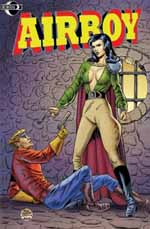
There was a long arc at the end of my run on Airboy that I felt at the time could have been presented better. The conclusion (with art by Adam and Andy Kubert) worked out great, but the lead-up to it didn’t come out the way I’d envisioned it.

What inspires you to write?

Everything. I’m a compulsive writer. I read recently where David Mamet said, “All prolific writers are lazy.” I think the fear of having to do actual manual labor drives me to write.

What writers have influenced your style and technique?

Archie Goodwin would be number one. Then Larry Hama, Harvey Kurtzman. Carl Barks, John Stanley and Frank Robbins.

Where would you rank writing on the "Is it an art or it is a science continuum?" Why?

It’s a craft. It can be art but not if you set out to make art. You learn what works and what doesn’t and spend your life (if you’re serious about it) trying to warp the rules to come up with something new. Even if you fail, the endeavor is what it’s all about.

Any other upcoming projects you would like to plug?

Well, I’m still on GI Joe and Snake Eyes over at IDW. I do a half dozen stories a year for Simpsons and Spongebob. In addition to that I’m adapting Robert Jordan’s Wheel of Time cycle to comics. And I’d like everyone to go see Dark Knight Rises a dozen times.

========================================

For more information about Chuck Dixon, step inside a comic book shop and ask for the best damn story ever. If you need more info than that, go to his website.

Monday, March 26, 2012

[Link] Old-time radio and comics heroes burst back onto the scene

By Brian Truitt, USA TODAY
 
Who knows what evil lurks in the hearts of men? (Hint: The guy dresses up in a cape and runs around at night. And it's not Batman.)

The Shadow still knows — as do Flash Gordon, the Lone Ranger, the Green Hornet and other heroes of 1930s and '40s radio shows, pulp magazines and movie serials.

These good guys are making a comeback, though mainly in comics and feature-length movies. Next month, The Shadow receives a comics reboot courtesy of Dynamite Entertainment, which also publishes ongoing series starring Flash Gordon and Green Hornet plus a new title with pulp hero The Spider that's due in May.

On the big screen, a masked Seth Rogen stung bad guys in last year's The Green Hornet. And in The Lone Ranger, in production for release in 2013, Armie Hammer rides tall as the title cowboy with Johnny Depp as his sidekick Tonto. Baby Boomers grew up watching the Clayton Moore TV series in the '50s, although the saga began as a 1933 radio show in Detroit.

Though these characters may not be as well known as today's comic-book superheroes or the Star Wars and Harry Potter clans, they were the bee's knees for a generation that was decades away from the Internet and iPods.

Before Batman, there was the alter ego Lamont Cranston donning the shadowy mask and hat while haunting radio waves as The Shadow, voiced by Orson Welles in the late '30s.

And before Superman and Captain America there was Flash Gordon, an all-American space adventurer who tussled with planetary tyrant Ming the Merciless in sci-fi comic strips by Alex Raymond and serial films starring Buster Crabbe.

"The '20s and '30s are seen as a very romantic age, with the criminal underworld of urban America and high adventure of exotic foreign locations providing a bit of an edge," says Garth Ennis, who is writing the new Shadow comic. "The reality, I'm sure, would have been mostly a lot more mundane and occasionally quite grim."

He's crafting The Shadow as a dangerous champion of law and order with a flair for the dramatic, and he is embracing one of the vigilante's oldest and most famous traits: his habit of laughing as he consigns his enemies to their doom.

"I decided to be fairly sparing with it," Ennis says. "If he started howling every time he threw a punch or fired a shot, it would get old fast. So I decided to preserve the laugh for moments of deep, dark, extreme humor."

His take on The Shadow comic is a bloody affair, where the mysterious figure dispatches bad guys with violent aplomb. More than 70 years ago, though, audiences had to visualize with their imagination what was going on during the radio-show exploits.

The popularity of the old Shadow and Green Hornet radio shows and their ilk in their heyday is best compared to programs children flock to today, such as Hannah Montana and Dora the Explorer, says Martin Grams Jr., a radio-show historian and author.

Back then, kids and adults would read books, pulps and comics because they were a cheap form of entertainment, and radio was an even bigger medium because it was free.

Continue reading: http://www.usatoday.com/life/comics/story/2012-03-20/Radio-stars-and-pulp-heroes-return-to-pop-culture/53659158/1