Showing posts with label Green Hornet. Show all posts

Thursday, July 14, 2022

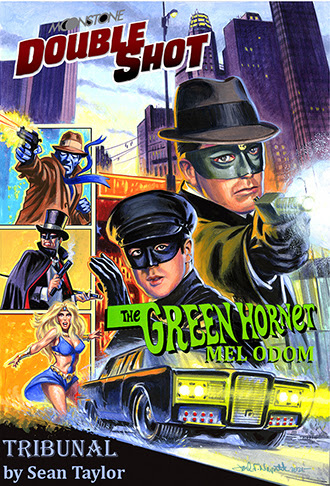
Tease! Tease! (Moonstone Double Shot)

I'm so excited about this new book from Moonstone Books. I love to write the adventures of Golden Amazon, and she really shines when she gets to play off other pulp heroes with differing modus operandis. And boy, do Secret Agent X and Phantom Detective have different ways of seeing the job of a hero than Golden Amazon. So much fun to write!


Want more than just this tease?

Saturday, July 9, 2022

Moonstone Double Shot -- featuring Green Hornet and The Tribunal now available!

Britt Reid carries a bitter legacy. When Britt was a boy, his father was framed and died in prison. That was the tragedy that birthed the Green Hornet. For years, he kept his two lives separate: upstanding successful businessman and a most wanted criminal known as the Hornet. The toll that dual identity takes on the man who is both is huge, and the enforced separation between the two selves grows thinner.

And: The TRIBUNAL -- The Golden Amazon, The Phantom Detective, Secret Agent X… Judge, Jury… and whatever else they need to be… (by Sean Taylor)

Who is the mysterious Bogill and why has he declared war on our heroes?

Item Name: Moonstone Double Shot May '22B

Item #: DS0522B

Price/ea: $5.49

Buy it now! 

Thursday, July 8, 2021

John Bruening: At Any Given Moment

John Bruening is, in his own words, at any given moment a writer, editor, publisher, artist, marketer, creator, dad, and husband.

He has been a professional writer and editor since the 1980s in a variety of disciplines: journalism, magazine editing, marketing, advertising and small-press book editing. He has won two awards for feature writing (2000 and 2011) from the Society of Professional Journalists. He is a co-founder and editor for Ohio-based Flinch Books, and the editor-in-chief of ARC Magazine, a quarterly publication covering the welding and fabrication culture.

Tell us a bit about your latest work…

This past April, Jim Beard and I published OCCUPIED PULP on our Flinch Books imprint. (For those who may not be familiar with Flinch, we publish novels and anthologies that span a variety of genres – adventure, mystery, horror, occult, and more – and it’s all written and packaged in the spirit of classic pulp fiction.) OCCUPIED PULP is a collection of short stories set in Allied-occupied Europe and Japan in the months immediately following the end of World War II – a time and place where the map of half the world was being redrawn and a whole new global balance of power was taking shape. The war was over, but old scores were still being settled and the geopolitical intrigue was getting into high gear. We have a great lineup of writers in this book: Will Murray, Patricia Gilliam, Bobby Nash, William Patrick Maynard and Justin Bell. In addition to co-editing the book, I also contributed a story of my own called “Searching for Benito.” Everyone on this project was on their A-game – not just the writers but also the cover artist (Adam Shaw) and the designer (Maggie Ryel). The end result is something we’re very proud of.

Just a few weeks prior to OCCUPIED PULP, Mechanoid Press issued WAR FOR MONSTER EARTH, the third and final installment in the Monster Earth trilogy originally developed several years ago by James Palmer and Jim Beard. I contributed a story to this anthology called “Titans of Tropic Fire,” which takes place in the Amazon jungle of South America. Anyone who’s been following my work for the last few years will know that stories about radioactive, fire-breathing kaiju in an apocalyptic battle for global domination is way outside of my wheelhouse. On top of that, my story had to fit into the context of a larger story arc established by an editor and five other contributing writers, so that was additionally challenging. But it felt good to stretch myself a little bit, and I think I pulled it off well enough not to embarrass myself. (Then again, the book has yet to receive many reviews, so it may be too early to tell).

What happened in your life that prompted you to become a writer?

I don’t know that there was one singular event. I think it was more of an evolution. I was consuming stories at a young age from the typical sources – and some atypical ones too. In the earliest days – the late 1960s in my case – it was animated cartoons and comics (my infatuation with the latter lasted well into adulthood). Then it was paperback novels, television, and movies – including a lot of black and white B-movies and cliffhanger serials. I was even listening to recordings of old-time radio dramas, which my dad turned me onto when I was no more than 10 or 12 years old. I’m pretty sure there weren’t too many kids in the mid-1970s who had much familiarity with the golden age of radio drama.

At some point in my late teens and early twenties, I started sticking my toe in the water and writing short stories of my own. They were pretty bad, but I kept coming back to it off and on over the years. At the same time, I was starting a career in newspaper and magazine journalism, so I was writing news stories and feature articles every day from the mid-'80s onward. By the time I was in my late twenties, I took a step back and looked at everything I had been doing and I realized I was a writer. So there was no pivotal moment. It was a gradual discovery of what I was good at and what I wanted to do with it.

What inspires you to write?

Good stories. Stories about individuals or small groups of people – sometimes fictional and sometimes in the real world – who have to dig deep and harness all their inner resources to overcome impossible obstacles and impossible odds to save the day or save the world.

I’m also inspired by other writers, the ones who take their craft seriously without taking themselves too seriously. And I think “craft” is the keyword here. I admire the writer who keeps putting the words on the page and keeps hammering and polishing, even during those stretches where the lightning bolt of inspiration isn’t striking. I think that’s part of the fascination of the original pulp era for me. It’s not just the stories themselves, but the people who generated them. We’re talking about writers whose livelihoods depended on cranking out the words, so they did it day after day and they rarely let up. In the process, some of them got really good at it. Not all, granted, but some. That unrelenting approach is something that inspires me.

What are the themes and subjects you tend to revisit in your work?

The gray area between the law and justice has been an interesting space to explore. I didn’t know it when I was writing the first Midnight Guardian book (Hour of Darkness), but I later realized that some of the inspiration had come from THE UNTOUCHABLES, the 1987 Brian DePalma film. The question that drives that entire movie is: How far are you willing to go and what limits (legal, ethical, moral, etc.) are you willing to test to accomplish your mission? It’s a question that comes up in the first Guardian book, and to some degree the second one. I even borrowed Sean Connery’s recurring line of dialogue in THE UNTOUCHABLES, “What are you prepared to do?” and inserted it into the second book.

If the question is about a specific time period, I’m pretty fascinated by the years between the Great Depression and World War II. It was a moment in history (if 15 or 16 years can be called a moment) when the state of the world was very precarious – first economically, and then geopolitically. Everything was uncertain and anything could happen, not just on the battlefront but here at home too. As a result, people were often forced to make hard decisions with potentially life-changing consequences. Those are the moments when the great stories emerge.

What would be your dream project?

Funny you should ask, because one of them just came my way in June when I was commissioned by Moonstone books to write a Green Hornet story for an upcoming issue of their DOUBLE SHOT magazine. This is a character who’s been all over the place since his inception in 1936: radio, comics, two cliffhanger serials in the 1940s, one season of television in the 1960s, a few short-story anthologies in the past ten or twelve years, and a feature-length film in 2011 (granted, not many Green Hornet fans are terribly enthusiastic about the last entry on that list). So I’m looking forward to making my small contribution to this 85-year legend.

Another character I’ve always been fond of is Spy Smasher, created in 1939 for Fawcett Comics by artist C.C. Beck and writer Bill Parker. Spy Smasher got the big-screen treatment in a well-crafted serial produced by Republic Pictures in 1942. Of all the serials ever made, this is probably my favorite, and I can say Spy Smasher was part of the inspiration for The Midnight Guardian. So it would be great to have the chance to go back and write a story of my own about Spy Smasher’s ongoing crusade against saboteurs in the years leading up to and during World War II.

What writers have influenced your style and technique?

I started reading Robert B. Parker’s Spenser series shortly after I finished college in the mid-1980s. Since then, I’ve read all the books in the series at least once, and some more than once. Parker was great at writing snappy dialogue, and Spenser was the ultimate smart-ass private detective. After reading Parker for a couple years, I read Raymond Chandler’s THE  BIG SLEEP, and I realized that Parker was riffing on Chandler in some respects, so I started reading Chandler as well. A couple people (not many, but a couple) have told me that my Midnight Guardian books read a little bit like Chandler. The mere mention of my name and Chandler’s in the same sentence is laughable, but I humbly accept the compliment.

There’s also Ed McBain’s 87th Precinct series. McBain was great at throwing the spotlight on the often tedious and unglamorous aspects of police procedure and detective work and somehow making it all fascinating. I admire his ability to riff on various aspects of New York and Manhattan to build a city that’s completely fictional but completely believable at the same time.

If you have any former project to do over to make it better, which one would it be and what would you do?

Luckily, there’s nothing I’ve written (so far at least) that makes me cringe when I look back at it, but I do believe the expression that “the devil is in the details.” I tend to sweat the small stuff. There are bits and pieces of larger stories that I wish I could go back and rewrite – maybe make an opening scene a little stronger, or make a chapter a little tighter. But I think I’ve had the wisdom to recognize the really godawful stuff and keep it in the drawer where it belongs.

Writers often get asked why they write. There are a million different answers, and some of them can be fairly pretentious. I write in the hope that I’ll continue to get better at it. Unfortunately, that means I’m learning the craft and refining it in front of an audience, which can be unnerving at times. 

Where would you rank writing on the “Is it art or is it science” continuum? Why?

This circles back to something I mentioned earlier. I tend to think of writing as “art versus craft” rather than “art versus science.” And in the context of that equation, I’m probably 25 percent art and 75 percent craft. I do get the occasional lightning bolt between the eyes that leaves me feeling like I just connected with something greater than myself, but I also spend a lot of time just typing one word and then another and then another to get to the end of the chapter or the end of the book.

There’s a great quote by Jack London about the relationship between hard work and inspiration. It often gets truncated to the point where it loses some of its impact, but the entire quote is: “Don’t loaf and invite inspiration. Light out after it with a club, and if you don’t get it you will nonetheless get something that looks remarkably like it.” This, to me, is what it’s all about. On those days when you don’t feel all that inspired, you just have to keep writing regardless. Because if you do, something good will inevitably emerge.

What is the most difficult part of your artistic process?

Plotting. Setting the characters and circumstances in motion to make a compelling story that comes to a logical and satisfying conclusion. I try to map a lot of it out at the front end of the process, so that when the writing starts, it’s a little easier (not easy, but easier) to get where I want to go without getting hung up on detours that go nowhere. So in the great plotter-versus-pantser debate, I’m definitely in the former camp. I have nothing but respect for those in the latter, but if I don’t have some kind of plan going into the process, I’m afraid I would wander aimlessly in the desert for years.

How do your writer friends help you become a better writer? Or do they not?

I’ve made a conscious effort in recent years to expand my creative circle and get to know more writers. The mere fact that some of these folks have reciprocated my efforts to establish relationships and friendships is a form of inspiration and encouragement all its own.

I mentioned Jim Beard earlier. He’s definitely a writer and definitely a friend. But he’s also my publishing partner, which means that if he and I are going to run a business, I have to get my share of the writing and editing projects done in a timely way and to a certain standard of quality. So he creates a layer of accountability that I might not have otherwise.

There are others. William Patrick Maynard has always been supportive, and he’s been good at the occasional pep talk in those moments when my stamina and/or confidence start to wane a little bit. Just being connected to friends who work hard at the craft – regardless of where they are in terms of their own creative development – is something that rubs off and makes me better.

What does literary success look like to you?

Would I love to be on someone’s bestseller list? Sure. But until that happens, I guess my version of success would be a combination of consistent output and a consistent readership. In other words, if I’m writing and publishing on a regular basis – something new at least once or twice a year, and something always in the pipeline – and if there’s a readership that’s interested in coming back for each new piece of work and spending the time (and yes, the money) to read it, then I guess I’m doing something right.

It feels weird to say this, but retirement is less than ten years away. But when I say “retirement,” I’m merely talking about the time when I stop punching someone else’s clock and start punching my own. The writing will continue long after that transition. I plan to do some version of this for as long as I can breathe, and when I can’t anymore, I hope to leave behind a substantial body of work for others to enjoy after I’m gone. That sounds like success to me.

Any other upcoming projects you would like to plug?

There are things I can talk about and things that are still under wraps for the time being.

Flinch Books will publish another anthology around the fall of this year. The collection will include ten stories in all, and I’m co-editing the project and writing the introduction. At the moment, I can’t offer specific details about the genre or the lineup of writers, but I imagine we’ll be able to say more by late summer.

In addition, I’ve written a post-apocalyptic sci-fi adventure for the third issue of PULP REALITY, published by Charles F. Millhouse at Stormgate Press. I’m currently working with Damian Aviles, an artist based in Mexico City, to develop some illustrations for the story. PULP REALITY #3 should be available late this year – around November or December.

I already mentioned the Green Hornet story for Moonstone. I’m not certain of the publication date, but I’m inclined to say it will be before the end of 2021.

The third Midnight Guardian novel is also in the works, but the timing on this one has been a little tricky. The story has a holiday setting and theme, so the original plan was to publish it in early November of this year. However, it was pretty obvious by mid-year that the projects listed above were going to eat up all of my bandwidth over the next few months, so the Next Midnight Guardian novel will publish in November 2022.

One project that isn’t necessarily writing but certainly writing-related: I’ve been trying for more than a year to put the finishing touches on my website and get it online. It’s way overdue, so I’ve made it a priority to get that finished this summer – which is one more reason why the next novel has been pushed back.

So regarding your earlier question about what success looks like: Having a steady stream of projects in the pipeline can be challenging, but I consider it a sign that I’m doing something right.

For more information, visit:

Facebook: www.facebook.com/john.bruening.9

Twitter: @jcbruening

Instagram: @jcbruening

Tuesday, May 11, 2021

Ron Fortier -- Of Course It's an Art

Ron Fortier is the Cap'n. I'm proud to call him editor, publisher, and friend. He's 1/2 of the brains and brawn behind Airship 27 Productions, and a damn fine writer and purveyor of pulp pulchritudes. 

Tell us a bit about your latest work. 

Considering I usually have three to four things in the fire at the same time, that simple question could be overly long. So let’s Reader’s Digest it. Comics-wise, I’ve just finished writing a 108-pg Black Bat graphic novel which artist Mike Belcher is drawing and will self-publish when finished. Pulp-wise, I’m in the middle of a new novel that will be a prequel to my Brother Bones series. And I recently finished a short story for Tommy Hancock’s tribute book for our late dear friend, Derrick Ferguson.

What happened in your life that prompted you to become a writer? 

Comics happened. My Dad started giving me comics when I was all of five years old. I couldn’t even read, but I sure could follow the pictures. From that I got a sense of narrative and then by the time I could read, it was all I ever wanted to do. Ergo, it only became natural for me to get the bug and want to tell my own stories.

What inspires you to write? 

The joy and pleasure I can give others, be they friends and families or total strangers. If my stories can entertain people in a positive way, that reward is priceless to me. 

What are the themes and subjects you tend to revisit in your work? 

The standard good versus evil is at the core of anything I write. Whether it’s a comedy superhero like Mr. Jigsaw defeating bad guys in his own hilarious fashion, on the creepy undead Brother Bones blowing away gangsters. With that as a foundation, I can layer on other themes such as loyalty, courage and sacrifice. Often times doing the right thing requires lots of sacrifice and that is great drama.

What would be your dream project? 

Writing a graphic novel detailing the making of the 1938 movie KING KONG.

What writers have influenced your style and technique? 

By the time I was 13, I was an avid reader and discovered Edgar Rice Burroughs, Edmond Hamilton, Richard Prather and Robert Heinlein. But the one writer who totally shaped my style was Evan Hunter writing his 87th Precinct mysterious under the pseudonym of Ed McBain. His economy of words and efficiency in using dialog was amazing and I marveled at it. Enough to try and emulate him every time I write…even to this day.

If you have any former project to do over to make it better, which one would it be, and what would you do? 

I once co-wrote a pulp entitled GHOST SQUAD with Andrew Salmon that we’d hoped to be the start of a pulp series. Unfortunately the book was coming in short and I urged to Andrew to extend a certain car-chase sequence. It was padding and we were called on it by several reviewers. That was all on me. If I could go back re-edit it, that scene would be severely trimmed. It was a hard lesson to learn.

Where would you rank writing on the "Is it an art or it is a science continuum?" Why? 

Of course it’s an art. It is nothing you put in a can or build in a machine shop, no matter what formula you envision. Whereas I consider all art spiritual, a gift from the Creator. All of us possess such a gift and have an obligation to use it for the betterment of mankind, be you a cook, auto mechanic, or singer. Writing is a gift, it is art.

What is the most difficult part of your artistic process?

The actual creating itself. As my old pal Derrick Ferguson always said, “You can’t correct it if it isn’t on the page.” I procrastinate way too much, always coming up with excuses to avoid that blank screen. But when I finally write something, the pump is primed and away we go.

How do your writer friends help you become a better writer? Or do they not? 

All my writing colleagues inspire me.  As I said before, I’m a lazy writer. When I see them producing so much work, it pushes me to do more. To join in the fun. I owe them all a great deal. People like Jim Beard, Barry Reese, Nancy Hansen, Fred Adams Jr., Tommy Hancock and so many others.

What does literary success look like to you? 

The words…THE END on a page.

Any other upcoming projects you would like to plug? 

Too many to remember them all. I’ve done a really different kind of Dracula story that will be coming from an Australian publisher later this year. And who knows, maybe those producers out in Hollywood pushing a Brother Bones TV series may get lucky. Time will tell.

For more information, visit:

www.airship27.com 

airship27.blogspot.com

Friday, January 29, 2016

Ideas Like Bullets -- HEY! DON’T CHANGE A THING! IT’S MINE!!!!

by Tommy Hancock

I recently became involved briefly in a discussion on social media with a person I consider a friend of mine, someone who I interact with online because of shared interests and have done so for a number of years.  The discussion involved a recent announcement about a major comic company getting its hands on some television cartoon concepts that many would consider classic and doing their own updated comic takes on them, in some cases changing the status quo of the idea dramatically.  This person I consider a friend commented that he wasn’t that interested in all this because this particular company had a habit of not doing right by its own characters so he didn’t trust them not to be “screwing things up” with the aforementioned concepts.  I responded with my thoughts on the term ‘screwing things up’ in connection to different creatives handling concepts that were not there on and dearly loved by some sort of fandom. What ensued after that was a discussion, he continued to stand by his assertion and I acknowledging that and standing by mine.

What follows in this column is not about this discussion and not at all about this friend.

But I do bring up said conversation and said friend to both clearly point out that what I’m about to say is not about him and the majority of fans of most anything out there AND to identify what I think the majority of supporters of any fandom are like.  I truly believe, although these days it is more like hoping than believing, that most people who are fans of a movie universe or a comic character or a tabletop game, or anything that might qualify for those of us who identify as geeks as having a fandom are actually normally functioning, reasonable people who just happen to feel strongly about a particular thing they like, maybe even love in a completely appropriate fashion.  They can make strong statements when they disagree with how a property they hold dear is being handled and on the same hand, they have the ability to comment positively when someone does something stellar with same property, be that by telling a story that keeps the property true to what they love about it or by doing something completely new and different that they actually feel works for the property.  That group of devotees to various and sundry properties is where I’d place my aforementioned friend, as I’ve seen him respond appropriately in every situation and even making positive comments on different takes on the things he loves when they have been done in a way that he thinks is appropriate to the concept he likes.  Again, that is how a fan should be and act and I really DO hope that most of us are still that way. 

No, from this point on I am not addressing the likes of my oft mentioned by never named acquaintance above or those like him.  Where my attention turns to now is the other type of ‘fan’, a term which I am hesitant to use because really, for the individuals I’ll now be discussing, the actual word from which fan is derived is probably more appropriate.  Fanatics.  People who not only like certain properties, enjoy certain stories, shows, characters, etc, but people who apparently have an unhealthy obsession for them,.  These fanatics, who not only voice their disapproval of how a particular character is being handled, but who believe that it is their place and function to comment on every sniggling point that is wrong with said handling are to whom I speak now, or at least speak about.  Because it’s not just this completely over the top arguing and reviewing of just what clause of the intergalactic law the character who would never violate that actually did violate, thanks to the new writers that we see so much of now that bothers me.  No, I am completely overwhelmed, angered, and saddened sometimes to be called a geek or a fan because that means that those I call the uninitiated lump me in with those nutbar fanatics who talk disparagingly and often disgustingly of the creator who has perpetrated this malfeasance of applying their take on said concept, to the point of insulting them or anyone who supports their version of the idea.  Those admirers so ardent over an idea that they loved as a kid or discovered while reading on a bus trip to somewhere that instead of acting like civilized human beings with one another, seek to discourage, incite, and be downright ugly to any who disagree with them.

I think what bothers me most of all about this class of ‘fan’ is that they often dig in their heels up to their armpits and become not only unwilling but whatever is ten parsecs beyond unwilling to even entertain anything new related to the concept they covet.  They refuse to go see the new movie, yet they critique the holy hell out of something they won’t even deign to damage their eyes with.  They won’t even read a page of a new author handling a character created by someone else because whatever trailer or preview they’ve seen just ticks them off to no end, so there can be nothing redeemable. 

Now, the friend I focused on when I started this? He’s not this type, and I know this for fact because I’ve discussed and witnessed his discussions of trying different takes on things and usually not being happy with the treatment of his favorite characters, but sometimes finding himself surprised.  No, again, a fan, as I now define them, will staunchly stand by whatever aspect of their favored concepts they believe in, but they will also not shut themselves off from any other takes on said idea and will be respectful not only of others who like the different takes, but also will have enough respect for people in general and the creative process specifically to at least try the different version, if for no other reason so that when they do argue about it and say it stinks to high seven heavens, they can say they have at least tasted of the rotted meat!!

But, no, the ‘fanatics’…or maybe they’re just really close minded, mean spirited…nah, wherever I was going with that was just going to be too long and hard to remember… what I am about to say is aimed at them.  Yeah, you out there who got butt hurt over the fact that The Force Awakens did have story beats from the first Star Wars movie, but you only know that because you stayed in your little dark cave and read your computer screen, wouldn’t even put out the effort to go see the movie before you attacked it based on what other people said and spoke of it as if you were some sort of vaulted expert.  Yeah, you who won’t pick up a Sherlock Holmes book up that doesn’t have the name Doyle in the author’s spot, but you’ll get on your mailing list and your Facebook page and not only malign stories you’ve not read, but make personal comments about an author’s parentage or whether or not they should live to write another Holmes story.. Oh, and yeah, you too who at conventions see some kid cosplaying their favorite character and proceed to walk up to them and ridicule them for using cheap face paint or duct tape or drawing the S they wear on their chest on a piece of construction paper because that’s not how it’s done and they’re nothing but a disgrace to the character that You know so well, even though you’re standing there in your street clothes, wearing a bat symbol t-shirt.

So, yeah, all of you who fall into the above, who probably haven’t hung on long enough to get this far, what comes next is for you.

Get. Over. Yourselves. Now. Today.

Before your own damned ignorance and stupidity on how your infatuation with a made up story forever cripples you in having any appropriate social interaction with human beings, muggle or otherwise. 

It has been said many times that the advent of the internet and of things like Facebook and Twitter has made it easier and more acceptable for people to make more personal attacks, to release more vile vitriol than ever before at one another.  My big round Death Star it has.  If you’re one of those people who are wishing ill will on creators who just don’t agree with you, whether that be the ruin of their career or something even more heinous, then the fact that you have an Instagram account didn’t make You that way.  You, something about You, allows you to be a brazen idiot where the whole world can see it. And guess what? Only You can make that any different.

Here’s the weakest argument, really, for any fan related tirade, even the ones I sometimes go on.  Though we may find a story, a movie, a show, an idea that we absolutely in many ways quite literally fall in love with at some point, and yes, my own list is very long, it is still just a fictional creation, albeit a world we feel at home in.  And, here’s the important part of this, we fell in love with the version we encountered.  Not the ones before it, were there any, and not the ones after it, but the singular one that impacted us the most.  To believe that our dislike or at least ambivalence toward the other versions gives us any more right to do more than grumble and complain and harken back to what we loved the most, which is what most sensible people do, is completely off base.  We are not experts in any fandom enough to claim that we know any better what should happen with an idea that 99 percent of us are never going to touch.  We can be saddened, we can even be angered by what X author does with Y character in Z universe, but that does not give us the right and shouldn’t even be enough to make it occur to us to be nasty and mean and vindictive or outright stupid enough to wish bad things on people we don’t know or to spend endless hours and days arguing about how bad something is that we’ve not even tried to partake of.

Seth Rogan made a movie a few years back.  The Green Hornet, some of you might have heard of it, most probably didn’t it because it had a mediocre showing at the box office. Now, although many fans of the character, myself included, went into the movie and all the hype before it with hope, it became pretty clear early on that this was not going to be the Green Hornet we wanted.  Not the version as originally conceived in the radio show in the 1930s and not the TV version which gave a young Bruce Li a leg up in Hollywood.  This wasn’t even going to be based on one of the better comic versions of the character that has come along in the last 20 or so years.  No, this was going to be a trainwreck of monumental proportions.  And, yes, it proved to be such, for Green Hornet fans and those who had never heard of the character alike.

At the time of all the fervor about the film, there were fans, like me, who said, “Okay, not hopeful, but I’ll at least give it a watch, to see what it’s all about.” I always want to know about whatever I may be arguing about in the near future.  Other said, “Nope, not gonna see it. Not gonna waste my time or money.” And some of those same people, when the reviews came out verifying what they felt was wrong with the movie, chimed in with an ‘I Told You So’ or two, maybe. And of course there were all sorts of responses between the two, including some GH fans, maybe two at last count, who liked it enough to say so.

Then one particular response stuck out to me, from someone I’d known a tad through the internet.  And it went something like this.  “Seth Rogan should die.  Anyone involved in this piece of Shit should rot in hell. How dare they do this to my Hornet!”

Yeah, that.

Don’t be that fanatic. Please. Ever.  That serves no purpose other than for someone to add to a probably already sizable mound of evidence they’ve been building for your upcoming commitment hearing. 

Love your fandoms.  Defend them if you feel you need to.  But don’t forget…and this is coming from a writer and a Publisher who would love someone to be uber passionate about some of the stuff I’m doing and my writers are doing as they are about the bigger properties… it’s not yours, only the feelings and emotions a particular version of it gave you are.  And why dishonor something that gave you pleasure, and maybe even acted as a way for you to feel good about yourself, by reacting like a complete and total lunatic when someone comes along that has a different bent on it?

Makes no sense to this fan.

Wednesday, August 8, 2012

GREEN HORNET: STILL AT LARGE NOW AVAILABLE!

Cover: Ruben Procopio


New Pulp writer/editor Win Scott Eckert has announced that Moonstone Books release of Green Hornet: Still At Large is now available.

The Green Hornet: Still at Large anthology features a story by ESO co-host Bobby Nash called “The Gauntlet.”

The Green Hornet: Still at Large is back from the printer and is now shipping direct from Moonstone Books! (I’m sure it will show up as “available” on Amazon soon.)

NOTE: Green Hornet editor, Win Scott Eckert will have copies available at PulpFest later this week. You can find Win at the Meteor House table. Win will also be doing a “New Fictioneers” session where he will read from his Green Hornet tale, “Progress.”

Edited by Joe Gentile, Win Scott Eckert, and Matthew Baugh, this third anthology featuring the 1960s Green Hornet, based on the television program starring Van Williams and Bruce Lee, follows The Green Hornet Chronicles and The Green Hornet Casefiles, and ships in two editions.

The softcover trade paperback features a cover by Douglas Klauba, while the limited edition hardcover boasts a cover by Ruben Procopio. It is anticipated that as with the prior books, the third volume will also see an eBook edition, although the specific date has not been announced.

Contents:
“Hero” by S.J. Rozan
“The Black Torpedo” by Will Murray
“The World Will End in Fire” by Richard Dean Starr
“The Man Inside” by Matthew Baugh
“Death from Beyond” by Ron Fortier
“Play the Game” by Thom Brannan
“The Gauntlet” by Bobby Nash
“Chaos and the Year of the Dog” by Bobbie Metevier
“Axford’s Sting” by Dan Wickline
“Revenge of the Yellowjacket” by Howard Hopkins
“The Man in the Picture” by Patricia Weakley
“Masks” by C.J. Henderson
“Bad Man’s Blunder” by John Allen Small
“Losers, Weepers” by Rich Harvey
“Stormfront” by Greg Gick
“The Night I Met The Hornet” by Mel Odom
“Progress” by Win Scott Eckert

The limited edition hardcover also features:

“The Green Hornet Timeline,” a chronology of the Moonstone stories from the three anthologies, fit into the timeline of the original television episodes, by Win Scott Eckert

A bonus story featuring the 1930s-40s Green Hornet from the radio show and serials, “The Green Hornet Meets The Avenger” by Michael Uslan

Friday, April 6, 2012

The Writer Will Take Your Questions Now (#132) -- Tinkering with Old Characters, part two

Yesterday you said, "The secondary elements can change as needed as long 
as the core of the character remains the same." What did you 
mean by that? What is the core, and what are secondary?

The core is who the character is, plain and simple. For example, Conan is a heroic warrior prone to fight rather than diplomacy. John Carter is a soldier. Captain America bleeds red, white and blue as a super soldier.

The secondary elements are things like time period, costumes, sidekicks, etc. (Unless they have direct bearing on the core of the character.) Tonto shouldn't be a wise-cracking comedian, for example, nor should Kato be the leader of the Green Hornet.

For an example, let's look at the recent Land of the Lost film. When the core dynamic of the group changed from a father trying to protect his children, the story lost it's footing and became a trapped by dinosaurs and mutant lizards generic story... then a comedy. Even with the cast and with humor, the movie could have added the kids to play it true to the core of the characters, and fans would have flocked to see it.

Does that make sense? I hope so. Because I'm not sure else how to explain it.

Monday, March 26, 2012

[Link] Old-time radio and comics heroes burst back onto the scene

By Brian Truitt, USA TODAY
 
Who knows what evil lurks in the hearts of men? (Hint: The guy dresses up in a cape and runs around at night. And it's not Batman.)

The Shadow still knows — as do Flash Gordon, the Lone Ranger, the Green Hornet and other heroes of 1930s and '40s radio shows, pulp magazines and movie serials.

These good guys are making a comeback, though mainly in comics and feature-length movies. Next month, The Shadow receives a comics reboot courtesy of Dynamite Entertainment, which also publishes ongoing series starring Flash Gordon and Green Hornet plus a new title with pulp hero The Spider that's due in May.

On the big screen, a masked Seth Rogen stung bad guys in last year's The Green Hornet. And in The Lone Ranger, in production for release in 2013, Armie Hammer rides tall as the title cowboy with Johnny Depp as his sidekick Tonto. Baby Boomers grew up watching the Clayton Moore TV series in the '50s, although the saga began as a 1933 radio show in Detroit.

Though these characters may not be as well known as today's comic-book superheroes or the Star Wars and Harry Potter clans, they were the bee's knees for a generation that was decades away from the Internet and iPods.

Before Batman, there was the alter ego Lamont Cranston donning the shadowy mask and hat while haunting radio waves as The Shadow, voiced by Orson Welles in the late '30s.

And before Superman and Captain America there was Flash Gordon, an all-American space adventurer who tussled with planetary tyrant Ming the Merciless in sci-fi comic strips by Alex Raymond and serial films starring Buster Crabbe.

"The '20s and '30s are seen as a very romantic age, with the criminal underworld of urban America and high adventure of exotic foreign locations providing a bit of an edge," says Garth Ennis, who is writing the new Shadow comic. "The reality, I'm sure, would have been mostly a lot more mundane and occasionally quite grim."

He's crafting The Shadow as a dangerous champion of law and order with a flair for the dramatic, and he is embracing one of the vigilante's oldest and most famous traits: his habit of laughing as he consigns his enemies to their doom.

"I decided to be fairly sparing with it," Ennis says. "If he started howling every time he threw a punch or fired a shot, it would get old fast. So I decided to preserve the laugh for moments of deep, dark, extreme humor."

His take on The Shadow comic is a bloody affair, where the mysterious figure dispatches bad guys with violent aplomb. More than 70 years ago, though, audiences had to visualize with their imagination what was going on during the radio-show exploits.

The popularity of the old Shadow and Green Hornet radio shows and their ilk in their heyday is best compared to programs children flock to today, such as Hannah Montana and Dora the Explorer, says Martin Grams Jr., a radio-show historian and author.

Back then, kids and adults would read books, pulps and comics because they were a cheap form of entertainment, and radio was an even bigger medium because it was free.

Continue reading: http://www.usatoday.com/life/comics/story/2012-03-20/Radio-stars-and-pulp-heroes-return-to-pop-culture/53659158/1

Thursday, February 2, 2012

THE GREEN HORNET: STILL AT LARGE pre-order and final covers

THE GREEN HORNET: STILL AT LARGE pre-order and final covers

Linked from: http://woldnewton.blogspot.com/2012/02/gren-hornet-still-at-large-pre-order.html

The third volume of short stories from Moonstone Books about the 1960s Green Hornet and Kato continues to move forward.

Win Scott Eckert revealed the final art for the limited edition hardcover by Rubén Procopio several months ago, and now is pleased to also show off the trade softcover by Douglas Klauba!

The Green Hornet: Still at Large is edited by Joe Gentile, Win Scott Eckert, and Matthew Baugh, and will be available either June 30, or July 17, 2012, depending on which listing you believe. :-)


Check out that discount on B&N! Get your pre-orders in now!

The Green Hornet: Still at Large anthology features a story by Bobby Nash called "The Gauntlet."

For more information on Bobby Nash, visit www.bobbynash.com
For more information on Moonstone Books, visit www.moonstonebooks.com
For more on Win Scott Eckert, visit http://woldnewton.blogspot.com
For more on Douglas Klauba, visit http://douglasklauba.com
For more on Ruben Procopio, visit http://maskedavengerstudios.blogspot.com