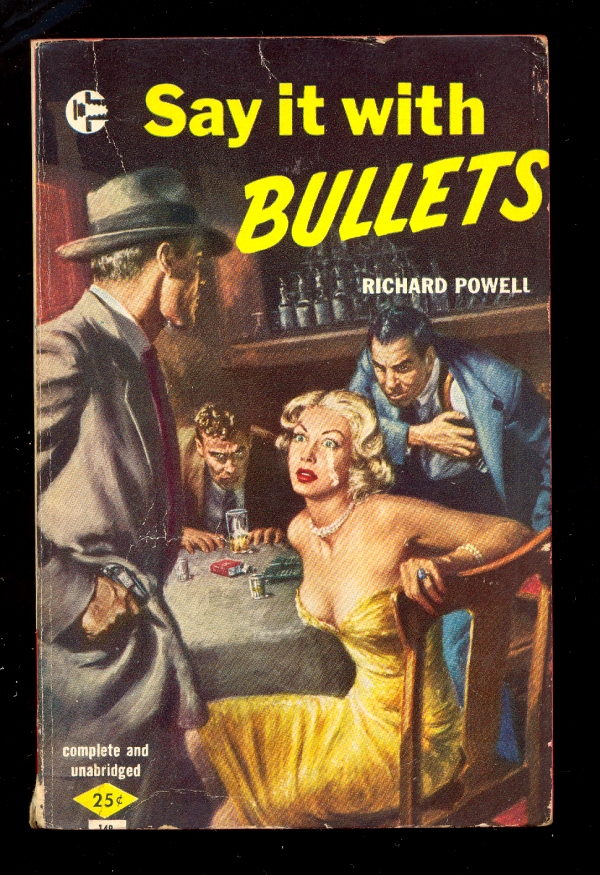
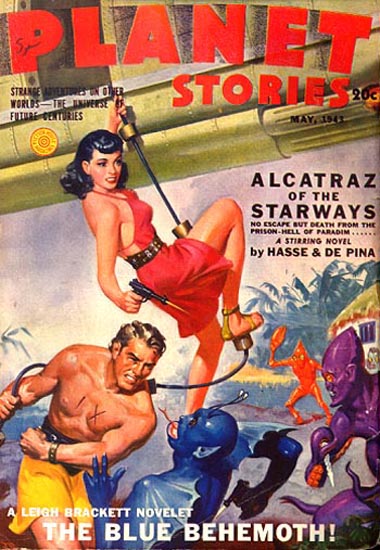
Sure, we all know that good pulp and Noir fiction (like any good genre fiction) is built on the recurring types of characters that inhabit the classic stories. But how do authors avoid complete stereotypes and cliches while being true to the tropes that are necessary for good pulp and Noir?
To find out, I went to a few hand-picked authors I really respect who handled their fiction deftly and with originality among the tropes.
Everyone knows of the hard-boiled loner. We've seen it too many times to count. What should writers avoid when crafting their protagonist for period piece detective fiction? What can they do to make more original and creative protagonists?
Derrick Ferguson: I don’t think writers have much of a problem coming up with original and creative protagonists for period piece detective fiction. At least not the ones I’ve read. I think it’s the readers of that particular genre (or any other for that matter) who don’t want the original and creative protagonists. I think the readers are expecting the Sam Spade/Philip Marlowe knock-off because that’s what they know and it’s as comfortable to slip into as those ten-year old jeans they won’t let their spouses throw out, no matter how ragged and holey they get.
And don’t get me wrong… I’m not playing the game of “I Blame The Reader Because I’m Not Outselling James Patterson.” I think Our Faithful Readers know exactly what they want, Odin bless ‘em. It’s just that a lot of the time they don’t know what they want until they see it. There’s a lot of satisfaction in reading about the hardboiled, hard-drinking, two fisted trenchcoated gumshoe who walks the mean streets alone. It’s what the fans of a genre know. It’s what they like. It’s what they want more of (how else to explain the subgenre of Tolkien-influenced fantasy that began back in the 1970s and is still going on to this day?)

But that’s not what you asked me. So what should writers avoid when crafting their protagonists? How about getting rid of the alcoholic ex-cop turned private dick still grieving over his marriage and ex-wife? This is one that infects not only period piece detective fiction but modern day detective fiction as well. How about a detective who is actually successful and makes money at his job? One of my favorite things about the “Chinatown” sequel “The Two Jakes” was seeing that Jake Gittes has prospered.
Tommy Hancock: When something is done over and over again, it usually becomes cliché. The trick that any creator runs into is how to do something that has been done in some form before, but to not have it seen as derivative, as cliché. That’s a sticky wicket when the genre itself is founded on and even built continually around characteristics that are, in and of themselves, already cliché’d to the point of lampoon. So, the question for me really is less what should be avoided and more about how writers handle the characters they are creating, and in a sense, copying, depending on the story and cliché in question.
It’s like the age old issue with eyewitnesses. You can have ten people witness the same event, standing within inches of each other, all of them having almost the same visual experience play out before them. Then, interview them not three minutes after the event and you will get at least 8 different versions, if not 10, of what all of them just saw.
Writing in a genre replete with established archetypes and situations that sometimes have to be beats in every story of that type is similar. The character is there, in front of us all. We see him, the hard boiled loner detective. Yet, how we respond to him should be different for each one of us. Our own experiences should impact how we write him. Also, interpretation, how we feel about aspects of his character will also impact that. We have to make a conscious decision NOT to cling to the cliché, but to fill the outline that provides with things of us, our differences and our nuances.

After we do that, then we may even need to make a conscious effort to shave away some of the obvious edges of the expected. If you’re guy keeps a bottle in the bottom left hand desk drawer of his desk only because every other private dick you’ve ever read does, then leave the drawer empty. Take that affectation away. But, when/if you do, let taking it away impact the creation and execution of the character. Don’t just have him not have a bottle, make it important, even if you don’t talk about it. Make the absence of the cliché’d aspects of characters work for you by them just being absent.
Ron Fortier: Before I get too far into this, let me say I’m not one of those writers who avoids clichés like the plague. There is a point in any genre that certain elements should always be present to validate the genre. Making a 1930s detective an intellectual who is afraid of physical violence only to purposely go against iconic typing dooms one’s tale as a gimmick. End of story. Embrace clichés…and then embellish them. So your detective is tough as nails, a World War One weary vet who has seen life’s worst. That’s the cliché place to start and from there add an ex-wife he still loves but couldn’t take his constant nightmares and ultimate drinking. What if he was a police dick who lost an arm in the war and now, due to city regulations, can’t be on the force so he opens his own private agency. Again, use your setting, research the times in which your protagonist exist and from it draw your inspiration to tweak those tried-and-true clichés into something new and intriguing. Hmm, I just invented a character I may have to come back to one of these days.
 Nikki Nelson-Hicks:
 For period pieces, read history. Learn all the things they didn't have that we take for granted. OR all the things they did have that we no longer have or need. Americans love to learn but they hate being taught SO they like learning stuff in stories. If you can slip in a educational fun fact, their subconscious loves that and eats it up.
As for the loner, I like loners. I am a loner. It comes from a lifetime of moving around and never setting down roots. People who are still in my life after a year or so confuse me a little bit. I'm like, 'Are you still here? Why?" HOWEVER, loners are not always unhappy. I'm not unhappy, generally. So, to answer your question, perhaps show introverts and solitary folks as happy people? Not alcoholic losers mourning some lost something? Although, the doe eyed 16 year old girl in me loves those Byronic dipshits.
On second thought, forget it. You're never going to erase that kind of character. We love those dark eyed, haunted, gunslinger, cowboy, gumshoes. They fulfill an ID wish we all have to do what we want and fuck the consequences.
Bobby Nash: No matter what genre you write, there are going to be tropes that are overused and clichés waiting to leap out at your writing from all corners. In creating a protagonist, or the antagonist, for that matter, it all starts with character. Yes, we’ve all seen the hardboiled loner type character, but if I’m creating a character that needs to be a loner, the first question I ask is what can I, as the writer, bring to this character that is unique to me and my writing? Once I have that hook, I have a better insight into the character and can hopefully elevate him, her, or it above the cliché of that type of character. Knowing your character is key.
Let's talk villains and dames. Sexy struts and legs up to there. Gunmen with speech affectations. How can writers avoid the done to death cliches?
 Nikki Nelson-Hicks:
 Just don't don't them! Go outside. Watch real people. You want characters? Just go to the mall or Wal-mart, hang around there and watch people. Or, if you are really brave, talk to people. I'm one of those cursed bastards that has face people feel comfortable spilling out their life stories to. It can get really uncomfortable sometimes but, DAMN...it is fodder crazy.
OR read history. I'm a huge fan of reading old newspapers and crime blogs.
As for sexy dames, i know it's hard to write female characters in a traditionally male genre that don't use their sexuality to push ahead. Most of the women in Jake Istenhegyi are evil or pawns. How cliche is that? I'm introducing a new female protagonist in Jake #4 (coming out in March, hopefully) that breaks the mold for that story even though she still doesn't pass the Bechdal test because she's there to save a guy.
Women are hard to write because we're crazy. My mind is racing and thinking on 15 levels, all the time. And in a genre like pulp where it's basically action packed fun filled BOOMBOOMBOOM kind of writing, nobody has time for that shit. This isn't the place for that. Go read Barbara Kingsolver.
 Ron Fortier:
 How you are ever going to write a grim, noire detective yarn without an alluring, desirable, oh so sexy femme fatale is beyond me. Femme Fatales are as much a part of classic pulp mysteries as “the butler did it.” And I would personally find any such story or book lacking even one hot tomato, boring as all get out. Whereas I think you can take the basic premise of a beautiful woman who bewitches your hero and find new ways to add new and original spice to the mix. Try an angle where, after being jaded by so many men, this leggy broad suddenly finds herself actually falling for the detective thus complicating the mystery. Falling in love with the killer can do wonders to any plot, look at the recipe whipped up in the Maltese Falcon. Then again, there’s nothing wrong with having the female lead a war widow raising a rebellions teenage daughter, or a down and out waitress looking for some sunshine in a rainy world. One of my own ploys in writing the opposite sex has been to imbue these women with traits I’ve found in the women in my own life, past and present. Even if she’s drop dead gorgeous, a writer needs to humanize his little sexpot or else risk writing a caricature with no real impact on the story at all.
As for Bozo tough guys, I personally love writing their dialogue. For the most part, gunmen are generally school dropout bullies and the fact that they come in cookie cutter dozens is a real hurdle to overcome. My favorite detective writer of all time, Ed McBain, often overcame this stereotype by injecting ridiculous, silly humor in his characterization of the tough-guy henchmen. Their dialogue rang with personal bits of idiosyncrasies that in the end made each stand out from the crowd as a truly unique, one of a kind character. Taken to cinematic life when Quentin Tarentino had two dumb gunmen talking foreign Big Macs in Pulp Fiction. Again, villains should be allowed to come in all shapes and sizes… and pedigree.
Tommy Hancock: It’s pretty simple. Don’t do them. Or, if you absolutely have to have the albino assassin or the dragon lady, then inform them with different information and characteristics than what the cliché’ offers. Characters in themselves are not the cliché’, but it’s their attributes, their characteristics that often are, or even their back stories. Make why the albino became an assassin different than all the other albino assassins before him… or her, there’s a difference. Don’t worry over the character being cliché’d. Because, you do that, and eventually you realize every character type has been represented and you can’t write anything if you’re afraid of cliché’ because in essence, any character type could be considered such, depending on who you ask.
 Bobby Nash:
 My rule of thumb is if it makes me cringe when I write it then it needs to go. Cliches exist and it is so easy to fall into them. If I write something cliché, I can generally tell because it doesn’t feel quite right. Just like with the protagonist, your villain and the sexy dames and femme fatales that make up this world have to feel like real characters. If I can make them real to me then they should, hopefully, feel real to the readers.
Derrick Ferguson: See, here’s where I scratch my head when it comes to clichés. Say you write a western. Okay, you’ve got horses and six guns and Indian attacks and schoolmarms. Now is it fair when somebody reads your western and accuses your work of being cliché ridden? When you read in a certain genre, shouldn’t you expect certain tropes of that genre to make an appearance?
I’m reminded of a frequent argument I have with friends of mine who detest the character of Willie Scott in “Indiana Jones and The Temple of Doom” simply because she wasn’t the two-fisted, hard-drinking Marion Ravenwood. My counter argument was this; hasn’t the heroine who is just as competent as the hero become itself something of a cliché by now? I mean, every woman you meet isn’t going to be Marion Ravenwood. Some of ‘em (perhaps more than you would like) are going to be Willie Scott.

But again, that’s not what you asked me. So here’s my short answer: Read as widely and as much as you can. I know a depressing amount of writers who tell me that they don’t read as they don’t want to be influenced by other writers. Okay, I can dig it. But then I read their work and find that all they’re doing is regurgitating plots that were old when Raymond Chandler was in diapers. They only way to avoid cliché is do become a sponge and absorb everything you can from books, TV, comics, movies, discussions with your barber, drug dealer, local alligator hunter and girlfriend/boyfriend/wife and let it marinate in your subconscious. You stay locked into your narrow view of what a genre can or should be and all you’ll do is repeat what’s been done over and over and over again.
Now for the clincher... Heroes solve mysteries. Heroes get the bad guy, if not the girl too. But how does a writer balance the expectations of the genre with managing to work off a checklist of "seen it all before" story beats?
Bobby Nash: As with the character, I ask how can I tell this
story. That’s really where the biggest changes will happen. You can give
ten writers the exact same plot/scenario and let them write it and you
will get ten different stories in return. Some of them might share some
of the same beats, but it’s a good bet that many of them will veer off
in unexpected and quite unsuspecting ways. The uniqueness of each writer
can bring a bit of that uniqueness to the story he or she is writing.
That’s how clichés get turned on their head or turns left when everyone
assumed the story would turn right. That’s where the magic that is
writing happens, at least for me.
 Ron Fortier:
 Again, I’m old fashioned in that I do think a “hero” should win out in the end. But how he does that can take so many different roads, even to the point of dying to bring a villain to justice. The point of any such victory is how much the hero had to overcome to achieve that victory and the more challenges you can put to him, the more satisfying the conclusion…to the point you don’t make him a superman. There should always be that vulnerability and infallibility. Example, say your detective brought in the wrong man and he is tried and executed. Years later, evidence resurfaces that proves the man’s innocent and now the flawed detective, knowing he caused the wrong man to lose his life, becomes obsessed with finding the real killer. Another element to a good mystery is being sure to pepper one’s tale with lots of red herrings to divert your
hero until the very end, when he finally puts the clues together in the proper sequence and uncovers the culprit. Playing fair is essential as well, making sure your readers are given the same clues you provide your hero. No cheating allowed. In the end, characterization is everything to me in any detective tale. I would argue that after you’ve met Sherlock Holmes, Sam Spade or Nero Wolfe several times, you soon begin to enjoy the stories because of them…and the mysteries almost become secondary to one’s enjoyment of the read. Now that’s great writing.
Nikki Nelson-Hicks: I can speak for me but...I
don't have a checklist. For me, writing is a bit holistic. I start with
an idea and I let it unfold. I try not to get in the way of the story.
Whiskey helps with that. The first draft is always a big pile of mush
but from that clay I am able to sculpt a cool story. Hopefully. If I
don't fuck it up.
SO, if you want my advice for not writing
cliche pieces of shit.....write it. And then once you have the huge
steaming pile in front of you, THEN you can get to work. Dig out the
boring bits and chuck them into the bin. See something cliche? Spin that
bitch into something new. You can't work in a vacuum.
Don't worry so much. Write the goddamn story and polish it until it sparkles.
 Derrick Ferguson:
 I don’t know any other way to write a story other than to write it the way that I want to write it and then present it to the Readers At Large and let them make up their mind about what I wrote. I’ll be the first to admit that I’m not a very original or innovative writer. I also admit that I don’t spend a lot of time burning up my brain cells trying to figure out ways to be original or innovative. I’ve got friends who desperately want to write. Have wanted to write for years. But they haven’t because they refuse to write anything that’s isn’t “totally and completely original.”
So let’s be honest here: unless you’re a literary genius (And hey, you may be. What do I know?) The chances of you telling a completely original and unique story are very slim. But by no means should that stop you from doing so. But what I am saying is don’t let that stand in your way of having fun telling the most entertaining stories that you can tell until that Thunderbolt of Zeus crashes into your brain and that literary masterpiece comes flowing out of you to amaze the world. You keep on writing. It’ll happen.
Excuse me…what was the question again?
Tommy Hancock: By not worrying about it. If your hero doesn’t have his/her own story to tell, then you might as well not even write the piece. Even those of us who write homages and pastiches of characters we love usually without effort make our version different, at least the good ones who do it, anyway. But if your focus is being overly concerned about making sure that your hero either meets all the requirements established in the genre by previous heroes OR that your hero meets none of those requirements, then you’re wasting a lot of time that you should be using just to tell the best damn possible story you can.


.jpg)
.jpg)
.jpg)

.jpg)


.jpg)
.jpg)
.jpg)