
Showing posts with label Mike Bullock. Show all posts
Showing posts with label Mike Bullock. Show all posts
Sunday, October 3, 2021

Thursday, March 25, 2021
Mike Bullock: Writing the Thousand Words (and more)

Tell us a bit about your latest work.
My first full-length sword & sorcery novel, Runemaster: Shield Maiden's Blade just dropped from Airship 27. It's been a long time coming and was so much fun to complete, it's almost surreal to have copies on my desk finally. Ron Fortier approached me about doing a book for Airship back in 2010 and soon after I started and wrote the first 10,000 words for the book. Well, life got in the way and I wasn't able to write the final 50k words until last Fall.
The story follows Skarl Kirwall, born during the Last Great War, he was destined to lead his clan as the next Runemaster. Betrayed by a clansman, Skarl is banished from his village, only to learn of its destruction at the hands of their bitter enemies, the Ysling clan. Mourning his father’s death, he discovers his beloved Lacina is still alive, but taken by the bloodthirsty Yslings as a sacrifice to their god, Ysfang, the world serpent. Now, Skarl must pursue his lost love across the frozen wastes of Njordica and save her from the slathering jaws of the serpent god and in the process, take his rightful place as the next Runemaster.
What happened in your life that prompted you to become a writer?
As a kid, I was raised with my brother and two cousins until I hit elementary school. The three of them all got into drawing when I was four years old, but try as I might I could not draw a recognizable stick figure. One morning, I complained to my aunt that they were all drawing and I couldn't and she told me "Well, they say a picture's worth a thousand words, so if you can't draw the picture you better learn to write the thousand words." I took that at face value and went back in the other room and wrote my first story, with exactly one thousand words. (haha) The rest is history.
What inspires you to write?
Anything imaginative. I think imagination is its own fuel, so when I see something creative, it sparks a fire in me. Going back to my childhood, as I grew older through the elementary and high school years, I spent a lot of time alone. Left to my own devices, back in the days when kids didn't have a million options for entertainment like they do now, I was forced to dream up ways to entertain myself. From creating games, to imagining far off worlds, conjuring new characters, places and conflicts just became something I did, spurred on by an intense fear of boredom.
What are the themes and subjects you tend to revisit in your work?
Personal loss and broken families seem to come up a lot...
What would be your dream project?

What writers have influenced your style and technique?
Edgar Rice Burroughs and Robert E. Howard had the biggest impact on my pulp writing, while the old Rankin/Bass stop motion movies of the 60s and 70s inspired my all-ages writing. There are also particular books that hooked me and stuck with me over the years, such as The Phantom Tollbooth and the Flash Gordon book series from ACE in the 70s.
If you have any former project to do over to make it better, which one would it be, and what would you do?
I took a shot at re-imagining the Black Bat over at Moonstone Books years ago and the existing fan base didn't much care for it. In hindsight, I think we should have established the original character in the Moonstone pulp universe first, then brought the re-imagined version in later on. Sort of eased folks into it instead of driving it right out of the gate.
Where would you rank writing on the "Is it an art or it is a science continuum?" Why?
While there's certainly a scientific craft to it, but I think it's more art, for sure. You can hit all the scientific marks of great storytelling and not invoke feelings in the reader. Conversely, a total hot mess of structure/theory can still trigger an emotional response. This is why you hear the word "lifeless" used to describe stories occasionally in reviews. A story is worthless if it doesn't make the reader feel something.
What is the most difficult part of your artistic process?
Landing the plane. I'll often psyche myself out with the ending of a tale, thinking it has to be a mind-blowing, paradigm-shifting, life-altering revelation. In reality, it just has to be a satisfying conclusion to the tensions created in the story.
 How do your writer friends help you become a better writer? Or do they not?

A big part of it is inspiration. Guys like Joe Gentile, Bobby Nash, Barry Reese, Ron Marz, JM DeMatteis and others have all inspired me to no end with their work, but also poured wisdom, knowledge and encouragement into me over the years to help make my work better. I wouldn't be the writer I am without those guys and their inspiration and advice.
What does literary success look like to you?
Having the work enjoyed by the audience. To clarify, I don't create to please anyone but myself - I write stories (and songs) I want to read (and hear). However, when I do that and others enjoy it too, then it feels like I did my job well.
Any other upcoming projects you would like to plug?
I'm working on a handful of things for Moonstone at the moment, including a dream gig with a well established property. Just wrapped up the first story yesterday, as a matter of fact. Along with that, I completed a tale featuring Gladiator, Golden Amazon and my own character, Death Angel at the end of 2020. Coming up we're introducing a few more of my original characters, The Red Widow, Lady Judex and others as well.
For more information, visit:
Friday, March 12, 2021
AIRSHIP 27 PRESENTS RUNEMASTER – Shield Maiden’s Blade

Airship 27 Productions is thrilled to present “RUNEMASTER – Shield Maiden’s Blade, a classic sword and sorcery adventure by Mike Bullock.
The greatest village in the northland of Njodica is that of Kirwall, led by the battle veteran known as the Runemaster. His son, Skarl hopes to one day take his place and possess the mystic Rune axe. But Skarl is falsely accused of a crime by a jealous warrior and cast out. Days later the same villain conspired with the Ysling, a bloodthirsty tribe bent on destroying Kirwall. What ensues is a massacre leaving all dead except for Skarl’s beloved, the fiery shield maiden Lucina.
Alone with only his courage and fighting skills, the young warrior sets off on an epic journey to save his beloved. Along the way he will encounter all manner of horrors, both human and animal, ready to end his life alone in the cold wilderness.
“Fans of Robert E. Howard are going to love this story,” says Airship 27 Productions’ Managing Editor Ron Fortier. “For a while now, lots of our readers have been wondering if we’d ever do fantasy sword and sorcery books. Well, at long last we found an exceptional manuscript in that genre worth our taking the plunge. Mike Bullock is one of the finest New Pulp scribes in the field and we are thrilled to be publishing this title.”
Artist Chris Nye provides the nine black and white illustrations and painter Steve Otis the fantastic cover. All of which is assembled and presented by Pulp Factory Award winning Art Director Rob Davis. So grab your swords and shields and get ready for battle!
AIRSHIP 27 PRODUCTIONS – PULP FICTION FOR A NEW GENERATION!
Available now at Amazon in paperback and Kindle.
Thursday, October 4, 2012
Words and Art: Finding the Right Blend in Comic Book Scriptwriting

How do you determine when a panel has too many words of dialog or captions?
Dan Jurgens: When it goes beyond two lines of type on my screen. Seriously, it may sound silly, but there's great validity to it. The other is to read it aloud and realize the page doesn't have the right sense of rhythm because it takes so long to read one panel.
Jim Beard: I'm verbose like nobody's business, so since I've become a writer I now espouse brevity :) I hope to NEVER get to the point that I'm choking a panel. Better to choke a dead horse.
Jenny Reed: When the editor says so :)
Bobby Nash: It’s generally a gut feeling, but based on experience. Although, no matter how many or how few words of dialogue I write per panel I expect the artist(s) to tell me there’s too much. I hear that way too often, even though my scripts contain hardly any dialogue compared to most mainstream comics published today. Go figure.
Ron Fortier: Comics are GRAPHICS, its about the art. So, it's too many words when they hide the art. A major boo-boo.
 John Jackson Miller: My
general rule, adopted from Dark Horse, is 45 words max. No more than
two speakers, no more than three balloons. This varies with panel size. A
splash page is likely to have four captions and 60-70 words.
John Jackson Miller: My
general rule, adopted from Dark Horse, is 45 words max. No more than
two speakers, no more than three balloons. This varies with panel size. A
splash page is likely to have four captions and 60-70 words. Michael Avon Oeming: If you have to ask yourself that question when you are writing, you probably have already.
Dan Jolley: Reading an overly wordy comic book is just not all that much fun. Huge walls of text surrounded by boxes or word balloons are clunky and look out of place. A super-verbose comic book detracts from both the words and the art.
First off, unless they are very very short, I limit the combined number of captions and word balloons in a panel to four. Four is the maximum, and that's only if I have a page with four or fewer panels on it.
If the page has five panels on it (unless one is much larger than the rest of them), the maximum combined count of word balloons and captions per panel drops to three.
If the page has six or more panels, it drops to two.
And as far as the word count in each caption or word balloon, I've developed a rule of thumb that's served me well (and never caused an editor to complain). I write my scripts in 11-point Times New Roman, and I set up a custom indent so that all of the captions and dialogue bits start at the 2 inch mark. Then I never let them run longer than two lines. (For a more in-depth study of Dan's approach, visit his blog at http://danjolley.blogspot.com/2012/06/how-to-write-way-i-write-part-5.html)
Roland Mann: I don't usually count words, but I think 3 balloons with a couple of sentences each (or less) is about right. More than that and you clutter up the panel -- and ART -- with too much noise. One speaker shouldn't have more than 2 balloons. In the same regard, I'm not a fan of page after page of no text to READ. I think comics are a blended art form and the READER needs stuff to read, too. Use silent panels for effect.
Mike Bullock: That's determined by what's in the panel, art-wise to a great extent, but Roland's reply is a good rule of thumb.
 Janet Stone Wade:
When you can't make out what's going on in the panel because all the
word bubbles are covering it up. I'm actually a fan of the pic doing the
talking, like action scenes and expressive faces.
Janet Stone Wade:
When you can't make out what's going on in the panel because all the
word bubbles are covering it up. I'm actually a fan of the pic doing the
talking, like action scenes and expressive faces.Erik Burnham: When it covers up too much of the art.
Percival Constantine: I'm a letterer as well, and that's really given me a feel for how many words can fit in a given panel. One thing I'd recommend every comic writer (or aspiring writer) do is learn a bit about the lettering process and, if you have the software, practice it for yourself. I think it'll give you a much better idea of how many words you can fit and where they should go.
If possible, I'll also check the dialogue again after the artwork has been completed, to make sure that it can still fit in. To date, I've lettered all the stories I've written myself so I've been able to make these changes without holding up the letterer.
What's a good rule of thumb to use when determining the number of panels for a page? Do you "go with your gut" or have a method that helps you?
Dan Jurgens: It's by feel. Do I want a big explosive panel? Were the previous pages leading up to something dramatic? Or do I want to slow time down with a lot of small panels, highlighting isolated action? Depends on the demands of the story and scene.
Jim Beard: The page should have exactly what it needs in terms of panels. I try to never go more than eight or nine, and try to keep it at a comfortable four or so.
Jenny Reed: And on a more serious note, the only rule I use is "try not to use the same number of panels that I used on the previous page" --- Other than that, well, I figure out what I want this page to say, and then figure out how many panels it will take to say it.
 Bobby Nash: It’s a pacing issue. I know what needs to happen on the page and where
the page has to end for either a scene change or a page turn reveal.
When I have the opportunity to know the artist before scripting, I ask
if he or she what their preference is for number of panels. I can’t
promise that I’ll make every page 4 panels, which is usually the answer I
receive, but on average, I write anywhere from 4 to 6 panels per page.
Rarely do I write more, but sometimes less.
Bobby Nash: It’s a pacing issue. I know what needs to happen on the page and where
the page has to end for either a scene change or a page turn reveal.
When I have the opportunity to know the artist before scripting, I ask
if he or she what their preference is for number of panels. I can’t
promise that I’ll make every page 4 panels, which is usually the answer I
receive, but on average, I write anywhere from 4 to 6 panels per page.
Rarely do I write more, but sometimes less.Ron Fortier: Five to six tops. Again, its about the art.
John Jackson Miller: Fewer panels is always better, though you must stick to the rule of one action depicted per panel. My average has been creeping down over the years. My goal is three cinematic page-width panels per page, but my average is closer to five, which seems to work as it allows for one cinematic panel and then two-on-two. If you're above six, you're giving the artist a postage stamp.
Michael Avon Oeming: It all depends on pacing. Pace your story or your story will pace you by forcing you into a writing corner.
Dan Jolley: A lot of it depends on the artist. Some artists I've worked with got their noses out of joint, so to speak, if I wrote more than four panels. Others don't think it's even worth it to draw the page unless you have five or more panels. That's why I've always tried to talk to the artist first, if I could, before I wrote the script.
Roland Mann: A five-panel page is a good base from which to start, I think (once upon a time, industry standard was six). From there, it depends on what you're trying to do story-wise (story is king, always!)...if you want it to move faster, then lots of smaller panels, less dialogue.
Mike Bullock: Depends on what's going on in the scene(s) that the panels encompass. If it's talking heads or something like that, you can do more, if it's big action then you want less. It's also dictated to some extent by the artist. Some artists want a lot of panels, some only like a few.
Erik Burnham: Some artists can make a ridiculous amount of panels work just fine (see David Aja on Hawkeye #2.) Usually, I make it no more than five panels as a rule of thumb. I'd love to see a 6 or 9 panel grid (and I certainly don't hesitate to do more panels when I'm drawing the story myself) but the vast majority of artists seem to like five and under panels per page best, so that's become my go-to number.
 Percival Constantine: As a general rule of thumb, I average about 4-5 panels per page, but
I'll add or subtract depending on the scene. If it's something with a
lot of close-ups, I can manage a few more, or if there is a lot that
needs to be shown in big splashes, I'll scale down the number of panels.
Percival Constantine: As a general rule of thumb, I average about 4-5 panels per page, but
I'll add or subtract depending on the scene. If it's something with a
lot of close-ups, I can manage a few more, or if there is a lot that
needs to be shown in big splashes, I'll scale down the number of panels. How do you determine when to throw the rules out the window and do something that might be "nonstandard" for the average comic book?
Dan Jurgens: One should discard the rules only after he masters them first. Which rarely happens.
Jim Beard: Again, when the situation demands it -- but if you have something "game-changing" in the middle of an otherwise standard overall layout, you run the risk of it not only looking weird, but also pretentious.
Bobby Nash: There are rules? [laughs] I employ whatever method or layout works best for the project at hand.
Ron Fortier: Break the mold and get verbose... that's called prose writing. It's not a comic. Nuff said.
John Jackson Miller: Throwing the rules out is permissible but there needs to be a very good reason for doing it, and you need good communication with your artist. Explain it wrong, and you've got a jumble.
Michael Avon Oeming: Once you have mastered the rules and feel like they have become old territory, like you are making choices simply on those rules- then shake it up. And always, always keep on producing. Writing, drawing, plotting, sketching, doodling, brainstorming something creative every day!
 Roland Mann: That's a gut/instinct thing, I
think. But you've got to know and understand the rules and know why
you're breaking them in order to do it effectively.
Roland Mann: That's a gut/instinct thing, I
think. But you've got to know and understand the rules and know why
you're breaking them in order to do it effectively.Mike Bullock: When that's what the story calls for. Listen to the muse...
Erik Burnham: Knowing the artist I'm working with and what they're capable of helps. Otherwise I go with my gut and ask for things when the story calls for them.
Percival Constantine: That's an interesting question. I guess it depends on the story I'm writing. To date, I haven't been in a situation where I've felt something like this was warranted, so I'm not sure if I'm very equipped to answer it. If it would benefit the story to do something non-standard, then by all means go ahead and do it. Knowing the rules is important, but one of main reasons for understanding the rules is so you're better equipped to break them.
========================================================
Who's Who:
Jim Beard (Ghostbusters Con-Volution, Star Wars Tales, Hawkman Secret Files)
Mike Bullock (Lions, Tigers, and Bears, The Phantom)
Erik Burnham (Ghostbusters, TMNT Splinter, A-Team)
Percival Constantine (Femforce, Kagemono, All-Star Pulp Comics)
Ron Fortier (The Green Hornet, Popeye, Street Fighter)
Dan Jurgens (Superman, Booster Gold, Teen Titans, Captain America)
Roland Mann (Cat and Mouse, Ex-Mutants, Switchblade)
John Jackson Miller (Star Wars Knight Errant, Iron Man, Mass Effect)
Bobby Nash (I Am Googal, Fuzzy Bunnies from Hell, Domino Lady vs. The Mummy)
Michael Avon Oeming (The Victories, Powers, Thor, Red Sonja)
Jenny Reed (Around the World in 80 Days, Charles Darwin)
Janet Stone Wade (Jetta: Tales of the Toshigawa)
Thursday, August 30, 2012
Press Release: Announcing Runemaster Press!

"The arrival of the Kindle and other eReaders has opened an entire new frontier for authors," states Runemaster President Mike Bullock. "A frontier where, with just the click of a mouse, anyone on the planet who has internet access can instantly get their hands on a treasure chest full of great stories."
Beginning with the first offering, Dr. Dusk: Sentinel of the Shadows Book One, Runemaster Press will launch new stories on Amazon/KDP frequently throughout the rest of 2012. By 2013, the new line will branch out into print, with a variety of books available through CreateSpace.
Thursday, May 31, 2012
Pro Se Productions proudly announces TALES OF THE ROOK!
OFFICIAL PRESS RELEASE:

Reese Unlimited, an Imprint of Pro Se Productions, proudly announces the
release of TALES OF THE ROOK! The Rook, a character created by Barry Reese,
now lives on in stories written by Reese as well as five other premiere
writers of New Pulp! 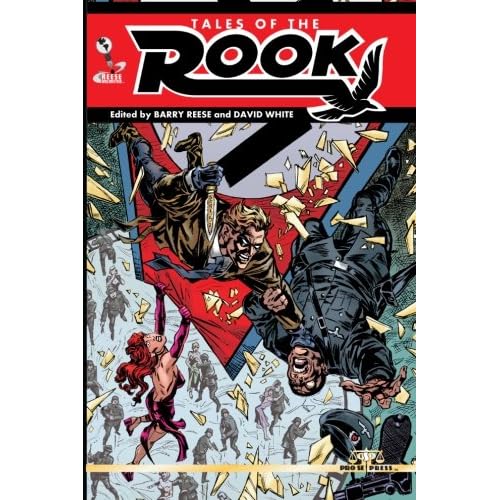
 "When The Good Is Swallowed By The Dark...There The Rook Shall Plant His
Mark!"

For years, New Pulp Author Barry Reese has masterfully written the
thrilling adventures of The Rook, a masked Hero of Reese's creation who is
compelled through dark dreams to hunt down and destroy evil wherever it
might hide! Assisted by loyal friends and a vast array of allies from the
annals of Classic and New Pulp as well as Comics of a bygone era, The
Rook's escapades have been a hallmark in the world of New Pulp!

Now, for the first time and under the REESE UNLIMITED imprint, Barry Reese
has invited some of New Pulp's finest authors into The Rook's world to put
their unique spin on the character and tell their own tales...TALES OF THE
ROOK! Featuring stories by Ron Fortier, Bobby Nash, Mike Bullock, Percival
Constantine, Tommy Hancock, and a brand new ROOK tale by Reese himself!

Concerning the popularity of The Rook and his cast of characters, Barry
Reese commented that the concept was still with him, six years after its
debut. In the book's introduction, Reese says, "Others have felt the
siren's call, as well. The Rook has appealed to them to the point where
they agreed to write new stories featuring my hero. I'm flattered and
thrilled to present the results to you. Some of the greatest writers in New
Pulp have crafted their own takes on The Rook and it's a lot of fun to see
where they went when given the chance."

TALES OF THE ROOK also features an explosive cover by Bob Hall, stunning
interior art by George Sellas, and outstanding format and design by Sean
Ali! Ready for the best in New Pulp? Get it today in TALES OF THE ROOK!
From Reese Unlimited and Pro Se Productions!
Available now on Amazon -
http://www.amazon.com/Tales-The-Rook-Barry-Reese/dp/1477532552/ref=sr
_1_1?s=books&ie=UTF8&qid=1338044331&sr=1-1
And at www.prosepulp.com!

EBOOK COMING SOON!

Pro Se Productions- Puttin' The Monthly Back Into Pulp! www.prosepulp.com
UPDATE: Tales of The Rook tops this week's Amazon Pulp Sales for its debut
week.
http://barryreese.net/2012/05/28/memorial-weekend-new-pulp-best-seller-list-based-
on-amazon-sales-ranks-52712/
has the details.
Thursday, April 26, 2012
[Link] Table Talk: Label Me This

This week, New Pulp authors Barry Reese, Bobby Nash and Mike Bullock return to the table to discuss labels and untapped genres.
Question (Bobby): I was recently on a panel at a convention with several writers. Each of them introduced themselves as “a dark urban fantasy author” or “a hard science fiction writer” or “a pulp writer.” This got me wondering about how we as writers present ourselves to readers. How do you introduce yourself on a panel at a convention, for instance? What type of label do you attach to yourself as a writer? Or do you attach a label?
Continue reading: http://www.newpulpfiction.com/2012/04/table-talk-label-me-this.html
Sunday, April 15, 2012
[Link] Table Talk -- What's It Worth?

It's time for another round of Table Talk, where we invite you, the reader, behind the table to listen in on what New Pulp authors Barry Reese, Bobby Nash and Mike Bullock discuss when they think no one is listening. Shhhh! Don't let them know you're here.
Question: Since most new pulp writing jobs pay very little, if they pay at all, how do you decide what jobs to take and what ones to turn down?
Continue reading: http://www.newpulpfiction.com/2012/04/table-talk-whats-it-worth.html
Wednesday, February 15, 2012
The Writer Will Take Your Questions Now (#81) -- Defeating Doubt
All writers have periods where they doubt their abilities.
How do you weather those emotional storms?
(Inspired by Table Talk at New Pulp)

My response?
I think it's important for a writer to have those moments of triumph he or she can look back on and be inspired by when we do lose our focus, or fall prey to the temporary battles with doubt and often even despair. For me, I keep my published books and comics beside my desk so that when I doubt or just get exhausted and feel run as a writer, I can look over to my right, see that row of comics, paperbacks and hardcovers, and remind myself that, "Yes. Yes, you can do this. You've done it before, and you can most certainly weather this and do it again. Just type something, and it'll all come back to you."
How about you? What to you do to help you through those moments?
Friday, February 10, 2012
[Link] Table Talk: Character Storms
Continue reading: http://www.newpulpfiction.com/2012/02/table-talk-character-storms.html
Thursday, December 22, 2011
[Link] Table Talk -- Readers' Questions, Take II

***
Question (Josh Bell): Pulps, and subsequently comics, have quite a long history of recycling a lot of material when an idea proves successful. Sometimes, I think the end result grows into its own, my favorite example being Ka-Zar, whom I love almost as much as Tarzan. Though he started out as a very close imitation of the pre-eminent Jungle Lord, his revamp by Stan and Jack in the 60's led to him being, in my opinion, an engaging character in his own right. Closer to the pulp home, the Spider is obviously very similar too and inspired by the Shadow, right down to the slouch hat and twin .45's. This said, the Spider ultimately took a different direction than his predecessor. Still, for every Ka-Zar and the Spider, there are loads more incarnations of the pulp archetypes that fall flat. Do you guys, as the current guardians of pulp fiction, think that the recycling of archetypes is a good thing, as they can serve to reinforce what pulp is all about, or a hindrance, given that it can be seen to lack originality?
For the full article: http://www.newpulpfiction.com/2011/12/table-talk-readers-questions-take-ii.html
Sunday, December 18, 2011
[Link] Table Talk -- the three amigos talk about word counts
Table Talk - Counting Words and Runaway Tales
The wonderful thing about creating stories is the often limitless nature of creating things. There are no boundaries, nothing a creator cannot do in the name of making up a great tale. However, this can often lead to pitfalls and unforeseen circumstances. This week, we check in on Barry Reese, Bobby Nash and Mike Bullock as they discuss applying some structure and what to do when the story bleeds over the lines.
Subscribe to:
Posts (Atom)